Skip to content
ELCA Blogs

ELCA Advocacy

Devotional: Stretching Past Self-doubts

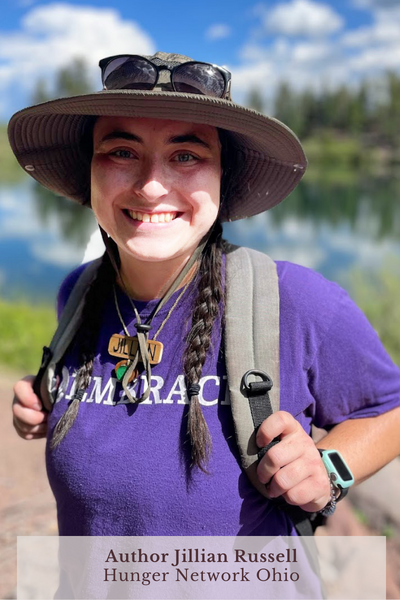
By Jillian Russell, Hunger Network Ohio [about the author]

I have always known myself to be a “self-doubter.” I am constantly doubting myself – my ability to lead, my ability to be a good friend, but especially my ability to lead God’s people. I have been a self-doubter when it has come to God’s plan for me. How was I supposed to do justice, to love kindness, and to walk humbly with my God if I didn’t even believe I could do so? As much as I have tried to change this aspect of myself in recent years, I constantly find myself being burdened by self-doubting thoughts.


Planning a gap year

I especially found this after I graduated with my undergraduate degree from Capital University in the spring of 2022. I had decided to take a gap year between undergrad and grad school but was still confused about what to do in that time. In my previous summers after college terms, I had worked at Lutheran summer camps, and I decided to do this again for one last summer, this time in Colorado at Rainbow Trail Lutheran Camp. I had decided to leave my beloved camp in North Carolina and stretch myself to have a new experience. And, to make things even more difficult, I decided to not be a counselor this time but take on a travel director role for the summer. A whole new camp, in a whole new state, and in a whole new position. I was terrified to say the least.

As a self-doubter, I started in on myself. Was I good enough to lead counselors? Was I even fit for this camp? Would I let people down? Could I really be a leader to these God-ly people? These thoughts and many others were constantly running through my head. I had begun to believe that this was not what God had planned for me. I was not meant to change lives and lead God’s people. This was not where I was meant to be.


While hiking

I went through many weeks severely doubting my abilities, until this one moment.

As a travel director, I was rarely on-site but was rather traveling doing day-camp ministry. But, this particular week, I was on-site helping to lead a family camp. On this particular day, my previous hike had been canceled, and I was really bummed because my new role was giving me fewer opportunities to hike. Then, out of nowhere, a family asked me to take them on a hike to a different location.

As we were hiking, I still had these self-doubting thoughts running through my head, and what made it even worse was that I actually got lost and went on a different route. I was totally bummed and disappointed in myself. I had not only failed myself, my self-doubts said, but this family I was leading. Then, the father of the family looked at me when we reached our new location and said, “I know you think you failed us, but look. If we hadn’t had made that wrong turn, my girls would have never cried looking at the beauty of God’s creation. We would never have made the memory of laughing at our wrong turns, but most importantly, I would have never admired God’s work like I am now. You showed us that.”


God’s assurance

I was stunned. But in that moment, I knew I was where I was meant to be. Even with all my mistakes and self-doubts, I was truly where God had put me. The self-doubting thoughts diminished with other guidance. God placed me in that moment to not only lead God’s people, but to do it by leading in justice, loving in kindness, and walking humbly with God.


ABOUT THE AUTHOR: Jillian Russell is currently serving with Hunger Network Ohio. Russell graduated from Capital University in Columbus, Ohio where she studied Youth Ministry and Christian Education and Psychology. As an ELCA Hunger Advocacy Fellow, she hopes to continue her work in building connections between people of different faiths and traditions, and expanding advocacy on state and local issues.

Devotional: Breathing Out Justice

By Savannah Jorgensen, Lutheran Office of Public Policy – California [about the author]

A specific song came to mind when I began reflecting on Micah 6:8. I often find that when I’m searching for the words to express my thoughts and feelings about something, music is my source of guidance. For me, music has always been a way of re-centering myself.

You can ask close friends and even teachers from my more creative days in school. They would attest that there have been numerous occasions where I would include a lyric or song reference in reflections or essays. If my friends read this, they will probably nod vigorously here since I have often used songs to guide serious conversations I’ve had with them, or to say goodbye before a move.

These words from the opening of the song Spark by The City Harmonic join breath and justice: When I breathe in hope, And breathe in grace, And breathe in God, Then I’ll breathe out peace, Breathe out justice, Breathe out love, Oh, this little light’s gonna shine With just a spark light a fire…

Keyword Justice

“Justice” is a keyword these days, with important social issues containing that word in their very name: environmental justice, racial justice, gender justice, etc. We are likely familiar with a definition people generally think of, which relates strongly to the criminal justice system. In that sense, justice is portrayed as being held to the standards of the law and society, especially in criminal cases when prosecutors may express concern with “getting justice.”

As a community of faith, we look to a different standard for measuring justice. The legal system and other institutions may not by that measure be just. In fact, these systems can be most plagued by distortions of systemic racism and classism in this country. So then, what does it mean when Micah 6:8 tells us to do justice, and what from a faith perspective does this justice mean?

We Fit Together

To me, the justice referenced in Micah 6:8 is about our duty as a community of faith to lift people up on an individual level all the way to a systemic level, to think about how we fit together as a whole not only as a particular part. It is about equity and accountability for our actions towards others. Justice is about compassion and that feeling of fervor that compels us to carry out that justice.

While it can be overwhelming at times, are we alone in this task? No! The end of verse 8 tells us to walk humbly with our God. God goes with us and before us in this journey towards justice on Earth. We also can find strength in a community of other justice-doers.

I am very grateful to be doing justice with a great team and community in the ELCA and beyond as a Hunger Advocacy Fellow this year, but I also humbly acknowledge that despite my great passion for wanting to do justice, I have fallen short of that calling. In that spirit, here are three things I’m committed to in 2023 in my efforts to do justice:

  1. Pick a few non-profits or charities to donate to, no matter how small the donation.
  2. Volunteer with an environmental justice organization.
  3. Contact more of my elected representatives to advocate for change.
Taking a Moment to Breathe

The Spark song lyrics ring in my ears and are especially poignant during this season of Epiphany. May we reflect on this season in our lives by taking a moment to breathe. When we breathe out into the world, may we do so with peace, justice and love. Much like the star shown a light to the world announcing the birth of a new kind of Savior, may this new year and season of Epiphany light a spark in each one of us to do justice, love kindness and walk humbly with God in 2023.


ABOUT THE AUTHOR: Savannah Jorgensen is currently serving with the Lutheran Office of Public Policy – California. Before her ELCA Hunger Advocacy Fellowship, Jorgensen received her master’s degree in Atmospheric Sciences from Texas A&M University. She has a passionate interest in environmental justice and climate change policy.

Devotional: Star Word – Curiosity

By Kayla Zopfi, 2022-23 Hunger Advocacy Fellow [about the author]

They were prodded by a desire to know. The magi who journeyed to baby Jesus were likely some of the only people who noticed this bright new star in the sky, and they took off with excitement and energy even still.

Story of the Magi

This past Sunday at my young adult and queer-led Synodically Authorized Worshiping Community (SAWC) in Northeast Minneapolis, Tree of Life Lutheran, we did Lectio Divina on the story of the magi. I couldn’t help but reflect on the virtue of curiosity. Curiosity about an anomaly in the established and expected patterns of astronomy led the magi to the Messiah. I like to image them packing their bags to head out on their journey, giddy to point people’s eyes towards the stars, rehearsing what their greeting line to God incarnate will be, and bickering about if they should pack their stylish shoes to change into once they get to Bethlehem or if they should just go with their sensible travel shoes to save space.

After worship we drew star words. A star word is a prayer practice connected to Epiphany, and it is a tool that can be used for periodical reflection throughout the coming year on how God is active in your life. As I flipped the exact star from the basket that seemed to be calling my name, I read the word: curiosity. I let out a laugh at the ironic humor of Holy Spirit giving me the idea I held during Lectio and read my word out loud. Immediately the friends around me started nodding, throwing out quips of, “Sounds about right!” and the like.

Curiosity Connections

Back home for the evening, I decided to pray about the word. For me, curiosity and justice have always gone hand in hand, they’re a package deal. Justice is communal and cannot happen without curiosity. Curiosity is often what ignites us to see and name injustice in the first place, and what nudges us to connect with others so that we might begin to imagine a more just future.

In Micah 6:8 we are asked, “…what does the Lord require of you but to do justice, and to love kindness, and to walk humbly with your God?” (Well, maybe we’re being told rather than asked. The “O mortal” thrown in the start of verse 8 is working overtime to help us with the humility part.) For the magi, following their curiosity led to accomplishing all of these requirements.

Curiosity led them to be part of affirming the true divinity of this tiny baby, born in the hay amongst the animals, who would go on to exemplify what ultimate liberation looks like. Curiosity led them to generosity, as they brought precious gifts to this family who’d been cast out by much of society. Curiosity led them to open their hearts to the will of God, trusting the dreams sent to them along their way.

Finding Excitement and Energy

Maybe we can only begin to fully do justice, love kindness, and walk humbly with God when we first agree to sit with what we know and what we don’t, and lean into the invitation to notice the world and people around us. Be curious. Like the magi, find excitement and energy in the things around you that many don’t even realize they are missing. May we, too, let our curiosity lead us closer to each other and closer to God.


ABOUT THE AUTHOR: Kayla Zopfi (she/they) is a Hunger Advocacy Fellow with the ELCA Witness in Society team, passionate about the intersection of faith and the policy. Zopfi is a 2021 graduate of Concordia College, Moorhead, where they studied Religion, Political Science, and Interfaith Studies.

November/December Update: Advocacy Connections

from the ELCA advocacy office in Washington, D.C. – the Rev. Amy E. Reumann, Senior Director

Partial expanded content from Advocacy Connections: November/December 2022

HOMELESSNESS AND AFFORDABLE HOUSING AWARENESS  |  GLOBAL FOOD SECURITY ACTION  |  STATUS OF TITLE 42  |  WORLD AIDS DAY DEMANDS ATTENTION  |  RESPECT FOR MARRIAGE ACT

HOMELESSNESS AND AFFORDABLE HOUSING AWARENESS: In January, the ELCA Witness in Society office will be hand-delivering invitations to members of Congress to encourage lawmakers to visit Lutheran ministries actively addressing homelessness and poverty in their district.

Interested Lutheran ministries which would like to host a site visit with a lawmaker through the January outreach should contact washingtonoffice@elca.org. This distribution will come after the Homeless Remembrance Blanket Project art display and press event on the West Lawn of the Capitol in D.C. Dec. 21 in which several synods, congregations and Lutherans are taking part through blanket making, interviews, logistics and viewing, highlighting similar issues to invited lawmakers. At the time of writing, over 1,500 blankets have been committed to the event—which will cover a considerable amount of area along the West Lawn of the Capitol. This event will be shared via podcast through organizers and national press is anticipated. Lutheran Advocacy Ministry in Pennsylvania in our state public policy office network, which has been active in local events in prior years and this year’s national stage, shares more information here.


GLOBAL FOOD SECURITY ACTION:  As a major producer of grains and oil seeds, we are encouraged by the 120-day extension of an U.N. backed deal to facilitate Ukraine’s agricultural exports from its southern Black Sea ports.

The agreement creates a protected sea transit corridor and is designed to alleviate global food shortages by allowing exports from three ports in Ukraine. The agreement was initially reached in July between Russia and Ukraine was and was negotiated by the president of Turkey and the U.N. secretary general.

Our ELCA advocacy efforts are also working with advocacy partners to push for passage of the Global Food Security Reauthorization Act in the U.S. Senate. An Action Alert pertaining to this legislation is available to relay your messages. The House passed the bill in September. We anticipate Congress will pass the bill before the end of the year.


STATUS OF TITLE 42: The Department of Justice has announced they plan to appeal a prior court decision (Nov 15) blocking Title 42. Irrespective of this appeal, a block on Title 42 is still on track to become effective Dec. 21.

Title 42 is a section of U.S. code empowers federal health authorities to prohibit migrants from entering the country if it is determined that doing so could prevent the spread of contagious diseases. The Biden Administration is expected to pursue expulsions until the stated date. Reports have circulated claiming that the Biden Administration may revive a “Transit Ban” applicable to single adults (expansion of a process for other nationalities akin to the process for Venezuelans), revamped refugee resettlement and much more in the post-Title 42 landscape. For those seeking safety from persecution, some of these policy proposals would indubitably raise the risk of exposure to danger and raise the difficulty in accessing humanitarian protection. Advocacy efforts will continue to seek to uphold humane principles of border management and protection consistent with AMMPARO and wider ELCA guidance.


WORLD AIDS DAY DEMANDS ATTENTION:  The Church Center of the United Nations was site of an Interfaith Service planned with the Lutheran Office for World Community. Keeping the concerning realities of HIV/AIDS before lawmakers is the subject of an available Action Alert issued on World AIDS Day 2022.

This year, World AIDS Day 2022 was marked under the theme Equalize, a call on global leaders and all peoples of goodwill to recognize and address inequalities holding back progress in ending aids. It is critical to equalize access to essential HIV services particularly for children and key populations and their partners.


RESPECT FOR MARRIAGE ACT:  The Respect for Marriage Act, with broad bipartisan support, will codify same-sex and interracial marriage protections into law. It passed the U.S. Senate at the end of November, was passed by the House on Dec. 8, and now advances for President Biden’s signature.

The bill was amended to uphold religious protections. ELCA advocacy staff joined several interfaith coalition letters in support of the legislation following its amended markup in the Senate and additionally sent a separate ELCA letter to Capitol Hill highlighting Lutheran social teaching in support of the measure.


Receive monthly Advocacy Connections directly by becoming part of the ELCA Advocacy network – http://elca.org/advocacy/signup , and learn more from elca.org/advocacy .
 

October Update: Advocacy Connections

from the ELCA advocacy office in Washington, D.C. – the Rev. Amy E. Reumann, Senior Director

Partial expanded content from Advocacy Connections: October 2022

GLOBAL MALNUTRITION PREVENTION AND TREATMENT ACT PASSES!  |  DACA-RELATED DECISION STILL INDICATES NEED OF PERMANENT PROTECTIONS  |  INFLATION REDUCTION ACT AND CHURCH BUILDING INFRASTRUCTURE  |  ACUTE AWARENESS OF DISASTER RESPONSE NEEDS  |  ELECTION DAY IS ALMOST HERE


GLOBAL MALNUTRITION PREVENTION AND TREATMENT ACT PASSES: We celebrate that the bipartisan Global Malnutrition Prevention and Treatment Act recently passed the Senate following spring passage by the House and thank the many Lutherans who used their voices to encourage this action!

The bill directs USAID to implement activities to prevent and treat malnutrition globally. The legislation provides better strategic vision and improves coordination and effectiveness of existing U.S. global nutrition programs. An Action Alert and other ELCA activity advocated for passage of this bill which doesn’t turn away from global malnutrition. #untilallarefed


DACA-RELATED DECISION STILL INDICATES NEED OF PERMANENT PROTECTIONS: On October 7, the U.S. Court of Appeals for the Fifth Circuit made a major decision impacting Deferred Action for Childhood Arrivals (DACA). Touching the lives of 600,000 current beneficiaries, the decision also impacts thousands of young adults who were locked out while litigation has played out.

The court sided with an earlier ruling by a judge finding that DACA violated the Administrative Procedure Act, but in light of a new regulation, which takes effect on October 31, they have returned the case to U.S. District Court Judge Andrew Hanen for further consideration. The fifth circuit decision maintains the freeze on all new applications, but renewals can continue. “For the time being, this semblance of protection is significant to the hundreds of thousands who depend on it to maintain their jobs, carry on their studies, and support their families. But there’s more to this decision. This is unresolved, leaving Congress with an unmistakable call to action. Congress should heed the call of advocates, amplified by DACA recipients and supporters across the political spectrum, to pass permanent protections now,” said Giovana Oaxaca, ELCA Program Director for Migration Policy. Oaxaca will be among panelists at “Faith Voices Call: Citizenship For All,” a webinar hosted by the Interfaith Immigration Coalition on Thursday, October 27 at 8 p.m. ET. Learn more from www.facebook.com/events/1066432484071714/


INFLATION REDUCTION ACT AND CHURCH BUILDING INFRASTRUCTURE:  Through the Inflation Reduction Act, faith-based and community-based organizations are eligible for new grant programs that the law will create to address pollution, incentivize the use of clean energy sources and mobilize certain places that commit to their communities to advance climate-benefitting solutions.

With the passage of the Inflation Reduction Act, non-profits and houses of worship now have easier access to clean energy funds and tax credits through a program called “direct pay.” Interfaith Power and Light wrote, “Before the IRA, only homeowners and commercial entities with some tax liability could claim tax credits when installing solar panels, wind turbines, or other eligible technologies on an eligible property. Now, the ‘direct pay’ option means non-taxable entities can also benefit from these credits.” Although incentives and monies will become available, reach and distribution specifics are unrolling. However, it is anticipated that churches will not experience up-front costs to participate in infrastructure updates; rather they will operate through participant agreements. Our ELCA advocacy staff will continue to monitor these aspects of the law and their interface with faith communities.


ACUTE AWARENESS OF DISASTER RESPONSE NEEDS Lawmakers in Congress, who are currently in their home state districts and not expected to return to Washington, D.C. until after Election Day, will be discussing what additional resources hurricane-impacted states will need in the coming days and weeks following Hurricane Ian.

Several members of the GOP Florida delegation have called on legislators to reconvene in D.C. to pass a “clean” supplemental relief bill before Election Day. ELCA advocacy staff will be working with affected synods and ministries to advocate for an adequate response to be procured in Congress. Use the Action Alert to give your input on disaster response needs in U.S. policy


ELECTION DAY IS ALMOST HERE As Lutherans, we live out our mutual responsibility for one another by guaranteeing our neighbor’s right to vote and supporting free and full participation in elections. As various election deadlines near in states across the country in the coming days, and Election Day arrives on Tuesday, November 8, encourage one another including with @ELCAadvocacy socials and #ELCAvotes resources. ELCA advocacy staff are monitoring mid-term election impacts.

Resources to explore what is on your local ballot include ballotready.org and vote411.org/. Consider congregation and other action like taking someone to the polls, setting up a booth to look up polling locations and other innovative ways to be there for our neighbors and neighborhoods. More from https://ELCA.org/civicengagement.

Attention to U.S. Hunger at White House Conference

When the ELCA signed a request of President Biden to host a White House Conference on Food, Nutrition, Hunger, and Health, the group of organizations stated: “We can end hunger in America, and a public commitment to a White House Conference, with ending hunger as a key priority, is an essential step in accomplishing this goal” (March 14, 2022 Letter). The conference sponsored by the White House on September 28 became the second of its kind in over half a century. Tackling hunger, nutrition and health in America was the theme, accompanied by the announced Biden-Harris Administration National Strategy on Hunger, Nutrition, and Health.


Hunger in the United States

According to the White House data on hunger, nutrition and health, 1 in 10 American households experience food insecurity. Additionally, diet-related diseases are some of the leading causes of death in the United States of America: 10% of Americans have diabetes, 1 in 3 Americans will have cancer in their lifetime, and more than 40% of Americans suffer from high blood pressure. These grim statistics disproportionately affect communities of color, people living in rural areas, people living in U.S. territories, people with disabilities, older adults, LGBT community members, military families and veterans. It is with this landscape that the work being done by government programs such as Supplemental Nutrition Assistance Program (SNAP); Special Supplemental Nutrition Program for Women, Infants, and Children (WIC); school meals and Child Tax Credits (CTC) is important for meeting basic needs. Among ELCA federal policy prioritization is supporting the strength and reach of these programs.


White House Conference and Strategy Highlights

Over 500 elected officials, advocates and activists, and leaders of business, faith and philanthropy groups from across the United States convened in Washington D.C. as well as virtually to discuss the Administration’s goal of “ending hunger and increasing healthy eating and physical activity in the U.S. by 2030.” The first step toward achieving this goal was announced by President Biden: the commitment of $8 billion by public and private sectors toward helping to provide more food and better nutrition by 2030.

It is through the release of the 44-page Biden-Harris Administration’s National Strategy on Hunger, Nutrition, and Health that the White House gave a direct and detailed plan. This strategy calls for a “whole-of-government” approach that is pursued across five pillars.

  1. Improve food access and affordability – approach includes goals to increase access to free and nourishing school meals, provision of Summer Electronic Benefits Transfer (EBT) benefits to more children, and expansion Supplemental Nutrition Assistance Program (SNAP) eligibility to more underserved populations. This pillar in the strategy names helping all Americans become economically secure as a critical step to reduce hunger and associated disparities toward “making it easier for everyone—including individuals in urban, suburban, rural, and Tribal communities, and territories—to access and afford food.”
  2. Integrate nutrition and health – approach includes pilot coverage of medically tailored meals in Medicare, testing Medicaid coverage of nutrition education, and expanding Medicaid and Medicare beneficiaries’ access to nutrition and obesity counseling.
  3. Empower all consumers to make and have access to healthy choices – approach proposes a front-of-package labeling scheme for food packages, an update the nutrition criteria for the “healthy” claim on food packages, expansion of incentives for fruits and vegetables in SNAP, and facilitation of sodium reduction in the food supply by issuing longer-term, voluntary sodium targets for industry.
  4. Support physical activity for all – approach includes expanding the U.S. Department of Health and Human Services’ Centers for Disease Control and Prevention’s (CDC) State Physical Activity and Nutrition Program to all states and territories, investing in efforts to connect people to parks and other outdoor spaces, and funding regular updates to and promotion of the Physical Activity Guidelines for Americans.
  5. Enhance nutrition and food security research – approach includes bolstering funding to improve metrics, data collection and research to inform nutrition and food security policy, particularly on issues of equity and access; and implementing a vision for advancing nutrition science.


This Strategy and Our Convictions

Non-governmental programs were highlighted by President Biden during the conference, and he expressed that “everyone has an important role to play”. This includes private and non-profit efforts, to which ELCA congregations, social ministries and ELCA World Hunger initiatives are deeply committed.

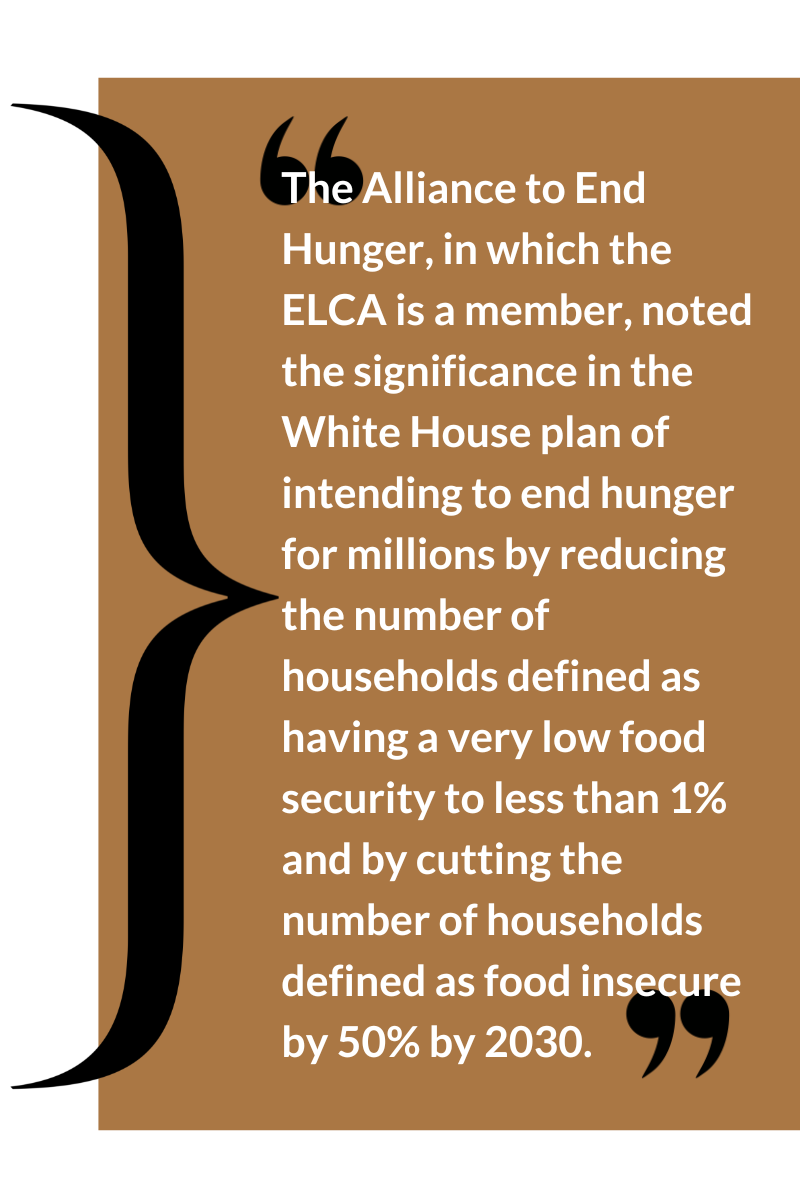
The Alliance to End Hunger, in which the ELCA is a member, noted the significance in the White House plan of intending to end hunger for millions by reducing the number of households defined as having a very low food security to less than 1% and by cutting the number of households defined as food insecure by 50% by 2030. “The White House laudably built its strategy based on feedback from stakeholders, the general public and those with lived experience of poverty and hunger… We now look forward to working with our diverse network to determine the action steps that will bring the plan to fruition.”

“The vision of ELCA World Hunger is nothing short of a just world where all are fed,” says Ryan Cumming, ELCA Program Director for Hunger Education. “Congregations, social ministries and local partners have a key role to play in this work. They are on the frontlines of responding to hunger and connecting neighbors to public support, but just as importantly, they are building the relationships rooted in justice, love and hope that will be needed to end hunger for good, together. The White House’s national strategy is a key step to that future.”

Recordings of panel sessions and plenary sessions are available online.

September Update: Advocacy Connections

from the ELCA advocacy office in Washington, D.C. – the Rev. Amy E. Reumann, Senior Director

Partial expanded content from Advocacy Connections: September 2022 

INFLATION REDUCTION ACT  |  FISCAL YEAR ENDING  |  U.S. DISASTER RESPONSE IMPROVEMENTS  |  REFUGEE RESETTLEMENT  |  WHITE HOUSE CONFERENCE ON HUNGER


INFLATION REDUCTION ACT:  The president signed the Inflation Reduction Act into law, which is the culmination of months of advocacy on important priorities with Lutherans and partners from every corner of our networks. In addition to significant climate provisions, the Act will make health care more accessible for more people by continuing the Affordable Care Act subsidies and allowing the government to negotiate prices for prescription drugs in the Medicare program. It also makes changes to current tax credits that impact some homeowners and car buyers as well as shifts some longtime tax policy, particularly for some large corporations, provisions which also aim to address inflation.

As a result of our sustained advocacy, the ELCA was represented by invitation to the White House by John Johnson at a reception on Sept. 14 celebrating the passage of the Inflation Reduction Act. Virtual relationships were deepened at this in-person event, including with staff of the White House Office of Faith-Based and Neighborhood Partnerships.


FISCAL YEAR ENDING:  The government fiscal year ends on October 1. Should a fully passed budget be absent, lawmakers are preparing a Continuing Resolution to keep federal programs funded. Extended flat funding levels will hurt low-income assistance and housing programs particularly hard due to inflation and the rising costs of housing nationwide.

A Continuing Resolution extension will keep funding levels flat from the previous fiscal year. Hundreds of Lutherans have already contacted their lawmakers in Congress over the past year, urging them to prioritize passing a budget with renewed investments in homeless and housing programs. As October nears, advocates are encouraged to continue taking action with the Action Alert to urge lawmakers to prioritize those investments as soon as possible.


U.S. DISASTER RESPONSE IMPROVEMENTS:  The Reforming Disaster Recovery Act (S. 2471) has been included by budget appropriators in Congress as an amendment to a greater FY23 budget bill. It would authorize Community Disaster Block Grant programs, one of the top policy asks of an ELCA Action alert over the last year, among other substantial improvements.

This comes as multiple communities are facing several natural disasters, such as wildfires and hurricanes, and others have failed to see adequate recovery assistance over the last year from the federal government. Though included for now, the inclusion of the amendment is expected to face challenges as the FY23 budget comes to a vote. Advocates are encouraged to take action to ensure the legislation meets final passage.


REFUGEE RESETTLEMENT: The U.S. Refugee Admissions Program has historically been an important foreign policy and migration policy tool, ensuring that the U.S. can receive its share of the global displaced population. So far, the United States has resettled just 20,000 refugees out of a goal of 125,000. The FY23 refugee admission target still needs to be authorized by Congress.

It is expected to retain a goal of 125,000 in FY23. Not including the 20,000 refugees resettled via USRAP in FY22, the country has admitted over 50,000 Ukrainians on a temporary basis through the Uniting for Ukraine initiative and over 79,000 from Afghanistan, many through humanitarian parole. With humanitarian parole, migrants are not guaranteed permanent status or access to many of benefits from other processes. Humanitarian parole has re-emerged as the most used policy option given constraints affecting USRAP and following extraordinary displacement crises like Ukraine and Afghanistan.


WHITE HOUSE CONFERENCE ON HUNGER:  In 2020, 38.2 million Americans, including 11.7 million children, lived in homes in which they were unable to always afford enough food. A White House Conference on Hunger, Nutrition, and Health is scheduled on Sept. 28 presents an opportunity to make ending hunger a national priority.

This is only the second time a conference focused on ending hunger has been held by the White House, following one more than 50 years ago. It has been organized to bring together Americans from all walks of life to accelerate progress in fighting hunger, diet-related diseases and health disparities. Sign up to watch the livestream from https://health.gov/our-work/nutrition-physical-activity/white-house-conference-hunger-nutrition-and-health/ .


Receive monthly Advocacy Connections directly by becoming part of the ELCA Advocacy network – http://elca.org/advocacy/signup , and learn more from elca.org/advocacy .
 

September Updates: U.N. and State Edition

Following are updates shared from submissions of the Lutheran Office for World Community and state public policy offices (sppos) in the ELCA Advocacy Network this month. Full list and map of sppos available.


U.N.  |  ARIZONA  | COLORADO  | MINNESOTA | NEVADA | OHIO | PENNSYLVANIA | WASHINGTON | WISCONSIN


U.N.

Lutheran Office for World Community (LOWC), United Nations, New York, N.Y. – ELCA.org/lowc

Christine Mangale, Director

UN General Assembly (UNGA 77) 

The 77th session of the UN General Assembly (UNGA 77) will open on Tuesday, 13 September 2022. Ambassador Csaba Kőrösi, Director of Environmental Sustainability at the Office of the President of Hungary is the President of the 77th session. UNGA 77 will meet under the theme “A watershed moment: transformative solutions to interlocking challenges”

The general debate of the seventy-seventh session will be held from Tuesday, 20 September, to Saturday, 24 September, and on Monday, 26 September 2022. In addition to the general debate, there are several High-Level Meetings planned:  

Opening of the 77th session of the General Assembly: 13 September 2022  

  • Summit on Transforming Education: 19 September 2022 Convened by the UN Secretary-General
  • General debate: Tuesday, 20 September to Monday, 26 September 2022 (including Saturday, 24 September)
  • High-level meeting to mark the commemoration of the 30th anniversary of the adoption of the Declaration on the Rights of Persons Belonging to National or Ethnic, Religious and Linguistic Minorities: 21 September 2022 | Resolution 
  • High-level plenary meeting to commemorate the International Day for the Total Elimination of Nuclear Weapons: 26 September 2022 | Resolution

In conjunction with UNGA77 High Level week, an Interfaith prayer breakfast will take place on Thursday, September 22, 2022, under the Communities of Faith Breakfast: Building Partnerships for a One-Community HIV Response. The event is organized by Faith Partners collaborating with the Joint United Nations Programme on HIV/AIDS (UNAIDS) and the United States President’s Emergency Plan for AIDS Relief (PEPFAR). The focus will be to discuss how to better address key gaps to end inequalities in HIV services for children. 


ARIZONA

Lutheran Advocacy Ministry Arizona (LAMA) – lamaz.org

Solveig Muus, Director

Arizona Anti-Hunger Alliance: Lutheran Advocacy Ministry Arizona (LAMA), together with its Arizona Hunger Policy Workgroup partners including Bread for the World, World Hunger Ecumenical Arizona Task-Force  Arizona Food Bank Network and Arizona Food Systems Network and Arizona Faith Network, hosted Arizona’s first statewide gathering of hunger advocates. More than 50 gathered to discuss shared values and goals, setting in motion the new Arizona Anti-Hunger Alliance, an organization for combined messaging, 2023 policy proposals, education, training, and organizing, cultivating and activating advocates. 

Becoming Conference: LAMA joined the Lutheran and interfaith state public policy offices and staff of the Witness in Society team from the Washington, D.C. office at the Becoming Conference in Chicago on Wednesday, August 24 – 28. The group discussed civic engagement, Christian Nationalism, abortion, the Inflation Reduction Act, hunger, housing, climate and the Farm Bill, along with a variety of housekeeping issues. 

LAMA Summit: LAMA’s third annual Advocacy Summit on Saturday, November 5, 2022 will feature a keynote address by the Rev. Eugene Cho, president and CEO of Bread for the World. Participants will meet and engage with congregational LAMA liaisons, the LAMA policy council, and other Lutherans and friends across Arizona who share a common belief that we are called through our baptismal covenant “…to strive for justice and peace in all the earth.” 

Arizona Hunger Policy Retreat Attendees

LAMA Liaison Roundtable: As the election season in Arizona and across the country heats up, LAMA is activating a monthly Roundtable to strategize about civic engagement, and advocacy engagement in general, at the congregational level. 


COLORADO

Lutheran Advocacy Ministry Colorado (LAM-CO) – lam-co.org

Peter Severson, Director

LAM-CO PUBLISHES 2022 VOTER GUIDE: The Lutheran Advocacy Ministry Colorado 2022 Voter Guide is here! We’re providing up to date info and thoughtful reflection on all eleven ballot measures that will face Colorado voters this fall. In addition, the LAM-CO Policy Committee has voted to take positions on four of the measures: 

  •  YES on Prop FF, Healthy School Meals. Creates and funds the Healthy School Meals for All program, providing free school meals to all public school students by capping income tax deductions for individuals earning $300,000 or more per year. 
  •  YES on Prop GG, Amount of Tax Owed Table for Initiatives. Requires ballot titles and fiscal impact summaries for initiatives affecting income tax to include information on how the change would affect different income levels. 
  •  YES on Prop 123, Dedicated Revenue to Affordable Housing Programs. Creates the State Affordable Housing Fund and allocates 0.01% of existing income tax revenue to fund housing and homelessness programs through it.  
  • NO on Prop 121, State Income Tax Reduction. Reduces the state income tax from 4.55% to 4.40%.  

THIRSTING FOR WATER: On September 17, advocates gathered at Bethany Lutheran Church in Denver and on Zoom for a day for holy conversation & community-building under the title “Thirsting for Water: At the Intersection of Climate, Water and Hunger.” Attendees heard from experts, pastors, and advocates about the drought affecting our region, engaged in theological reflection and storytelling, heard stories of the impact on agriculture, considered policy and advocacy, and contemplated how we might respond to the crisis together. 


MINNESOTA

Lutheran Advocacy – Minnesota (LA-MN) – lutheranadvocacymn.org

Tammy Walhof, Director

Next Steps for ELCA Hunger Advocacy Fellow: We were blessed to have Rachel Wyffels working with us as a Hunger Advocacy Fellow over the past year. She is now at Luther Seminary and working part-time as Communications Coordinator for the Northeastern Minnesota Synod’s EcoFaith Network (& the Saint Paul Area Synod Creation Care Team). While at Lutheran Advocacy-MN, Wyffels helped with several EcoFaith/Creation Care events, and developed deep interest in what congregations can do to care for creation. We are excited for her in these next opportunities! 

Director’s Sabbatical: Tammy Walhof is back from part 1 of her 3-month sabbatical (part 2 will be in December). Her focus is on climate impacts in the Artic and in Minnesota, climate change adaptations appropriate to Minnesota, transition to a Clean Energy Economy, and congregational engagement. She is particularly interested in messaging for the different regions and Lutheran groups across the state. Stay tuned for more to come! 

No Special Session: We are disappointed that partisan divisions prevented a summer special session, needed to pass bills already negotiated across chambers and parties. Particularly concerning is the loss of Federal infrastructure funding (from the Bipartisan Infrastructure Act) without minimal matching funds in the unpassed state bills. If the bills don’t pass on time, other states will take Minnesota’s share of funds. 

Fall Foci: Partisanship and polarization are out of control. We are focusing on bridging differences, avoiding triggers, and helping advocates de-escalate conversations. We also want candidates to consider ways to overcome polarization, address the ongoing housing crisis, and help our state positively transition into a clean energy economy. 


NEVADA

Lutheran Engagement and Advocacy in Nevada (LEAN)- leanforjustice.org

William Ledford, Director

Lutheran Engagement and Advocacy in Nevada is gearing up for our “once every two years” session that will start at the beginning of next year. Due to Nevada’s biennial legislature, our legislators only hold sessions in odd-numbered years. We are tracking Bill Draft Requests and are excited to see what will come down the pipe this session. Nevada is always an interesting place to watch legislation and this session should be no different. 


OHIO

Hunger Network Ohio (HNO) – hungernetwork.org

Deacon Nick Bates, Director

In September, Hunger Network Ohio continued exploring the advocacy issues related to the ELCA social statements with a discussion on Criminal Justice Transformation to end hunger. We are grateful for the partnership with ARCH – a re-entry advocacy and support organization – for their leadership on this issue and sharing their expertise with all of us. You can view the forum here on our Facebook page. We are also grateful for Sister Kriss Buss, an ELCA Deacon who currently serves as a prison chaplain for leading a powerful opening devotional.  

Does your congregation want to get involved in supporting our neighbors upon release? Their families? If so, reach out to Deacon Nick Bates Nick@hungernetohio.com for upcoming opportunities! 

Our advocacy in Advent returns! Join the Hunger Network and the Ohio Council of Churches for an advocacy day on November 29th. Every two years, the final two months of the legislature are filled with a rush of activity, trying to finish up many good ideas and slow down many bad ones. During this Holy Season of preparation, let us prepare for a hunger-free Ohio, an Ohio where all receive their daily bread, and justice is done.  

Read more and register here!    


PENNSYLVANIA

Lutheran Advocacy Ministry – Pennsylvania (LAMPa) lutheranadvocacypa.org

Tracey DePasquale, Director

LAMPa staff assisting congregations in writing letters to lawmakers on “God’s work. Our hands” Sunday.

Pennsylvania’s General Assembly returned after an August recess with a few session days remaining before the Nov. 8 election. In anticipation of heavy turnout and in response to turnover among elections staff and poll works, Lutheran Advocacy Ministry in Pennsylvania volunteers and staff are once again conducting an elections support project, calling every county to offer prayers and assistance, assessing their needs and recruiting support to ensure safe and fair elections.

LAMPa director Tracey DePasquale with Marcus Coleman, Director for the Department of Homeland Security Center for Faith-Based and Neighborhood Partnerships for a tour of Eastwick, PA.

In addition to preparing for our annual policy council retreat later this month, Lutheran Advocacy Ministry in Pennsylvania’s staff assisted congregations in adding advocacy to their service for “God’s work. Our hands.” Sunday. Letters invited lawmakers to visit ministries with those experiencing homelessness and urged them to support lifting the revenue cap on the housing trust fund. 

Lutheran Advocacy Ministry in Pennsylvania director Tracey DePasquale joined Lutheran Disaster Response Northeastern Region Coordinator Julia Menzo for a visit by Marcus Coleman, Director for the Department of Homeland Security 

Listening to residents of Eastwick, PA about their frustrations, gratitudes and hope for their future in light of threats from climate change.

Center for Faith-Based and Neighborhood Partnerships, and other local, state and federal emergency management officials for a tour of Eastwick, a Southeastern Pennsylvania community still trying to recover from 2020 Tropical Storm Isaias. We listened to residents’ frustrations and fears as a community that has long suffered environmental injustice. As part of Lutheran Disaster Response’s accompaniment, we also heard their expressions of gratitude and hope for the future as they prepare for major decision-making points with governments in the face of bigger threats from climate change. 


WASHINGTON

Faith Action Network (FAN) – fanwa.org

Elise DeGooyer, Director

As we enjoy this back-to-school time and our state’s bountiful agriculture, we continue to work for a harvest of hope. We know the fruits of our labors will be the policy changes, reforms, and transformations needed for all our neighbors to thrive. Our state legislative agenda for 2023 is beginning to take shape as the 25+ coalitions we work with craft next-step policy changes and find legislative champions. Priorities this year again include balancing our tax code, which is the most regressive in the nation, and implementing/expanding our state Working Families Tax Credit. 

In August we were also immersed in collaborative efforts with local organizers to stand against Christian Nationalism as the ReAwaken America tour (featuring Mike Flynn and others) came to the Washington-Idaho border in September. More than 1,000 signed the petition and 40 vigils, that we know of, were held statewide to support a different narrative than that of “spiritual warfare” espoused by Flynn and tour organizers. 

The Faith Action Network has onboarded two new part-time organizers in Central Washington who are working with immigration rights and food security efforts. Another two part-time staff members will be working on outreach to Spanish-speaking communities and college-aged advocates. We are currently preparing for our annual celebration in November celebrating our statewide, multi-faith movement with the theme: Pathways to Solidarity. 


WISCONSIN

Lutheran Office for Public Policy – Wisconsin (LOPPW) loppw.org

The Rev. Cindy Crane, Director

August and September have been a time for planning. The Lutheran Office of Public Policy in Wisconsin (LOPPW) staff has met with the following groups:

  • Faith in Place, formerly known as Wisconsin Interfaith Power & Light, about holding a Care for God’s Creation advocacy day in the spring of 2023. Advocacy will be monitoring the next Wisconsin State Budget. The former Wisconsin Interfaith Power & Light staff contributed to our last advocacy day that was started by LOPPW and that focused on climate justice and water issues. The governor’s Clean Energy Plan will be a significant part of our discussion for the next budget.
  • Members of our youth advocacy to begin planning a Wisconsin/Upper Peninsula gathering in the spring of 2023.
  • Hunger leaders’ group, organized by ELCA World Hunger leaders in Wisconsin/Upper Peninsula to include the LOPPW.
  • Interfaith clergy group to review upcoming public policy efforts to be alert to.
  • Raise the Age Coalition to plan a meeting with the Bucks to discuss how they might elevate our juvenile justice efforts and to discuss other ways we can launch an educational campaign.

For Wednesday Noon Live in September, we focused on social justice highlights from the Churchwide Assembly, the farm bill, and conflicts related to the Wisconsin Elections Commission, the dissolution of which LOPPW opposes.

Creation Care Investments in Inflation Reduction Act

By Christine Moffett, Federal Policy Intern, ELCA Witness in Society

After many months of deliberation, Congress has passed and President Biden has signed the Inflation Reduction Act of 2022, a federal spending bill that was heralded as a crucial step towards finding solutions to the climate crisis by making the largest federal investment ever in clean energy technologies. This investment comes as movement toward the United States fulfilling its pledge, under the Paris Climate Agreement, of 50% reduction in emissions by 2030. By fulfilling this pledge, the United States will prioritize our environment in need of care and aim for a better quality of life today without shortchanging future generations.

Our faith community acted on our convictions, adopting during the very recent 2022 ELCA Churchwide Assembly a memorial on Greenhouse Gas Reduction. This memorial reaffirms our commitment to engage in creation care and act in support of 50% reduction in 2005 U.S levels of greenhouse gas pollution by 2030 and achieving net-zero emissions by 2050, including having the churchwide organization meet these goals. With all of this in our minds and in our hearts, it is not without discernment that we can celebrate the recent passage of the largest federal clean energy investment in U.S. history.


Elements of the Act

The Inflation Reduction Act of 2022 most notably invests $369 billion in energy security and climate change programs over the next ten years. This is the largest investment by the United States in climate and clean energy to date. This bill contains crucial investments in solar, wind, electric vehicles and environmental justice, along with new penalties on methane pollution that will make a significant dent in our carbon pollution.

The climate investments from the Inflation Reduction Act will put our nation on the path to cut climate pollution emissions 37-41% by 2030 as compared to 2005 levels, according to Energy Innovation: Policy and Technology, a non-partisan energy and climate policy think tank. Additionally, this bill is projected to create 1.5 million new jobs. The Inflation Reduction Act of 2022 also pledges to invest $40 billion in agriculture, forestry and rural communities. This investment would put a priority on climate-smart agriculture, rural power and clean energy, and wildfire protections and climate-smart forestry.

In addition to climate provisions, the Inflation Reduction Act of 2022 will make health care more accessible for more people by continuing the Affordable Care Act subsidies and allowing the government to negotiate prices for prescription drugs in the Medicare program. It also makes changes to current tax credits that impact some homeowners and car buyers as well as shifts some longtime tax policy, particularly for some large corporations, provisions which also aim to address inflation.


Compelled to Act on Climate Change by Faith Foundation

As Lutherans, we understand our human role to serve creation as God has modeled for us. As people of God, we must carry out our calling to care for creation through principles of vision, hope and justice as described in the ELCA social statement on Caring for Creation. It is through our sin and captivity that we have contributed to the urgent crisis of the world: climate change.

Our changing climate only continues to intensify our world’s tribulations including floods, wildfires, droughts and intensified storms, driving global migration and civil conflicts while intensifying hunger, poverty and natural disasters. These climate burdens, while felt by all, are not equal. Some of us who have contributed the least are feeling the most intense effects of climate change. As God’s people, we are compelled to act on climate with and on behalf of our neighbor and for the wholeness of Creation. It is our vision to embody a “flourishing creation” that is not burdened by the issues of climate change. It is our hope, that as people of God, we can imitate God’s care for creation by demanding a legislative response to human-induced climate change. Finally, it is justice that shall guide us in decisions made about our environment in the interest of all creation.


A Step in the Right Direction

While the Inflation Reduction Act of 2022 is by no means perfect, we can celebrate this historic achievement to address climate change. It did not include poverty-cutting provisions that we had advocated for like enhancing the Child Tax Credit and paid family leave. Yet it is the beginning of a new, less carbon-reliant nation. It is a hope for a new kind of world that better honors the integrity of creation and prioritizes an acceptable quality of life for present generations without compromising that of future generations. It is a testament to the work of those who have spent tireless hours advocating for creation, including many who’ve taken actions through the ELCA Action Center, and those lawmakers who received our cries for change. It is a step in the right direction.


Advocacy Cafe

See one another and share stories on important themes in our lives as people of faith in our communities – both as church and citizens. Bring your experience, new or seasoned, and your questions. Our Christian faith compels us to attend to the world through the lens of our relationship to God and to one another. Sometimes, we may echo the sentiment: The world’s so big and I’m so small. Yet there is much we can do act for greater justice, and we are far from alone.

Register today – and invite others!

The ELCA “is called to be a part of the ecumenical Church of Jesus Christ in the context in which God has placed it—a diverse, divided, and threatened global society on a beautiful, fragile planet” (from the ELCA social statement Church in Society: A Lutheran Perspective). Together, there is much we can do.


Tue. Oct. 25 – Can Talking Politics Be Healthy?

Anxiety and passions that run high in election season don’t stop when we enter our church doors. Yet we can shift the tone, facing the heightened rhetoric with tools and faith-centered convictions that break through heightened rhetoric. We can and do foster civil relationships and dialogue that invites trust amid our differences and lead healthy community conversations on the common good.
Offered in conjunction with the ELCAvotes initiative.

Choose


CONCLUDED: Tue. July 26 – August Recess

With the Tue. July 26 cafe exploring August Recess opportunities to start us out, drop by an Advocacy Cafe to hear from ELCA advocacy community leaders about timely topics on the last Tuesday of every month. Get to know staff, issues and one another!

CONCLUDED: Tue. Aug. 30 – Our Stories of Civic Engagement

There is no shortage of ways we and our congregations can and do get involved in civic engagement around the electoral process. As a church, we do not endorse a particular candidate, party or form of government or strive for a Christian one. Yet in Lutheran teaching, one way God works to preserve creation and build a more peaceful and just social order in a broken world is through government. Let’s have a positive impact!
Offered in conjunction with the ELCAvotes initiative.


CONCLUDED: Tue. Sept. 27 – Bringing Down Barriers to Voting

Being alert to barriers to voting and acting to guarantee that all citizens be able to exercise the right to vote can demonstrate our Christian faith as Lutherans and have value for our communities and country. The right to vote on an equal basis is a fundamental requirement for a just society, affirmed in ELCA social teaching. Let’s hear from one another about ways we remove barriers as individuals, congregations and in partnerships.
Offered in conjunction with the ELCAvotes initiative.