ELCA Advocacy Office, Washington, D.C.
The Rev. Amy Reumann, director ELCA.org/advocacy
DECEMBER 21, PRAY. FAST. ACT: As we near the end of the year, we recognize the final month of our shared #PrayFastAct campaign with The Episcopal Church. Over the course of the last two years, we have been grateful for our shared ecumenical partnership, focusing on the ways systemic change can make a meaningful difference for those of us struggling with poverty.
Focusing on a different theme each month (from hunger, health, community, shelter, and much more), the #PrayFastAct campaign stemmed from the recognition that effective approaches to poverty address the needs of the whole human person. Taking a small amount of time out of our busy schedules each month to pray, fast and act may seem like a small step; but in routine action it can serve as a transformative tool to ensure our neighbors do not fall through the cracks when times are hard. Through the end of this month, we hope you have a chance to review the current alerts found at ELCA Action Center and ELCA.org/prayfastact that address many of those needs today.
We act out of the conviction that the status quo has not been effective enough for many of us in need, and that conviction continues. Look forward to an upcoming video later this month to see a full review of our campaign, and what steps are ahead for 2019.
HIV AND AIDS PROGRAMS EXTENDED: Congress has finally passed legislation to reauthorize the U.S. President’s Emergency Plan for AIDS Relief (PEPFAR), a U.S. government global health initiative that works to combat HIV and AIDS. We expect the president will sign the bill.
- The legislation extends the PEPFAR mandate for five years
- PEPFAR is the largest global health program devoted to a single disease.
- Today PEPFAR supports 14 million people around the world by providing care and lifesaving HIV treatment.
ELCA Advocacy shared an action alert in support of funding for PEPFAR and other federal programs that work to address global health concerns. Interested advocates can customize a letter of their support to lawmakers from the ELCA Action Center at http://elca.org/advocacy/ActionCenter.
STATEMENT ON ASYLUM POLICIES: ELCA Advocacy shared an interfaith pledge to stand with people seeking asylum, following the announcement that the White House would be taking steps to prevent asylum seekers entering the U.S. between ports of entry from protection. The ELCA firmly stands against policies that restrict anyone’s legal right to seek asylum.
Presiding Bishop Elizabeth Eaton commented, “As a church, we cannot remain silent as our asylum laws are unilaterally changed and our nation’s door is shut to people fleeing dire humanitarian situations. From our companion churches in Central America, our church knows many people leave to escape grinding poverty, violence or persecution and to seek a better life for their children.” Advocates can take action and join the pledge here.
ELCA AT THE UNITED NATIONS CLIMATE CONFERENCE: The United Nations Framework Convention on Climate Change (UNFCCC), climate change conference (COP 24) is being held in Katowice, Poland from Dec. 3 -14. The international parties are tasked with negotiating the terms of the rulebook for implementation of the Paris Agreement. Although the ELCA has previously participated in the COP conference, this year we attend with our own accreditation for the first time, with participants from ELCA Advocacy, ELCA Global Mission and ELCA Young Adults. ELCA Advocacy has been actively preparing for this conference by working with other faith-based groups and non-governmental organizations.
Lutheran Office for World Community, United Nations, New York, N.Y.
Dennis Frado, director
LEADERS OF THREE CHURCHES RAISE GRAVE CONCERN ON DECISION TO HALT FURTHER U.S. HUMANITARIAN ASSISTANCE TO HOSPITALS IN EAST JERUSALEM: Leaders of three U.S. church groups including ELCA Presiding Bishop Elizabeth Eaton, issued a statement in early November raising “grave concern” about the Trump administration’s decision to halt further U.S. humanitarian assistance to hospitals in East Jerusalem, including Augusta Victoria Hospital, which is operated by the Lutheran World Federation. Leaders from The ELCA, The Episcopal Church and the U.S. Conference of Catholic Bishops said the six hospitals in the East Jerusalem Hospital Network are “providing invaluable medical care for the most vulnerable populations, including Palestinians living in East Jerusalem, Gaza and the West Bank.” They also said “this decision to discontinue that funding leaves the patients, the wider Palestinian community, and us disappointed and perplexed. It is difficult for us to understand why this humanitarian assistance is being brought to a halt, given that lives are being threatened unnecessarily.” The statement will be shared shortly with all members of Congress as part of a greater effort to obtain release of FY 2018 funds for the hospitals and build support for FY2019 funding.
U.N. RECEIVES REPORTS ON RACISM, RACIAL DISCRIMINATION, XENOPHOBIA AND INTOLERANCE: The Third Committee of the General Assembly heard several reports from UN Special Procedure mandate-holders and other experts in recent weeks. Work is progressing on a “Framework for a Declaration on the promotion and full respect of human rights of people of African descent” related to the implementation of the International Decade for People of African Descent (2015-2024). The special rapporteur on contemporary forms of racism, racial discrimination, xenophobia and related intolerance focused one of her two reports on “ascendant nationalist populist ideologies and strategies that pose a sobering threat to racial equality by fuelling discrimination, intolerance and the creation of institutions and structures that will have enduring legacies of racial exclusion.” The other dealt with the contemporary use of digital technology in the spread of neo-Nazi and related intolerance. A full summary report of presentations, questions and comments from Member States on these and related matters is available.
California
Mark Carlson, Lutheran Office of Public Policy (LOPP-CA) loppca.org
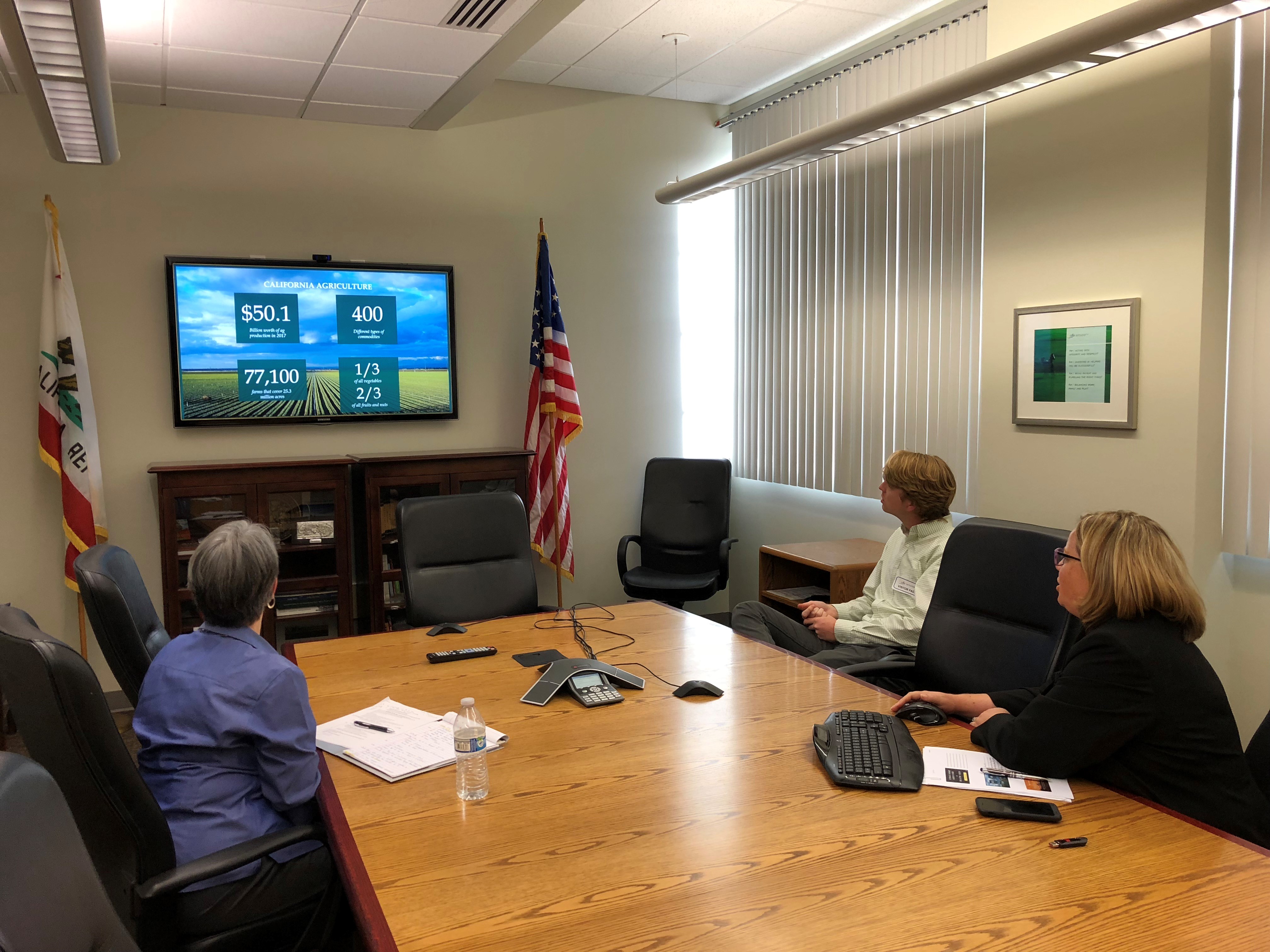 |
| State and county officials in CA Dept of Food and Agriculture conference room Skyping in to Lutheran Disaster Relief national gathering in Chicago |
CLIMATE CHANGE: A SADLY PROPHETIC VOICE: Lutheran Disaster Relief (LDR) requested the the Lutheran Office of Public Policy – California to ask state officials to share how California is trying to mitigate (reduce carbon emissions) and adapt to (plan and prepare for) climate change. Skyping in from the conference room of the California Department of Food and Agriculture (CDFA) to the LDR gathering in Chicago were an undersecretary of the CDFA who shared about their climate-smart agriculture focus; a Lutheran woman who works in the Sacramento County Public Health Department on disaster preparedness (e.g. extreme heat episodes); and the special assistant for climate change to the resources agency secretary-The latter said the “new normal” of extreme weather events, such as fires and floods, will not remain “normal,” but those events and their harm are projected to accelerate as the planet warms. Gov. Jerry Brown has called this the “new abnormal.” Sadly, eight days later, the most destructive wildfire in California history, in terms of fatalities and structure loss, broke out in Butte County, where fire season normally ends with fall rains in September and October.
 |
| Mark Carlson, Director or LOPP-CA, voting in Sacramento at the polling place located at The Urban League. |
NOVEMBER ELECTION: LOPP-CA is delighted with the passage of proposition 1 and 2, which provides several billion dollars for low-income housing and permanent supportive housing, and the defeat of proposition 6 to repeal a gas tax recently adopted by the Legislature. The tax supports public transportation, as well as urgently needed road repair for safety, commuters and goods movement. The Legislature convened Dec. 3.
Colorado
Peter Severson, Lutheran Advocacy Ministry–Colorado lam-co.org
ELECTION RESULTS: Colorado voters approved two measures for which we’ve spent much of the summer and fall advocating. The first is Proposition 111, which will limit payday loan interest rates and fees to 36 percent APR while limiting the scope of such products. The second is Amendment A, which will remove the exception to the clause banning slavery in the Colorado Constitution. We are the first state in the nation to remove such a clause!
Proposition 111 passed with 77 percent Yes, 23 percent No.
Amendment A passed with 65 percent Yes, 35 percent No.
We are disappointed that another measure, Amendment 73, failed to pass. This would have created a progressive state income tax bracket to create a public education fund in Colorado. It failed with 45.6 percent voting Yes, 54.4 percent voting No.
 |
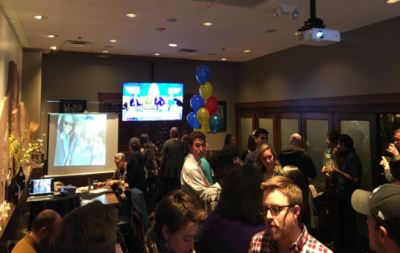
| Election night watch party in downtown Denver for the Yes on 111 and Yes on Amendment A campaigns, Nov. 6, 2018 |
NEW LEGISLATURE: A new Legislature will be seated January 4, 2019, and leadership in the state Senate will change party from Republican to Democrat. The House remains under Democratic control. Coloradans also elected a new governor, secretary of state, attorney general, and treasurer, all of whom are Democrats. Even with all of the changes in leadership, our advocacy for the sake of neighbors experiencing hunger and poverty will continue to be the same. We look forward to meeting with new and re-elected members of our state legislature in the coming weeks.
Minnesota
Tammy Walhof, Lutheran Advocacy–Minnesota lutheranadvocacymn.org
HOMES FOR ALL COALITION (H4A): Meetings galore- Never have there been so many proposals to consider for the coalition’s collaborative agenda! Lutheran Advocacy-MN (LA-MN) director Tammy Walhof, serving with the H4A Policy Team, listened to proposal presentations, evaluated proposals, and helped cull them to a more manageable list. One colleague thinks the team spent around 30 hours in that process!
ENVIRONMENTAL COALITIONS: LA-MN is part of Minnesota Environmental Partnership (MEP), the MN 100% Campaign, and the State Climate Table. We’re further from knowing which clean energy proposals to address jointly.Walhof, in leadership positions with both the MEP Energy Cluster and the Climate Table, has worked hard to bring more unity and common focus to the array of groups and coalitions. Nevertheless, she is glad to turn MEP Cluster leadership over to others, allowing more time with churches throughout Minnesota that are actually addressing issues.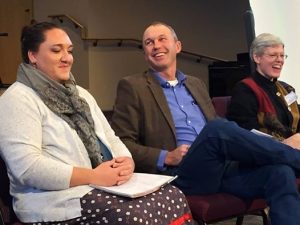
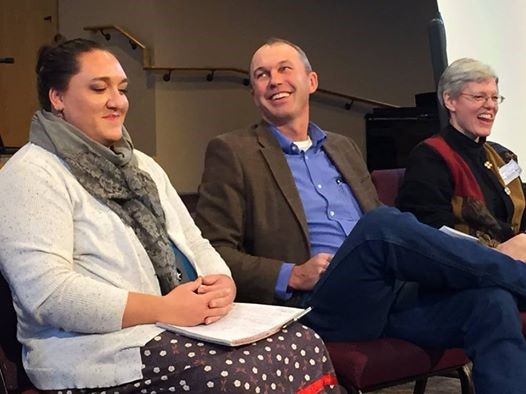
HUNGER EVENT: At a hunger awareness gathering of the Northwestern Minnesota and Eastern North Dakota synods, Walhof described LA-MN’s work to promote policies that ground the fight against hunger in the Christian call for justice, and joined fellow panelists Prairie Rose Seminole (American Indian/Alaska Native Ministries), Ryan Taylor (ND Rancher), and keynote speaker Craig Nessan (Wartburg Seminary) in answering questions about hunger, the farm bill, food aid, affordable housing, justice, and more! It was an important and thought-provoking event, but, as you can see, not without laughter! Thanks to Karen Ehrens for the photo.
 |
| Banner at Iglesia Luterana de San Juan Bautista, Tucson, AZ |
PASTOR’S CONFERENCE: The Northeastern Minnesota synod’s Laurentian Pastor’s Conference invited Walhof to speak on immigration at their meeting. She shared her experience visiting the Mexican-American border this past summer and reflected on the Bible’s many stories of migration.
North Carolina
GeoRene Jones, North Carolina Synod Social Justice & Advocacy Ministries (SJAM)
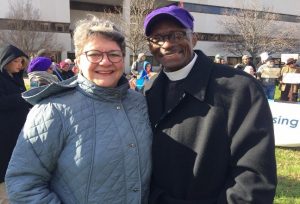 |
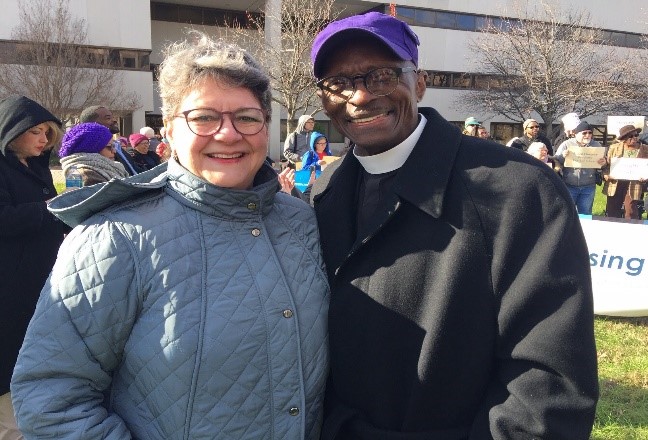
| Hood Theological Seminary alumni, The Rev. Dr. T. Anthony Spearman, president of the NC NAACP (right) and Deacon Jones(left) joined forces at the Legislative Complex supporting Just Florence Recovery. |
NC WOMEN OF THE ELCA: ] legislative advocacy on immigration, the economy, and gun violence. This month NC Women urge enacting “sensible immigration legislation” that secures our borders while safeguarding Dreamers, creates a path to citizenship for those already in this country, and improves the process for immigrants seeking asylum and entering legally so they can be processed quickly and without their children being separated from them
JUST FLORENCE RECOVERY: In the aftermath of Hurricane Florence, the need for response remains overwhelming in at least 28 of our 100 counties. SJAM joined a coalition of concerned North Carolinians at the state Legislative Complex to advocate for Just Florence Recovery. The group urged funding and legislation for broad-based recovery efforts including affordable housing, healthcare access, environmental clean-up and clean water legislation. Deacon GeoRene Jones, synod liaison for Lutheran Disaster Response, spoke before the North Carolina Senate Appropriations Committee at its hearing on a supplemental budget amendment for post-Hurricane Florence recovery. The committee received favorably the appeal for funding in support of affordable housing, identified by the Federal Emergency Management Agency as a critical need for the recovery process.
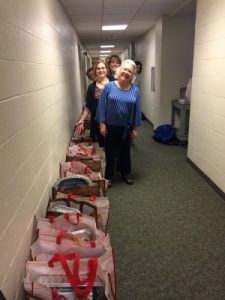 |
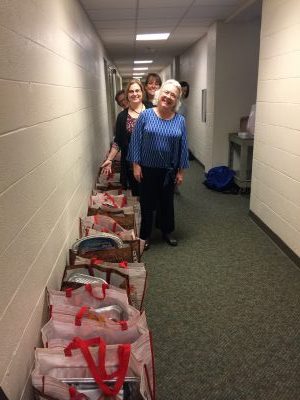
| St. Mark’s members prepare to deliver Thanksgiving Dinner “fixin’s” to 100 new Charlotte neighbor families |
REFUGEE FAMILIES RECEIVED THANKSGIVING SUPPORT: Eager to learn US traditions, 100 refugee families received Thanksgiving support from St. Mark’s Lutheran Church, Charlotte. Displaced families from Burma, Bhutan, Syria, and the Democratic Republic of Congo, were accompanied through their celebrations when St Mark’s which provided meals for each of the families as they gathered in their new homes.
New Mexico
Ruth Hoffman, Lutheran Advocacy Ministry- New Mexico (LA-MN) lutheranadvocacynm.org
 |
| Bishop Jim Gonia |
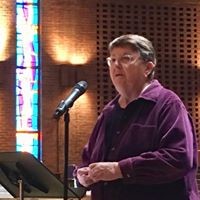
ADVOCACY CONFERENCE: The 2018 LAM-NM Advocacy Conference was held on Nov. 17 at St. Paul Lutheran Church in Albuquerque. There were over 100 attendees with many full communion, ecumenical, and interfaith advocacy partners joining advocates from ELCA congregations in New Mexico. The director of ELCA Advocacy, Amy Reumann, was our keynote speaker with the theme of “God’s Word Spoken Publicly, Boldly, and Honestly.” Rocky Mountain Synod Bishop Jim Gonia opened the conference
with prayer and remarks. Attendees networked and learned about ELCA
 |
| LAM-NM director
Ruth Hoffman |
Advocacy and LAM-NM issues that are expected in the upcoming 2019 legislative session. Those issues included creating a Medicaid buy in program for low-income people; creating the mid-level profession of dental therapist to help deal with the lack of access to dental care; and building a “Roadmap to a Stronger New Mexico” through tax reform. During lunch, Justin Remer-Thamert, executive director of the New Mexico Faith Coalition for Immigrant Justice and a member of the LAM-NM Policy Committee, updated the gathering about migrant advocacy work along the border and in New Mexico
Ohio
Nick Bates, The Hunger Network Ohio (HNO) www.hungernetohio.com
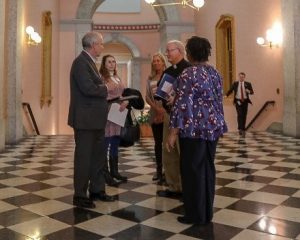 |
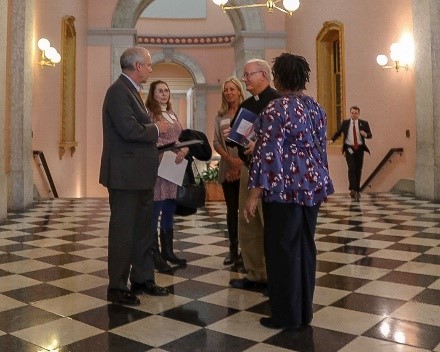
| The Rev. Larry Novak, Paisha Thomas and others lobby in the lobby about poverty issues at the Ohio Statehouse |
HAS IT REALLY ONLY BEEN A MONTH?: Like the rest of the nation, Ohio was following closely election results throughout our state. State Issue 1 failed at the ballot box on Nov. 6, but has launched an important conversation about racism in our criminal justice system, the need for treatment instead of incarceration, and ways to help an individual’s transition from prison back into society effectively. We are hopeful that Ohio’s Legislature will fulfill its promise to pass meaningful legislation on these issues in 2019.
 |
Beautiful Lake Picture
|
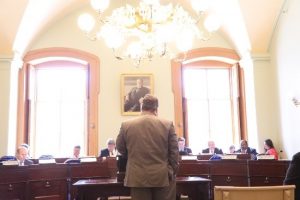
ADVOCACY IN ADVENT DAY: On Nov. 28, the (HNO) hosted its Advocacy in Advent day. Director Nick Bates testified on HB 390, a bill that will shorten the time a family has after receiving an eviction notice, which is likely to lead to an increase in family instability and homelessness.
Faith advocates met with legislators and director Bates offered testimony on the issue (Which can be found here). Sadly, the bill was voted out of the committee on a party line vote after many members engaged Bates on the issues of homelessness, fairness, housing costs, and other issues.
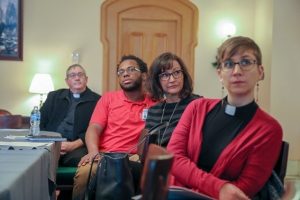 |
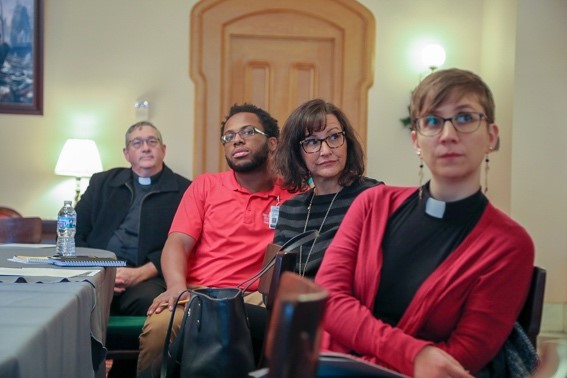
| The Rev. Liz Lowry listens to an overview of HB 390 prior to the legislative hearing on the issue. |
Paisha Thomas, an ELCA hunger advocacy fellow in Ohio, was amazed at how receptive many legislative offices were to the message and how easy it was to get meetings set up. You can read Paisha’s entire reflection here.
HNO will be busy for the final two weeks of the lame duck legislature – where more than 100 bills could be considered.
Pennsylvania
Tracey DePasquale, Lutheran Advocacy – Pennsylvania (LAMPa) lutheranadvocacypa.org
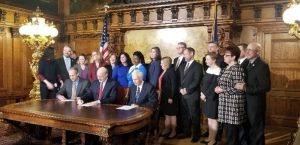 |
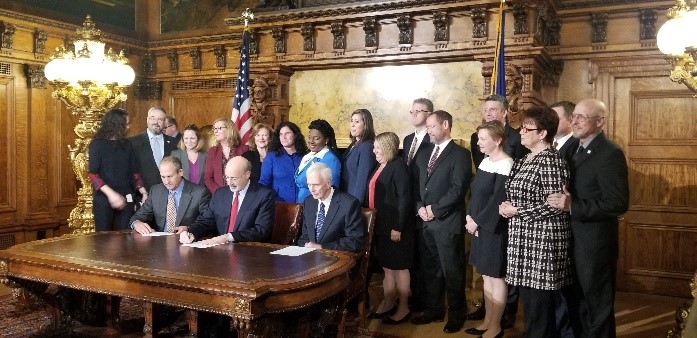
| Director Tracey DePasquale represented LAMPa advocates who worked for years on legislation to protect child sex-trafficking victims as the Safe Harbor bill was signed by Gov. Tom Wolf. |
STARTING OVER: In the weeks since the election and close of the General Assembly, when all pending legislation expired, LAMPa staff has been connecting with partners and its advocacy network to shape priorities for the upcoming two-year term. LAMPa’s bishops and policy council will meet Dec. 5-6 to discern where and how we are called to act together.
HUNGER ADVOCACY: With the re-election of Gov. Tom Wolf, whose administration established a blueprint for Hunger-Free PA, LAMPa plans to be part of the momentum toward that goal. We are starting with a sign-on letter from Lutheran anti-hunger advocates requesting an increase for the State Food Purchase Program and Pennsylvania Agricultural Surplus System in the governor’s budget proposal.
LOOKING AHEAD: LAMPa is leading an effort to strengthen interfaith and ecumenical advocacy in Harrisburg with plans to combine our traditional Lutheran advocacy day (May 20) with an interfaith day of service, fellowship and learning for advocacy for our common home on May 19. Our theme, “Set a Welcome Table,” is based on Psalm 133:1, “How very good and pleasant it is when kindred live together in unity.” Registration begins in January.
ECUMENICAL PARTNERSHIP: Program Director Lynn Fry attended the annual LARC (Lutheran-Anglican-Roman Catholic) Day of Dialogue: “A Christian Response to Violence.” DePasquale participated in the Pennsylvania Council of Churches’ Commission for Public Witness meeting.
Virginia
Kim Bobo, Virginia Interfaith Center for Public Policy virginiainterfaithcenter.org
2019 VIRGINIA GENERAL ASSEMBLY SESSION: VICPP has been hard at work preparing for the 2019 Virginia General Assembly session, which starts in January and lasts for six weeks. VICPP has put together an ambitious legislative package including bills to mitigate wage theft, create a driver’s privilege card for immigrants, allow students to pay in-state tuition and reduce evictions in Virginia. We have been organizing meetings with legislators and providing information to constituents who want to discuss our issues with their legislators.
During the General Assembly, there are many opportunities to raise your voice for justice and get involved. Register for our Day for All People lobby day on Jan. 22 or donate your time to become a Witness at the Capitol during the 2019 session. For those who don’t live in Richmond, you can join our Social Media Team to share action alerts with your circles. Make sure to follow us on Facebook, Twitter, and Instagram!
#GIVINGTUESDAY: VICPP also celebrated #GivingTuesday on Nov. 27 and raised over $5,000! We are so grateful for all our supporters, advocates, and allies.
Washington
Paul Benz, Faith Action Network (FAN) fanwa.org
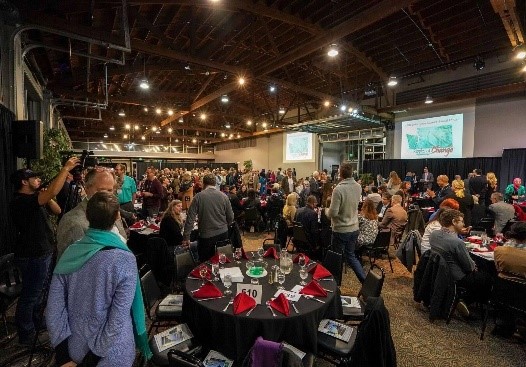
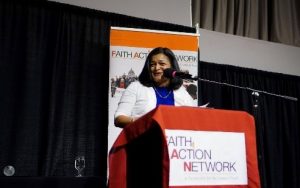 END OF OUR CLUSTER GATHERINGS: It’s been a busy season for FAN as we wrapped up our cluster gatherings – 21 regional meetings for the 144 advocating faith communities in our network. We had over 260 advocates join us for these meetings around the state. After we wrapped up these meetings and made it through election season, we moved right into hosting our Annual Dinner.
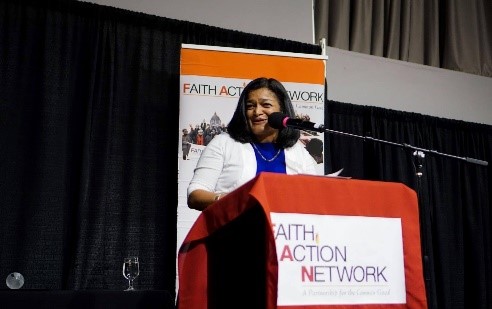
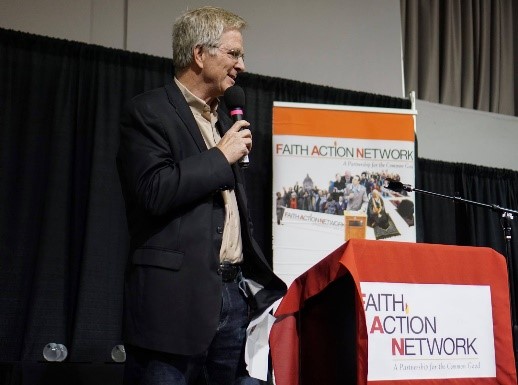
RIPPLES OF CHANGE: Our Annual Dinner’s theme this year was “Ripples of Change”. We were joined by keynote speaker Congresswoman Pramila Jayapal, as well as travel author and TV host Rick Steves. FAN gave awards to faith communities, individuals, organizations, and partners that have started ripples of change in our state this year with their advocacy and their work for justice. It was a wonderful night to celebrate this past year with almost 500 people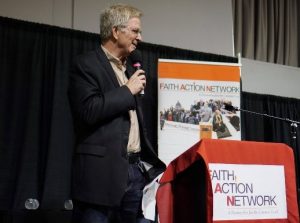 , and get fired up for next year. Pictured is the FAN staff, our two wonderful speakers, and the whole gathering.
FAN’s Legislative Agenda: Washington state’s 2019 legislative session begins in January. As we prepare for a longer budget-setting year, we have started to draft our legislative agenda for this session.
Public Charge: A reminder that there are less than two weeks left to submit public comments regarding the proposed public charge rule change. This rule change would affect and harm millions of our immigrant neighbors, and as people of faith we need to take a public stance against this proposal. The public comments must be unique, and can be submitted to the federal register or through comment portals through the Protecting Immigrant Families coalition, or at bit.ly/FANopposesPublicChargeRule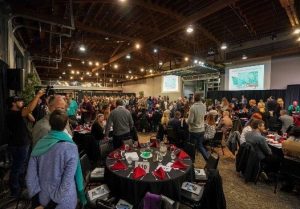
INTERFAITH ADVOCACY DAY: FAN’s next big event is Interfaith Advocacy Day (IFAD) at the state Legislature. This year IFAD will take place Feb. 14, and our office is busy beginning preparations.
Wisconsin
Cindy Crane, Lutheran Office for Public Policy in Wisconsin loppw.org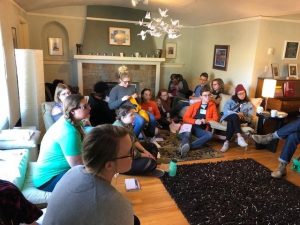
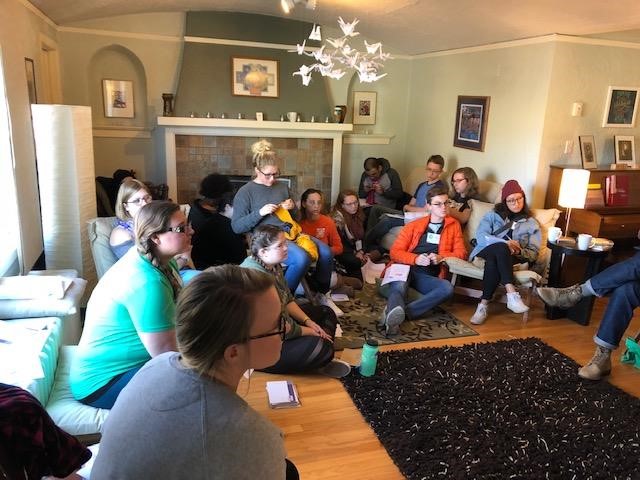
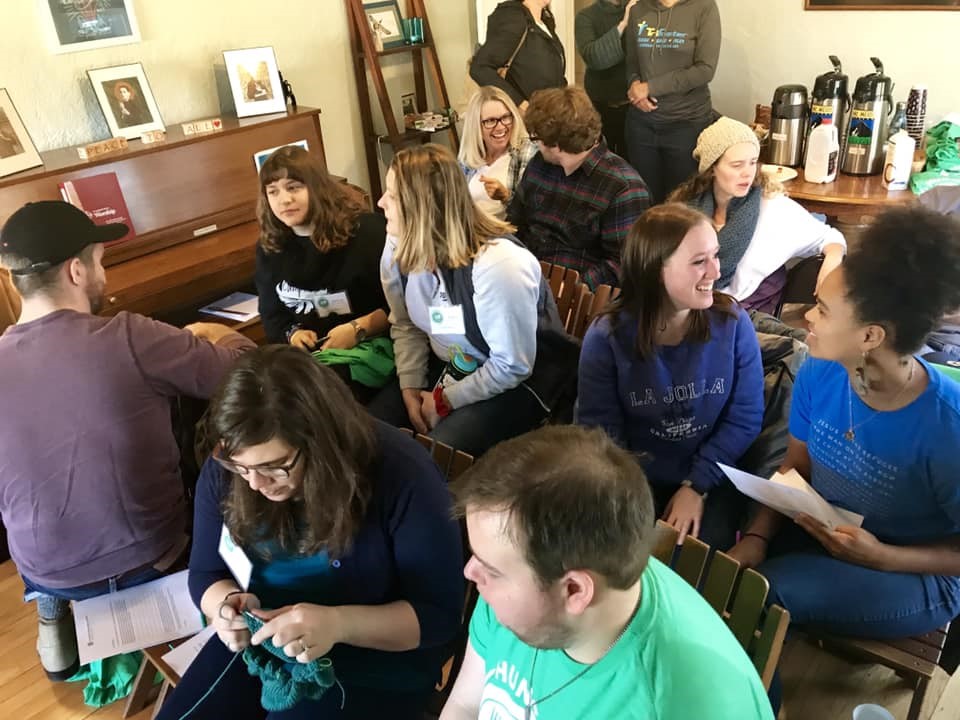
HUNGRY FOR CHANGE: This was the theme of our second overnight advocacy retreat, attended by students from six colleges. UW-Madison campus pastor Emily Tveidt, UW-Milwaukee campus pastor Rachel Young Binter and LOPPW planned this year’s in Milwaukee. Binter took major leadership and coordinated opportunities for students to hear from UW-Milwaukee’s food pantry director, ELCA minister Venice Williams of Alice’s Garden, Tricklebee Cafe representatives, a Young Adults in Global Missions representative and a panel from Lutheran Volunteer Corp (LVC).
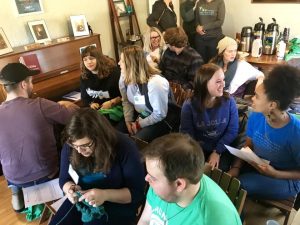 LOPPW’s Kelsey Johnson and Sarah Schultz led exercises on advocacy. Cindy Crane connected what reps from LVC, YAGM and the food pantry discussed to advocacy on public policies.
VOTING: We made a final push to encourage people to vote. Schultz contacted several churches and Johnson continued to use social media to promote our materials.
IMMIGRATION: Johnson continued to keep our constituents alert about public charge.
BUILDING ADVOCACY: Crane provided materials to an East-Central Synod congregation to hold a letter writing event. She also led a workshop on advocacy in Prairie du Sac and provided sample letters on the farm bill.
PARTNERS IN WISCONSIN: Our interfaith breakfast group strategized approaching the new governor. Met with People of Faith United for Justice to organize for our 2019 Advocacy Day. Was in communication with Jewish partners to sign on a letter addressing Baraboo youth raising their arms in what looked like Nazi salutes.
ELCA: Crane participated in a relator (for directors’ of evangelical missions) meeting led by Rev. Sandy Chrostowski.

 Members of Congress continue to have the power ensure funds do not go toward policies that are harmful to the common good. As citizens acting on our faith values, we can hold our leaders accountable to good stewardship of public funds.
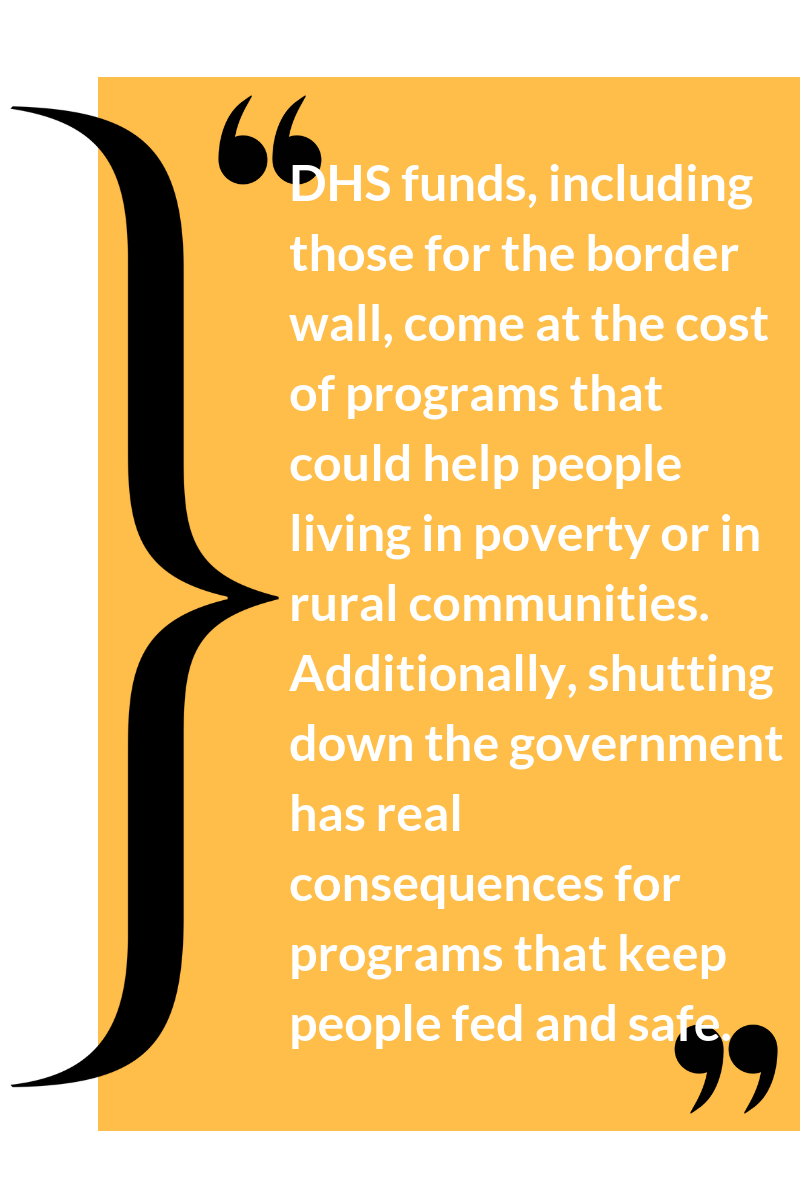 DHS funds, including those for the border wall, come at the cost of programs that could help people living in poverty or in rural communities. Additionally, shutting down the government has real consequences for programs that keep people fed and safe. People of faith across the country should continue to urge members of Congress to approve a moral budget that reflects our values and advances the common good.