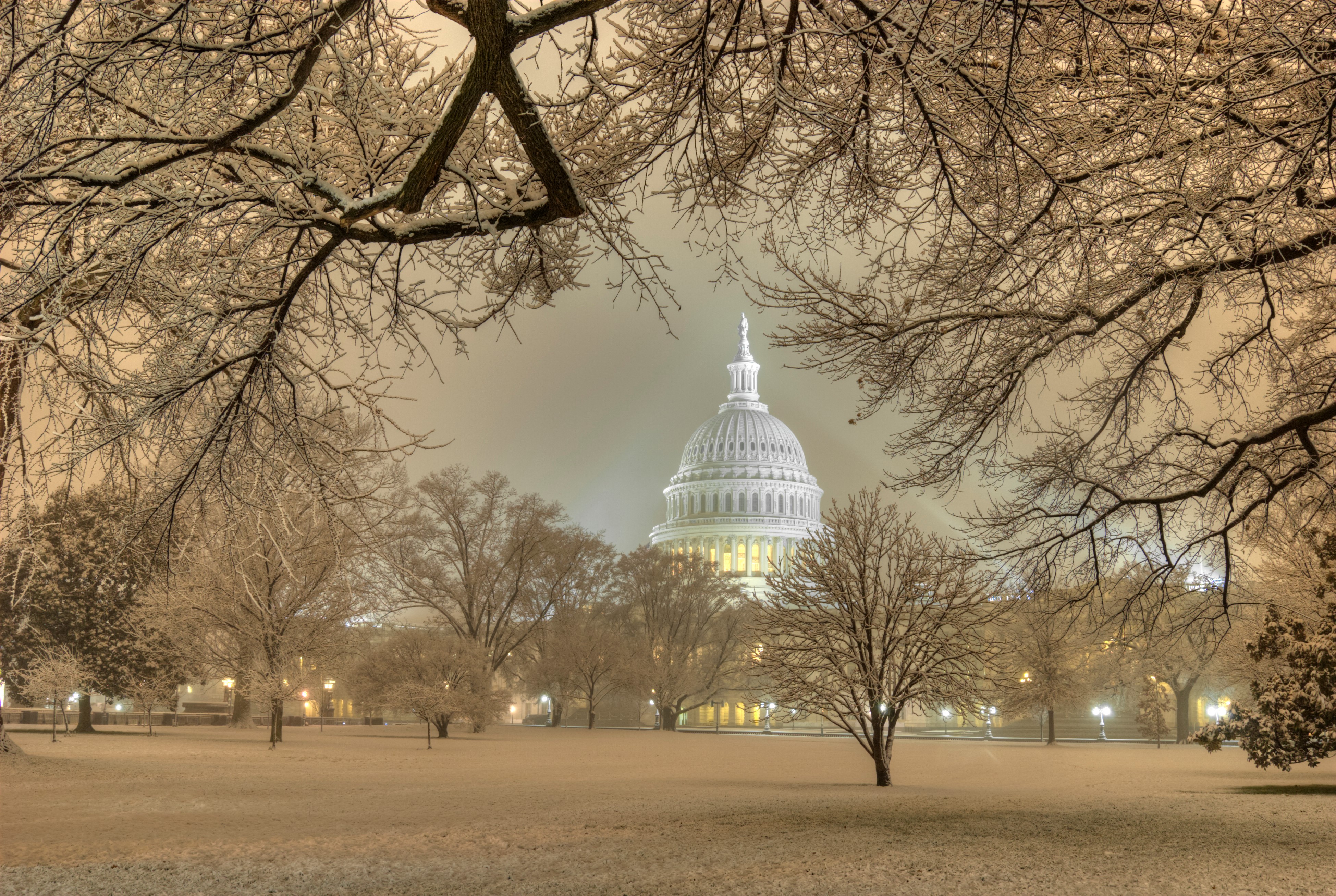
ELCA Advocacy Office, Washington, D.C.
#FOR SUCH A TIME: The January day to #PrayFastAct is Sunday, Jan. 21! This month, we are mindful of major programs that help curb poverty, namely Medicaid, Medicare and Social Security, and the good they provide for those in the greatest need. People of faith have been champions and voices of support for anti-poverty programs for decades, which continue to serve as a backstop to ensure a minimum level quality of life and security. Be on the lookout for a shared statement from ELCA Advocacy and the Episcopal Church later this month!
HUNGER AND THE FARM BILL: Lutherans from across the country will travel to Washington, D.C., in January for the annual ELCA World Hunger Leadership Gathering to discuss and take action to address the impact of hunger in communities.. The event occurs as lawmakers begin to discuss reauthorizing the Farm Bill, legislation that sets critical agricultural, conservation, energy, rural and hunger policies. While hunger leaders meet with their lawmakers on January 23, ELCA Advocacy will encourage our national advocacy network to stand in solidarity with these advocates by contacting Congress via the Advocacy Action Center.
RENEWING CHIP HEALTH CARE: On Sept. 30, 2017, Congress failed to reauthorize funding for the Children’s Health Insurance Program (CHIP), which helps provide critical medical care for children in low-income families. With reserves running low, states are beginning to limit coverage to basic, quality health insurance coverage, putting some 9 million children across our country at risk. Shortly before Christmas, ELCA Advocacy shared an action alert encouraging lawmakers to renew the program and sustain health care for the many children who need essential care. As Congress continues to debate a final spending extension, this month is a critical time for advocates to reach out to their lawmakers.
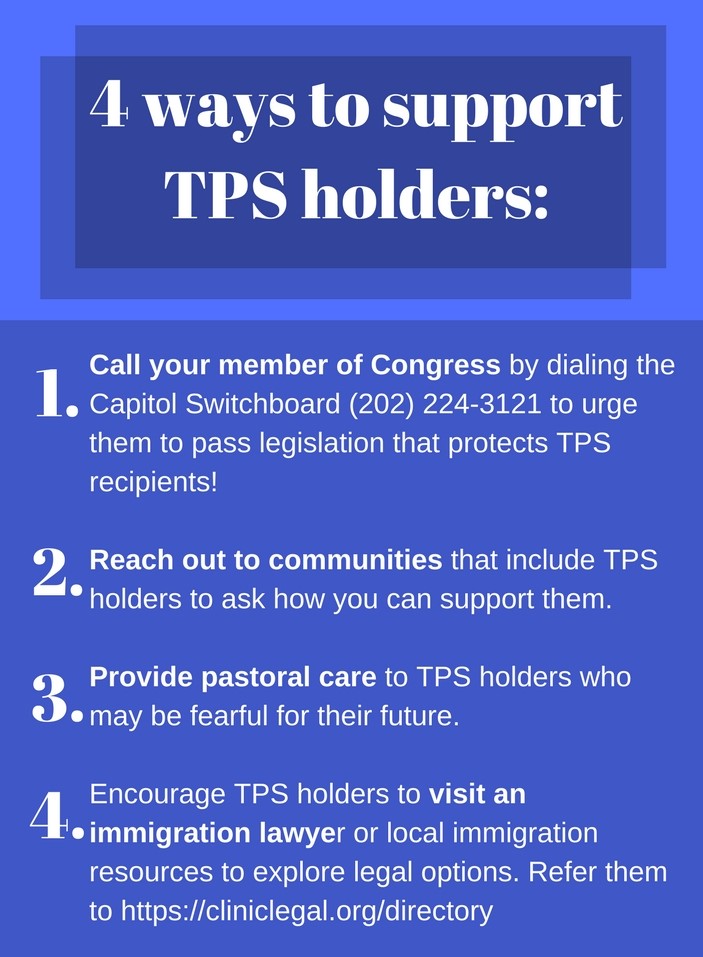
TEMPORARY PROTECTED STATUS: The Administration ended Temporary Protected Status (TPS), an immigration status meant to protect citizens from other countries present in the U.S. when a tragedy strikes in their country, for Salvadorans in early January. This decision affects over 200,000 TPS holders, many with U.S. citizen children, who have lived legally in the U.S. for years. ELCA Advocacy released a statement highlighting our deep disappointment with the decision and calling on Congress to pass legislation to protect TPS holders. We are concerned that TPS for Honduran citizens will also be taken away in May.
Lutheran Office for World Community, United Nations, New York, N.Y.
Dennis Frado, director
GENERAL ASSEMBLY CONCLUDES ITS MAIN WORK ON HUMAN RIGHTS ISSUES FOR 72ND SESSION: This past autumn the Third Committee of the United Nations discussed human rights issues that included protection of religious minorities; responsibility for the education of refugee children; people with disabilities; racial discrimination and intolerance, especially increased racist rhetoric and Nazism; promoting self-determination; the public trust and “fake news;” all reported on in previous ELCA Advocacy Updates.
Once the committee concluded its session in November, it approved 63 resolutions, which were then recommended for consideration and adoption by the General Assembly in its p lenary session on Dec. 19. The Assembly occasionally took a recorded vote on several resolutions at a member state’s request, considered several amendments, and adopted all the resolutions that had cleared budgetary consideration. They included reports on social development, the advancement of women, questions relating to refugees and humanitarian questions; promotion of the rights of children; rights of indigenous peoples; elimination of racism, racial discrimination and xenophobia; the right of peoples to self-determination; promotion and protection of human rights; implementation of human rights instruments including enjoyment of rights and fundamental freedoms; specific human rights situations in North Korea, Iran, Crimea and Syria; implementation of and follow-up to the Vienna Declaration; crime prevention and criminal justice; and international drug control.
SECURITY COUNCIL AND GENERAL ASSEMBLY TAKE UP STATUS OF JERUSALEM:
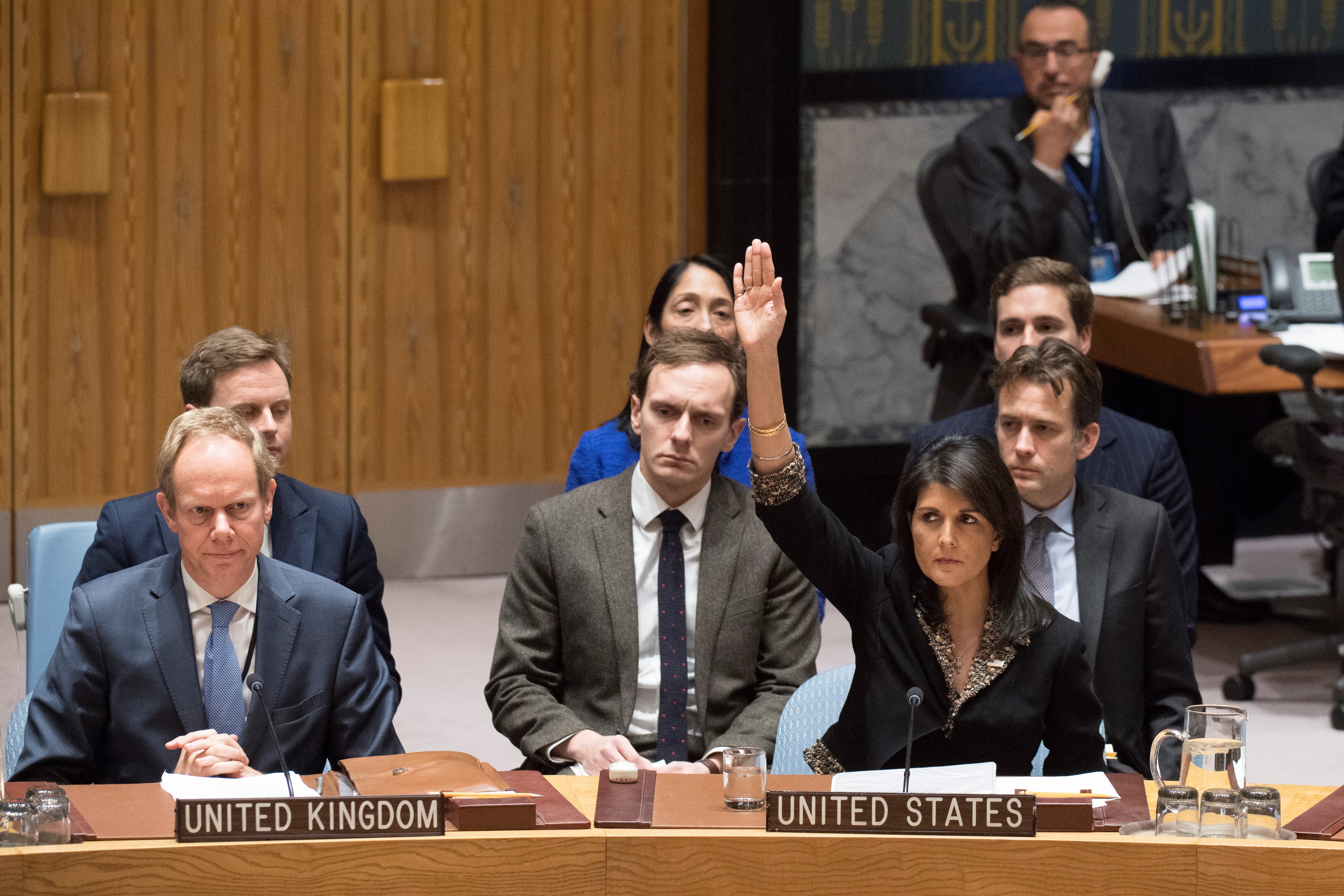
President T rump’s announcement in early December that his government recognized Jerusalem as Israel’s capital and would soon move the U.S. Embassy there prompted discussions in both the Security Council and the General Assembly. In the Security Council, an Egyptian-sponsored draft resolution was vetoed by the U.S.on Dec. 18 with all other Security Council members voting in favor. Citing negative trends that are imperiling the two-state solution, the draft resolution would have affirmed that any decisions and actions that purport to have altered the character, status or demographic composition of the Holy City of Jerusalem have no legal effect are null and void and must be rescinded and called upon all states to refrain from the establishment of diplomatic missions in the Holy City of Jerusalem. The General Assembly took up a similarly worded draft resolution on Dec. 21, and it was adopted by a vote of 128 in favor to 9 against with 35 abstentions and 21 not present.
California
Mark Carlson, Lutheran Office of Public Policy loppca.org
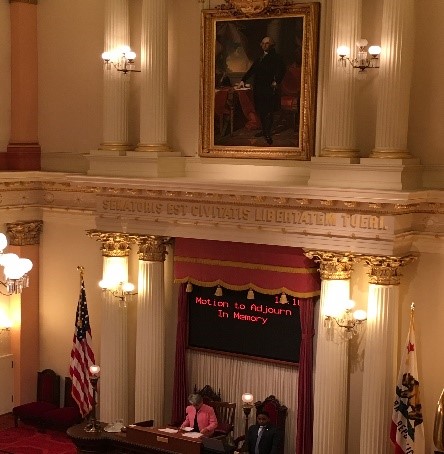
LEGISLATIVE UPDATE – CARE FOR CREATION: The Legislature returned on Jan. 3, roiled by allegations of sexual harassment and abuse and focused on honoring the memories of fire victims (including Cory Iverson, a CalFire engineer whose paternal grandparents are members of San Marcos Lutheran Church), and law enforcement officers killed in the line of duty since adjournment in S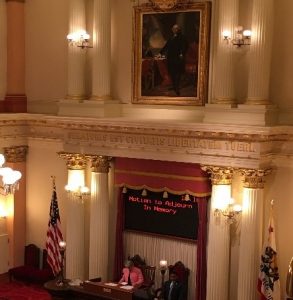 eptember. Oversight hearings are scheduled on California’s recently enacted and updated cap-and-trade carbon reduction and air quality improvement plans, supported by LOPP-CA. We have signed onto, and circulated to others, a faith-based organization letter in support of SB 100, which seeks to achieve 100 percent carbon-free electrical energy by 2050. The Southwest California Synod Green Faith Team is one group that added its name. LOPP-CA is participating in a January conference “to launch a movement to make California the first trauma-informed human resilience enhancing state in the U.S. for climate traumas and stresses!”
HEALTH AND HUMAN SERVICES: LOPP-CA Director Mark Carlson will be attending the legislative reception hosted by Stronger Together, a women-led coalition of groups concerned with economic and other gender justice issues. The California Partnership to End Domestic Violence rallied at the Capitol to support doubling the state budget for domestic violence programs from its current $21 million, a modest amount given a $125 billion General Fund budget and a projected multibillion-dollar surplus. LOPP-CA will be looking to support that effort. Carlson attended a community interfaith service at an Islamic center for 9- and 12-year-old sisters killed by their father in a murder-suicide on New Year’s Eve. Gov. Jerry Brown releases his budget proposal later in January.
Colorado
Peter Severson, Lutheran Advocacy Ministry–Colorado lam-co.org
LEGISLATIVE SESSION KICKS OFF: The second regular session of the 71st Colorado General Assembly convened on Jan. 10. Lawmakers will be in session for 120 calendar days, a four-month session concluding in early May.
Lutheran Advocacy Ministry-Colorado is already monitoring legislation that will be introduced soon, including bills related to disability benefits, driver’s license access, workforce development, family leave, and housing stability for low-income renters. Colorado has an open hearing law, which means that every bill introduced must receive at least one public hearing, so we anticipate opportunities to speak to each of these issues.
LUTHERAN DAY AT THE LEGISLATURE: Registration is now open for Colorado Lutheran Day at the Legislature! Join us on Feb. 15 for a morning of learning, equipping and action. Participants will learn what Lutheran Advocacy is working on in the current session, be equipped to use the tools of citizen lobbying, and meet their legislators at the Capitol. It promises to be a great day, so register now at lam-co.org.
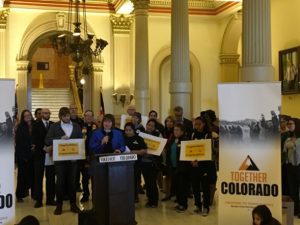 |
United Methodist Bishop Karen Oliveto
speaks at a Together Colorado news conference related to SB 13-251.
|
NEWS CONFERENCE: Lutheran Advocacy joined ecumenical partners at a news conference on Jan. 4 in support of bipartisan upcoming legislation to improve access to driver’s licenses for undocumented residents. The program was curtailed two years ago, making it very difficult to renew a license or get a new appointment, but a broad ecumenical coalition is working together to expand the program again.
Minnesota
Tammy Walhof, Lutheran Advocacy–Minnesota tammy@lcppm.org
FAITH AND CLEAN ENERGY CAMPAIGN: The campaign started with a great October introductory event. Since then, LA-MN and its partners have met and strategized with bipartisan lead House and Senate authors of Renewable Energy Standard (RES) legislation. It would modify the current state RES (25 percent renewable energy by 2025), to 50 percent by 2030 (Minnesota is already at 23-24 percent). Join the campaign and help build new champions of clean energy! How many signers can you get from your congregation on the faith campaign letter to legislators?
Upcoming event: Faith & Clean Energy Campaign Legislative Visit Basics – Thursday, Feb. 8, 3 p.m.-4:30 p.m. (St. Paul) RSVP: goo.gl/forms/B2A3H6lwOkF7Rm352
OTHER CLEAN ENERGY EFFORTS: Tammy Walhof continues to chair the Energy & Climate Cluster of Minnesota Environmental Partnership and was elected to a leadership team of the State Climate Table. Fall was full of meetings to coordinate many groups, find common ground, and collaborate on main messages. Despite the RES modification focus, defensive action will be needed to protect clean energy programs and accomplishments. (Significant fossil fuel money found its way to Minnesota in recent electoral campaigns).
HOMES FOR ALL: LA-MN participates in the Policy, Communications and Community Engagement teams of the statewide coalition. Tammy Walhof and Kendrick Hall have been deeply engaged in the long deliberative process to decide 2018 legislative proposals (affordable housing bonds/appropriations). Kendrick is helping create messaging and educational materials for the coalition’s proposed legislation. LA-MN also joined the new Protect Our Homes coalition to address disturbing proposed cuts and changes in federal housing programs.
New Mexico
Ruth Hoffman, Lutheran Advocacy Ministry – New Mexico lutheranadvocacynm.org
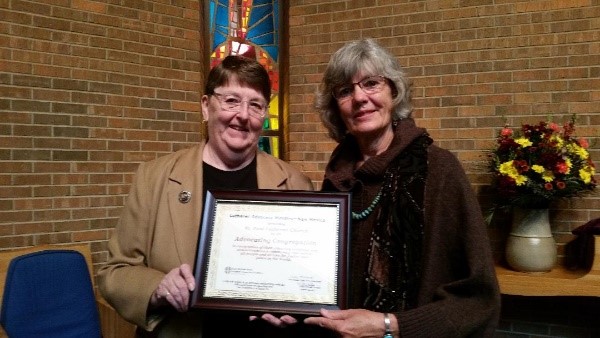 LAUNCHING OF THE LAM-NM ADVOCATING CONGREGATION OPPORTUNITY: The latter part of 2017 saw the launching of our new Advocating Congregation program. The LAM-NM Policy Committee approved the launch of the program and the information about the program was sent out to the LAM-NM Advocacy Network. Congregations are asked to participate in at least six advocacy education activities or actions.
 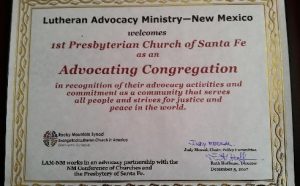 By the end of 2017 six congregations had submitted applications and two certificates had been presented by LAM-NM director, Ruth Hoffman. Fittingly, the first Advocating Congregation to be recognized was St. Paul Lutheran in Albuquerque. Several members of St. Paul were instrumental in the formation of Lutheran Advocacy Ministry in New Mexico in 1984. The second congregation recognized was 1st Presbyterian Church in Santa Fe which has been an ecumenical partner in advocacy for more than 20 years.
Ohio
Nick Bates, The Faith Coalition for the Common Good Nick@HungerNetOhio.org
ADVENT ADVOCACY DAY: Ohio advocates ended 2017 with an Advent Advocacy Day. Attendees began the day reflecting on the Advent’s season strong call for justice.
“He has shown strength with his arm; he has scattered the proud in the thoughts of their hearts. He has brought down the powerful from their thrones, and lifted up the lowly; he has filled the hungry with good things, and sent the rich away empty” (Luke 1:51-53).
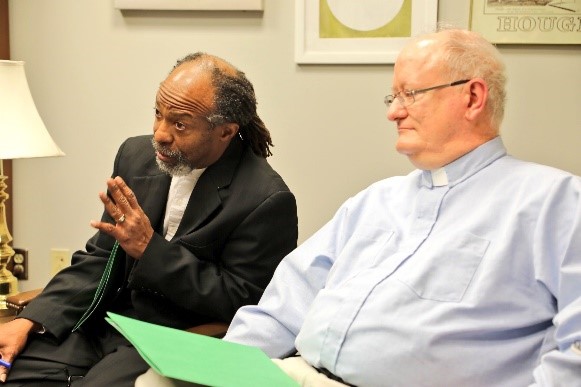 |
Pastors Leonard Killings and Larry Novak talk about the importance of nutrition in food assistance
|
Advocates began the day with a briefing on poverty and how it intersects with a wide array of issues, including education, infant mortality, health care, hunger and much more. Too often we treat those who are struggling economically as “other.” Instead, it is time that we honor the dignity of the children of God who are unable to make ends meet. Poverty is not caused by a moral failing but by a lack of resources and decent pay. Currently, 1 in 3 Ohio households is unable to make ends meet, even though more than 80 percent of these households are working.
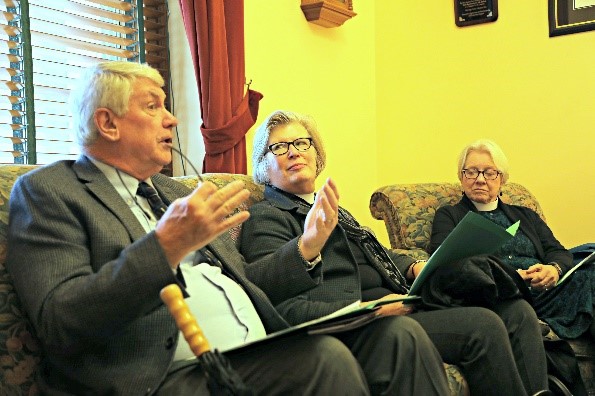 |
Pastors Glen Bengson, Libby Buuk and Leanne Reat talk about the long-term
effects of poverty on children.
|
In 2018, HNO will engage congregations and legislators in a more comprehensive understanding of poverty and its causes and effects.
Other updates:
- Without a long-term funding solution to CHIP at the federal level, 200,000 kids in Ohio are at risk of losing health insurance.
- The Legislature continues to work toward redistricting solutions. Advocates continue to gather signatures for a ballot issue in November to force a redistricting fix.
- Ohio’s unemployment compensation system needs to improve to guarantee the resources are there to help families in need. The Legislature has been unable to improve this important work support.
Pennsylvania
Tracey DePasquale, Lutheran Advocacy–Pennsylvania lutheranadvocacypa.org
Alleviating hunger, poverty and injustice while addressing their root causes remains central to the work of LAMPa in 2018. On Dec. 7, LAMPa’s Policy Council adopted a broad agenda that encourages disciples to act where they are called, lifting their ministry context, lived experiences, vocations and gifts for public witness.
“The Hebrew and Greek Scriptures call God’s people to care for widows, orphans and sojourners,” said LAMPa’s newly elected chair, the Rev. William Snyder. “As we look forward, let us join them in lifting up the song of abundant life for all people.”
In addition to informing LAMPa’s work by sharing their ministries and communities in every synod, the Policy Council elected new officers and continued to refine a restructuring that reflects a closer relationship with the ELCA churchwide organization while seeking to give voice to the work of the church in Pennsylvania. The deliberation affirmed LAMPa’s mission to advocate for wise and just public policies in Pennsylvania that promote the common  good in response to God’s love in Jesus Christ. Read more.
2018 is a both a legislative and gubernatorial election year, making the outlook for legislative action even more partisan, especially given the announcement that House Speaker Mike Turzai is one of several candidates, including state Sen. Scott Wagner, seeking the Republican nomination for governor. Current governor, Tom Wolf, a Democrat, faces overwhelming Republican majorities in both the House and Senate.
Washington
Paul Benz, Faith Action Network fanwa.org
2018 LEGISLATIVE SESSION: Washington’s legislative session begins on Jan. 8 and will last 60 days. FAN will be working on critical bills like Breakfast After the Bell, which would give students access to breakfast as they begin their school day. During the session, FAN will have three part-time lobbyists pushing for the issues on our Legislative Agenda while working in conjunction with key partners: the Racial Equity Team, the Welfare Anti-Poverty Advocates Group, the Revenue Coalition, the Farmworker Coalition, the Alliance for Gun Responsibility, the Alliance for Jobs & Clean Energy, and many more. FAN will also be hosting and facilitating our annual meeting with the governor later this month.
FAN is also gearing up for Interfaith Advocacy Day in the state capitol. We hope to bring 300-400 advocates from at least 40 of our 49 legislative districts to engage with speakers, workshops and caucuses by legislative district. Advocates will meet with their legislators and/or their staff and hear key legislators speak about current, critical issues in the Legislature.
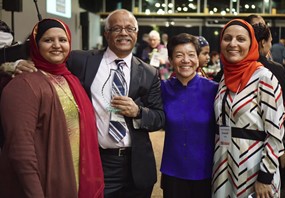 |
Washington State Supreme Court Justice Mary Yu was our Annual Dinner keynote speaker, and leaders at the Muslim Association of Puget Sound were honored for their work to combat Islamophobia.
|
STAFF UPDATE: In 2017, FAN expanded our staff capacity by hiring a full-time statewide organizer. Amber Dickson now focuses on engaging with faith communities in South King County, an area especially affected by the issues on our Legislative Agenda, and not yet well represented within our network. Amber will also be the staff lead for our criminal justice work group, as well as FAN’s community organizer representative to the Racial Equity Team.
FAN’s 2017 ANNUAL DINNER: Last November, over 450 FAN advcocates from 20 faith traditions gathered to celebrate our movement for justice and to raise funds. At the dinner, FAN honored faith leaders, communities and justice activists, including ecumenical faith leaders who signed a 1987 apology letter to Northwest trib
Wisconsin
Cindy Crane, Lutheran Office for Public Policy in Wisconsin loppw.org
ADVOCACY DAYS:
- LOPPW’s director joined two Wisconsin bishops and a grass-roots leader to advocate for refugees and immigrants at the ELCA Advocacy Convening in D.C.
- LOPPW helped organize People of Faith United for Justice Advocacy Day to advocate on issues related to hunger and poverty in the proposed state budget.
INVOLVING VOLUNTEERS:
- Three members of the South-Central Synod of Wisconsin/LOPPW Care for God’s Creation Team led workshops on climate change; one leads workshops frequently.
- A Northwest Synod of Wisconsin volunteer traveled to La Crosse to be a key speaker on anti-sex trafficking.
- Two Northwest Synod of Wisconsin Synod Council members led a workshop and two other council members co-led a workshop with the director in the South-Central Synod of Wisconsin.
- Two members of Women of the ELCA and a council member of the East Central Synod of Wisconsin testified at a hearing on anti-sex trafficking.
- The La Crosse Hunger Team has begun educating others about the farm bill.
NEW AND GOOD IN 2017:
- “Called into the World” – devotional on the social statements by LOPPW Advisory Council:
- New workshops: Luther and Economic Justice and Anti-trafficking and Healthy Relationships for youth (the latter led for first time in the Northern Great Lakes Synod)
- Monday quotes – weekly devotions: https://www.loppw.org/resources/
- Overnight advocacy retreat for college students organized with Lutheran Campus Ministry
COMING UP IN 2018:
- Updated Advocacy Manual and trainings, beginning with two advocacy conferences in the East Central Synod of Wisconsin
- Regular communication on legislation to synods with a Greater Milwaukee Synod volunteer

 ELCA Advocacy presents our public policy priorities for 2018. This policy action agenda focuses the work of the Washington, D.C., advocacy office on current issues central to God’s vision of a just world where all are fed.