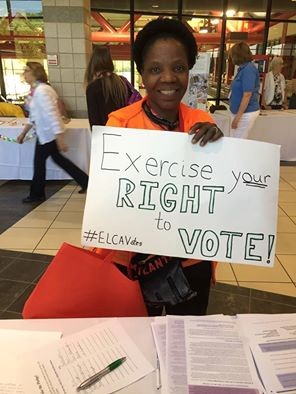
Lutherans are taking action across the country! Below you will find our monthly State Advocacy Newsletter. Share with your friends!
____________________
Washington, D.C. – Amy Reumann, Director of Advocacy
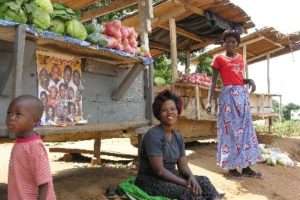 THE GLOBAL FOOD SECURITY ACT PASSES CONGRESS: After long months of advocacy and policy negotiations, Congress has finally passed the Global Food Security Act, a landmark food security legislation. A top priority of ELCA Advocacy, this bipartisan legislation authorizes Feed the Future– a vital global food and hunger initiative, into law. Feed the Future works to bolster agricultural development, improve nutrition, and stimulate local economic growth, which in turn helps to reduce poverty. In addition, the Global Food Security Act strengthens transparency and accountability measures to ensure effectiveness and stewardship. Together we celebrate this great milestone; for it is because you raised your voices and took action that we were able to compel Congress to pass this legislation.
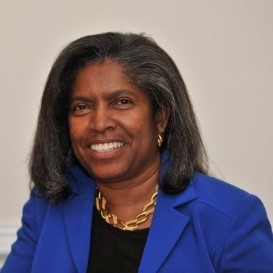 WELCOMING RUTH IVORY-MOORE TO THE ELCA ADVOCACY TEAM: ELCA Advocacy is delighted to introduce our new Program Director for Environment and Energy, Ruth Ivory-Moore. Ruth has had careers in chemical engineering, as a corporate legal counsel, and brings legal specialties including environmental law and climate change. Ruth is married and has two children. She enjoys spending time with family (especially her two grandchildren) and friends. Ruth is involved with Christian education in her church and is about to embark on training to become a Stephen Minister. Her other volunteer work includes chairing a young adult and youth leadership summit in southern Virginia, as well as addressing various community needs such as criminal law reform and health care. Welcome Ruth!
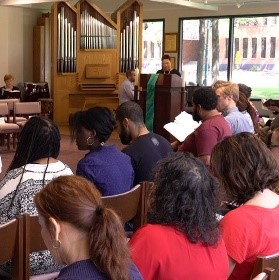 GRIEVING WITH OUR CHURCH AND NATION FOR THE TRAGIC LOSS OF LIFE: ELCA Advocacy continues to grieve with our church and nation for the tragic loss of life last week, the repeated reminders of the wounds of racism, fear and injustice, and our own complicity in their infliction. Bishop Eaton has called on ELCA ministries and members to be present in our communities in the wake of this and any violence; to accompany protesters, law enforcement, and any who are frightened, despairing or searching for hope. The Gospel calls us to be present, to show up in the places of pain under the shadow of the cross, because these are the places Jesus will be, where he promises to be present for us with mercy, hope and resurrection to new life. Read more.
GREEN CLIMATE FUND: The Senate Appropriations Committee recently  voted to continue U.S. support for the Green Climate Fund. As people across the developing world continue to be deeply impacted by climate disruption, the fund is already implementing vital and innovative projects for nations to prepare for and build community resilience. The fund is a top ELCA Advocacy priority because it dedicates a large percentage of resources to serve people already impacted by climate change. An ELCA advocacy alert was sent a day before the amendment vote and the ELCA Advocacy Office will continue to monitor the issue as it moves to the Senate and House.
GUN VIOLENCE: Following the tragic events in Orlando, Fla., Rep. John Lewis, D-Ga., led House and Senate Democrats in a sit-in demonstration on the House floor, protesting the long-standing status quo of congressional inaction after mass shootings. Three days after the Orlando shooting, Sen. Christopher Murphy, D-Conn., led a nearly 15-hour filibuster until Republican leaders agreed to vote on four gun-related amendments. All the measures failed in the Senate. ELCA Advocacy shared two action alerts encouraging lawmakers to support meaningful regulations. Though the Senate measures failed, a gun-violence action alert is still live for advocates who would like to continue to weigh-in on the issue.
PAYDAY LENDING RULE: The Consumer Financial Protection Bureau last month released a newly proposed rule aimed at ending high-interest “debt traps” from payday lenders. The bureau said the typical payday loan lasts about two weeks and has an average annual interest rate of 390 percent. Under the proposal, a lender could only make a high-interest loan to a borrower who passed a credit check and was found to be able to repay the loan. Those failing the check could still borrow under “less risky longer-term lending options.” The proposed rules are now open for public comment, allowing individuals, community leaders and congregations to weigh in on payday lending policy. The ELCA Advocacy Office released an action alert urging followers to submit their comments the day the rule was released.
CRIMINAL JUSTICE REFORM: Congress has yet to act on meaningful criminal justice reforms this year. The Sentencing Reform and Corrections Act of 2016, which has broad bipartisan support in the Senate, would affect many who are faced with overly harsh and unfair sentences. You can read more about criminal justice reform, where it stands in Congress, and how the faith community is part of the conversation at the ELCA Advocacy Blog.
____________________
New York, NY – Dennis Frado, Lutheran Office for World Community
HIGH-LEVEL MEETING ON HIV AND AIDS: On June 8, the 2016 Political Declaration on HIV and AIDS was adopted, providing a political framework for ending the AIDS epidemic by 2030. This declaration is strong on certain issues. For example, it is the first to provide treatment targets for children, age 0-14, living with HIV – 1.6 million children on antiretroviral therapy by 2018 and a reduction of new infections by 95 percent by 2020. It also includes a commitment to reduce the number of adolescent girls and young women, aged 15-24, newly infected with HIV globally each year to below 100,000 by 2020 (about 2,000 young people between the ages of 15-24 become affected by HIV daily). On the other hand, challenges in the declaration remain, including the overall lack of mention of “key populations” – men who have sex with men, transgender people, people who inject drugs, sex workers and prisoners.
One day before the adoption of the declaration, the World Council of Churches – Ecumenical Advocacy Alliance hosted an interfaith prayer service on ending AIDS at the Church Center at the United Nations. At this service, people of different faiths came together in common prayer to end AIDS, particularly praying for the world leaders and diplomats who ultimately make decisions on how to address the epidemic. Prayers also called for activities among people of faith and faith leaders as outlined in the alliance’s Call to Action.
The Lutheran Office for World Community helped organize the prayer service and participated in a three-day high-level meeting on the HIV and AIDS declaration. Participating in this high-level meeting will bolster the ELCA’s presence in Durban, South Africa, for the International AIDS Conference in July.
GUIDELINES TO PROTECT MIGRANTS IN COUNTRIES EXPERIENCING CONFLICT OR NATURAL DISASTER: On June 15 at the United Nations, the Migrants in Countries in Crisis Initiative, co-chaired by the Philippines and the United States, launched guidelines to protect migrants in countries experiencing conflict and natural disasters. The guidelines look at crisis preparedness, emergency response and post-crisis action and offer ways to save lives, improve protection, decrease vulnerability and improve responses.
SUMMIT MEETING ON ADDRESSING LARGE MOVEMENTS OF REFUGEES AND MIGRANTS: U.N. members will have a Sept. 19 summit to address large movements of refugees and migrants. Several preparatory meetings are taking place. The U.N. secretary general is calling for global commitments through three pillars: upholding safety and dignity in large movements of refugees and migrants; a global compact on sharing responsibility for refugees, and a global compact for safe, regular and orderly migration. The LOWC, in collaboration with The Lutheran World Federation office in Geneva has been participating in preparatory meetings with other civil society groups.
____________________
California – Mark Carlson, Lutheran Office of Public Policy
STATE BUDGET ADOPTED: The Legislature passed and the governor signed a 2016-2017 budget that took effect July 1. After several years of effort, the Maximum Family Grant Rule for CalWORKS/Temporary Assistance for Needy Families was repealed – with some drama and great celebration – and the cost was funded in the budget. A top priority for LOPP-CA this year, this rule restricted additional public assistance for children born into a family currently on assistance, causing unnecessary deprivation and worsening California’s child-poverty rate.
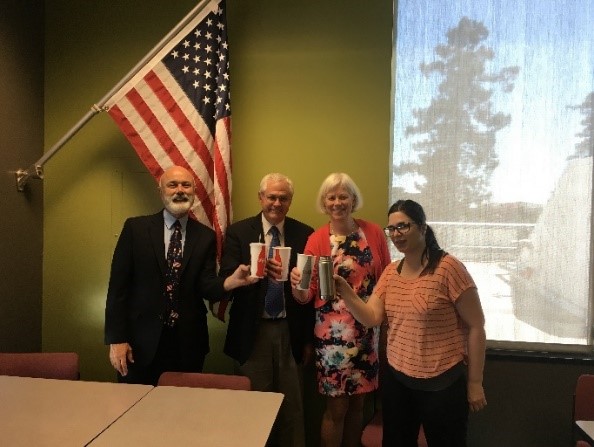
LEGISLATIVE UPDATE: The Legislature adjourned for a month-long recess July 1 and returns for a final month of work Aug. 1. It completed most policy committee work on bills, with appropriations committee work and floor sessions up next. AB 2590, adding restorati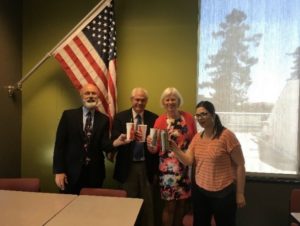 ve justice principles to the Penal Code, is pending. A package of firearms regulation bills received accelerated attention after the Orlando, Fla., shooting deaths and with the specter of a ballot initiative sponsored by Lt. Gov. Gavin Newsom looming. LOPP-CA delivered a “floor alert” to legislative leadership, selected legislators and the governor, with the ELCA policy on firearms regulation contained in the Social Message on Community Violence. LOPP-CA Director Mark Carlson joined volunteer Brady Campaign advocates Nick and Amanda Wilcox for a soft- drink toast in the Capitol cafeteria after the bills passed. The next morning, Gov. Brown signed six bills and vetoed five (gov.ca.gov). Policy Council member Ben Hogue, a Pacific Lutheran Theological Seminary student, represented LOPP-CA at the annual Law Center to Prevent Gun Violence dinner at the Westin St. Francis in San Francisco and was invited to sit at the table with Newsom, Gabby Giffords and Mark Kelly.
Colorado – Peter Severson, Lutheran Advocacy Ministry Colorado
 BALLOT ISSUES: The Policy Committee of Lutheran Advocacy Ministry-Colorado has endorsed two measures for the fall ballot in Colorado. One is an increase of the state’s minimum wage to $12.00/hour by 2020. The supporters of this measure are working together in a coalition called Colorado Families for a Fair Wage.
We are also supporting the No Slavery, No Exceptions measure, which will be on the ballot as Measure T. It comes from Senate Concurrent Resolution 006, which was passed unanimously by the Legislature this session. It will amend Article II, Section 26, of the state constitution to eliminate a 19th century exception to Colorado’s ban on slavery and involuntary servitude.
COUNT  ME IN! INITATIVE: LAM-CO has joined an initiative called Count Me In! to encourage Coloradans to vote their fall ballot from the bottom up. Because we’ll have a long ballot this year, with many important things to decide, LAM-CO is encouraging voters to consider ballot issues first and Vote Bottom Up! This initiative is sponsored by several groups and is coordinated by the Colorado Fiscal Institute.
AIDS 2016 GLOBAL CONFERENCE: LAM-CO Director Peter Severson will be traveling to Durban, South Africa, for the AIDS 2016 Conference in July. Check out our website and Facebook page for information about how to follow along with the ELCA delegation’s journey!
____________________
New Mexico – Ruth Hoffman, Lutheran advocacy Ministry New Mexico
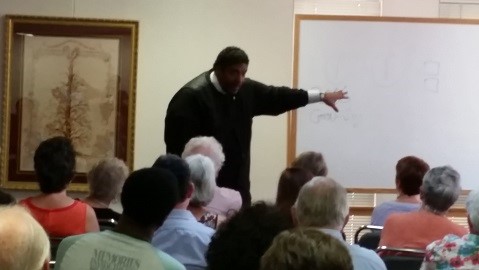
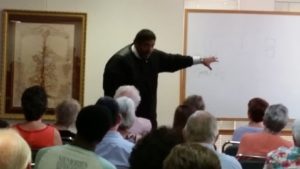 Lutheran Advocacy Ministry-NM cosponsored a training event led by the Rev. Dr. William Barber, the leader of the Moral Monday movement in North Carolina. On June 29, nearly 80 people from throughout New Mexico participated. The morning began with the sound of shofar and an understanding of the role of music in organizing. Barber led the group through the biblical foundations of declaring the prophetic moral voice in public policy. The afternoon included a presentation by LAM-NM Director Ruth Hoffman, outlining the context for advocacy in New Mexico. Plans are being made for a larger group gathering in October again led by Barber.
____________________
Ohio – Nick Bates, The Faith Coalition for the Common Good
nick@oneohionow.org
THE RUSH TO END FOR SUMMER: Advocates were busy helping state policymakers finish their business before recessing for a summer of campaigning. Ohioans are encouraged to ask every candidate or campaign this summer, “What will you do to reduce hunger in our community?” Here is a quick rundown of some of the legislation passed in the final hours before summer recess:
FOSTER CARE: Ohio expanded foster care to youth up to the age of 21. This has the potential to help a lot of youth transition successfully to adulthood and avoid homelessness and exploitation.
ELECTIONS: The governor vetoed a bill that would have imposed a poll tax if somebody sought a judicial order to keep polling locations open. Gov. Kasich said the bill went too far in limiting the discretion of the common-pleas judge.
Also, online voter registration continues to be delayed in Ohio, despite the secretary of state’s approval of the system.
MEDICAL MARIJUANA: The Legislature legalized medicinal marijuana, however, this legislation didn’t address the criminal justice and racial justice concerns associated with decades of marijuana policy.
UNEMPLOYMENT COMPENSATION: Ohio will use existing funds to pay off our unemployment compensation debt to the federal government. This temporarily delays action on a proposal that would have drastically cut benefits for unemployed workers. However, Ohio’s unemployment compensation system still needs structural improvements to guarantee promised benefits to families who face unemployment during the next economic slowdown.
____________________
Pennsylvania – Tracey DePasquale, Director
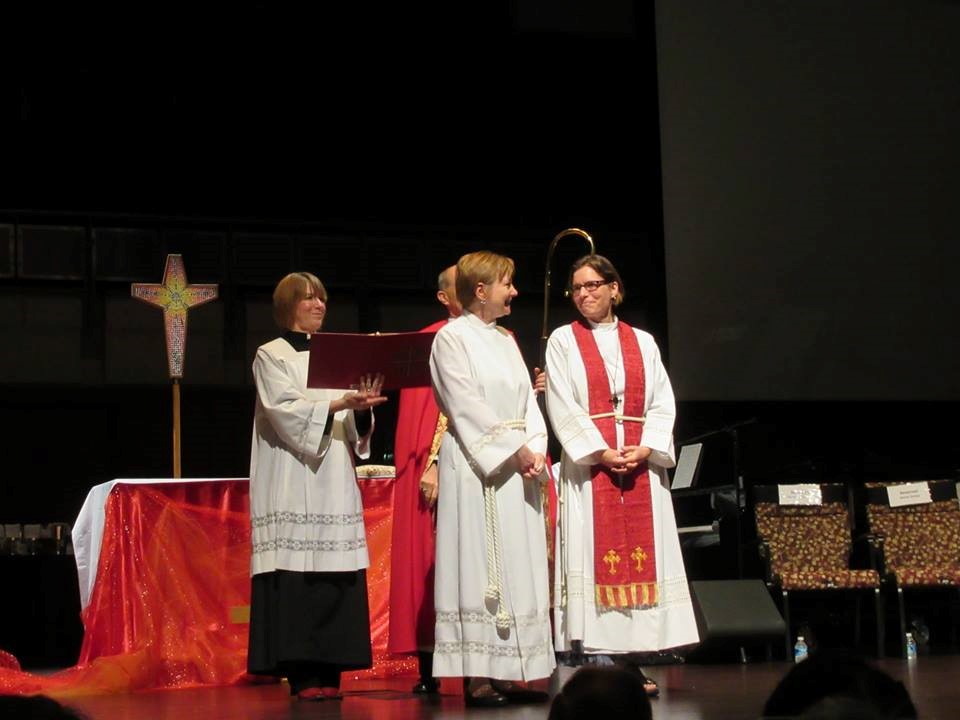
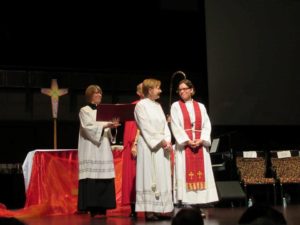 June saw LAMPa busy with synod assemblies. Tracey worked with hunger leaders to teach about hunger and underlying causes at Lower Susquehanna’s Hunger JAM (Justice and Mercy) meal-packing, collecting signatures on approximately 500 letters to Congress about Child Nutrition Reauthorization. She also taught a forum linking service and advocacy on a Sept. 11 day of service and advocacy. Tracey delivered the letters to the Rev. Amy Reumann, director of ELCA Advocacy, as both were installed in their new positions during Sunday worship at the assembly.
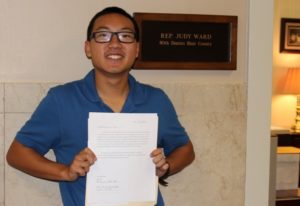 LAMPa intern Kent Zelesky attended the Northwestern and Southwestern Pennsylvania synod assemblies, gathering letters on education funding. It was an easy task at the Northwestern assembly, where one of its districts (Erie) has faced closing four high schools.
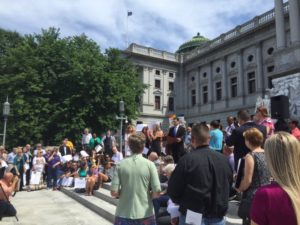 Kent also attended a rally for fair education funding. The legislature passed a spending plan that includes a $200 million increase for basic education. A step in the right direction, it falls short of what is needed to close the estimated $3 billion adequacy and equity gap and faces a potential veto unless an adequate revenue bill is passed.
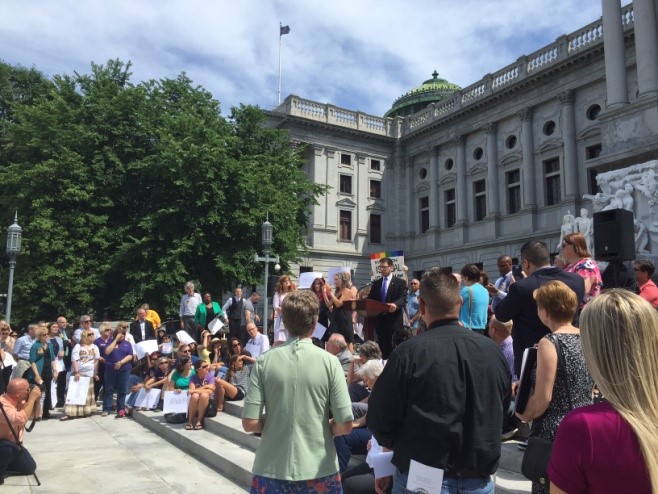
 In the wake of the Orlando, Fla., shooting, LAMPa staff encouraged and accompanied Lutheran participation in vigils and a rally for the Pennsylvania Fairness Act, on which related bills are slated for hearings in August.
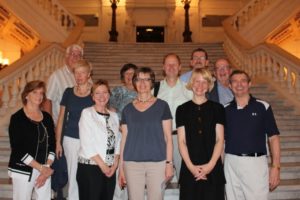
Tracey accompanied Bishop Robert Driesen and a delegation from the Upper Susquehanna Synod companion synod in Germany for a Capitol tour and lunch. Bishop Gisela Bornowski encouraged American Lutherans to advocate for direct relief for migrants and for policies addressing climate change.
____________________
South Eastern Synod–Hilton Austin, Director
haustin337@att.net
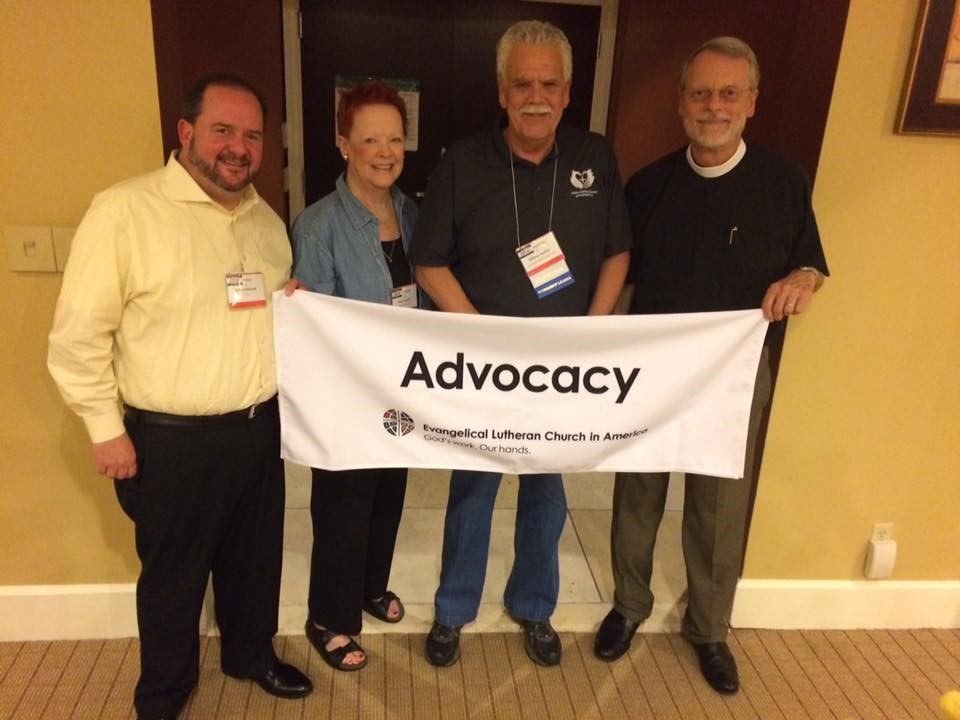
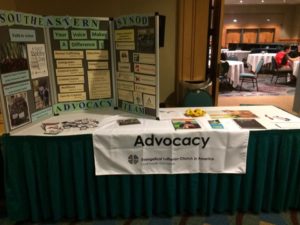 Having been officially authorized at the last Synod Assembly, we were very excited to have our first exhibit at the Southeastern Synod Assembly in June. The exhibit was well received, and several people signed up either as leaders or to participate in our state advocacy efforts. John Johnson joined us for the second year and announced to the delegation that we would receive a grant to help us continue to grow the ELCA’s first regional advocacy team. It was quite exciting and very well received by the entire assembly.
The assembly also passed a “Resolution for Congregational Advocacy.”: “Whereas … therefore, be it
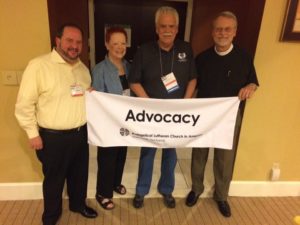 “Resolved that all congregations of the Southeastern Synod be encouraged to keep their members informed on current state and national public policy by having at least one, but not limited to one, member to serve as a congregational advocate; and be it further
“Resolved that the synod advocacy team, in coordination with the Bishop, the synod staff, and the Washington, D.C. advocacy office, provide training, coordination, and support to the congregational advocates, and be it further
“Resolved that Congregational Councils encourage the 50,000 members of the Southeastern Synod to fully participate in public life by voting and regularly contacting their state and national representatives and sharing their opinions on pending legislation.”
On June 30, stakeholders from our four states are meeting to plan the path forward and begin discerning our priorities for the 2017 legislative season.
____________________
Virginia – Kim Bobo, Virginia Interfaith Center for Public Policy
Neill Caldwell, Communications Director
As part of the Virginia Interfaith Center for Public Policy and its programs, Virginia Consumer Voices for Healthcare has increased efforts to get Virginia to take the $4.4 million daily of federal Medicaid funding to close its health insurance coverage gap.
Members of the Virginia Consumer Voices team attended a hearing on May 25 at the Virginia State Corporation Commission, which was called to evaluate the impact on Virginia residents of the proposed merger of health insurance giants Anthem and Cigna. A number of people testified, and all but one opposed the proposed merger, which would reduce consumers’ choices on health insurance coverage in the commonwealth.
Representatives of the Medical Society of Virginia and the Virginia Hospital & Healthcare Association both opposed the merger, noting the anti-competitive marketplace that would result in an already highly concentrated health insurance market in Virginia, where Anthem dominates.
Virginia Consumer Voices Director Karen Cameron testified, pointing out the narrowed networks and lack of consumer choices that would result from the merger would hurt access to quality, affordable healthcare for people across Virginia.
The Bureau of Insurance still has to submit its report to the commission on the implications of the merger.
The Virginia Interfaith Center continues to prepare resources for its faith communities to use in organizing support for expanding healthcare and registering voters.
____________________
Washington – Paul Benz, Faith Action Network
FROM SUMMITS TO CLUSTERS: Faith Action Network has completed two of its four programmatic seasons: 1) the state legislative session, January through April; and 2) four regional summits in May and June. In August through October, we will convene 17 cluster gatherings. Each of our clusters are made up of four to eight faith communities in that local area, and each cluster gathers to share about advocacy efforts and discuss how they can more effectively partner with each other and the work of FAN.
INTERN SHUFFLE: During July and August, we say farewell to our three organizing interns from the ELCA, United Methodist Church, and United Church of Christ. We will welcome our new interns in August and early September.
INITIATIVES AND CANDIDATE FORUMS: Every year, FAN does candidate and initiative forums at faith communities around the state. We have about six or seven forum events in the beginning planning stages now. All of them will be after our state’s August primary. FAN has taken positions on five initiatives; two are already on the fall ballot:
- 732 – Carbon Tax (revenue neutral) FAN is neither opposed or supports
- 735 – Overturn Citizens United (campaign finance – memorial to congress) FAN supports
- 1433 – Increase Minimum Wage and Paid Sick & Safe Leave – FAN supports
- 1491 – Extreme Risk Protection Orders for gun responsibility – FAN supports
- 1515 – Require transgender people to use public bathroom by their sex at birth-FAN opposes
____________________
Wisconsin – Cindy Crane, Lutheran Office for Public Policy in Wisconsin
 HIGHLIGHTS IN JUNE! LOPPW is part of the emerging Wisconsin Climate Table, comprised of several secular environmental agencies and interfaith groups. Recently, we held an all-day meeting at the Midwest Renewable Energy Association in Stevens Point to set priorities.
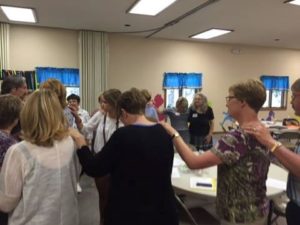 LOPPW/Cherish All Children’s Northwest Synod team held a half-day conference on human trafficking at Grace Lutheran Church in Wisconsin Rapids (East-Central Synod). At the end, the Rev. Scott Adams led us in the blessing of letters participants wrote to their legislators.
SYNOD ASSEMBLIES: LOPPW distributed resources, increased its advocacy network and received invitations to further our outreach during the Greater Milwaukee and La Crosse Area synod assemblies.
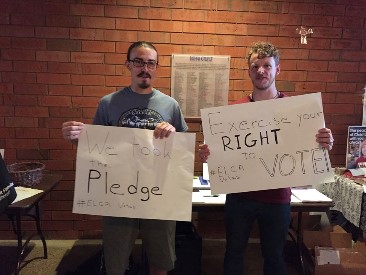
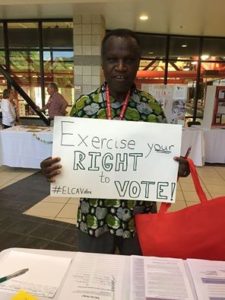
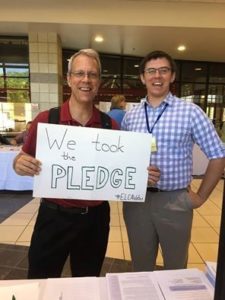
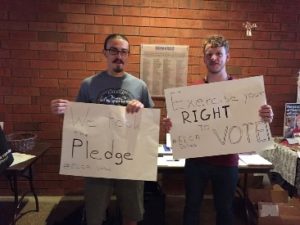
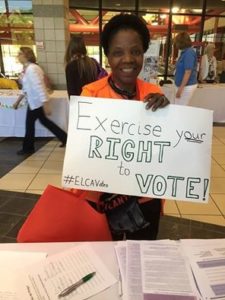
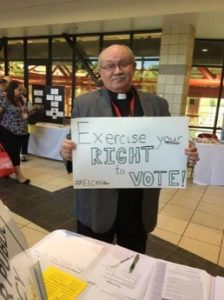
Below, the Rev. Elias Nasari, Bishop Jim Arends, Thaurra Stallings, Bishop-elect Paul Erickson, intern Kyle Kreschmann, Ryan Hall and the Rev. Benjamin Morris say, ELCAvotes!
____________________
What advocacy efforts are going on in your synod or state? We want to hear about it!