Skip to content
ELCA Blogs

ELCA World Hunger

Advent Study Series, Session 4: Holy Communion

Advent Study: Session 4

The guests sit back, satisfied. The plates are scraped clean. The utensils are carefully stowed for the next meal. Where do we go from here?

In the first session of this study, Babette’s guests had finished their sumptuous, if strange, feast, praising the talents of their hostess, if not the exact recipes she brought to life. The eponymous meal was not the end of the story, however. Thirty-year-old spoiler alert: At the end of the film, Babette informs the two sisters for whom she works that she has spent all her newfound wealth on the meal and so, rather than returning to France, will be staying on as their live-in servant. Almost as important as the climax of the meal is the denouement of Babette’s decision to remain in their service. The feast is not a farewell dinner but rather a celebration of transition — from the servitude she was forced into by circumstance to the loving service she continues by choice.

In the second session of this study, Martin Luther extolled the virtues of Abraham, whose radical hospitality created an opening — both literal and figurative — for Abraham and Sarah to hear the promise of God in their humble tent. It was a model of hospitality Luther commended to the church, that it might be a place of refuge for all who are vulnerable, for all the strangers-maybe-angels in our midst. The people of God are called to be church for the sake of the world — and this starts with the concern for the well-being of others that gives rise to hospitality.

In the third session of this study, Paul admonished Peter for creating tables that were exclusive rather than inclusive. Peter had refused to dine with Gentiles and, in so doing, had decided who was in and who was out based on the law rather than on grace. Paul also held the Corinthians to account for their treatment of people in need, chastising them for mimicking in the church the pattern of relationships already present in the world, where those with earth and power received the places of prestige, and those in poverty had to make do with scraps.

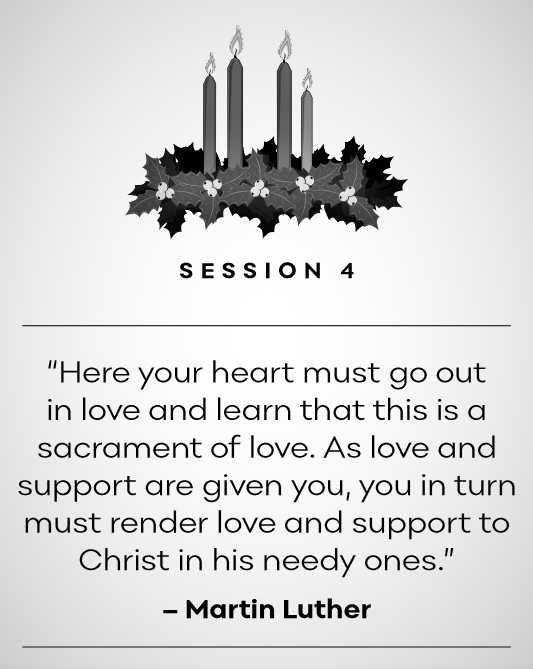
Each of these threads is pulled together in Luther’s teaching on the most important meal in the Christian church, Holy Communion. Calling Holy Communion a “blessed sacrament of love,” Luther writes:

The fruit of the sacrament is nothing other than love. As Christ gave himself for us with his body and blood in order to redeem us from all misery, so we too are to give ourselves with might and main for our neighbor…That is how a Christian acts.

For Luther, Holy Communion draws those at the altar closer to God and closer to one another. To partake of the sacrament authentically, one must remember both dimensions — the presence of grace in the sacrament and the willingness to bear the burdens of the other people at the table. Holy Communion is a means of grace that forms us to be signs of grace to one another.

In Holy Communion, we are reminded of Christ’s sacrifice for us and are invited to give ourselves in like manner to one another. The sacred meal is nourishment for a sacred vocation. In fact, for Luther, the sacrament has no meaning without this: “For the sacrament has no blessing and significance unless love grows daily and so changes a person that he is made one with all others,” he writes. At the table, a community is fed and formed for service in the world. The sacrament’s significance does not end at the table where we eat but extends into the world in which we live — a world we shape by our witness to the hospitality of God, who welcomes all to the table. It is a somber meal of penitent reflection and a celebratory feast of new beginnings.

This season, as we have prepared for the arrival of Christ, it may be easy to see Christmas as the end, the culmination of what has gone before, rather than as the beginning, the inauguration of what is to come. But the coming of Christmas is not merely the end of Advent. It is the start of the life of the church in the world. Freed from sin and death by Jesus Christ, it is the beginning of the servitude we choose — service of the world in gratitude for the grace we have received. It is a celebration of the freedom to join with others at the table and the freedom to concern ourselves wholly with the needs of our neighbors. In Advent, the church is created to be part of the re-creation of the world begun on Christmas.

The “reason for the season” is Christ’s birth, certainly. But it is also the creation of the people of Christ, who are called into the world to “do justice, and to love kindness, and to walk humbly with your God” (Micah 6:8).

The guests sit back, satisfied. The plates are scraped clean. The utensils are carefully stowed for the next meal. Now, the work of Christmas begins.

Questions for reflection:

  • What memorable meals in your life have brought you into relationship with other people at the table? How did dining together help you become closer to them?
  • How does Holy Communion help nourish you for service of others?
  • Where is God inviting you to be in the new year?
  • How are you renewed for service of the world by the holiday season?

Prayer

Gracious God,

we give you thanks for the many ways you nourish us — with food, with family, with friends, with faith. In you, we are made new to be instruments of your grace in our world. Recall to us the many places of need in our world — places of injustice and violence, of hunger and poverty. Enrich us with love at the tables you set that we may seek justice, love kindness and walk humbly with you into the future you have promised.

In your holy name,

Amen.

Learn

To download this entire Advent study, click on the cover image below. To other congregational resources from ELCA World Hunger, please visit www.elca.org/Resources/ELCA-World-Hunger.
Advent Study Cover Image

Give

Gifts to ELCA World Hunger are acts of love toward our neighbors living with hunger and poverty both here and around the world. This Advent, join ELCA World Hunger in working toward a just world where all are fed.

Give now

Connect

Sign up here and receive news, information and the latest resources from ELCA World Hunger.
VBS 2019! Who Is My Neighbor?


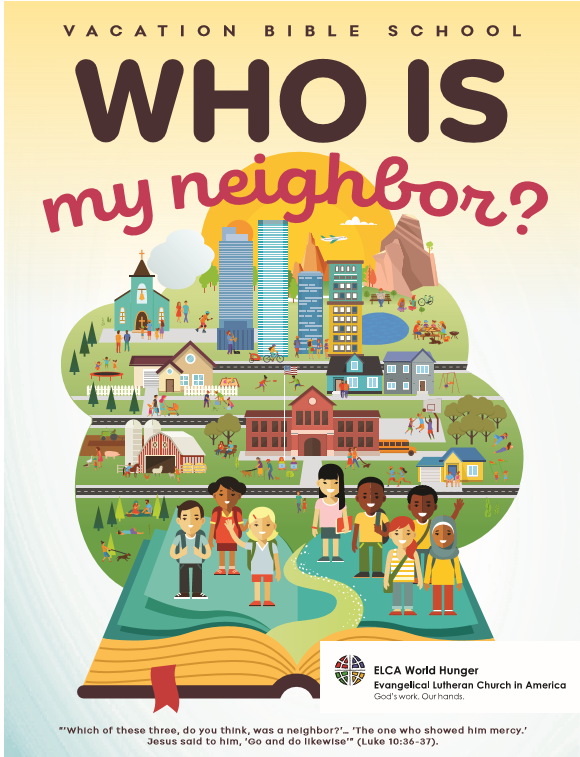
Are you daydreaming about summer as much as we are? Around the country, ELCA congregations are already making plans for next year’s Vacation Bible School, and ELCA World Hunger is thrilled to invite you to explore our new VBS curriculum for 2019, “Who is My Neighbor?” This curriculum is a free resource that is now available to order and download!

Who is my neighbor?

“Who is My Neighbor?” invites children and youth to re-imagine what it means to be neighbors in Christ. Based on the Good Samaritan story, this full, five-day program contains skits, games, crafts, snacks and intentional activities for children to enjoy and learn how our faith calls us out into the world to love and serve our neighbors.

The skits for each day introduce a new character in the Good Samaritan story, starting with the lawyer who asks Jesus, “Who is my neighbor?” Each skit shares an important lesson that directly relates to the theme and theme verse, which groups will practice at the start and end of each day.

Themes for each day:

Day One – God loves us (1 John 4:19)

Day Two – Let your light shine (Isaiah 58:10)

Day Three – No fear (1 John 4:18a)

Day Four – God loves everyone (Acts 10:34b-35)

Day Five – Building God’s neighborhood (Romans 15:2)


Based on your feedback, we’ve made “Who is My Neighbor?” more user-friendly for VBS planning teams by organizing each section by activity categories, rather than by days of the week. Organizing the sections in this way allows everyone on the team to be able to flip to the activities that they are assigned so that all of your leaders can find the materials and directions for their roles in one section. The program is organized in the following sections:

VBS 2019 - Table of Contents

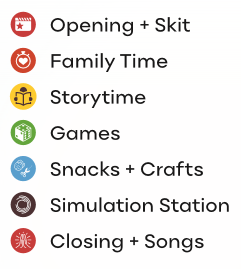
Each day begins with a large group opening, including a skit to introduce the daily theme and a new character within “The Good Samaritan” story. This is followed by “family time” – small group sessions to dig deeper into the theme and bible verse. Then, participants travel through five rotations: crafts, games, snacks, storytelling and a “simulation station” – an interactive and engaging activity to learn more about hunger and how our faith calls us to respond. The stories for each day are based on real stories from projects supported by your gifts to ELCA World Hunger. Not only will children, youth and adults hear about the work this church is doing around the world, but through “Who Is My Neighbor?” they will be part of the response!

Leaders will find schedule templates, theme song suggestions and options for younger (K-2nd grade) and older (3rd grade and above) participants so that you can adapt to the needs of your group! Each lesson is rooted in Lutheran theology, drawing on our church’s strong tradition of theology and practice in the world.

The VBS program is also flexible, so you can adapt it to fit your needs. Already have a VBS for this summer? “Who is My Neighbor?” can also be used for Sunday School, family faith formation, and children’s sermons throughout the year.

How can I get my whole congregation involved?

A month or two prior to your VBS, create your own “Who Is My Neighbor?” campaign! Set a goal for your congregation to meet before the VBS starts and raise funds for your neighbors here in the United States and around the world through ELCA World Hunger.

Look for free posters, certificates and additional pictures accompanying the Storytime section coming soon!

If you have any questions about “Who is My Neighbor?” or ELCA World Hunger’s educational resources, please contact Ryan Cumming, program director of hunger education, at Ryan.Cumming@ELCA.org.

Learn

Click on the image below to download “Who Is My Neighbor?” To see some of ELCA World Hunger’s other congregational resources, including confirmation lessons, interactive immersion experiences, stories and videos, visit www.elca.org/Resources/ELCA-World-Hunger.

Who is my neighbor?


Share

We want to hear from you! Share the story of your Vacation Bible School on social media, or email us directly at hunger@elca.org.


Give

Gifts to ELCA World Hunger are acts of love towards our neighbors living with hunger and poverty both here and around the world. Together, we are creatively and courageously working toward a just world where all are fed.

Give now


Advent Study Series, Session 3: A seat at the table


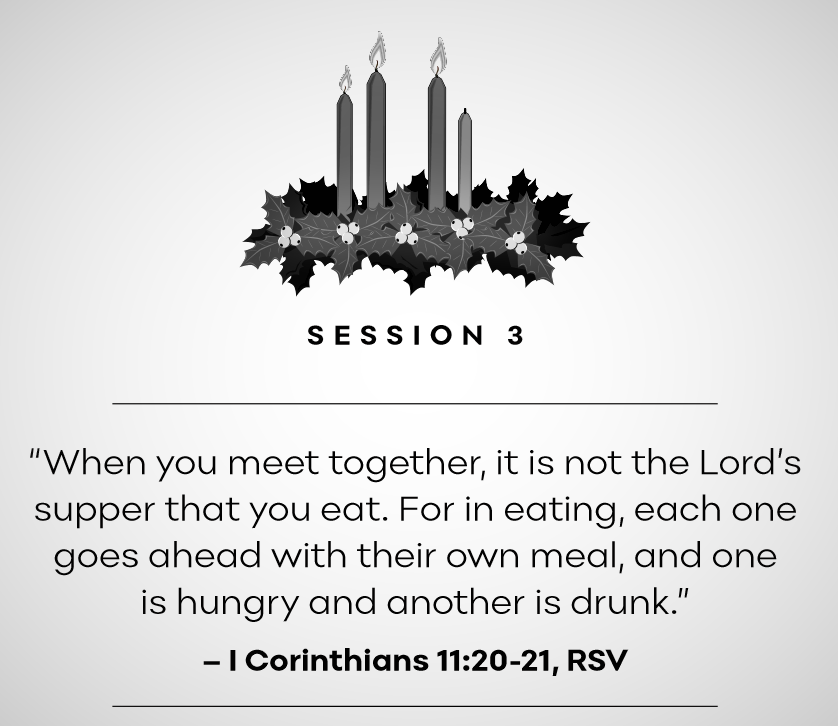
Session 3: 1 Corinthians 11:20-21

Advent is a season of anticipation, but this anticipation is not passive waiting. Perhaps a better way to describe it is as a season of preparation — we prepare our hearts and minds for the coming of the Christ-child on Christmas. But more than this, Advent is a time for the church to prepare itself for the reign of God that “broke in” to human history on the first Christmas. It is a time to reflect on the year behind and consider the year ahead — and to evaluate both in light of the question: How well do the ministries of our church anticipate the coming fullness of God’s reign?

At a community meal at Unity Lutheran Church in Milwaukee, guests gather around long tables, sharing in the hot meal volunteers serve from overflowing warming trays. The room is full to bursting with families, couples and individuals. Among them are both neighbors dealing with hunger and homelessness and volunteers and visitors sharing in the evening experience. With the exception of the servers, it is impossible to tell at first glance who among the hundred or more diners is a member of which group. All dine together; every seat is an equal station in the room.

The situation in Paul’s Corinth was very different. The meal Paul writes about in his first letter to the Corinthians is a corruption of this kind of community supper. The early meal he refers to is a first-century version of Holy Communion, at which the church would share not just bread and wine but an entire meal. Historian Helen Rhee writes that this meal was a primary way the church served the community. The sacrament, while ensuring that each church member received the means of grace through the consecrated elements, also ensured that the community received the more mundane nourishment of food, particularly for those who were facing the first-century version of food insecurity.

But that wasn’t the way it was working in Corinth. The early church included both members of wealth and members in poverty, according to Rhee, and in Corinth, it appears that the former received their fill while the latter yet again were left wanting: “One is hungry and another is drunk,” Paul admonishes.

This isn’t the first time Paul has written about eating and drinking in the church. In his letter to the Galatians, by some estimates written in the year before the letter to the Corinthians, Paul recollects his brazen challenge to Peter, the apostle of Antioch: “I opposed him to his face, because he stood condemned” (Galatians 2:11). Peter, who used to dine with both Jews and Gentiles, has begun to limit his gustatory activities to more exclusive parties, dining only with Jews. The reason for this, according to Paul, seems to be the presence of a group of Jews (“the circumcision party”) who felt that such intermingling was unbecoming of a Jew like Peter.

Paul disagrees — forcefully. Confronting Peter, Paul charges that his exclusive dining choices are a transgression against the gospel, which teaches that it is Christ alone who justifies and not circumcision. By refusing to eat with uncircumcised Gentiles, Peter is reverting to the belief that it is the law that proves a person worthy of a spot at the table and not the grace of Jesus Christ. And you thought choosing a lunch table in high school was hard!

For Paul, the table is a sign of the reign of God. The community gathered to eat and drink represents the community that will be gathered together in the full reconciliation of God’s coming kingdom. The church, witnessing to the “already-but-not-yet” reign of God, reflects not what is or what has been but what is to come — a banquet to which all will be welcomed and at which all will be filled. Peter’s transgression, like the error of the Corinthians, was to fail to see how the gospel they preached was to shape the life of the church here and now. For Paul, there was no clearer evidence of where the church stood on the gospel than where its members stood on meals.

Paul’s letters — and much of Scripture — invite us to think about the people who join us at our tables. But it would be too narrow a question to ask, who will dine with us this holiday season? For Paul, the dining table was a central symbol of who the church is, but there are so many “tables” at which we choose to sit — or choose not to sit. Our communities are filled with tables — places where we are invited to gather with neighbors, to stand with one another, to advocate for each other and to meet our common challenges together. Will we be like Paul, who envisioned tables as places of grace where all have a place and all are filled? Will we be like Peter, who abandoned the gospel by refusing to dine with unclean Gentiles? Will we be like the Corinthians, whose corrupted table perpetuated hunger?

The tables the church participates in reflect our beliefs about who the church is called to be and the transformation of the world God is enacting in our midst. As we look back on the year past and look ahead to the year to come, we are invited to reflect on the tables at which we sat — and the invitations awaiting us. Where is God inviting the church to be? Who is God inviting the church to be?

Questions for reflection:

  • Read Galatians 2:11-21 and 1 Corinthians 11:17-34. What problems did Paul see with Peter’s practices in Antioch and the Corinthians’ practices in their community?
  • Where have we been invited to be present with neighbors in our community? How have we responded?
  • Where is God calling your congregation to be in the next year?

Prayer

Loving God,

you sent your Son to invite the world to the heavenly banquet, from which no one will go away hungry. Remember us in our hunger for union with you and fellowship with one another. Inspire us to join with our neighbors at tables together, where we may work together toward a just world where all are fed.

In your gracious name,

Amen.

Learn

To download this entire study, click on the cover image below. To see some of our other congregational resources, please visit www.elca.org/Resources/ELCA-World-Hunger.

Advent Study Cover Image

Give

Gifts to ELCA World Hunger are acts of love towards our neighbors living with hunger and poverty both here and around the world. Together, we are creatively and courageously working toward a just world where all are fed.

Give now

Connect

Sign up here and receive news, information and the latest resources from ELCA World Hunger.
Advent Study Series, Session 2: Radical Hospitality

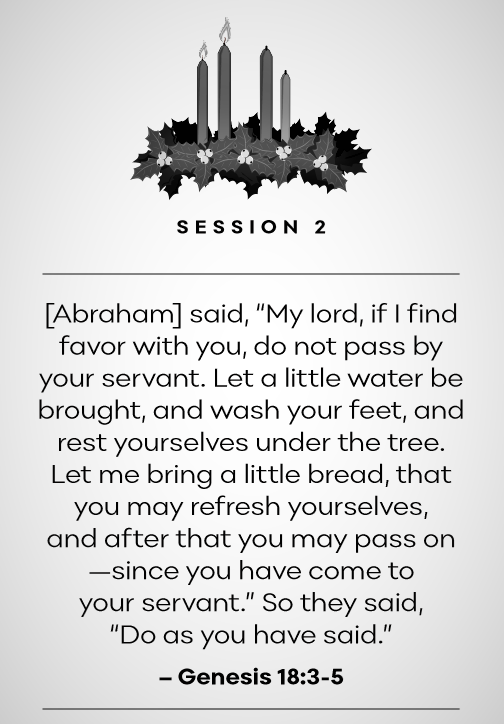
Session 2-Genesis 18:13-15

Advent is a season of anticipation, of waiting and of preparation. In faith, we prepare our hearts and minds for the coming of the Christ, joining the sacred journey of the holy family to the manger where the Savior will be born. Unlike the innkeeper in the Gospel of Luke, we know the guest who is coming, and prayerfully, we prepare for the Christmas morning arrival.

In the midst of this spiritual preparation, many families will be making the practical preparations for the arrival of kith and kin in their homes for the holiday festivities. The season is marked by careful planning — and lots of work! — to ready our homes for guests from near and far.

The hosting of guests in the home and at the table is a recurring event in the Bible. In one of the earliest stories, Abraham is cooling himself in the shade of the oak trees in Mamre when three strangers approach. Abraham immediately goes to meet them and invites them to stay and dine with him and Sarah. The three strangers — messengers of God on their way to Sodom — accept the invitation with a promise: Sarah, despite her advanced age, will bear a son.

It isn’t clear from the story in Genesis 18 whether Abraham knew from the start the identity of the guests he invited to his tent. For Martin Luther, the question isn’t significant. What is significant for Luther is that Abraham’s invitation is a central example of the distinctive hospitality of the people of God. Abraham’s ancestors, wanderers themselves as God brought them to the promised land, “treated all guests rather respectfully and hoped for occasions on which they themselves would associate with angels.” Luther saw in Abraham’s example a lesson for the church in all ages: In love, we are called to attend to the needs of strangers with “generous and bounteous” hospitality. To be church, for Luther, is to be “like some refuge of the exiles and the poor,” those whose well-being depends on the hospitality of others.

The uninvited guest at holiday celebrations can throw a wrench in the best-laid plans. Another place at the table must be set, another plate must be prepared. Sometimes their presence is a welcome surprise. Often, their presence is a problem that must be addressed.

How often do we treat the unexpected stranger as a problem to address rather than as a welcome surprise? Much of the rhetoric about neighbors in need makes it easy to miss the humanity of the stranger in our midst. A neighbor living in poverty becomes a statistic, a member of “the poor” whose poverty must be managed. A family seeking refuge in a new country becomes yet one more set of “migrants,” the growing numbers of which must be “dealt with.”

Around some tables this holiday season, guests will find their names written on handcrafted cards indicating their place at the table. This seemingly simple act is a powerful symbol of welcome. Here, at this table, you have an identity. You have a place. Crafting and displaying nametags is a simple yet profound act of hospitality. Hospitality, at its root, is a witness to the identity and inclusion of each person at the table. Wanderers at Mamre become “lords” at Abraham’s table. “Exiles” in Luther’s Germany become guests worth serving and protecting in the refuge of the church.

Luther links Abraham’s hospitality with the well-known line from Hebrews: “Do not neglect to show hospitality to strangers, for by doing that some have entertained angels without knowing it” (Hebrews 13:2). By showing radical, abundant hospitality to the three strangers, Abraham and Sarah opened themselves up to the strangers’ revelation of their full identity as messengers of God — and to the promise of God they bring. We may not encounter angels in our community this season, but by remaining open to the strangers God sends into our midst, by keeping our spiritual “inns” open to the guests who come to our door, we can prepare for God to be revealed in the unexpected neighbors we encounter.

Hospitality means more than being polite. It means remaining open to what God is revealing to us through our neighbors — and it is a witness to the world that every neighbor is welcome at our table.

Questions for reflection

  • How does Abraham’s story shape our understanding of hospitality?
  • In what ways do our church and our larger community show hospitality toward strangers? do our neighbors experience our church as a refuge welcoming them in or as a fortress keeping them out?
  • How can the practice of hospitality be a witness to the value and dignity of all our neighbors?

Prayer

Loving God,

you welcomed people into relationship with you while we were still sinners, stranger to your promise. Guide us to show hospitality to the neighbors in our midst, that our church may reflect the grace and love you first showed us. Let out open table give rise to open hearts that witness to the dignity and worth of all of your creation. In your gracious name, we pray.

Amen.

Learn

To download this entire study, or to see some of our other congregational resources, please visit www.elca.org/Resources/ELCA-World-Hunger.

Give

Gifts to ELCA World Hunger are acts of love towards our neighbors living with hunger and poverty both here and around the world. Together, we are creatively and courageously working toward a just world where all are fed.

Give now

Connect

Sign up here and receive news, information and the latest resources from ELCA World Hunger.

World AIDS Day 2018 – Out of Darkness, Light

December 1 is World AIDS Day, an important occasion to remember those who have died because of this disease, to re-commit ourselves and our church to accompanying people living with HIV or AIDS, and to raise awareness to continue the fight against HIV. This World AIDS Day, Pastor Joe Larson of St. Mark’s Lutheran Church in Fargo, North Dak., shares his story of hope in the midst of darkness and the congregation’s ministry among neighbors living with HIV and AIDS in Minnesota and North Dakota. Their work is supported by a grant from ELCA World Hunger.

“Bringing Hope into a Dark World”

“O Come, O Come, Emmanuel” is a favorite Advent hymn that puts into words the feelings that many of us face this time of year:

O Come, O Dayspring, come and cheer
   our spirits by your Advent here;
Disperse the gloomy clouds of night
   and death’s dark shadows put to flight;
Rejoice! Rejoice! Emmanuel
   shall come to thee O Israel.

This is an old hymn. Back in the Middle Ages, an unknown monk penned these words during a dark time. Humanity was threatened by the Black Death, wars and ignorance. Yet, out of the darkness came a beautiful song. Its haunting melody and poetic verses convey the mixture of sadness and hope that go hand-in-hand with a disease like HIV/AIDS.

I know what it’s like to create hope out of darkness. Thirty years ago, I lost a partner to AIDS. Since then, I’ve spent most of my career with programs for people living with HIV/AIDS. For 14 years, I served as executive director of the Aliveness Project, an AIDS service organization in Minneapolis that provides hot meals, a food shelf program, integrative therapies and other supportive services for people living with HIV/AIDS.

When I started serving St. Mark’s Lutheran Church in Fargo nearly three years ago, I felt God’s call to continue in ministry among people living with HIV, so I reached out to Minnkota Health Project, a volunteer-led program that offers support groups and food assistance to HIV-positive individuals living in rural Minnesota and North Dakota.

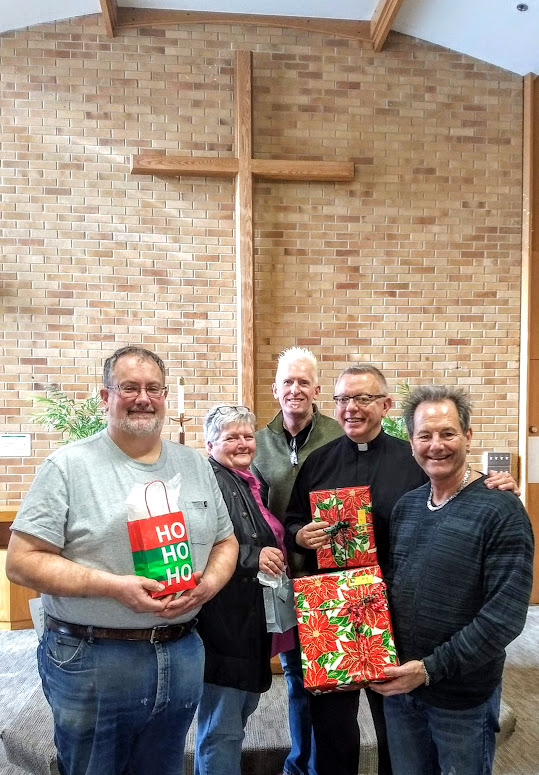
Many of the group participants struggle daily with isolation, depression and chemical dependency. Some mourn loved ones who have died. Others have been rejected by their families because of their HIV status and sexual orientation. They come to the monthly meetings for the support and compassion that they cannot find anywhere else.Christmas Gift group from St. Mark's in Minnkota

This year, St. Mark’s Lutheran Church received a Domestic Hunger Grant from ELCA World Hunger to provide grocery gift cards for Minnkota group members. Many of the group members lack the resources needed to cover the cost of rent, food, utilities, and medical expenses. For them, the assistance makes a tangible difference.

At their monthly meetings, I try to offer a sympathetic ear and a personal connection to St. Mark’s community. This Christmas season, congregation members are providing gifts to individuals in the group. When I asked our congregation for help, their response was immediate.

December 1, 2018, marks the thirtieth year of observing World AIDS Day, a day to remember those who have lost their lives, celebrate the progress that has been made in addressing HIV and AIDS, and to re-commit ourselves to the work that still needs to be done to reduce the prevalence of HIV and AIDS and accompany our neighbors who are living with HIV and AIDS. The people of St. Mark’s and the participants and volunteers in the Minnkota Health Project, work together to find light in the midst of the darkest nights. Their faces reflect the light of God that shines in the darkness. And the darkness has not overcome it.

Worship

Consider including pieces from the World AIDS Day worship resource in your liturgy on Sunday, December 2. You can find the ELCA World AIDS Day worship resource, bulletin inserts and more at ELCA. org/HIV.

Advocate

You can advocate for policies and programs that support prevention, testing, treatment and other important services for people living with HIV. Take action today to advocate for programs that support global health, including PEPFAR and the Global Fund.

Give

Through your gifts, ELCA World Hunger provides crucial support to ministries like St. Mark’s grocery gift card program for Minnkota members. You can support this important work by making a gift for HIV and AIDS ministries through ELCA World Hunger.