Skip to content
ELCA Blogs

ELCA World Hunger

Advent Study Series, Session 1: Just Food


Session 1

Alppha Banda, Irene Banda, Kristina Stephano, Dorothy Ngamira and Martha Kamphata all have children attending the Chibothel Lutheran Nursery School, operated by the Evangelical Lutheran Church in Malawi. This school has 42 students and, with support from ELCA World Hunger, is the base for a feeding center for children.

Every school day, Alppha, Kristina, Dorothy, Irene and Martha show up as volunteers to cook for nearly 70 children aged 6 months to 5 years who travel to Chibothel from the surrounding 10 villages. Pooling resources, the women prepare food that has been donated, cup by cup, from the families of the children.

Whether it’s daily meals of sustenance or occasional feasts of celebration, there is something special, something intrinsically communal about preparing a meal. In the 1987 film “Babette’s Feast,” the title character is a French refugee as a live-in maid and cook for two sisters. Dutifully, she prepares their austere, simple meals day-in and day-out, until one day, Babette learns she has won a lottery, making her a wealthy woman. In celebration of her newfound fortune and in thanks to her two hostesses, she prepares an elaborate meal featuring the complex and sophisticated dishes of her native French cuisine. The meal itself is almost comical, as the modest diners nervously try turtle soup, quail and caviar.

The meal is the climax of the film, but the story is as much about the preparation as the eating. Gathering the ingredients requires substantial planning and expense, including arranging for shipments of meats and cheeses from Paris. Babette has labored in the sisters’ kitchen for months, but the work she puts into preparing the feast is different. It is a performance of art, a labor of love and a pouring out of herself. Each dish reflects an aspect of the life she left behind and an element of her history that she will share with the dinner guests.

To prepare a meal is to conjure elements of our own selves and our history of family recipes and cultural tastes and to share these in the creation of something new — a new table, a new experience for guests. It is to invite them into our past, to experience our memories of family dinners from years gone by, and into our present, to see part of who we are. Sharing a meal is sharing a piece of our stories as a gift to others.

For the fictional character Babette, the meal is an invitation into her past and an expression of love and welcome to the other characters in the film. For the women of Chibothel Lutheran Nursery School, the pooling of ingredients from across the community and the careful preparation of the students’ repast is a witness to the love for and support of the students. As Dorothy describes it, “Each and every child here is everyone’s child through the bond of love.”

For many of us, Babette’s feast is a luxury we cannot afford. Juggling unpredictable work schedules and limited finances often means family dinners are more functional than formal. Without access to the food we want, we must use what we have — or what we are given. Meals eaten in the many households facing food insecurity may  meet caloric needs, but they often leave other needs unfulfilled — the need for self-expression through cooking, the need to share and to share in our own history, and the need to pass on our traditions.

The privilege of making meaningful choices about our food is one way hunger affects more than just nutrition. Without adequate access to food, we lose a key avenue for sharing part of our history and our story. On the other hand, by supporting ministries to end hunger with an eye toward the importance of food as a symbol of our history and community, we can create opportunities for real feasting.

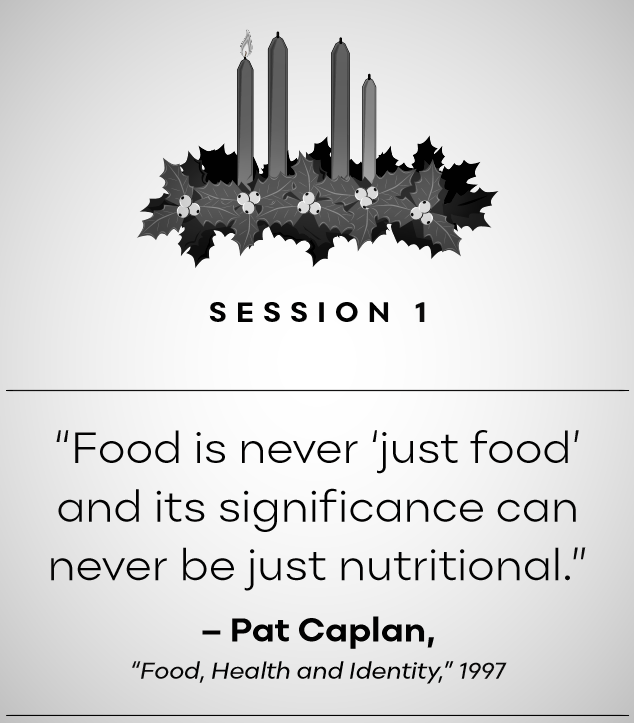
The women at Chibothel Lutheran Nursery School know this. Their morning routine meets the nutritional needs of the children, but as anthropologist Pat Caplan points out, “food is never ‘just food.'” The meals at the nursery school are a symbol of the care, love and concern of the community for its youngest members. The promise of God for the day when we will all feast together at the banquet is more than a promise of adequate nutrition. It is a promise of a time when God will reconcile our stories, our histories and our communities together.

As we anticipate the coming of the Christ-child this season, with all the opportunities it carries for preparing food together, we look forward to this day, preparing family recipes, mixing familiar ingredients, and plating dishes for a meal whose “significance can never just be nutritional.”

Questions for reflection:

  • What types of food or meals bring up special memories for you? How do they reflect part of your “story”?
  • What other needs — besides nutrition — can meals shared with others help fulfill?
  • How can ministries responding to hunger address needs beyond physical hunger?

Prayer

Gracious God,

in your loving care, you bring forth good things from the earth to sustain and nourish your people. We give you thanks for these gifts and for the community that you gather to feast together this season. Open our hearts to our neighbors facing hunger that we may with love remember both those at the table and those absent from it. Preserve us and accompany us this Advent season as we await with eager anticipation the salvation of the world.

In your name,

Amen.

Learn

To download this entire study, or to see some of our other congregational resources, please visit www.elca.org/Resources/ELCA-World-Hunger.

Give

Gifts to ELCA World Hunger are acts of love towards our neighbors living with hunger and poverty both here and around the world. Together, we are creatively and courageously working toward a just world where all are fed.

Give now

Connect

Sign up here and receive news, information and the latest resources from ELCA World Hunger.

Hunger and Poverty by the Numbers – 2018


With so much information out there, it can be difficult to know the most accurate statistics for measuring hunger and poverty. But knowing the data about what is happening can go a long way to helping us talk about the issues accurately and craft effective, forward-looking responses. For those who share with their congregation information about hunger and poverty, these numbers can also be helpful in putting together presentations or workshops.

Below, we have compiled the data from the most reliable sources we have for official numbers on poverty and hunger in the United States and around the world. You can download the slides to put directly into a presentation or use the numbers in your communications and work. You can also download the entire Power Point presentation at the link at the end.

ELCA World Hunger relies on several sources for data:

*One important note before we get started is that data are always for previous years. Below, we’ve indicated what years are being measured by the data. These are the most up-to-date statistics available from the sources. All statistics, graphs and charts come from the respective sources listed above.

U.S. Poverty

We’ll start off with data about the United States. Here are the thresholds used to measure poverty in 2017:

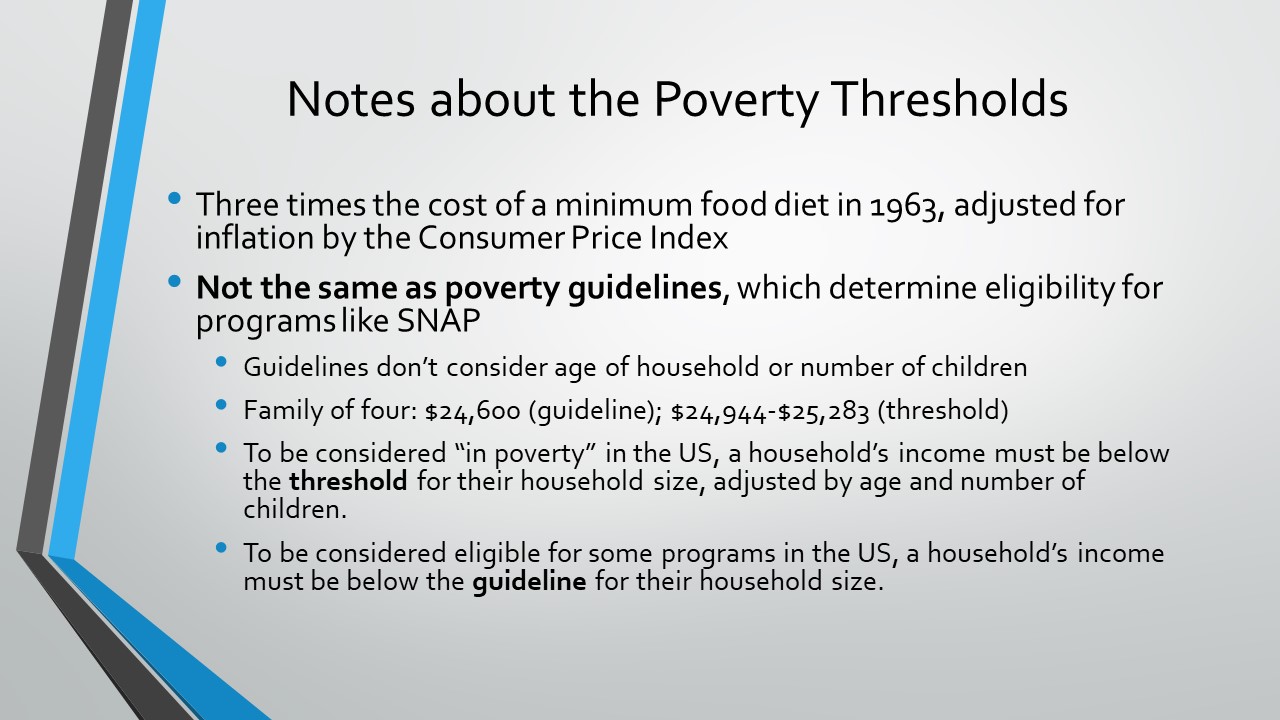
The poverty thresholds are reported here as averages for households by number of people. The Census Bureau takes into account the age of householders and the number of children to determine the threshold. So, for example, for a household of four, the average poverty threshold is $25,094. The range, though, is $24,944-$25,283, depending on the characteristics of the household. You can see another example in the slide under the household of a single person.

Another important point here is that the poverty thresholds differ from the poverty guidelines.

The guidelines are used to determine eligibility for certain government programs, like the Supplemental Nutrition Assistance Program (SNAP; formerly food stamps). The guidelines don’t vary based on age or number of children. The thresholds are used to measure poverty. The thresholds are based on three times the cost of a minimum food diet in 1963, adjusted for inflation.

To be considered “in poverty” in the US, a household’s income must be below the threshold.

To be considered eligible for some government assistance programs, a household’s income must be below (or below a certain multiple) of the poverty guideline.

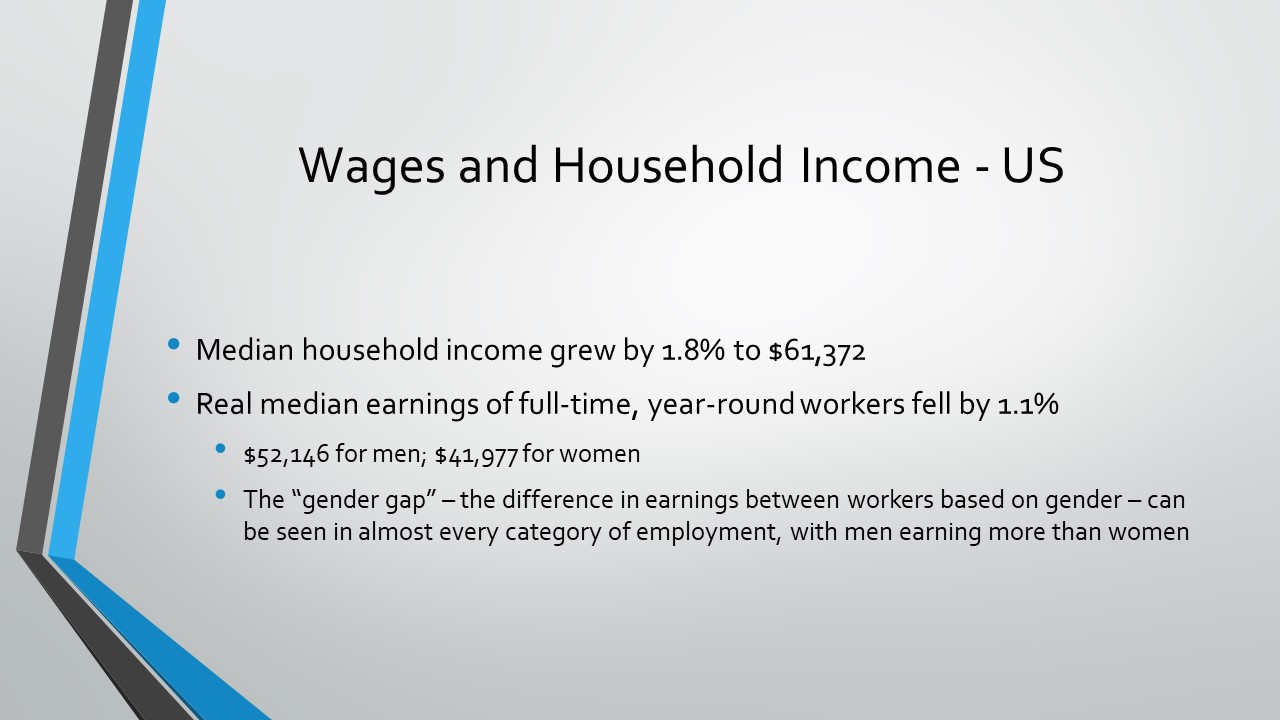
The economy in the US has been growing in terms of employment and median income, but the data seem to point to some contradictions in this growth. Median household income has grown from 2016 to 2017, but real median earnings (wages) have declined. What explains the difference? It would seem that either people are working more hours or more people in the household are working. Both would make the household income increase while wages are decreasing.

Source: US Census Bureau

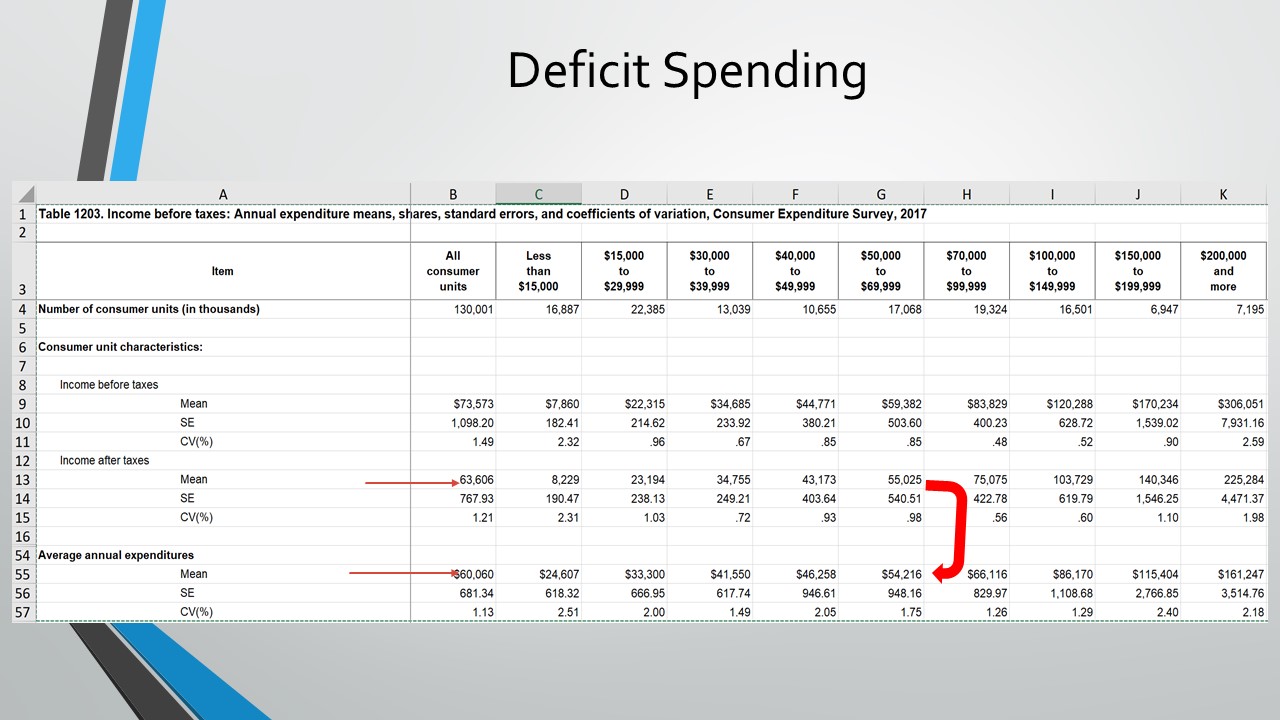
One of the other worrisome trends is that there appears to be a good number of folks spending more money than they are making. The table above shows income before taxes, income after taxes and average annual expenditures. The red arrows indicate the comparison between income after taxes and expenditures for all households. It appears that for all income groups making less than $50,000 after taxes, their expenditures exceed their income. It isn’t until we reach the big red arrow (under the group making between $50,000 and $69,999) that the income starts to exceed expenditures.

It could be that people are misreporting their income, leaving off sources of income like government assistance. Or, it could be that people are drawing on more credit. But either way, it would appear that a great many Americans are unable to sustain their expenditures on their own income.

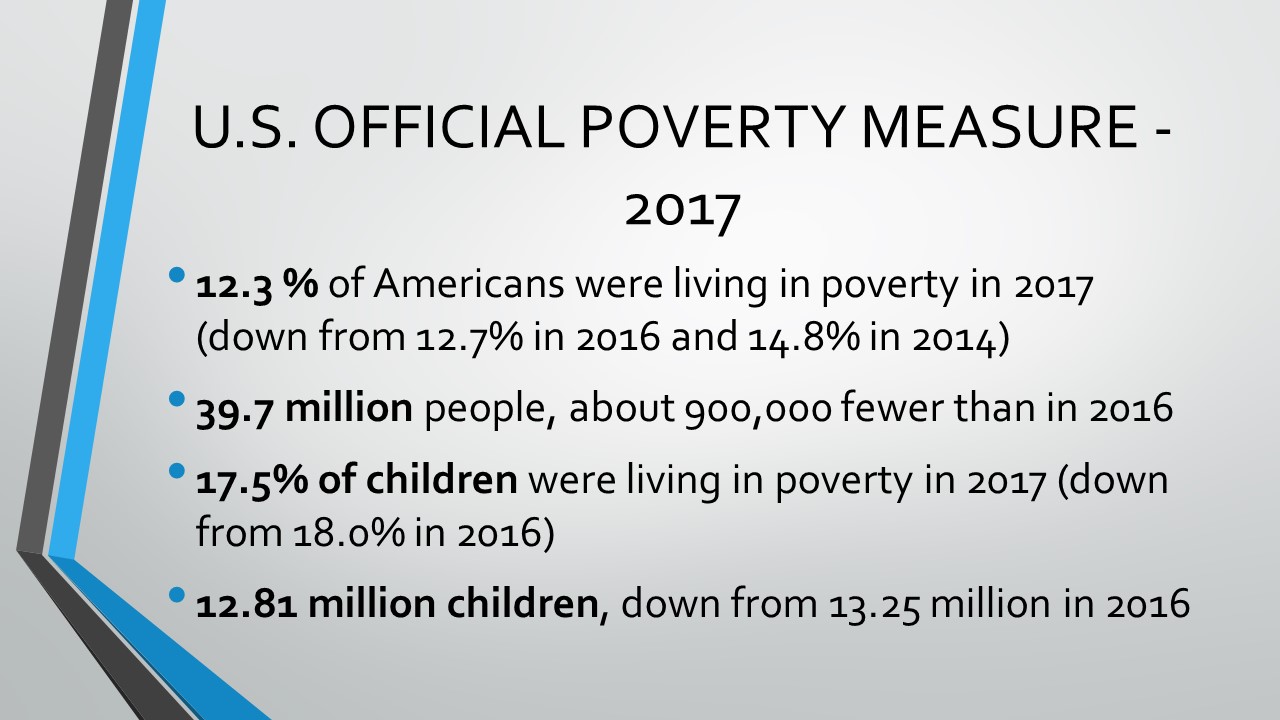
Here are the official numbers of people in the US with incomes below the poverty threshold:

We see a slight decrease nationally, though the number is still really high – about 39.7 million people living in poverty in 2017.

When we look at the education level of people in poverty, interestingly, the only group that saw an increase was people with at least a bachelor’s degree, though they still have the lowest rate of all people based on educational level.

U.S. Food Insecurity

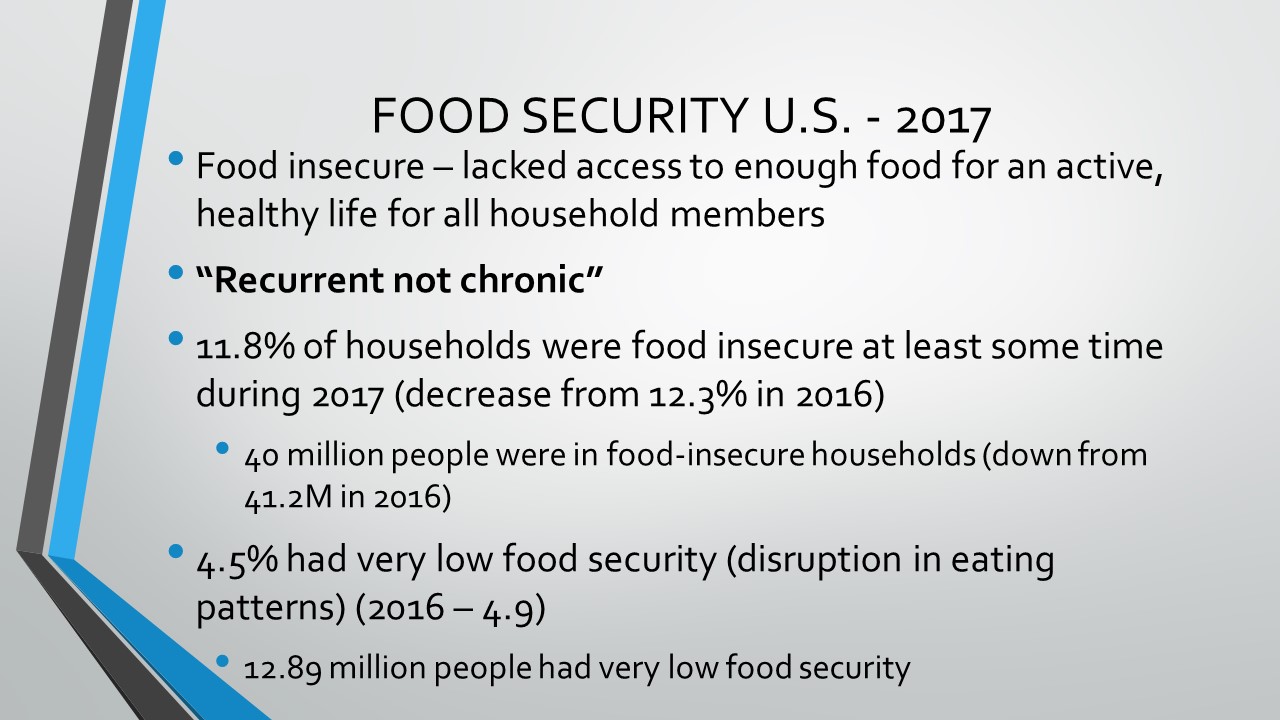
Turning to food security in the United States, we can see a slight decrease from 2016 to 2017. The USDA uses the term “food insecurity” instead of “hunger” to capture more accurately the situation for most people in the US. Food insecurity means that at some point during the year, a household lacked access to enough food for an active, healthy life for all household members. Chronic hunger, the kind we’ll get to when we turn to global hunger, is relatively rare in the US. The phrase the USDA uses is “recurrent not chronic,” which means that households experience periods of food insecurity throughout the year, but this is usually not persistent day-to-day. For many, periods of food insecurity come at the end of the month (when benefits run out) or during seasons when work is harder to come by.

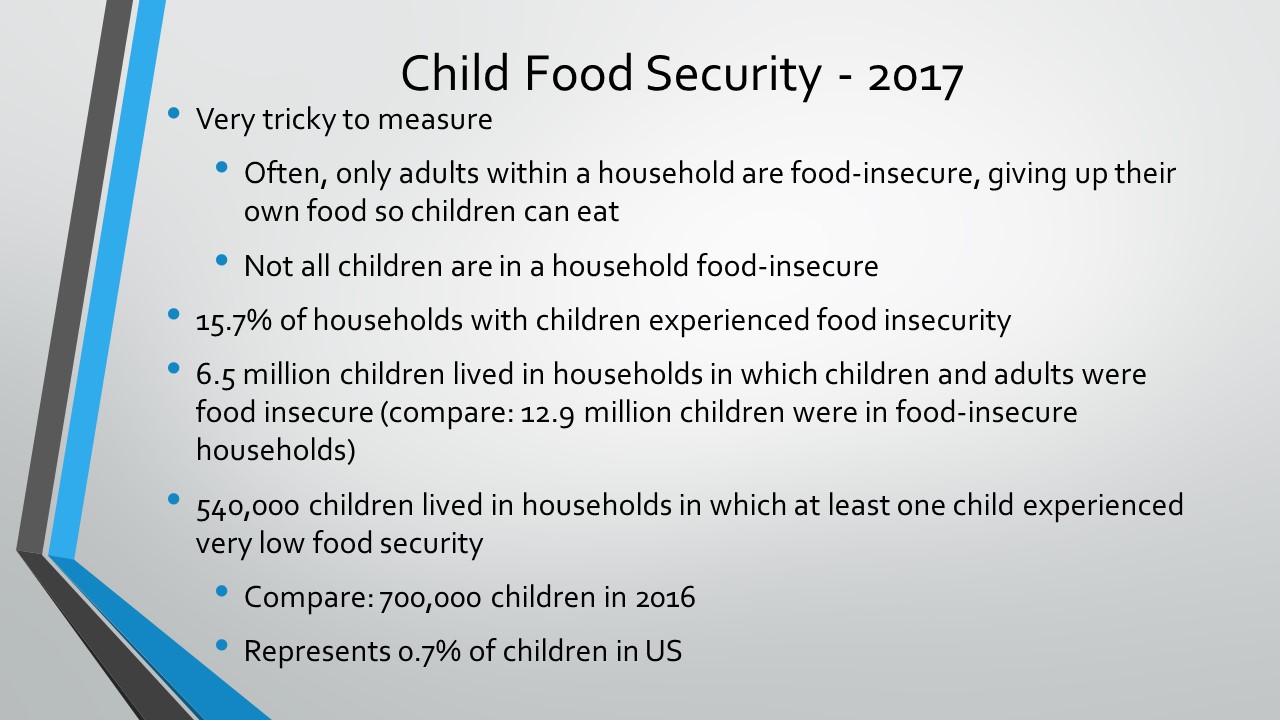
Child food insecurity in the US is really hard to measure for a couple reasons. First, children, especially young children, are usually the last people in a household to experience food insecurity. Often, adults or older children will give up their food to ensure the younger ones have enough to eat. There are also some programs specifically geared toward school-age children that can help, like the National School Breakfast and Lunch Programs. Because of the difficulty in measuring child food insecurity, the notes on the slide are carefully phrased. We can say how many children lived in households where children and adults faced food insecurity, though the data from the USDA don’t allow us to say for sure that every child in that household was food insecure.

Global Poverty

Source: World Bank

Source: World Bank

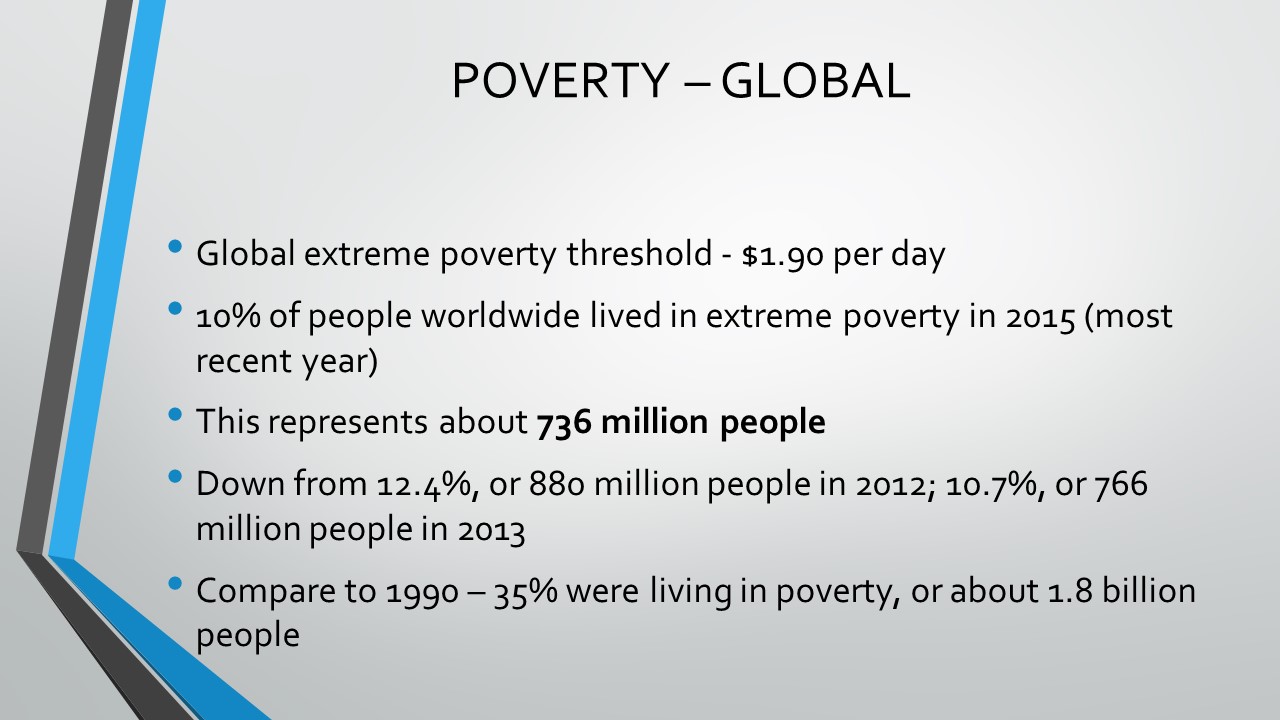
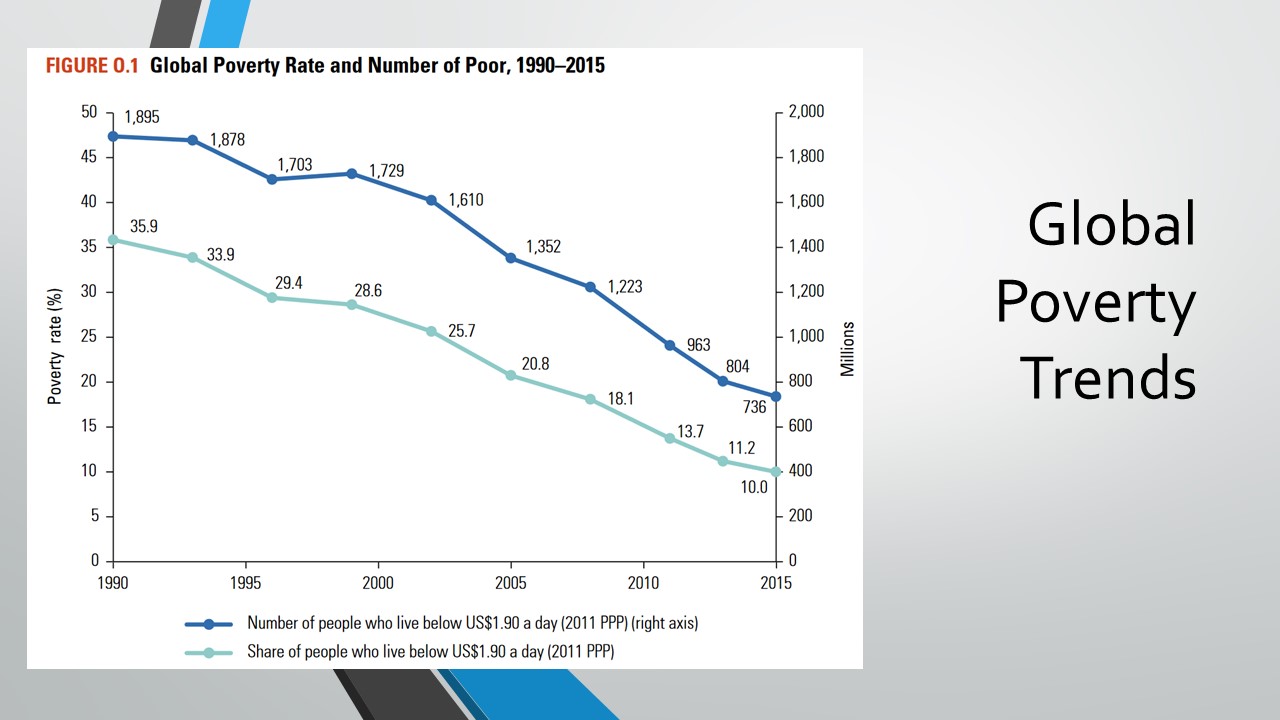
Global extreme poverty is defined as income below $1.90 per day. The numbers point to some tremendous progress since 1990, when about 35 percent of people worldwide were experiencing extreme poverty. The biggest contributor to this decline, according to the World Bank, has been economic growth, particularly in Asia. On the last slide above, you can see the poverty rate by region of the world shifting pretty drastically. In East Asia and the Pacific, the rate of poverty has gone from 60 percent in 1990 to less than 3 percent in 2015 (the most recent year.)

This has led the World Bank to conclude that “extreme poverty is increasingly becoming a Sub-Saharan African problem,” since  Sub-Saharan Africa has the highest rates of extreme poverty and is the only region where poverty seems to be increasing.

This does tend to miss another trend in global poverty, though. Fewer and fewer people are living today in what might be called “low-income” countries. What this means is that there needs to be more of an emphasis on poverty within middle- and high-income countries. It also means that governments and organizations can no longer focus solely on “poor countries.” For the World Bank, this shift has signaled the need to measure poverty from a higher line, since participation in a labor market in a middle-income or high-income is more expensive than in a low-income country.

As an example, to get a job in a low-income country, a worker might only need food and clothing. In order to get a job in a middle-income or high-income country, however, the same worker might need internet access, a cell phone or transportation. For this reason, the World Bank has also started measuring poverty at $3.20 per day and $5.50 per day. At these lines, the global poverty rate jumps to 26.3 percent (at $3.20) and 46.0 percent (at $5.50 per day.) An important note: these lines have not replaced the $1.90 per day threshold by which global poverty is still currently measured.

Global Food Security

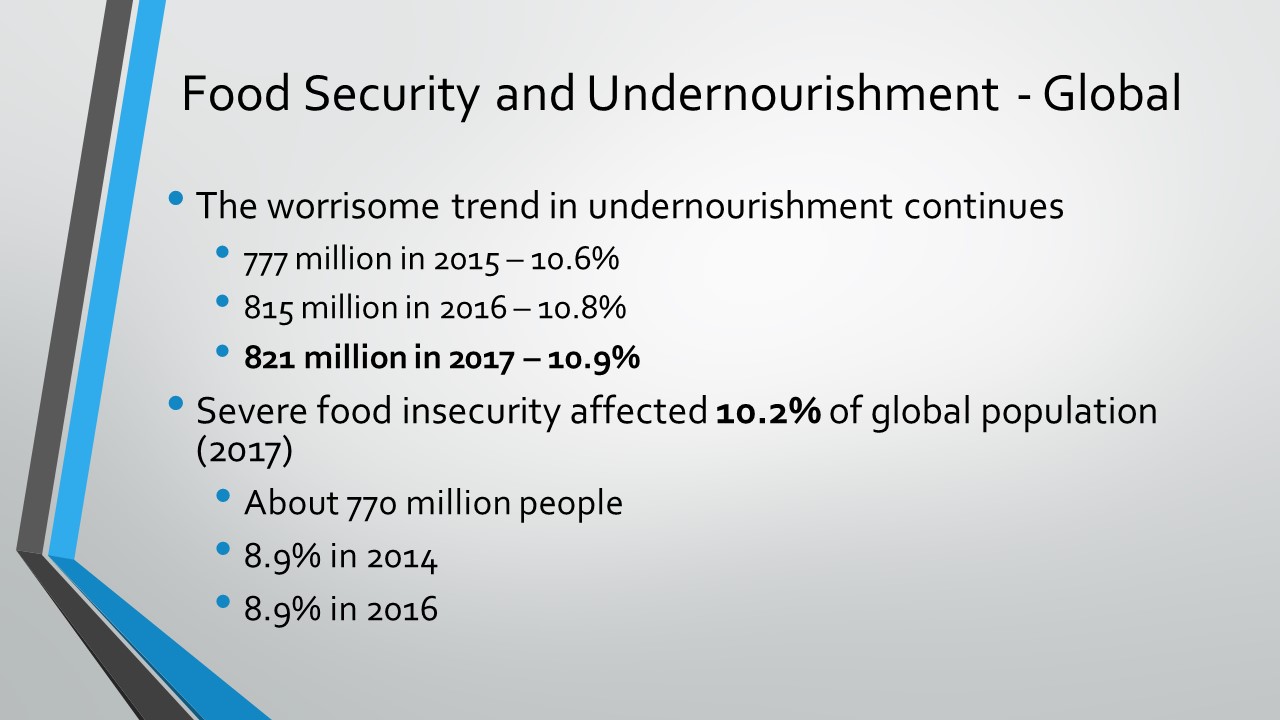
Global undernourishment is where we see some very concerning trends. After years of decline, we have seen a rise in global hunger over the last couple years, as the data show. The growth is slight – about 0.1 percent between 2016 and 2017 – it’s still a big shift after so much progress. There has been a much greater increase in severe hunger over the same time, from 8.9 percent in 2016 to 10.2 percent in 2017.

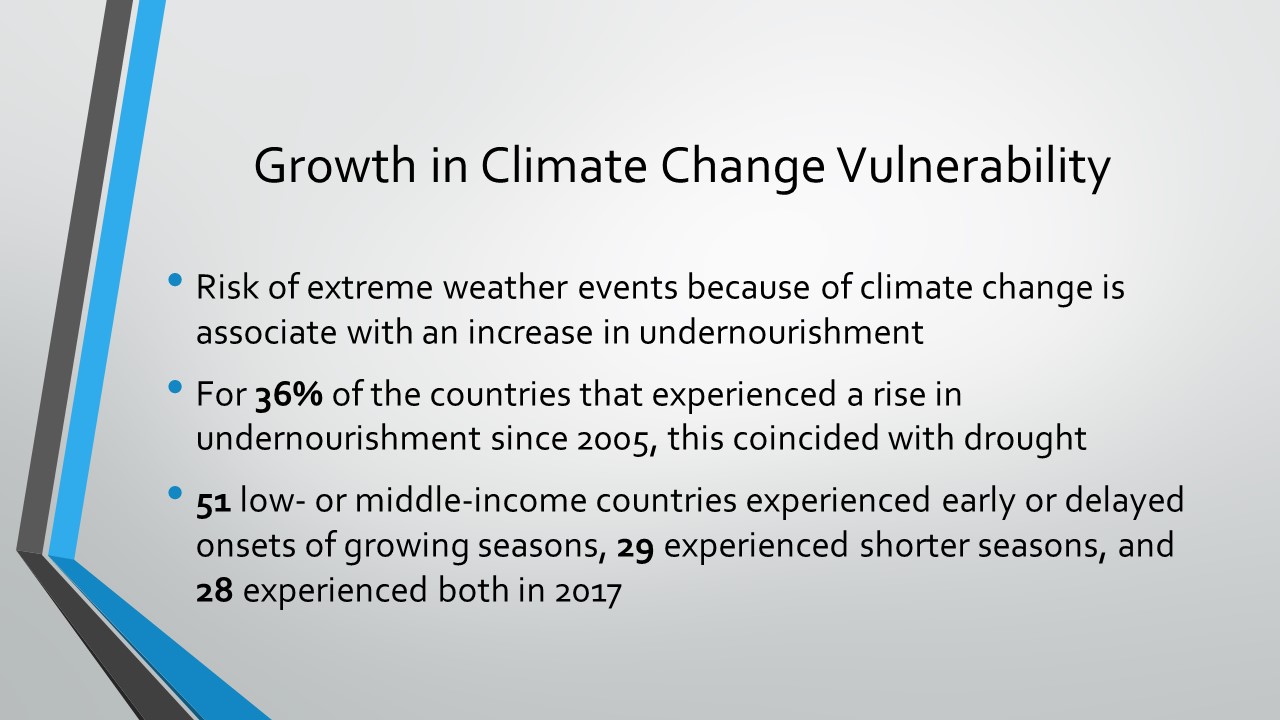
One of the biggest drivers of this, according to the Food and Agriculture Organization of the UN (FAO) is climate change.

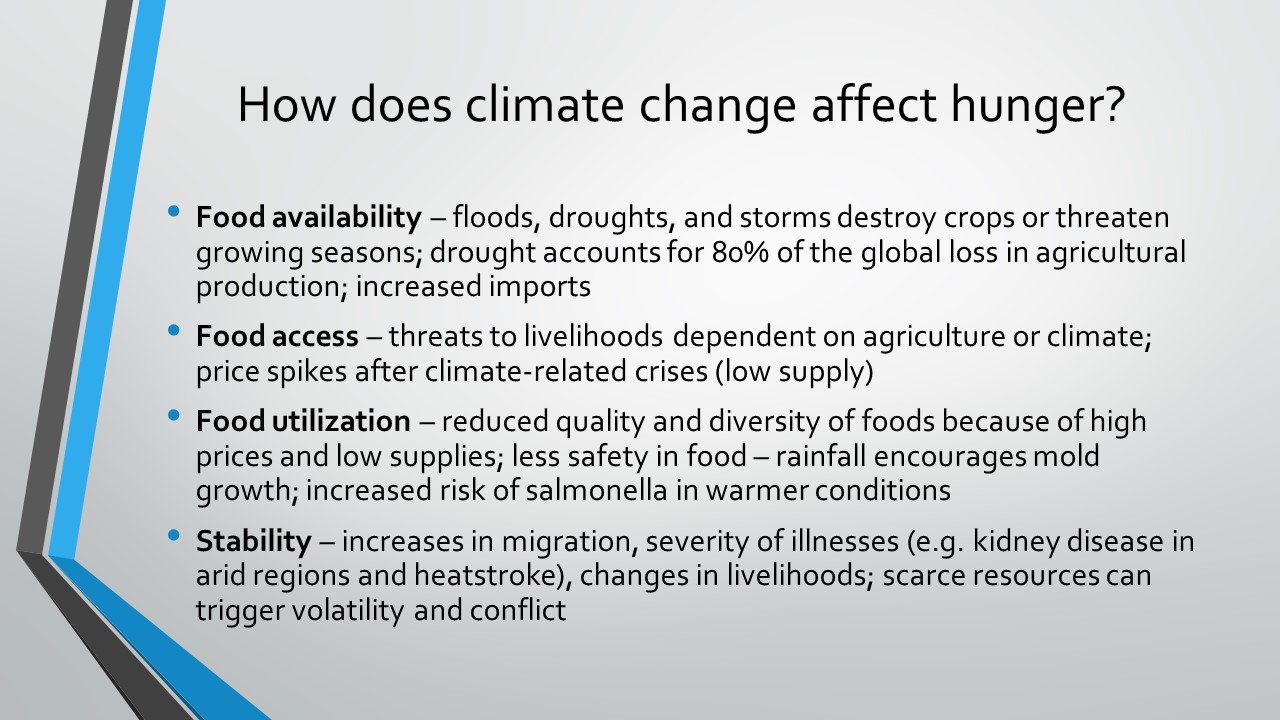
Climate change impacts hunger in several ways. The FAO discusses four of these. Climate change decreases:

  • Food availability – When droughts and floods destroy crops, there is less food to harvest;
  • Food access – When agricultural workers lose their jobs because of climactic changes, they cannot afford the little food that is available in the market;
  • Food utilization – When supplies become low (see food availability), costs go up at the same time incomes of farmers are going down. Moreover, with floods and warmer weather, the conditions are ripe for increased growth of mold and bacteria;
  • Stability – The health and welfare of people is deeply affected by the climate. A lack of water due to drought can exacerbate kidney problems and increase the risk of heatstroke. With a limited variety of foods available, the nutritional needs of children and adults may not be met. And when resources are scarce, people may feel the need to migrate to other areas (making them vulnerable to hunger) or conflict can erupt between communities competing for the same resources (again, making hunger more likely.)

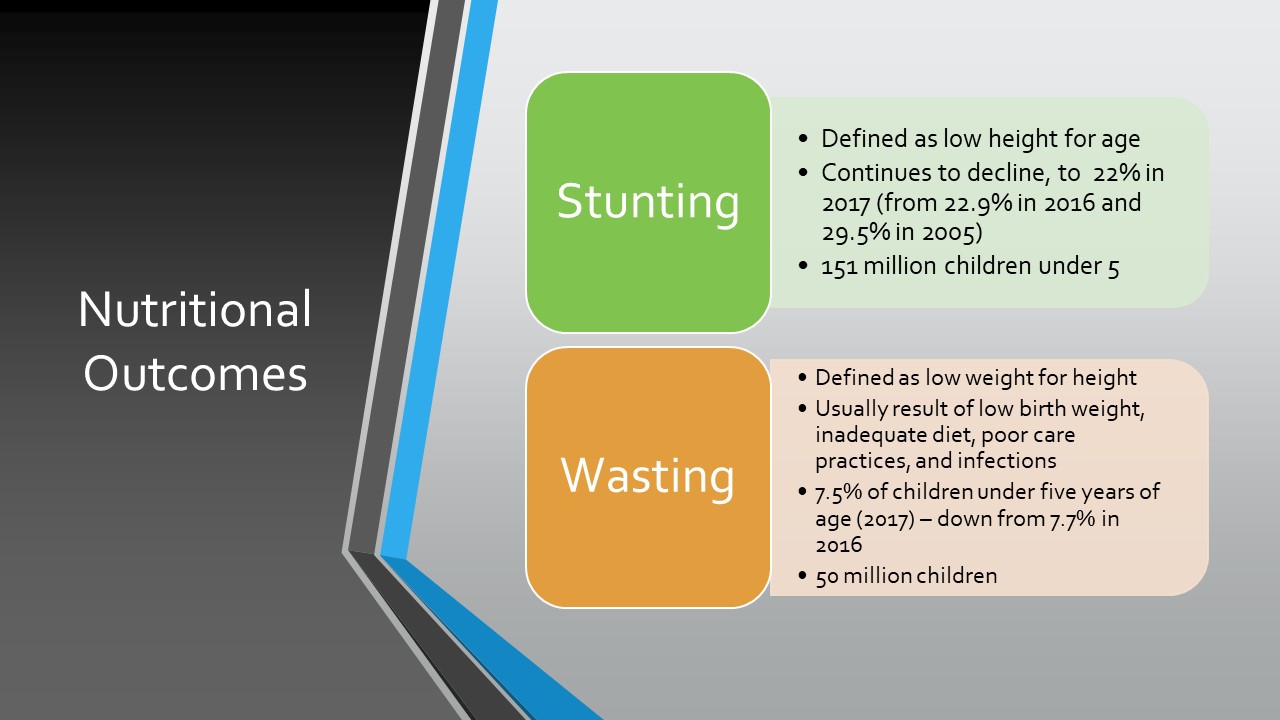
Finally, the FAO last year started measuring nutritional outcomes of wasting and stunting, which are defined on the slide. Stunting is more closely linked to long-term undernourishment, while wasting is more closely linked to immediate spikes in undernourishment, so they are a bit different. Both are serious outcomes, though, and can indicate immediate and future needs for children who are undernourished.

Together, the statistics point to some good news, like the continued decrease in poverty both worldwide and in the US, and some challenging news, like the rise in global hunger and the millions of children still affected by stunting or wasting. But the main message to take away from this is that great progress can and has been made over the years against poverty and hunger. Now, there is a need to re-focus energies and attention to continue this progress and, especially, to prevent the rise in global hunger from continuing.

Follow this link to download the full PowerPoint presentation.

Thank you for all that we do together to respond to poverty and hunger in our world!

If you have any questions about the data presented here, please contact Ryan Cumming, program director for hunger education with ELCA World Hunger, at Ryan.Cumming@ELCA.org.

The Hunger Catechisms – A New Resource for Justice and Faith Formation


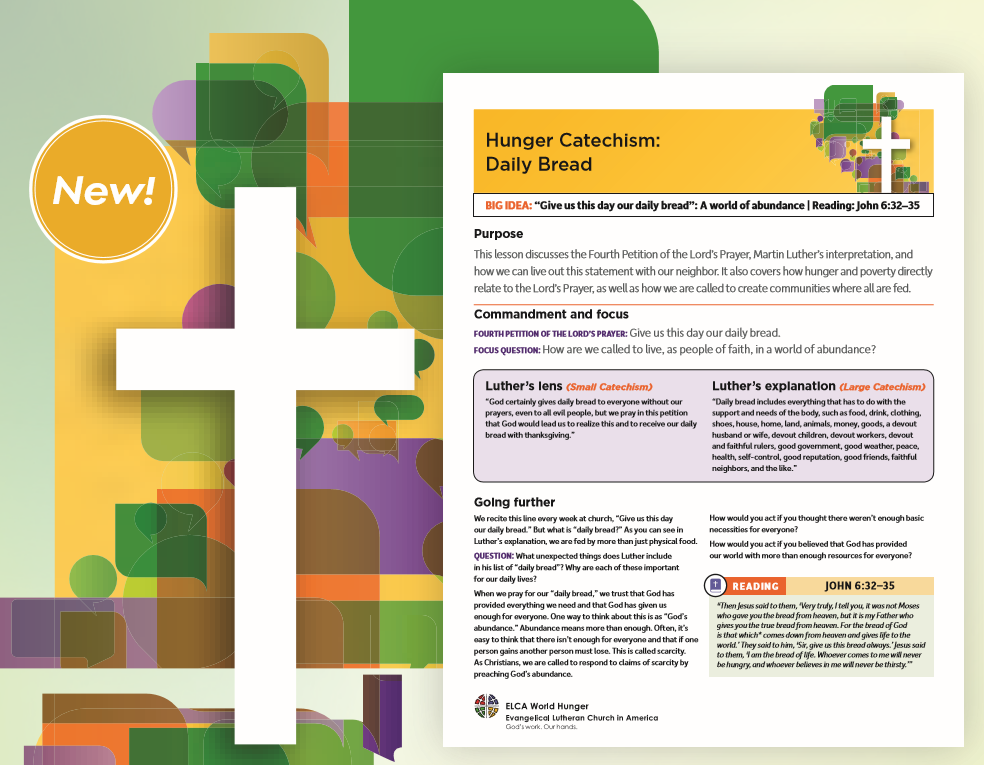
With the 501st anniversary of the Reformation calling us out into the world, ELCA World Hunger is excited to announce the completion of our confirmation lesson series, “Hunger Catechisms.”

The Hunger Catechisms are intended to encourage understanding of the Small and Large Catechisms as they relate to our faith, our personal life and our public life for confirmation, high school youth groups and mentoring programs.

Each lesson begins with Martin Luther’s interpretations in both the Small and Large Catechisms and discusses their spiritual implications and social applications. At the end of each lesson is an example of how the ELCA is working alongside neighbors within the U.S. and around the world through the ministry of ELCA World Hunger.

Hunger Catechism: Daily Bread

Each lesson focuses on a variety of topics related to our call to justice:


The ELCA defines confirmation as, “…a pastoral and educational ministry of the church that helps the baptized through Word and Sacrament to identify more deeply with the Christian community and participate more fully in it mission.”

It is our hope that these lessons encourage your ministry to dive deeper in your faith conversations and inspire the youth of your community to participate more fully in our shared mission of working towards a just world where all are fed.

Suggested uses

Although you know your ministry best, here are some ways that other folks have used this resource:

  • Youth group discussion guide
  • Leader’s script (turn the main points and facts into slides)
  • Supplemental curriculum during Catechism instruction
  • Youth Advent or Lenten study
  • Adult forums
  • Mentor conversations

Please contact us at hunger@elca.org and tell us how you used these lessons in your ministry!

Learn

If you’d like to learn more about other resources that ELCA World Hunger offers to congregations,  please visit www.elca.org/Resources/ELCA-World-Hunger.

Give

Gifts to ELCA World Hunger are acts of love towards our neighbors living with hunger and poverty both here and around the world. Together, we are creatively and courageously working toward a just world where all are fed.

Give now

Connect

Sign up here and receive news, information and the latest resources from ELCA World Hunger.