Skip to content
ELCA Blogs

ELCA World Hunger

Top Ten Tips for Your Garden in the Spring

ELCA World Hunger is excited to welcome back Ed Merrell as a guest blogger. Ed previously wrote a series of Fall tips for your garden for the ELCA World Hunger blog.

Ed is an Independent Seeds Professional. He engages with seed-centric charity organizations and other agricultural groups. In this capacity, he applies his extensive seed industry skills and experience to provide relevant information and solutions.

His 35+ year career in the vegetable and flower seed industry included plant breeding to develop new and improved varieties, domestic and international seed production, quality assurance and seed testing, seed processing plant operation, and quality information systems. Ed is a member of Advent Lutheran Church (ELCA) in Morgan Hill, Calif. This post also appeared in the Spring 2017 issue of Seeds for the Parish.
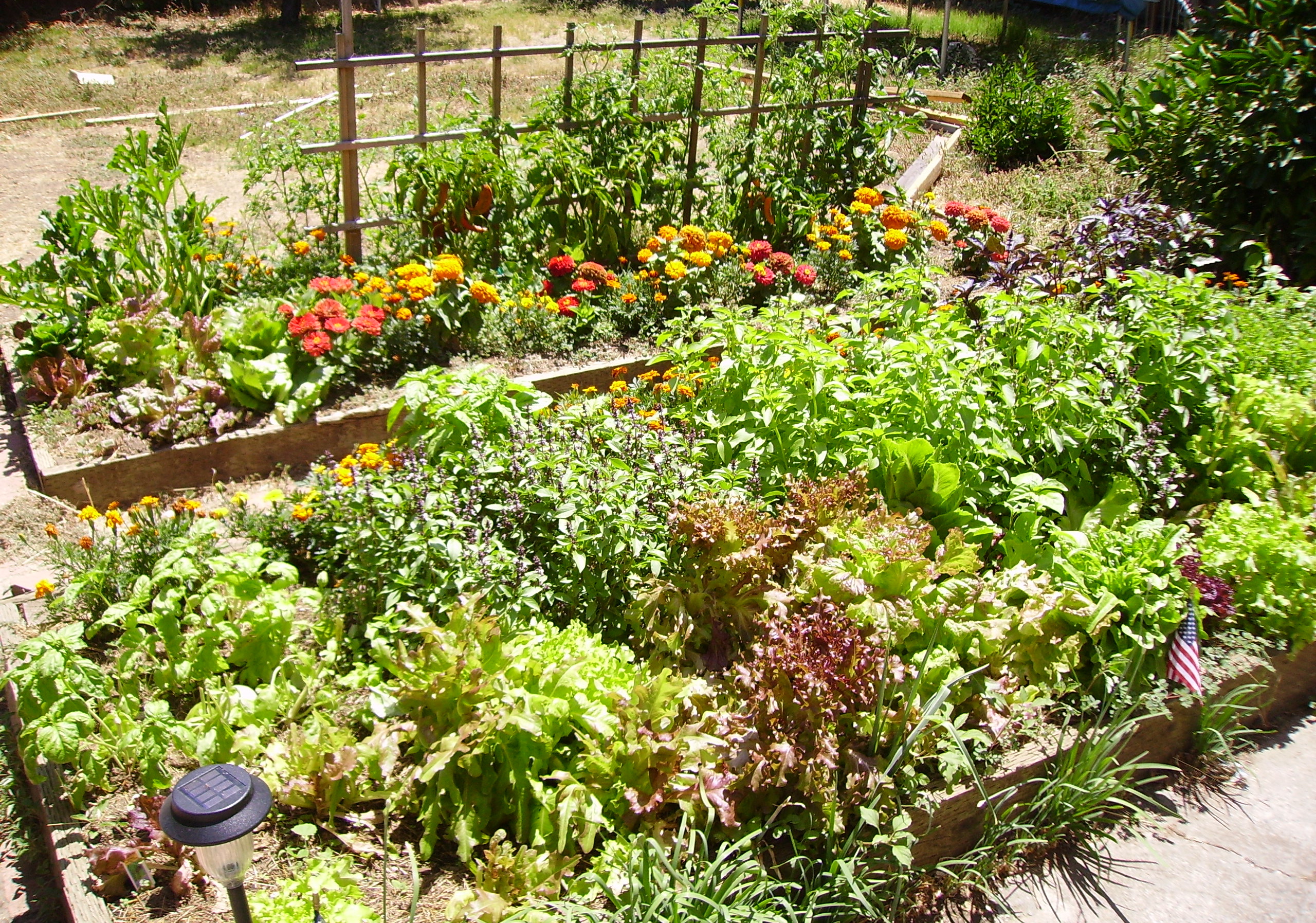
After a long winter of colder temperatures, gray skies, and hopefully sufficient rain and snow to replenish the earth, many of us are looking forward to longer days and our next gardening season! Here are some tips for a bountiful, healthy community garden:

  1. Start planning early.

When snow still covers the ground and spring seems so far away, it’s great time to plan your first or next community garden! Aim to be ready before your first sowing date. Visit ELCA.org/hunger/resources to download ELCA World Hunger’s “Community Gardens How-To Guide,” filled with tips from community gardeners across the ELCA. Click on the “Hunger Ed” tab to download or order the guide.

  1. Has your community garden vision changed?

Were you able to accomplish what was planned? By matching your communities’ needs with your resources, the gardeners and the community will be energized. Not too small a garden that may not keep everyone engaged, not too large a garden that may be frustrating, but just right!

  1. Get the word out!

Notify all your gardeners that the planting season is coming, and they can help prepare. Form a team to review last year’s garden, decide what to continue and what to change.  Last season’s planting map will help you rotate crops effectively. Maybe you want to build or repair raised beds, trellises, or compost bins. Another team can assess the garden’s fertility and add soil amendments and fertilizer as needed.

  1. Extend invitations

Recruit new gardeners and/or new partners for the coming season. More hands make lighter work, expand what the garden can produce, and grow enduring friendships.

  1. What new vegetables are you longing to try?

Seed companies introduce new varieties every year. Explore online, see what’s new or request a catalog to enjoy the photos and descriptions. Did you know that there are seed exchange libraries and seed swaps? A seed library is a place where community members can get seeds for free or for a nominal fee and is run for the public benefit. Seed swaps are events where gardeners meet to exchange seeds. Maybe there’s one in your area, and you can find just the variety you want.

  1. What to plant really early?

Use hot caps, row covers, or mulch to expand your planting window. These products hold heat from the sun and enable germination and growth to occur even when it is otherwise too cold to plant outside.

  1. Ask an expert

Remember to tap other resources. Local cooperative extension services and Master Gardeners can provide advice on soil fertility, plant varieties adapted to your area and pest control.  Garden supply stores may donate tools or supplies, if you ask them.

  1. Expand your planting ideas

What about flowers? They bring color to a garden and, when picked, they brighten homes and places of worship.

  1. Is your garden space committed for the long haul?

If your community garden space will be available for years to come, consider planting fruit trees and berry bushes. They do require space to grow, maintenance such as pruning, and it may be a few years until they bear fruit. However, once established, they will produce for many seasons.

  1. Is there a quiet place in your garden?

A comfortable bench set in a quiet spot in the garden can be a perfect place for meditation and prayer. Gardeners may rest from their labors and visit with others. Perhaps install a trellis with climbing plants for some shade.

For more information, get a copy of ELCA World Hunger’s Community Gardens How-To Guide.

Now that you have everything ready, it’s time to plant!
2017 ELCA World Hunger Education and Networking Grants Are Available!


ELCA World Hunger Education and Networking Grants are designed to support local projects and programs in ELCA congregations, groups and/or synods. The grant opportunity encourages ELCA congregations, groups and/or synods to think creatively about educating, mobilizing, and expanding their networks to increase awareness of and engagement with the root causes of and solutions to hunger.

Education grants can be used for events, educational programs or the development of shareable resources. For networking proposals, congregation-based and synod-wide hunger leadership events and trainings will be prioritized.

Proposals must be submitted by a non-profit charitable organization classified as a 501(c)(3) public charity by the Internal Revenue Service, or organization that operates under the fiscal sponsorship of a 501(c)(3).

Submit your proposal electronically as a pdf to hunger@ELCA.org.  Or, you can mail your proposal to:
ELCA World Hunger
Attn: Ryan Cumming
8765 W. Higgins Rd.
Chicago, IL 60631-4101

PROPOSAL SECTIONS AND FORMAT – All proposals must include the following items.

1. Background and Context

a brief (2-3 paragraphs) description of your congregation, group or organization and a narrative of the context in which the project, event or initiative will take place. This should clearly show what your program, congregation or group is attempting to address and how the proposal relates to the current priorities of ELCA World Hunger Education and Networking.


2. Project Summary

a description of how the project, event or initiative will:

  • Educate and engage ELCA congregations, groups, and/or synods;
  • Influence this church body toward better action and engagement against hunger and poverty; and
  • Encourage sustainable participation in the anti-hunger work of ELCA World Hunger past the conclusion of the project, event or initiative.
  • Note: If your project involves service-learning, please include a detailed summary of your plans for preparing the participants and debriefing with the group after the event.


3. Project Goals, Objectives, Outcomes and Outputs

Goal – a brief statement that summarizes the direction and focus of the program and defines the scope: What are you hoping to accomplish? Who will be your audience? How many people will be affected?

Objectives –  statements that communicate your hopes for the program or project

  • What will participants learn by participating? (for educational proposals)
  • What actions will participants do together, begin or carry out in their congregations, synods or communities after the event or training? (for networking proposals)

Outcomes – How will you measure the success of your project? Please include one process objective (What activities will be completed in what specific time period?) and one impact outcome (What will change in the lives of participants or in your community because of this project?)

Output – Will your project create a story, resource, or learning that can be shared with the broader Church? If so, how will this be shared?


4. Project Plan and Timeline

a brief description of how the project will be implemented and funded with a projected timeline; if the project is ongoing, what is your plan for sustainable funding for the life of the project?


5. Budget

a clear statement of the amount of funding you are seeking using the format below:

Item Amount Explanation
Put the line item label here. Put the line item cost here. Describe how you came to that amount. You may also use this section to further explain why you need this cost covered, if you believe that is not clear from the proposal.


6. Contact Information

the organization’s name, address, contact person, email, phone number, and tax ID number


7. ELCA Letter of Support

All proposals must include a letter of support from an ELCA pastor, bishop, synod or churchwide organization staff person or Lutheran agency/institution that explains how a relationship between the organization and ELCA World Hunger impacts/enhances each other’s work and furthers the objectives and guidelines of ELCA World Hunger, especially in education and networking.

IMPORTANT INFORMATION

  • ELCA World Hunger Education and Networking Grants, in general, cannot be used to support international travel.
  • If your proposal involves direct service, you may want to consider ELCA World Hunger’s Domestic Hunger Grant program. In general, this is a more appropriate granting opportunity for direct service activities.
  • If your group is seeking a grant to support a service learning experience, please include a detailed summary of your plans for preparing the participants and debriefing with the group after the event.

Proposals will be reviewed throughout the year and typically take 2-4 weeks to process. All proposals must be received by December 31, 2017, to be considered for funding.

Submit your proposal electronically as a pdf to hunger@ELCA.org.  Or, you can mail your proposal to:
ELCA World Hunger
Attn: Ryan Cumming
8765 W. Higgins Rd.
Chicago, IL 60631-4101

If you have any questions please email hunger@ELCA.org.

“I Carry Her with Me”: A Reflection from the UN CSW


This post is in honor of Wynona J. Fields.

The ELCA Young Adult Cohort is a partnership of the ELCA Justice for Women program, the ELCA Strategy on HIV and Aids, the Young Adults in Global Mission Alumni, ELCA Young Adult ministry and ELCA World Hunger. These networks have identified a shared interest in young adult leadership development and faith formation within a social justice framework. In March 2017, members of the cohort participated at the United Nations 61st Commission on the Status of Women (UN CSW).

In preparing for the trip to the UN CSW, some thoughts would keep coming to mind: How will what is learned from this experience influence my work? How can I share this with my church and community? How can I share with the team I work with on a daily basis? In this extraordinary space, there are signs of God’s work all around us, and as I hear the stories, it will become more clear not just for me but also for all those in attendance what we will be led to do after this experience.

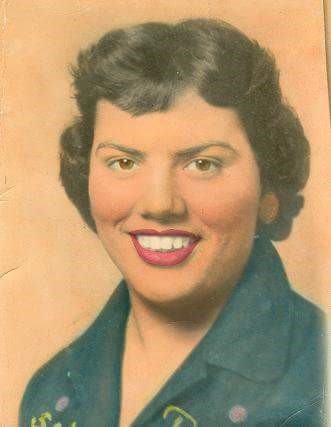
My maternal grandma’s face keeps popping up in my head when I hear the words “caregiver,” “care work,” “domestic” and “economic impact of women.” As my grandma aged and was looking at how she was going to support herself in her later years, she was told she did not work enough in her lifetime to receive any Social Security benefits. The amount of money that she received was dependent on her husband’s work and the fact that she was his caregiver. Her worth in dollars was tied to her marital status and caring for him; therefore, it was deemed that she could receive an income. I remember thinking, as a kid, how could they say she has not worked enough? My grandma was always busy, working and taking care of someone else’s needs. She raised seven kids and helped raise several grandchildren, myself included. The regular income she worked for in her lifetime was for cooking, cleaning and care-taking jobs for a local school, children’s home and local people. As kids, if we wanted extra money for special events, she was the first one to tell us we needed to work for it, and she would take us to pick strawberries, wild blackberries, wild onions and walnuts to sell. Many times my grandma did those same things for extra money for gas, food or personal care needs. Other times when she would need money, she would make pies. I would go door-to-door and sell the pies.

Looking back, I would give anything to have those times again, to be able to say, “Grandma, you have worked too hard, let me care for you, tell me what you need.” She was a strong, Cherokee woman. She was a fighter, and she had great faith. She had faith that her Lord and Savior would provide for her family. She had faith that she would be taken care of despite her struggles, and she had faith that these values would live on in her family.

Throughout my time here at UN CSW 61, I carry her with me; I carry her spirit and her dreams of independence. There are many stories like this and many more that have not been told.

Thank you to ELCA World Hunger, The Lutheran World Federation, and Ecumenical Women for advocating for women to be recognized for their work and contributions. I am honored to be here with such phenomenal women who use their gifts selflessly to make the world a better place for women and children.

Jennifer Kirby is a member of the ELCA Young Adult Cohort and Eben Ezer Lutheran Church in Oaks, Oklahoma. This post originally appeared on the ELCA Young Adult Cohort’s blog at https://elcayacohort.wordpress.com/.


International Women’s Day – March 8

Often on days like this, I am moved in remembrance of stories. Perhaps this day invokes memories of women whom you have loved and who have loved us. Perhaps you remember the fierce women from the sacred texts — my personal favorite: the Daughters of Zelophehad (Numbers 27). Maybe you reflect on women who have led their communities and world and need no introduction, from girls like Malala Yousafzai to women like Nobel Peace Prize Laureate and ELCA International Leaders scholar Leymah Gbowee to those who names have been hidden like Mary Jackson, Katherine Johnson and Dorothy Vaughan, most recently illuminated in the major film “Hidden Figures.”

The global agenda for women is driven by a seminal meeting of the United Nations “Fourth World Conference on Women” in 1995 in Beijing. It was at this meeting that Former Secretary of State – and then-First Lady – Hillary Clinton brought to prominence the phrase “Women’s rights are human rights; and human rights are women’s rights.”


Each year, the United Nations Economic and Social Council (ECOSOC) convenes the “Commission on the Status of Women” (CSW), the principal global intergovernmental body exclusively dedicated to the promotion of gender equality and the empowerment of women. This year marks the 61st year since the United Nations First World Conference on Women (Mexico City), and the theme for CSW this year is “Women’s Economic Empowerment in the Changing World of Work,” a critical theme for those of us dedicated to a just world where all are fed.


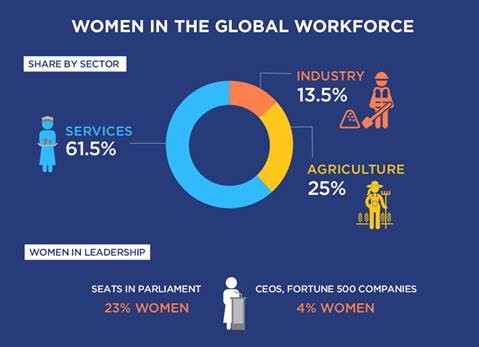
Take this quick quiz to see how much you know about women in the global economy!

UN Women


ELCA World Hunger is a founding member of the ELCA Young Adult Cohort, a group of young adults engaging at the intersection between faith + justice. One of the signature leadership experiences of this Cohort is at the UN CSW, and beginning next week, this group will again join hands, stories and voices together to learn, convene and strive toward a just world where are all are fed and all might flourish. You can follow along with the larger movement through Ecumenical Women online and on social media by following @ELCAWorld Hunger (Twitter and Instagram) and on Twitter, Instagram and Facebook, with the #ELCAYACohort hashtag.


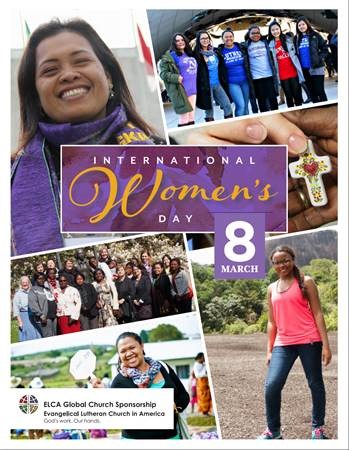
ELCA Global Church Sponsorship and ELCA Global Mission leaders often also join the Lutheran delegation at UN CSW and have produced some great materials for ELCA congregations and friends to use on this day. This International Women’s Day booklet is a great place to start, full to the brim of excellent ideas to learn, share and support this ministry.


But perhaps my favorite parts are the smiling faces that greet us on the front cover and throughout the materials. These are the women whose stories we know and can journey alongside as they build stronger communities and a more just world.


I could write about many of them by name and you can learn more about the ELCA International Leaders program and meet some of them in this video. But today, I leave you with an example of how our work together as a church is interconnected, or as Presiding Bishop Elizabeth Eaton says, “We are church together!”

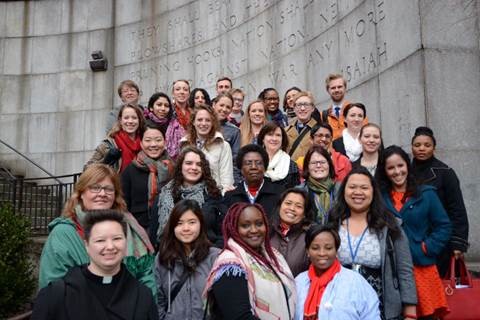
On the top left corner of this booklet cover is a woman named Julinda. Julinda is the executive director of the Women’s Crisis Center, a ministry of the GKPS church in North Sumatra, Indonesia. I have written more about her ELCA World Hunger supported work and ministry here. Julinda has advocated at the UN CSW (pictured below), is also an international women leader and has participated in one of the signature leadership events, a series of seminars hosted in Wittenberg Germany, birthplace of the Reformation, for women from the Global South to come together for conversation and ongoing reformation.

In this 500th anniversary year of the Reformation, let us:

From stories of Leymah and Julinda to those who will advocate and educate at next week’s UN CSW, we are church together. Join us. (Have a “her-story” to share? Check out Lutheran World Federation’s “Women on the Move” her-stories project.)

2016 UN CSW Delegation, Julinda pictured second row, second from the right.

Mikka McCracken is the Director of Planning and Engagement for ELCA World Hunger.