
I recently visited a congregation that has been a very generous supporter of ELCA World Hunger for many years. They also have their own thriving anti-hunger ministries for their community. During an adult forum, I asked them, “Why do you do it? How does your faith motivate you to serve?” They gave a lot of different answers, but in general, there were two themes that came up: “This is work God invites or calls us to,” and “This is work God tells us we have to do.”
Which is it for you? Do you serve because God invites you to be part of this work? Or, do you serve your neighbor in obedience to God’s command? Are you called or commanded?
Lutherans have a great way of talking about this difference. We call it “law and gospel.” There are a lot of books and articles on this, but honestly, I think the best example of how Law and Gospel work is found on bus stops in my city during the winter. Chicago, for a Catholic city, is profoundly Lutheran when it comes to shoveling snow:
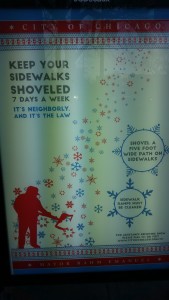
We Northerners know how frustrating it can be to trudge through knee-high snow. Chicago helpfully reminds us to keep sidewalks clear for pedestrians. But why should we do it? Take a closer look at the poster:
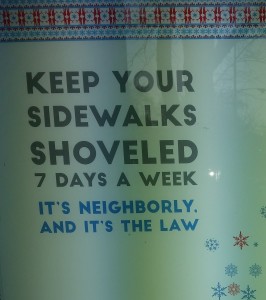 As the poster says, “It’s neighborly.” It’s just what you do to help each other. But if that doesn’t move you to grab a shovel, maybe a ticket will: “and it’s the law.”
Hopefully, most people will clear the sidewalk out of concern for others. But just in case some ruffian leaves the white stuff out front, the city will send a citation with a hefty fine to make sure it gets done.
This is a great example of what Lutherans mean by “Law and Gospel.” With the Gospel, the hope is that we will do what is right because we feel called to do it, out of gratitude for God’s love and out of our love for one another. But, if that doesn’t work, God commands it, too.
When it comes to serving the neighbor, Martin Luther left room for both:
“This demonstrates that we are children of God, caring and working for the well-being of others…”
That’s the gospel side. And appropriately, it comes from Luther’s treatise “Freedom of a Christian,” which is, ironically, all about the freedom we have in Christ. Luther’s main argument is that we serve because we feel called to it in gratitude for God’s grace. We were saved by a free gift, so we serve others freely.
But just in case:
“If your enemy needs you and you do not help him when you can it is the same as if you had stolen what belonged to him, for you owe him your help. St. Ambrose says, ‘Feed the hungry: if you do not feed him, then as far as you are concerned, you have killed him.’ ” – Treatise on Good Works (1520)
And thus the Law side. Just in case gratitude doesn’t move us, perhaps condemnation will.
Does our motivation matter? Think to the snow-shoveling sign. If I clear my sidewalk out of love for my neighbors, how good of a job will I do? When I was a kid, I used to clear the walks for our elderly neighbors, a really nice couple. I made sure their path was as wide as could be. Heck, there was grass showing at the edges. It was a labor of love to help them, a way of showing thanks for their kindness to me over the years.
What will that path look like if the sidewalk is cleared just to avoid a ticket? If you’ve ever walked down a sidewalk shoveled so poorly that your legs knock snow off the mounds at your sides, you might have an idea. Some of the paths in my neighborhood are about ten inches wide and as slick as a skating rink. But, at least they’re shoveled. No tickets today.
Love pushes us to go as far as we can, to encounter our limits and then to find ways to go beyond them. The gospel draws us into a life of faith that is consuming, energizing, and challenging. The Law, on the other hand, sets a minimum standard we have to meet. We look for clear, minimal expectations and do what we must to meet them (or, sometimes, find a loophole.)
Another interesting thing about snow-shoveling in Chicago: elderly and differently-abled people are still required by the law to clear their walks. How they are supposed to this isn’t exactly clear. But if they don’t, they get cited like the rest of us. That’s the way the Law works. The Law doesn’t help us follow it. It merely condemns us when we get it wrong.
The Gospel, on the other hand, invites us into relationships where we support each other. So, the “Lutheran” government of Chicago encourages people to help their neighbors if they know they can’t take care of their sidewalks. It encourages the sort of “gospel” activity where we go out of way to serve one another, not out of fear but out of love and concern. The Gospel lets everyone participate.
What motivates your ministry? Each of us has days when we need the Law to get us out of bed and back to the work of fighting hunger. But each of us also needs the Gospel to help us see God’s reconciling grace at work, creating something new in our midst, something all of us can be part of. How can we be continually reminded of both the Law and the Gospel in our service?
Ryan P. Cumming, Ph.D., is program director for hunger education with ELCA World Hunger. He can be reached at Ryan.Cumming@ELCA.org.