Skip to content
ELCA Blogs

ELCA Innovation

Tier 1 Digital Ministry Grants: Digital Assessments from Evoke

ELCA Innovation is excited to offer three tiers of support for digital ministry in 2026.

We recognize the challenges of digital ministry in our current landscape as a church and a society. We’ve developed these opportunities to support ELCA congregations and organizations in their digital ministry efforts and to encourage some creative and meaningful ministry ideas in your congregation or organization. As we collect feedback from congregations throughout the year, we also hope to curate additional digital ministry resources and learning opportunities, where needed.

The first tier of support for digital ministry is a limited number of Digital Assessments, which will be conducted by our contracted partner, Evoke Engagement Experts. Evoke works frequently with ELCA congregations and synods, offering a variety of digital services and marketing resources. A digital assessment is a process that will include a comprehensive review of your organization’s current online presence: your website, your social media pages, and how your organization ranks in search results.

Digital Assessment from Evoke

How to effectively get the word out about your congregation and ministries has changed significantly over the last 10 years.

Is your church asking questions like: Does our website share the right information? Why are people not finding our congregation? How much time should we dedicate to posting on social media? Then, a digital assessment from the communication experts at Evoke is an impactful starting point for your church.

Through an assessment of your congregation’s digital communication channels, you can learn:

· What channels/tools/strategies are performing the best for your church

· How engaging is the content you are posting on social media

· Simple updates to make your website easier to browse and engage new viewers

· Strategies you should keep doing to effectively share your mission with those in your community

· Areas of improvement to help increase the reach of your message and engagement with those who don’t know about your church yet

After analyzing your communication channels and analytics, Evoke will provide a recommendations report that will highlight their findings and offer a priority list of improvements to help your congregation better tell your (and God’s) story and make more disciples!

Sign Up for Digital Assessments Now Open

Within ELCA Innovation, we are grateful to Evoke and their team’s understanding of the joys and challenges of digital ministry in an ELCA context.

There are currently 25 slots available for digital assessments between now and August 2026.

Eligible organizations include ELCA congregations and synod-authorized worshipping communities and outreach ministries, as well as ELCA-affiliated campus and outdoor ministries.

Please note: A digital assessment will require the temporary sharing of your login information for any current accounts (website, social media, etc.) so that Evoke Experts can analyze your content and analytics. A digital assessment will entail: (1) Assessment of organization’s current digital presence and analytics (2) Report of findings and recommendations for improvement shared with organization (3) One 30-60 minute call with organization contact(s) to discuss report findings and next steps.

If you would like to sign up your ELCA congregation or affiliated organization for a digital assessment, please complete this linked online form: Organization Sign-up for Digital Assessment: Digital Ministry Support from ELCA Innovation (https://forms.cloud.microsoft/r/GuqKtty7iG)

If your sign-up is approved, you will be contacted by Evoke Engagement Experts directly, to begin the process and share your account logins. ELCA Innovation staff may contact you about your digital assessment experience via email once your assessment has been completed.

If a large number of sign-ups are received up-front, the ELCA Innovation team reserves the right to randomly select five recipients per month from the sign-up list. If your organization is not selected to receive a digital assessment, you will be notified via email by ELCA Innovation staff from the address lab@elca.org at the end of August. Any sign-ups that are not selected in any given month will be automatically re-entered for future months.

When all digital assessments have been awarded in August 2026, the sign-up form will be deactivated and this post will be updated.

It’s possible we may offer a second round of digital assessments in the second half of 2026. If that is the case, we will re-post on our blog and website, as well as our Instagram feed.

Upcoming Digital Ministry Support

The second and third tier of Digital Ministry Grants will be launched later in 2026. We anticipate opening applications to ELCA congregations and affiliated organizations for the following grant awards:

· thirty $3,000 grants

· three $30,000 grants

The registration and application process for these grants will take place in ELCA GrantMaker. More information about these grants, award criteria and eligibility requirements will be available soon.

If you would like to be notified of the digital ministry grant application launch date and sent a copy of the grant application guide, please email lab@elca.org with the subject line “Request for Digital Ministry Grant Launch Notification”.

Innovation Is a Privilege—Let’s Make It a Right

By: Rahel Mwitula Williams

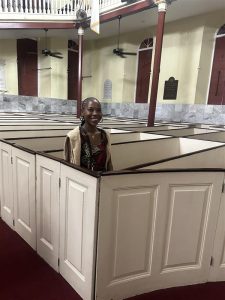
Rahel Mwitula Williams, the author, inside the oldest ELCA church, Frederick Evangelical Lutheran Church on St. Thomas, U.S. Virgin Islands

“Infrastructure is the dream!” stated one of the members of an inner city congregation. In my last blog, I spoke about the concept of innovation as a way to continuously reinvent ourselves, finding new ways to communicate the gospel and serve our brothers and sisters in an ever-evolving world. However, I would be remiss if I did not take a moment to acknowledge that innovation is a privilege. Yes, to try something new and test a concept, one must be in a space where dreaming and visualization are possible. But how can that happen if you lack stable footing, if your foundation is crumbling? 

The church is often seen as a place of vision, hope, and new possibilities. It is where communities gather to dream about a better future, new initiatives, and transformative ministries. However, for many marginalized communities, the idea of dreaming beyond survival can feel like a luxury they cannot afford. When basic infrastructure is crumbling—both literally and figuratively—calls for innovation and risk-taking often fall on exhausted ears. 

The struggle is real…Very real…

Before congregations and communities can dream of new ministries or ideas, they must first have a solid foundation. Many communities are burdened with economic hardship, lack of resources, and crumbling infrastructure. When we encourage marginalized communities to apply for grants and experiment with bold new ideas, we must first consider whether these communities have the stability to support such endeavors. It is difficult to innovate when you are barely surviving. 

A church with a leaking roof, failing heating system, uneven parking lot, broken windows, or financial instability cannot launch new ministries.  Infrastructure matters; ignoring it can set communities up for failure rather than success. 

Funding infrastructure and funding projects are not mutually exclusive 

Too often, funding and grant opportunities prioritize new and innovative ideas over addressing foundational needs. Indeed, our own grant processes at the ELCA Innovation Lab look for new and useful ahead of rooted and ready. Grant processes often include disclaimers like  “no brick and mortar,” or exclusions for fixing roofs, basements, and other structural necessities. But, as one church member pointed out, we rarely talk about these things!

We see this pattern across many grant applications. It raises the question: why does the Church feel the need to adopt secular standards that say investment in infrastructure is unwise? What happened to “Do not conform to the pattern of this world”? I would argue that without strong infrastructure—both physical and organizational—even the boldest ideas cannot truly thrive. 

When we invest in infrastructure, it helps ensures that: 

  • Basic needs are met so communities can shift from survival mode to visionary thinking. 
  • Churches and organizations are structurally sound and capable of sustaining new initiatives. 
  • Technology and resources are accessible, making it easier for communities to engage in innovation. 
  • Leadership and financial stability are prioritized, preventing the collapse of new initiatives and giving them a chance before they even begin. 

A sustainable future for any congregation or community requires a balance between maintaining what exists and dreaming of what could be. 

The challenge of “Fail Boldly”  

In our own work as the ELCA Innovation lab, we often use the phrase “fail boldly” . We use this phrase to celebrate entrepreneurial spirit, encouraging risk-taking and experimentation. But I’m not always comfortable with the fail boldly concept; this phrase can pose danger to many communities. 

I know for a fact that I cannot approach my own community with the phrase “fail boldly.” For many in my community—and in other marginalized communities—we often have just one shot to get it right. Resources for implementation are limited, and the stakes are high. So, the response to “fail boldly” is often, “We can’t afford to fail,” though, in reality, that sentiment may be expressed with even stronger language. 

At the same time, some of the most innovative ideas and solutions come from these very communities—not in spite of the struggle, but because of it. Survival has required creativity, resilience, and innovation. The alternative was never an option: to die, to close, to let dreams go unrealized. But this can’t be the only strategy available. Marginalized communities deserve the freedom to innovate not just out of necessity, but with the same privilege and support that others receive. 

The consequences of failure can mean further economic distress, displacement, or deepened systemic struggles. While taking risks is important, those risks must be calculated, supported, and rooted in a solid foundation. The church should recognize that true innovation requires both inspiration and infrastructure.  We must invest in stability for true creativity to take place; God established order, stability, and provision first—setting the land, sea, and sky in place—so that all living beings could thrive. This reflects God’s intentionality and care, showing that a strong foundation is essential.  

So what? 

We (the church) have a responsibility to ensure that our congregations and communities are not merely surviving but thriving. Before asking congregations to dream big, leaders must assess whether their foundational needs are being met. Addressing these challenges is not just about fixing buildings—it is about ensuring that the people within them have the capacity to engage in meaningful innovation. 

Funding infrastructure is an act of faith and justice. It affirms that all communities, regardless of socioeconomic status, deserve the opportunity to dream and create. It ensures that when ideas emerge, they are built on a foundation strong enough to sustain them. 

For the church to truly support innovation, it must recognize that before we call people to dream, we must first give them a solid ground to stand on. 

No One Is Prototyping a New Jesus: Innovation in the ELCA

Rahel Mwitula Williams serves as the Director of Innovation and Ideas within the ELCA churchwide organization.

This year marks two years in my role as the ELCA Director of Innovation and Ideas. While I’d love to say I’ve stopped getting this question, the most persistent question remains: What do you do again? The question persists no matter how many conversations I have with partners, colleagues, and friends. So, I’ve decided to reflect on it in this blog post.

When people hear “innovation,” most think of tech startups, Silicon Valley, or the latest app. Rarely does the term conjure up images of church pews, liturgy, “churpreneurs” (church entrepreneurs), or communion wafers (seriously, who decided we should use those?). Yet, here we are, talking about innovation in the ELCA.

Don’t worry—no one’s in a lab tinkering with prototypes for “God 2.0.” The ELCA isn’t trying to “upgrade” Jesus. Jesus is the same yesterday, today, and forever.

Instead, at the ELCA Innovation Lab, we focus on how we experience, communicate, and share the unchanging message of God’s love in ways that adapt to who we are, where we live, and how we see the world.

For centuries, the Christian church has communicated the Gospel in ways that reflect the times and cultures of its people—because that’s what humans do. Luther’s 95 Theses? It was the printing press that made it possible for people to access the Bible in their own language—an innovation that brought both tears of joy and torches of outrage.

People encounter God in deeply personal ways, shaped by their cultural contexts, identities, and experiences. The ELCA understands that innovation doesn’t mean changing God; it means rethinking how we connect with God and one another in an ever-evolving world.

We know that the Gospel doesn’t change. The message remains one of grace, mercy, forgiveness, and love. However, we also know that how we communicate that message must be as dynamic as the people we are called to serve.

Our approach to innovation isn’t about marketing gimmicks or trendy buzzwords. It’s about recognizing that God meets us where we are—whether that’s in a small rural congregation, a city coffee shop turned worship space, a barbershop, a community center, an ecumenical Christmas cantata, or even a neurodivergent choir.

It’s about asking the question: What does it mean to create spaces where God’s presence feels tangible, accessible, and life-changing?

Innovation isn’t about manufacturing cookie-cutter experiences of faith. It means truly listening to people’s stories, contexts, and needs. It means asking, How can we make room for God to meet you where you are? God isn’t confined to steeples and Sunday mornings; God is present in the messy, beautiful complexity of our lives.

Innovation isn’t about losing the sacred; it’s about making the sacred relevant. It’s about embracing creativity and laughter because a joyful God delights in our joy.

The Bottom Line: Jesus Doesn’t Need Rebranding. The message of love, sacrifice, and redemption is timeless. How we carry that message into a world searching for hope, connection, and belonging does need rethinking.

The ELCA’s unique ability to innovate lies in its commitment to remaining rooted in tradition while staying agile enough to adapt to the world as it is. God is not a distant relic but a living, present reality, and the work of innovation in the church is to help people realize that.

So, no, we’re not prototyping a new God. But we are reimagining what it means to encounter the God who has always been here—in the beginning. And in a constantly evolving world, that’s an innovation worth celebrating.

Then, let’s reimagine the future of faith together! Contact the ELCA Innovation Lab to explore meaningful ways to collaborate, dream boldly, and shape new expressions of ministry.

Is your synod, church, or community ready and willing to try something new? Let’s connect (Lab@elca.org) and create something new!