Skip to content
ELCA Blogs

Lutheran Disaster Response

LDR Facilitator Attends Climate Reality Project Training

I grew up the daughter of a water and wastewater engineer. On summer vacations and road trips of any length, our family made detours to visit water treatment plants. I met my dad’s colleagues from around the world when they would come for dinner. Their conversations would revolve around things from concern about water rights between countries in the middle-east, to flooding in central Pennsylvania. I think it was by osmosis that I came to know that there is a relationship between human activity and the natural environment and so it is not surprising that I studied natural resource economics in school and ended up as one of the Disaster Response Coordinators in the Lutheran Disaster Response (LDR) network. I serve Northeast and Southeast Pennsylvania Synods, on behalf of Liberty Lutheran Services.

Doing this work for over a decade now, it’s only been in the last five years or so that the disaster response community has started to talk about climate change in the daily context of our work. Here in the Northeastern part of the US, according to the 2018 National Climate Assessment, the amount of rain falling in the heaviest 1% of storms has increased 71% from 1958 to 2012. In my daily life, this means a lot of work around flash flood preparedness and response. It means community discussions about the few options available to low-income communities in flood-prone areas. It means talking about upstream development and the impact on communities downstream. It should also mean talking about the impact of human activity on climate, which the scientific community overwhelming agrees exists.

Given our shared interest in climate change, vulnerable people, and the church, Lutheran Advocacy Ministry Director in Pennsylvania, Tracey DePasquale, suggested the Climate Reality Project training to me. I looked up the training goals and agenda. I discovered that The Climate Reality Project was founded by Vice President Al Gore, shortly after he wrote the screenplay for the film An Inconvenient Truth in 2006. While the training looked robust, I was a little concerned that there would be political undertones. But just a few days after Tracey approached me, my daughter, a high school sophomore, came home fired up about this old film they watched in social studies, An Inconvenient Truth, and that’s when I decided to attend. Like many at the training, I am motivated by our obligation and caring for my own and all children in generations to come.

The Climate Reality Project training provided me with the latest information on climate change, access to a new network of advocates, and most importantly provided a context to consider the critical role of the church in the face of climate change.

The training I attended was held in Minneapolis MN Aug 2-4, 2019. I approached it with some hope and with some reservation. I wondered what I’d be taught that I couldn’t already find on the internet or through my colleagues. I wondered if there would be a partisan tone. I wondered how a training with 1,200 people attending could have real substance.

Those reservations were eased almost immediately as the conference became immediately relevant given that attendees were seated with others from their same general location on earth. I found myself in Minneapolis seated with others from greater Philadelphia, southern New Jersey, York, and Pittsburgh. After plenary sessions and breakout groups where we had opportunities to learn from people around the world, we would reconvene for meals to talk about how what we learned was relevant to the areas where we live and work together.

Another way the training was implicitly instructional was that it was designed to be a carbon-neutral event. Held at the Minneapolis Convention Center in a large ballroom, the event demonstrated how we can as individuals and organizations set new expectations for each other. Instead of having wait staff refill water and coffee, beverage stations were set up, so that water and coffee were accessible, but not wasted. All food served was vegan. We had delicious and filling meals like black bean meatloaf and falafel salads.

The heart of the training was around learning how to utilize the most up to date slides and information from An Inconvenient Truth in the context of our own lives. The training challenged us to explore how to relate those slides to issues related to justice, indigenous rights, belief systems, spirituality, religion, economic development, and more.

Another key component of the training was the experience of identifying and composing our own climate story. It was amazing to me that a room of 1,200 people could be silent as we were guided through the story writing process by well thought out prompts.

Those completing the training leave with access to a global network of partners in this work, with their own stories to tell, and with the challenge to participate or lead ten related outreach activities over the next year. Outreach activities can include writing letters to the editor, hosting community forums, participating in local environmental fairs, and more.

Working for a Lutheran Social Ministry Organization, and also being a part of the ELCA’s Lutheran Disaster Response program, and being a Christian who happens to be Lutheran, the training was really helpful to me in these ways:

  • Having access to tools to share with the Lutheran Disaster Response network for continued efforts related to climate change and disaster
  • Being welcomed into a global network of people facing a variety of issues related to climate change, and the opportunity to help each other problem solve
  • Discovering new partners in the church, such as leadership from Interfaith Power and Light, who have developed best practices for having discussions around climate change with church groups
  • Challenging myself to host two carbon-neutral events this next year

What was most valuable to me coming out of the training was hope. Hope that there are people using creativity and innovation to solve problems related to global emissions; hope in the fact that young people see the future as theirs and calling for bold policy action, and hope that there is still time to act on the information that has been gathered the past half-century. And, in the power and truth of the Resurrection, I was reminded at the event that there is hope and love to face any challenge. Through that lens, the church must be a leader in spirit, action, and partnership as we confront the challenges of climate change.

I am grateful for having had the opportunity to attend this training on behalf of the church.


Julia Menzo is Director of Community Outreach for Liberty Lutheran/Lutheran Congregational Services. She lives in Lansdale Pennsylvania, a town just north of Philadelphia. She serves as the facilitator for the Eastern Region of Lutheran Disaster Response and Co-Chair of SEPA VOAD (Southeastern Pennsylvania Voluntary Organizations Active in Disaster).


Be a part of the response:

Pray

Continue to pray for all those impacted by climate change and disaster.

Give

Thanks to generous, undesignated donations, Lutheran Disaster Response is able to respond quickly and effectively to disasters around the globe. Your gifts to Lutheran Disaster Response will be used where there is the greatest need.

Connect

To learn more about global migration and what Lutheran Disaster Response is doing:
  • Like Lutheran Disaster Response on Facebook.
  • Follow us on Twitter.
  • Visit our website at LDR.org
  • Sign up to receive Lutheran Disaster Response alerts.


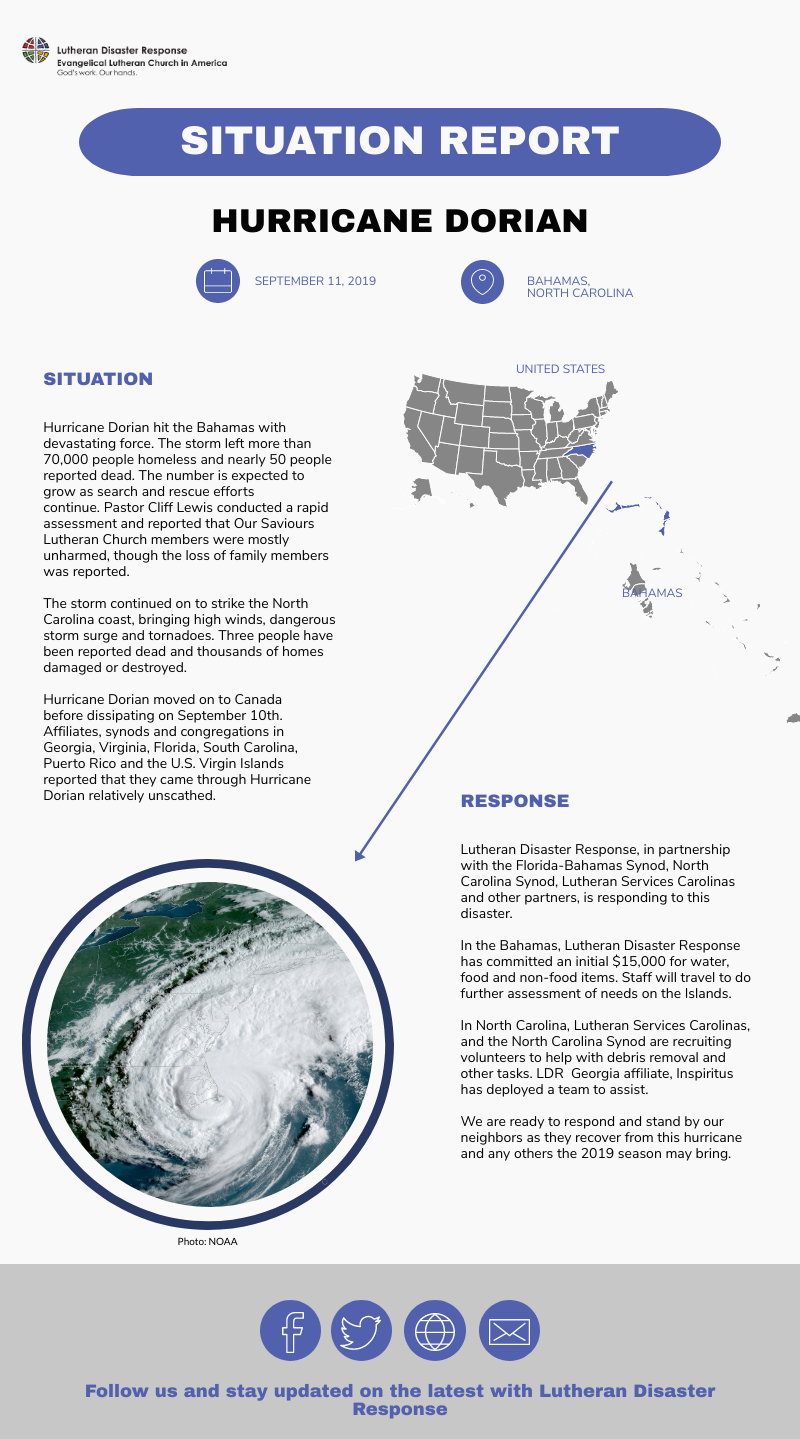
Situation Update 2: Hurricane Dorian


Be a part of the response:

Pray

Please pray for the communities that have been affected by Hurricane Dorian. May God’s healing presence give them peace and hope in their time of need.  You can find additional resources for worship here.

Give

We invite you to stand by all the communities impacted by Hurricane Dorian. Your gifts to Hurricane Relief ensure that our church will be able to provide help and hope for those affected by this disaster for years to come.

Connect

To learn more and stay connected to the latest events and our response to this and other disasters:

  • Help spread the word in your congregation by sharing this bulletin insert.
  • Like Lutheran Disaster Response on Facebook and follow us on Twitter.
  • Visit our website at LDR.org.
  • Sign up to receive Lutheran Disaster Response alerts.
  • Click here for information on volunteer opportunities.
  • To download a PDF version of this situation report, click here.


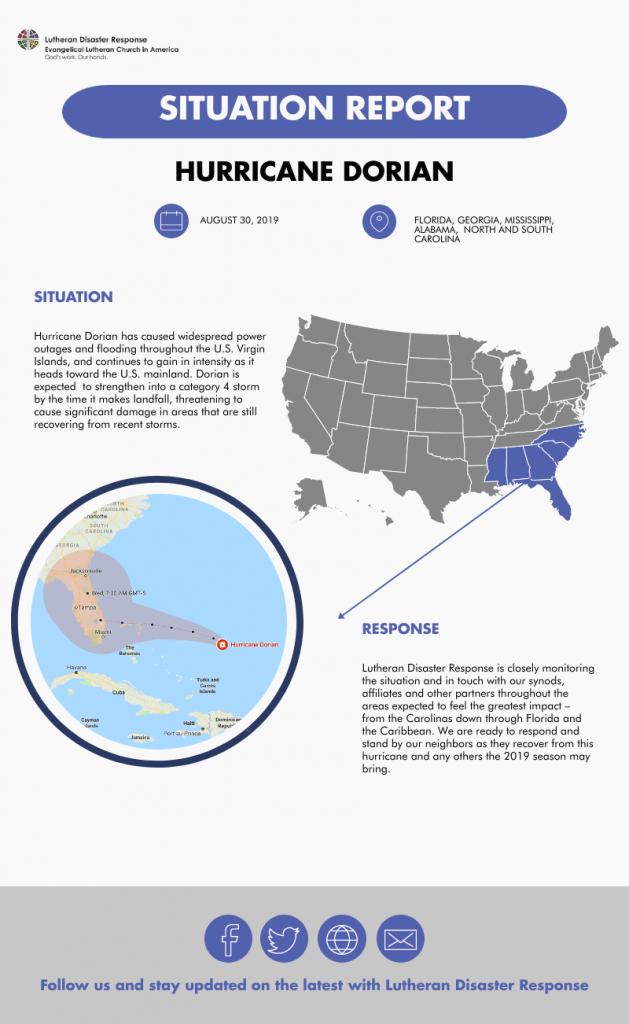
Situation Update: Hurricane Dorian


Be a part of the response:

Pray

Please pray for the communities that have been affected by or lie in the path of flooding. May God’s healing presence give them peace and hope in their time of need.  You can find additional resources for worship here.

Give

We invite you to stand by all the communities impacted by Hurricane Dorian. Your gifts to Hurricane Relief ensure that our church will be able to provide help and hope for those affected by this disaster for years to come.

Connect

To learn more and stay connected to the latest events and our response to this and other disasters:

  • Help spread the word in your congregation by sharing this bulletin insert.
  • Like Lutheran Disaster Response on Facebook and follow us on Twitter.
  • Visit our website at LDR.org.
  • Sign up to receive Lutheran Disaster Response alerts.
  • Click here for information on volunteer opportunities.
  • To download a PDF version of this situation report, click here.

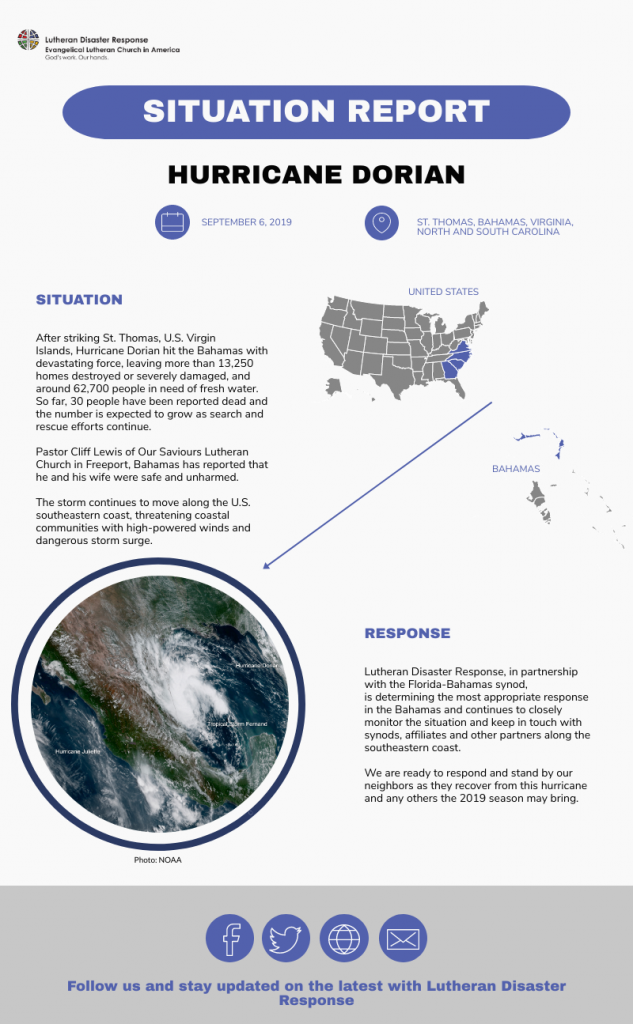
Situation Report: Hurricane Dorian


Be a part of the response:

Pray

Join us in prayer and partnership, and to help spread the word in your congregation. You can find additional resources for worship here.

Give

We invite you to stand by all the communities impacted by Hurricane Dorian and future hurricanes. Your gifts to Hurricane Response ensure that our church will be able to provide help and hope for those affected by this disaster for years to come.

Connect

To learn more and Stay connected to the latest events and our response to this and other disasters:

  • Like Lutheran Disaster Response on Facebook and follow us on Twitter.
  • Visit our website at LDR.org
  • Sign up to receive Lutheran Disaster Response alerts
  • To download a PDF version of this situation report, click here.

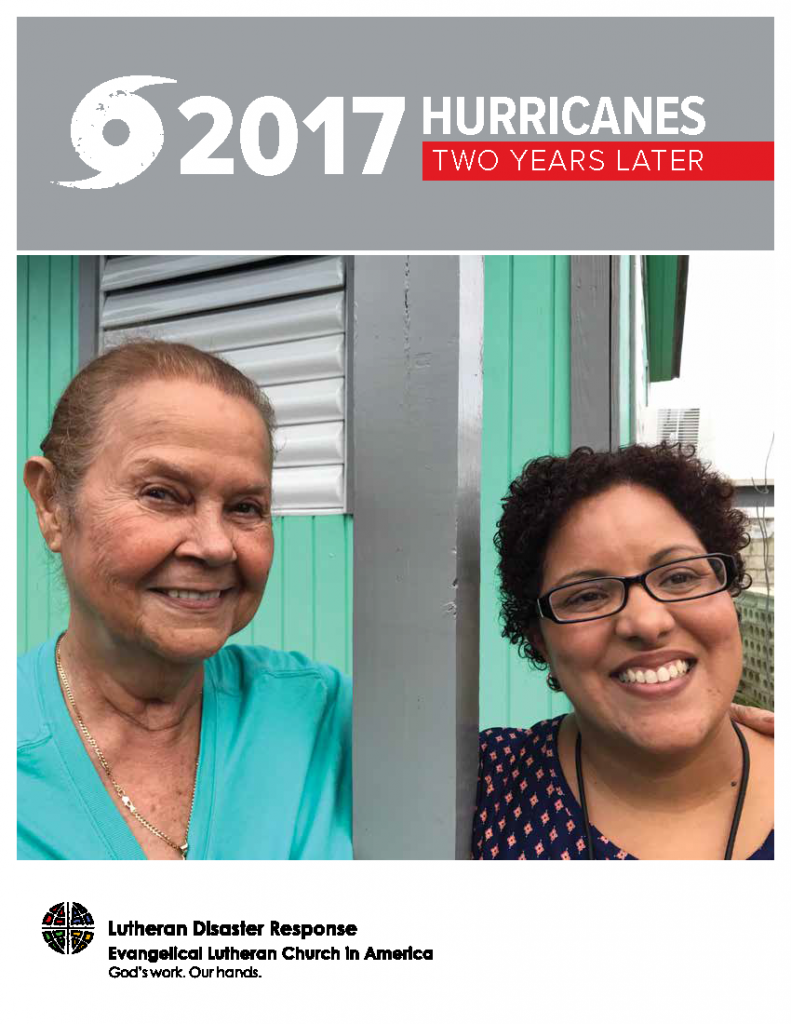
2017 Hurricanes: Two Years Later

In 2017, hurricanes Harvey, Irma and Maria swept through the United States and the Caribbean, causing widespread damage and interrupting the lives of millions. Two years later, Lutheran Disaster Response is still present, working in partnership with congregations, synods, social service organizations and other partners to bringing God’s hope, healing and renewal to affected communities.


Last year, Dennis, a 72-year-old retired Marine living in St. Croix, U.S. Virgin Islands, met an employee of Lutheran Social Services of the Virgin Islands — the local Lutheran Disaster Response affiliate. He told them about the damage to his home, and soon after they came for a visit. “I was hoping to get help from FEMA. I wasn’t expecting the Lutherans,” Dennis said. Last year at the anniversary of the Hurricane, through the LDR supported volunteer rebuild/repair program, Dennis began to rebuild his home and his life. “The house isn’t done, but how it looks now is beyond my wildest expectations,” Dennis said then. Now, two years after the storm, his house is complete. “It [the house] is bringing me joy… “I’m thankful to Lutheran Services for helping me out,” Dennis said.


Lutheran Disaster response, in our commitment to the long-term recovery of Puerto Rico and other hurricane-impacted states/territories, has committed significant funding and other forms of support to help survivors and continue building the capacity of our partners and affiliates on the ground. Thanks to you, survivors like Dennis,  have been connected with needed support — from emergency relief supplies to emotional and spiritual care, as well as the repairing and rebuilding of their homes.

To read our full report – 2017 Hurricanes – Two Year Later, click here.


Be a part of the response:

Pray

Join us in prayer and partnership, and to help spread the word in your congregation. You can find additional resources for worship here.

Give

We invite you to stand by all the communities impacted by the recent hurricanes. Your gifts to Hurricane Relief ensure that our church will be able to provide help and hope for those affected by this disaster for years to come.

Connect

To learn more and Stay connected to the latest events and our response to this and other disasters:

  • Like Lutheran Disaster Response on Facebook and follow us on Twitter.
  • Visit our website at LDR.org.
  • Sign up to receive Lutheran Disaster Response alerts.
  • Click here for information on volunteer opportunities.

ELCA as a sanctuary church: What does this mean?


Last week, the ELCA Churchwide assembly declared the ELCA a sanctuary church body. Below, Bishop Elizabeth Eaton shares a message on what this means for our church.


Dear siblings in Christ,

As many of you know, last week the ELCA Churchwide Assembly adopted a resolution that, among other things, declared the Evangelical Lutheran Church in America (ELCA) a sanctuary denomination. Many of you are asking, “What does this mean?”


Our call to love our neighbor is central to our faith. In our baptismal covenant we promise to strive for peace and justice in all the world. One of the ways we live out this vow is through our commitment to welcoming the stranger. With this declaration, we publicly state that walking alongside refugees and immigrants is a matter of faith.


We have prepared talking points to provide a better understanding and further clarification on what sanctuary means for you and your congregations. We acknowledge this will look different in different contexts across the ELCA.


We also hope this resource will help guide conversations with your parishioners and your community about what our faith says about immigration.


“Welcome one another, therefore, just as Christ has welcomed you,
for the glory of God” (Romans 15:7).


In Christ,

The Rev. Elizabeth A. Eaton
Presiding Bishop

Be a part of the response:

Pray

Continue to pray for migrant children and families.

Give

Thanks to generous, undesignated donations, Lutheran Disaster Response can respond quickly and effectively to disasters around the globe. Your gifts to Lutheran Disaster Response will be used where there is the greatest need.

Connect

To learn more about global migration and what Lutheran Disaster Response is doing: