Skip to content

ELCA Blogs

December 30, 2018–Discovering Where He Belongs

Scott Moore, Erfurt, Germany

Warm-up Question

What is the best thing you like about when you come home from being away for a while? 

Discovering Where He Belongs

It’s beginning to look a lot like the Christmas Nick Schneider dreamed about much of his life. He just recently took advantage of new Indiana law which just made possible the release of more than 50 years of adoption records, including Schneider’s. He was one of those fortunate children who was adopted as a baby by two loving parents. They raised him with love and care and provided him all the things that one hopes for in life. Shirley Williams gave Nick up for adoption those many years ago when he was just one day old. She was a 17 year-old, unwed mother. In that time, that was rather scandalous, so she was sent to a place away from her home in order to give birth in secret. 

Schneider found out that he was adopted when he was 12 years old. Reporting to local news sources Schneider said,  “There was always a void. I just needed to know, I wanted to know where I came from. I wanted to know my roots.” In recent years, he started trying to find out about his ancestry through an online DNA test. That led to identifying his grandfather and finding a picture. A television station ran a story on him and when they showed the picture of his grandfather a biological cousin reached out and eventually connected him to his mother.  This has been a been a dream come true in the making. 

Shirley and Nick met last September and, at last report, were planning on celebrating this Christmas together for the first time. 

Discussion Questions

  • How many generations can you trace back in your family?
  • What is your experience with adoption?
  • When have you ever looked hard for something and found it?
  • If someone adopted grows up in a loving home, why do you think they still go looking for their biological parents?

First Sunday of Christmas

1 Samuel 2:18-20, 26

Colossians 3:12-17

Luke 2:41-52

(Text links are to Oremus Bible Browser. Oremus Bible Browser is not affiliated with or supported by the Evangelical Lutheran Church in America. You can find the calendar of readings for Year C at Lectionary Readings

For lectionary humor and insight, check the weekly comic Agnus Day.

Gospel Reflection

Jesus of Nazareth in Galilee, still technically a boy in the eyes of his community but on the brink of being seen as an adult (this was at the age of thirteen), is traveling along with his parents. They are traveling in the security of friends and family and go to Jerusalem for the Passover, one of the most important religious festivals in the Jewish tradition. Jesus has parents who care.

Just last week, we relived the story of this newly betrothed couple away from home with no place to give birth to the one promised by the Archangel Gabriel. Now he is all grown up. Mary and Joseph seem to have done a good job. Jesus is twelve years old, healthy, and…lost! They lose Jesus in Jerusalem, a city full of thousands of people from all over the region. How worried must they have been? Apparently, these loving, adoptive parents didn’t need to be worried at all as they come to find him in the temple.

Jesus found his way home to his first parent. “Did you not know that I must be in my Father’s house?” This statement is surprising and not surprising at the same time. If we have been following Jesus’ story closely, we know who he is and we know that Mary and Joseph know who he is. Maybe they forgot over the past twelve years. Maybe they knew Jesus was special but didn’t know if he knew. Whatever the case may be, Jesus knows who he is. Jesus lays claim to his divine heritage. Jesus seeks a home-coming of biblical proportions. He amazes the learned leaders gathered discussing God and God’s word. Jesus yearns to be in his Father’s house and comes into his own. It is three days after they notice him missing that they find Jesus.

How long was Jesus there in his Father’s house? Certainly long enough to be passionately engaged in study of scripture and theological discussion. We don’t know any of the other details of this experience like where Jesus stayed, how he got by, etc. All we know is that Jesus is doing just fine and Mary chastises him for “treating us like this” and “causing us great anxiety”. They didn’t notice he was missing but when they did, they were scared. They love their son, and like so many parents when their child goes missing, they were terrified something might have happened to him. Here the Gospel of Luke helps us see Jesus with new eyes. He is not just the baby in the manger or the lost twelve-year old. Jesus is not lost in Jerusalem but he lost in God’s word. No worries, Mary and Joseph. Jesus is right where he is supposed to be. 

Jesus, however, still has family responsibilities to his earthly parents. He is a good son to them despite giving them a scare. Jesus goes home with Mary and Joseph, even if it is very clear now how strong his connection is to his first Father. This divine child is a loving son to both parents, those on earth and the one in heaven. The next time we see Jesus in the Gospel of Luke, he is all grown up “in wisdom in earthly years” and ready to begin his ministry of preaching and being the good news. 

Discussion Questions

  • When have you ever had the feeling of knowing you belonged somewhere or not belonged somewhere?
  • Where would you like to be right now?
  • When have you felt like you were old enough but others still treated you as a child?
  • What are you passionate about? What kind of activities could you “get lost” in?
  • Which bible stories or topics of the faith could you “get lost” in?

Activity Suggestion

A faith family tree: Have the participants trace all those in their family and their connection to the faith. They can draw this as a family tree or as a chart. Help the participants identify patterns in their faith family tree. 

Closing Prayer

O God our loving parent, we thank you for giving us the gifts of knowledge, wisdom, and curiosity. Give us a spirit of passion for you and your word. Open our minds and our hearts to engage in conversations about our faith with our family, friends, and others who are interested. May we be examples of your love and may the world see us as your children. We ask this in the name of your Son, our friend and heavenly brother, Jesus Christ our Lord. Amen 

Share

Advent Study Series, Session 4: Holy Communion

Advent Study: Session 4

The guests sit back, satisfied. The plates are scraped clean. The utensils are carefully stowed for the next meal. Where do we go from here?

In the first session of this study, Babette’s guests had finished their sumptuous, if strange, feast, praising the talents of their hostess, if not the exact recipes she brought to life. The eponymous meal was not the end of the story, however. Thirty-year-old spoiler alert: At the end of the film, Babette informs the two sisters for whom she works that she has spent all her newfound wealth on the meal and so, rather than returning to France, will be staying on as their live-in servant. Almost as important as the climax of the meal is the denouement of Babette’s decision to remain in their service. The feast is not a farewell dinner but rather a celebration of transition — from the servitude she was forced into by circumstance to the loving service she continues by choice.

In the second session of this study, Martin Luther extolled the virtues of Abraham, whose radical hospitality created an opening — both literal and figurative — for Abraham and Sarah to hear the promise of God in their humble tent. It was a model of hospitality Luther commended to the church, that it might be a place of refuge for all who are vulnerable, for all the strangers-maybe-angels in our midst. The people of God are called to be church for the sake of the world — and this starts with the concern for the well-being of others that gives rise to hospitality.

In the third session of this study, Paul admonished Peter for creating tables that were exclusive rather than inclusive. Peter had refused to dine with Gentiles and, in so doing, had decided who was in and who was out based on the law rather than on grace. Paul also held the Corinthians to account for their treatment of people in need, chastising them for mimicking in the church the pattern of relationships already present in the world, where those with earth and power received the places of prestige, and those in poverty had to make do with scraps.

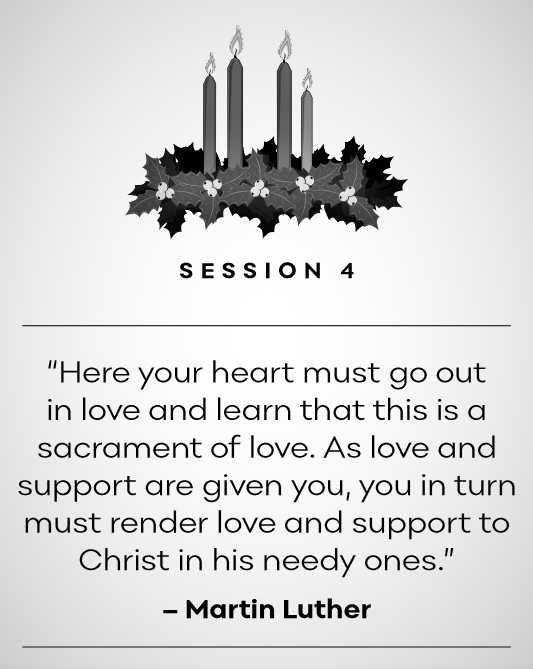
Each of these threads is pulled together in Luther’s teaching on the most important meal in the Christian church, Holy Communion. Calling Holy Communion a “blessed sacrament of love,” Luther writes:

The fruit of the sacrament is nothing other than love. As Christ gave himself for us with his body and blood in order to redeem us from all misery, so we too are to give ourselves with might and main for our neighbor…That is how a Christian acts.

For Luther, Holy Communion draws those at the altar closer to God and closer to one another. To partake of the sacrament authentically, one must remember both dimensions — the presence of grace in the sacrament and the willingness to bear the burdens of the other people at the table. Holy Communion is a means of grace that forms us to be signs of grace to one another.

In Holy Communion, we are reminded of Christ’s sacrifice for us and are invited to give ourselves in like manner to one another. The sacred meal is nourishment for a sacred vocation. In fact, for Luther, the sacrament has no meaning without this: “For the sacrament has no blessing and significance unless love grows daily and so changes a person that he is made one with all others,” he writes. At the table, a community is fed and formed for service in the world. The sacrament’s significance does not end at the table where we eat but extends into the world in which we live — a world we shape by our witness to the hospitality of God, who welcomes all to the table. It is a somber meal of penitent reflection and a celebratory feast of new beginnings.

This season, as we have prepared for the arrival of Christ, it may be easy to see Christmas as the end, the culmination of what has gone before, rather than as the beginning, the inauguration of what is to come. But the coming of Christmas is not merely the end of Advent. It is the start of the life of the church in the world. Freed from sin and death by Jesus Christ, it is the beginning of the servitude we choose — service of the world in gratitude for the grace we have received. It is a celebration of the freedom to join with others at the table and the freedom to concern ourselves wholly with the needs of our neighbors. In Advent, the church is created to be part of the re-creation of the world begun on Christmas.

The “reason for the season” is Christ’s birth, certainly. But it is also the creation of the people of Christ, who are called into the world to “do justice, and to love kindness, and to walk humbly with your God” (Micah 6:8).

The guests sit back, satisfied. The plates are scraped clean. The utensils are carefully stowed for the next meal. Now, the work of Christmas begins.

Questions for reflection:

  • What memorable meals in your life have brought you into relationship with other people at the table? How did dining together help you become closer to them?
  • How does Holy Communion help nourish you for service of others?
  • Where is God inviting you to be in the new year?
  • How are you renewed for service of the world by the holiday season?

Prayer

Gracious God,

we give you thanks for the many ways you nourish us — with food, with family, with friends, with faith. In you, we are made new to be instruments of your grace in our world. Recall to us the many places of need in our world — places of injustice and violence, of hunger and poverty. Enrich us with love at the tables you set that we may seek justice, love kindness and walk humbly with you into the future you have promised.

In your holy name,

Amen.

Learn

To download this entire Advent study, click on the cover image below. To other congregational resources from ELCA World Hunger, please visit www.elca.org/Resources/ELCA-World-Hunger.

Advent Study Cover Image

Give

Gifts to ELCA World Hunger are acts of love toward our neighbors living with hunger and poverty both here and around the world. This Advent, join ELCA World Hunger in working toward a just world where all are fed.

Give now

Connect

Sign up here and receive news, information and the latest resources from ELCA World Hunger.

Share

December 23, 2018–Are you Excited?

Seth Moland-Kovash, Palatine, Il

Warm-up Question

 What are you most looking forward to right now?

Are you Excited?

Anticipation and excitement are two very powerful human emotions. We look forward to vacation, to time off from school or other responsibilities. We might look forward to family time, to Christmas, to gifts (giving and receiving). Simply the act of anticipating something releases powerful chemicals into our bloodstream which make us feel the joy – that’s what anticipation is.

Companies that try to sell products to us know this well. This is what advertisements and pre-release promotions are all about. The companies are trying to create anticipation in us so that we feel that joy and then want it more and more—and seek out the product they are promoting. Sometimes this is done through industry events like the Consumer Electronics Show. This event, held in January each year, is all about creating anticipation. The event is an opportunity for companies to tell us what consumer electronic products (mobile phones, televisions, computers and the like) they will be releasing in 2019. But the weeks leading up to the event are themselves about anticipation. Companies will tease what products they will be announcing at CES to build up the anticipation. As the linked article tells us, even before the official event starts on January 8, there are two “media days” where companies jostle for headlines and buzz – all trying to create the most excitement and anticipation they can for their products.

Discussion Questions

  • Do you like to be the first one in your family or friend group to try something new? This could be a technological thing or some other kind of experience.
  • Are there new technological products or innovations you are excited to see? 
  • Have you ever experienced disappointment when you’ve finally gotten to do or see or use something that you’ve been anticipating?

Fourth Sunday of Advent

Micah 5:2-5a

Hebrews 10:5-10

Luke 1:39-45 [46-55]

(Text links are to Oremus Bible Browser. Oremus Bible Browser is not affiliated with or supported by the Evangelical Lutheran Church in America. You can find the calendar of readings for Year C at Lectionary Readings

For lectionary humor and insight, check the weekly comic Agnus Day.

Gospel Reflection

Mary was excited and Elizabeth was excited. These two women were experiencing an anticipation that is a common occurrence for people throughout history – the expectation of the birth of a child. Each was excited to meet her own child and to see what would become of him.

This story tells us of another level of excitement. When Elizabeth saw Mary, the child in Elizabeth’s womb (John the Baptist) “leaped for joy.” Elizabeth is sharing her testimony that even the unborn child she carried was anticipating and excited about the unborn child Mary carried.

We know the rest of the story – we know that John was a bit of a predecessor to Jesus in public ministry. We know that John baptized Jesus. We also know that Jesus would save the world through his life, death, and resurrection. It seems that John knew that too – even before birth.

Discussion Questions

  • Can you relate to John’s excitement about Jesus? What excites you about Jesus?
  • John shared his excitement by leaping for joy. How can we share our excitement about Jesus?

Activity Suggestion

Snap pictures of you and your youth group showing your excitement at Jesus’ coming. Get creative. Use props or facial expressions. Share your pictures with the world through social media.

Closing Prayer

Come Lord Jesus, and fill us with joy at your birth. Amen.

Share

Christmas message from Jerusalem

Bishop Sani Ibrahim Azar of the Evangelical Lutheran Church in Jordan and the Holy Land (ELCJHL) shares a message of joy from Jerusalem.

Read the full message here.


Share

The federal budget and migration: An update

by Alaide Vilchis Ibarra, Program Director, Migration Policy

I learned about the importance of the federal budget during the government shutdown in 2013 by seeing my friends having to halt their work supporting refugees, trafficking victims and unaccompanied children. With the threat of a government shutdown again looming over border wall funding, I wanted to update what I wrote originally in April 2017 on what is at stake.

A REMINDER OF THE BUDGET PROCESS

For our government to function, a federal budget must be approved by Congress every fiscal year (FY). Over the last few years, Congress has been unable to pass a substantial new budget by the deadline, opting instead to pass shorter-term temporary Continuing Resolutions (CR). A CR only authorizes the federal government to operate with the same funding levels as the previous year. If more money is needed for specific purposes not already in the existing year’s budget, Congress decides whether to consider the funding increase.

In January 2017, President Donald Trump signed multiple executive orders that severely limited the ability of individuals to seek asylum, increased the detention of migrants, actively separated children and families and expanded border enforcement. These executive orders are already being implemented, but continuing to do so in the future will be prohibitively expensive and require cuts to other important domestic or international programs to pay for them.

Members of Congress continue to have the power ensure funds do not go toward policies that are harmful to the common good. As citizens acting on our faith values, we can hold our leaders accountable to good stewardship of public funds.

The budget process is complicated, so here are some important things you should know right now:

WHAT IS GOING ON WITH THE FEDERAL BUDGET?

Although FY2019 started in September 2018, the budgets of seven agencies, including the Department of Homeland Security (DHS), have not passed for the year. Congress has relied on short-term funding (CRs) instead. The latest CR ensures that these seven agencies have funding until December 21, 2018. If Congress and the Administration can’t agree on funding issues by this date, the government could shut down.

The budget process for this fiscal year formally began when the White House sent Congress its budget “wish list” in February.

HOW IS IMMIGRATION INVOLVED IN NEGOTIATIONS?

On December 11, 2018, President Trump threated to shut down the government over funding for a border wall in a conversation with Democratic leaders at the White House. At the core of this argument is a request from the President to provide $5 billion in funding in this year’s budget bill for DHS.

The current draft of the bill in the Senate version appropriates $1.6 billion for wall funding. This number matches the formal request that DHS made to Congress in February 2019. While the number included in the draft Senate bill fulfills the request made by the Administration, the government may still shut down if the President refuses to sign a budget into law. Churches and faith-based organizations, including ELCA Advocacy, have urged Congress and stood together against funding for a border wall.

DHS funds, including those for the border wall, come at the cost of programs that could help people living in poverty or in rural communities. Additionally, shutting down the government has real consequences for programs that keep people fed and safe. People of faith across the country should continue to urge members of Congress to approve a moral budget that reflects our values and advances the common good.

 WHERE DOES THE ELCA STAND?

As a church, we serve society when we “hold power accountable, advocate justice, stand with those who are poor and vulnerable, provide sanctuary, and meets human need” (ELCA social statement: “For Peace in God’s World”). We stand firmly against inflicting harm in all communities by cutting funds for programs that serve vulnerable people or defunding programs that better the conditions that force people to flee their home countries.We stand for a budget that honors the image of God in each person.

WHAT CAN I DO?

  • Keep up with what is going on.
  • Call your member of Congress now and urge them to reject additional funding aimed at separating families.
  • Pray every day for all legislators that shape policy and for the communities that live with policies’ effects.

IF YOU WANT TO FIND OUT MORE


ELCA Advocacy is grateful to our author, Alaide Vilchis Ibarra, who has shared her insights in this blog post update and will be leaving ELCA Advocacy at the end of this year. Her dedication and contributions over the past 4 years have been a compassionate presence in a heated climate, from helping shape the ELCA AMMPARO strategy to raising a compelling voice for social justice on Captiol Hill.


Share

VBS 2019! Who Is My Neighbor?


Are you daydreaming about summer as much as we are? Around the country, ELCA congregations are already making plans for next year’s Vacation Bible School, and ELCA World Hunger is thrilled to invite you to explore our new VBS curriculum for 2019, “Who is My Neighbor?” This curriculum is a free resource that is now available to order and download!

Who is my neighbor?

“Who is My Neighbor?” invites children and youth to re-imagine what it means to be neighbors in Christ. Based on the Good Samaritan story, this full, five-day program contains skits, games, crafts, snacks and intentional activities for children to enjoy and learn how our faith calls us out into the world to love and serve our neighbors.

The skits for each day introduce a new character in the Good Samaritan story, starting with the lawyer who asks Jesus, “Who is my neighbor?” Each skit shares an important lesson that directly relates to the theme and theme verse, which groups will practice at the start and end of each day.

Themes for each day:

Day One – God loves us (1 John 4:19)

Day Two – Let your light shine (Isaiah 58:10)

Day Three – No fear (1 John 4:18a)

Day Four – God loves everyone (Acts 10:34b-35)

Day Five – Building God’s neighborhood (Romans 15:2)


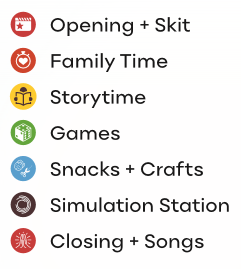
Based on your feedback, we’ve made “Who is My Neighbor?” more user-friendly for VBS planning teams by organizing each section by activity categories, rather than by days of the week. Organizing the sections in this way allows everyone on the team to be able to flip to the activities that they are assigned so that all of your leaders can find the materials and directions for their roles in one section. The program is organized in the following sections:

VBS 2019 - Table of Contents

Each day begins with a large group opening, including a skit to introduce the daily theme and a new character within “The Good Samaritan” story. This is followed by “family time” – small group sessions to dig deeper into the theme and bible verse. Then, participants travel through five rotations: crafts, games, snacks, storytelling and a “simulation station” – an interactive and engaging activity to learn more about hunger and how our faith calls us to respond. The stories for each day are based on real stories from projects supported by your gifts to ELCA World Hunger. Not only will children, youth and adults hear about the work this church is doing around the world, but through “Who Is My Neighbor?” they will be part of the response!

Leaders will find schedule templates, theme song suggestions and options for younger (K-2nd grade) and older (3rd grade and above) participants so that you can adapt to the needs of your group! Each lesson is rooted in Lutheran theology, drawing on our church’s strong tradition of theology and practice in the world.

The VBS program is also flexible, so you can adapt it to fit your needs. Already have a VBS for this summer? “Who is My Neighbor?” can also be used for Sunday School, family faith formation, and children’s sermons throughout the year.

How can I get my whole congregation involved?

A month or two prior to your VBS, create your own “Who Is My Neighbor?” campaign! Set a goal for your congregation to meet before the VBS starts and raise funds for your neighbors here in the United States and around the world through ELCA World Hunger.

Look for free posters, certificates and additional pictures accompanying the Storytime section coming soon!

If you have any questions about “Who is My Neighbor?” or ELCA World Hunger’s educational resources, please contact Ryan Cumming, program director of hunger education, at Ryan.Cumming@ELCA.org.

Learn

Click on the image below to download “Who Is My Neighbor?” To see some of ELCA World Hunger’s other congregational resources, including confirmation lessons, interactive immersion experiences, stories and videos, visit www.elca.org/Resources/ELCA-World-Hunger.

Who is my neighbor?


Share

We want to hear from you! Share the story of your Vacation Bible School on social media, or email us directly at hunger@elca.org.


Give

Gifts to ELCA World Hunger are acts of love towards our neighbors living with hunger and poverty both here and around the world. Together, we are creatively and courageously working toward a just world where all are fed.

Give now


Share

Advent Study Series, Session 3: A seat at the table


Session 3: 1 Corinthians 11:20-21

Advent is a season of anticipation, but this anticipation is not passive waiting. Perhaps a better way to describe it is as a season of preparation — we prepare our hearts and minds for the coming of the Christ-child on Christmas. But more than this, Advent is a time for the church to prepare itself for the reign of God that “broke in” to human history on the first Christmas. It is a time to reflect on the year behind and consider the year ahead — and to evaluate both in light of the question: How well do the ministries of our church anticipate the coming fullness of God’s reign?

At a community meal at Unity Lutheran Church in Milwaukee, guests gather around long tables, sharing in the hot meal volunteers serve from overflowing warming trays. The room is full to bursting with families, couples and individuals. Among them are both neighbors dealing with hunger and homelessness and volunteers and visitors sharing in the evening experience. With the exception of the servers, it is impossible to tell at first glance who among the hundred or more diners is a member of which group. All dine together; every seat is an equal station in the room.

The situation in Paul’s Corinth was very different. The meal Paul writes about in his first letter to the Corinthians is a corruption of this kind of community supper. The early meal he refers to is a first-century version of Holy Communion, at which the church would share not just bread and wine but an entire meal. Historian Helen Rhee writes that this meal was a primary way the church served the community. The sacrament, while ensuring that each church member received the means of grace through the consecrated elements, also ensured that the community received the more mundane nourishment of food, particularly for those who were facing the first-century version of food insecurity.

But that wasn’t the way it was working in Corinth. The early church included both members of wealth and members in poverty, according to Rhee, and in Corinth, it appears that the former received their fill while the latter yet again were left wanting: “One is hungry and another is drunk,” Paul admonishes.

This isn’t the first time Paul has written about eating and drinking in the church. In his letter to the Galatians, by some estimates written in the year before the letter to the Corinthians, Paul recollects his brazen challenge to Peter, the apostle of Antioch: “I opposed him to his face, because he stood condemned” (Galatians 2:11). Peter, who used to dine with both Jews and Gentiles, has begun to limit his gustatory activities to more exclusive parties, dining only with Jews. The reason for this, according to Paul, seems to be the presence of a group of Jews (“the circumcision party”) who felt that such intermingling was unbecoming of a Jew like Peter.

Paul disagrees — forcefully. Confronting Peter, Paul charges that his exclusive dining choices are a transgression against the gospel, which teaches that it is Christ alone who justifies and not circumcision. By refusing to eat with uncircumcised Gentiles, Peter is reverting to the belief that it is the law that proves a person worthy of a spot at the table and not the grace of Jesus Christ. And you thought choosing a lunch table in high school was hard!

For Paul, the table is a sign of the reign of God. The community gathered to eat and drink represents the community that will be gathered together in the full reconciliation of God’s coming kingdom. The church, witnessing to the “already-but-not-yet” reign of God, reflects not what is or what has been but what is to come — a banquet to which all will be welcomed and at which all will be filled. Peter’s transgression, like the error of the Corinthians, was to fail to see how the gospel they preached was to shape the life of the church here and now. For Paul, there was no clearer evidence of where the church stood on the gospel than where its members stood on meals.

Paul’s letters — and much of Scripture — invite us to think about the people who join us at our tables. But it would be too narrow a question to ask, who will dine with us this holiday season? For Paul, the dining table was a central symbol of who the church is, but there are so many “tables” at which we choose to sit — or choose not to sit. Our communities are filled with tables — places where we are invited to gather with neighbors, to stand with one another, to advocate for each other and to meet our common challenges together. Will we be like Paul, who envisioned tables as places of grace where all have a place and all are filled? Will we be like Peter, who abandoned the gospel by refusing to dine with unclean Gentiles? Will we be like the Corinthians, whose corrupted table perpetuated hunger?

The tables the church participates in reflect our beliefs about who the church is called to be and the transformation of the world God is enacting in our midst. As we look back on the year past and look ahead to the year to come, we are invited to reflect on the tables at which we sat — and the invitations awaiting us. Where is God inviting the church to be? Who is God inviting the church to be?

Questions for reflection:

  • Read Galatians 2:11-21 and 1 Corinthians 11:17-34. What problems did Paul see with Peter’s practices in Antioch and the Corinthians’ practices in their community?
  • Where have we been invited to be present with neighbors in our community? How have we responded?
  • Where is God calling your congregation to be in the next year?

Prayer

Loving God,

you sent your Son to invite the world to the heavenly banquet, from which no one will go away hungry. Remember us in our hunger for union with you and fellowship with one another. Inspire us to join with our neighbors at tables together, where we may work together toward a just world where all are fed.

In your gracious name,

Amen.

Learn

To download this entire study, click on the cover image below. To see some of our other congregational resources, please visit www.elca.org/Resources/ELCA-World-Hunger.

Advent Study Cover Image

Give

Gifts to ELCA World Hunger are acts of love towards our neighbors living with hunger and poverty both here and around the world. Together, we are creatively and courageously working toward a just world where all are fed.

Give now

Connect

Sign up here and receive news, information and the latest resources from ELCA World Hunger.

Share

December 16, 2018–Standing By and Standing Up

Paul Baglyos, Baltimore, MD

 Warm-up Question

When does standing by require standing up?

Standing By and Standing Up

Montgomery County, Maryland is considering a revamped proposal to allow public high school students to take as many as three excused absences a year to participate in political protests and other forms of “civic engagement” during the school day.  This would allow students to take part in marches, protests, lobbying, and other acts of political action.

Students feel that many current issues affect them and that students shouldn’t be punished with an unexcused absence for taking part in demonstrations so directly connected to issues affecting their lives.  “We’re taught about how important it is to be engaged in our world and community, and to be aware of what’s going on and to be a responsible participant in the democratic process,” said Ananya Tadikonda, 17, a senior at Richard Montgomery High School and the student representative on the Montgomery County Board of Education. “This proposal gives students an opportunity to exercise civic responsibility without being penalized for it.”

When it was introduced in September, the proposal required parental consent, the approval of the school principal and permission from the organization sponsoring the political activity or protest.  Excused absences would not be approved for spontaneous walkouts or protests. Students who leave campus without receiving approval would not receive an excused absence.  The final version of the proposal is still being drafted.

Public reaction to the proposal has been mixed.  Critics agree that students should have an opportunity to express their concerns, lest students feel their voices do not matter.  But they  express concern that students would be missing out on valuable school time and disrupting the school day.  “You are sending a message to the MCPS community that student protesting is more important than them being at school engaged in learning,” one commentator wrote.


Discussion Questions

  • Do you favor or oppose the proposal discussed in the above news article?  What are your reasons?
  • How would you respond to people whose opinions about the proposal differ from your own?
  • How would such a proposal be regarded in your school district?

Third Sunday of Advent

Zephaniah 3:14-20

Philippians 4:4-7

Luke 3:7-18

(Text links are to Oremus Bible Browser. Oremus Bible Browser is not affiliated with or supported by the Evangelical Lutheran Church in America. You can find the calendar of readings for Year C at Lectionary Readings

For lectionary humor and insight, check the weekly comic Agnus Day.

Gospel Reflection

One way to understand and interpret the figure of John the Baptist in the New Testament gospel narratives is to regard him and the movement he generated as a protest against the status quo.  John’s fiery preaching arose from a holy impatience with human complacency toward the evils of injustice and oppression.  He called for repentance, which meant a change of direction in the ways of human behavior and society.  Many of the people who gathered around him were eager to change their own lives in accordance with his preaching and they asked him for instruction on how to do that.  They had, apparently, grown tired of their own complacency and become ready to make changes for the better, changes that would alter the status quo.

We can picture the kind of protests discussed in the preceding news article as similar in sight and sound and character to the gatherings occasioned by John the Baptist.  Both contexts involve impatience with the status quo and calls for change.  Students who might receive an excused absence from class in order to participate in a protest are eager to stand up for the better world they long to see rather than stand by in complacency toward the way things are.

The phrase “standing by” can mean two very different things.  In one sense, “standing by” can mean remaining detached and indifferent, uninvolved, uninterested and unengaged.  In that sense, “standing by” can mean accommodating the status quo.  But “standing by” can also mean remaining alert and watchful, expectant and ready.  In that sense, “standing by” can mean remaining prepared to take action against the status quo.  In Christian faith and practice, the liturgical season of Advent focuses on “standing by” in the second sense of that phrase.

Christians understand themselves to be on “stand by” for the coming of Jesus Christ.  The world’s form and future belong to Jesus rather than to any other person, power, or authority.  The fulfillment of all longing for a better world is assured by the life, death, resurrection and promise of Jesus, and this is the good news that Christians celebrate and confess.  Christians live on “stand by” for the culmination and completion of that good news and Advent is the season in which the church annually re-trains its “stand by” muscles.

But Christian “standing by” for the coming of Jesus (which is to say, for the culmination and completion of his good news, his gospel) does not mean remaining detached and indifferent, uninvolved, uninterested and unengaged.  In fact, the Advent call to repentance is itself a protest against the status quo and all habits of complacency.  To stand by for the coming of Jesus means to stand up for the better world that his coming inaugurates.  Christians are called to protest the status quo and to resist the habits of complacency because the coming of Jesus brings the extinction of the status quo and raises new life from the tombs of complacency.

Discussion Questions

  • Has there ever been a situation in your life that stirred you to stand up against the status quo?  If so, share that story and describe what you did, why you did it, and what happened in consequence.
  • Have you ever felt yourself stirred to stand up for something but did not do so?  If so, share that story and describe what held you back and what you learned from that experience.
  • How does your faith in Jesus influence your decisions about whether to stand by or to stand up?
  • What instruction do you imagine John the Baptist might offer you regarding your own repentance?

Activity Suggestions

Think of a person you know and admire as an example of someone standing up against the status quo.  Share what you know about that person and their actions, and describe how their example has influenced your life.

Closing Prayer

God grant me the serenity to accept the things I cannot change; courage to change the things I can; and wisdom to know the difference.  Amen – from the “Serenity Prayer” of Reinhold Niebuhr

Share

Index of December 2018 Issue

Issue 61 of Administration Matters

Inspire, thank and educate with Stories of Faith in Action

The newest edition of Stories of Faith in Action is out — and it’s packed with vibrant photos and stories to encourage giving! Mailed to ELCA congregations, synods and leaders in early September, this annual publication highlights the impact of Mission Support and the ministries it funds.

Visit ELCA.org/SOFIA now to:

  • Order free print copies (all you cover is shipping).
  • Download an electronic copy.
  • View video stories, bulletin inserts and other resources.

How to complete a Pastor’s W-2 IRS Form

Year-end is quickly approaching and with it, the task of tax reporting to the IRS.  Different rules apply when dealing with clergy taxes and withholdings.  The sample W-2 provided will assist congregations in completing W-2 forms for clergy.  >More

Help pastors tap the clergy housing allowance

The clergy housing allowance allows pastors to exclude a portion of their compensation from federal gross income if it can be justified to the IRS as spent on housing expenses. If congregations don’t proactively designate a portion of their pastor’s compensation as a housing allowance, your pastor loses an important tax benefit. Sign-in at Portico EmployerLink required. >More

Don’t be left in the cold — inspect your heating boiler

One of the biggest risks with boiler heating systems is that a problem will cause the internal pressure in the system to escalate to a point where it causes an explosion. This not only results in major physical damage to the facility but can also be life-threatening if your members or employees are in the building. The risk of this occurring can be greatly diminished with proper maintenance. > More

New video: Managing ELCA Benefits 101

A new 22-minute video by Portico Benefit Services, offered on EmployerLink, covers the basics of providing ELCA benefits — key terms, answers to common questions, and action steps to take each year. It’s a great introduction for new treasurers, office managers, plan administrators and human resource directors, and a refresher for seasoned benefit providers. >Watch

Winter checklist

Whether your climate is snowy or mild, it’s important to protect your church property during the coldest months of the year. >More

Share

Pathway to equality with justice in Universal Declaration of Human Rights

by Christine Mangale, Program Director, Lutheran Office for World Community

A fundamental document turns 70 years of age on Dec. 10, 2018. Translated into 500 languages, its 30 articles guarantee and affirm rights, freedom, inherent dignity and equality of all humankind. Its principles represent tools that have allowed individuals to claim their dignity and provided them an avenue to fight for their rights.

As Lutherans, we join in celebration of the adoption of the Universal Declaration of Human Rights (UDHR). We celebrate because we identify with its universal principles of justice and equality. And we celebrate because we were represented at its drafting.

GROUNDING AND ASPIRATIONS

Created in the aftermath of World War II in 1945, the United Nations (UN) was chartered to build a space for multilateralism with the aim of never returning to the scourge of global conflict and work to advance human rights. Following the UN Charter, another foundational text was created: the UDHR. Adopted by the UN General Assembly in 1948, the monumental document states that “all human beings are born free and equal in dignity and rights” (UDHR Article 1). These rights are to be respected and enjoyed by all.

The UDHR is not a stand-alone agreement. It is further substantiated with the generation of a normative framework known as “international human rights law,” which has offered a legal guidepost for countries and international organizations to universalize rules and principles of conduct that allow states to engage with their citizens and each other.

Elaborating on this framework, the UN has created demographic-specific human rights instruments which build on and reinforce each other to ensure that all people are represented and protected. For example, the International Covenant on Civil and Political Rights and the International Covenant on Economic, Social and Cultural Rights, both adopted in 1966, affirm individual and state freedoms, especially freedom from violence and torture, and offer equal protection under international law.

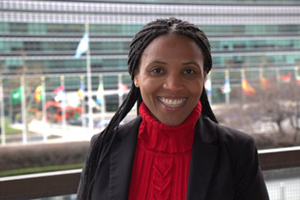
Our author, Christine Mangale, standing in front of the United Nations building

These documents are also aspirational, identifying and stating an adequate standard of living for all humankind. These agreements include commitments by states to provide adequate basic needs like food, shelter and clothing by calling them “fundamental rights.”

LUTHERAN CONNECTION

The Rev. Dr. Frederick Nolde, a Lutheran, contributed to article 18 of the UDHR. Article 18 pertains to the “Right to freedom of thought and religion,” indicating that “Everyone has the right to freedom of thought, conscience and religion; this right includes freedom to change his religion or belief, and freedom, either alone or in community with others and in public or private, to manifest this religion or belief in teaching, practice, worship and observance.”

We have seen firsthand how the UDHR has served as a beacon of hope for the vulnerable and marginalized – allowing them to emerge from the shadows with confidence and in the protection of the international community. This resonates with our call to “act justly, love mercy, and walk humbly with God” (Micah 6:8).

ANNIVERSARY INTERSECTION

Dec. 10 also marks the last day of the 16 Days of Activism against Gender-Based Violence, a campaign driven by civil society to accelerate action to end violence against women and girls. Structures of inequality are mostly unchanged, and the relationship between men and women remains unequal. There has been failure to address and challenge broader dynamics of patriarchy and inequality among men and women that result in lack of economic and social rights for women and girls. It is time to “Walk our Talk,” the theme of Lutheran World Federation over the 16 days and beyond.

TODAY

Millions of people are still suffering from poverty, hunger, conflicts, war, gender inequality and unjust systems that leave UDHR promises unfulfilled. We are witnessing a breakdown of international multilateralism, shrinking space for civil society engagement, violations of fundamental human rights with impunity, xenophobia, homophobia, racism, ongoing patriarch and gender-based violence, just to name a few. The aspiration of the UDHR is, therefore, more relevant now than ever. We celebrate how far we have come, yet we must simultaneously examine how little has changed in these 70 years.

Despite it all, as people of faith we remain hopeful. Together we have the power to #standup4humanrights, make a difference for stronger respect, greater freedom and more compassion, and overcome the challenges identified by the UDHR.

GET INVOLVED

Take the Human Rights Pledge organized by the UN and stand in solidarity with victims and survivors of human rights violations. Show love, compassion and empathy to your neighbor. Speak out against violence facing women and girls. Engage your local and national level officials, holding them accountable to international law and principles, and ensuring that they espouse values of respect, dignity and equality.

The next 70 years can take us on a pathway to the realization of the inspiring UDHR message of equality and justice. As the Rev. Dr. Martin Luther King, Jr said, “Injustice anywhere is a threat to justice everywhere.”


Share