
Updated May 27, 2026
STATUS ON CAPITOL HILL | ACTION ALERTS | RESOURCES AND WEBINARS | OUR COLLECTIVE VOICE
The Farm Bill, which guides much of U.S. agriculture, rural and food policy, is currently being debated in Congress. The ELCA urges Congress to pass a 2026 Farm Bill that promotes priorities consistent with our advocacy during 2023-24 Farm Bill reauthorization discussions:
- food for hungry neighbors at home and abroad,
- healthy rural and farming communities,
- inclusion of people of all backgrounds,
- care of creation to feed future generations
In a world of abundance, we strive for an end to hunger and poverty, and towards a just world where all are fed. Additionally, we are to work with each other and the environment to meet needs without causing undue burdens elsewhere. The Farm Bill is one of the most influential pieces of legislation affecting farmers, hunger and conservation in the United States and around the world.
ELCA social statements call for policies that provide adequate nutrition for all and create livelihood opportunities that are genuinely sustainable. We urge lawmakers to pass a 2026 Farm Bill that reflects these faith-based values.
 Status on Capitol Hill
– May 27, 2026
The House of Representatives passed a Farm Bill at the end of April on a near-party-line vote (224-200). ELCA advocacy priorities for nutrition programs, conservation and international food aid were not included in the House-passed bill (see Mar. 5, 2026, Status on Capitol Hill update).
Now, the Senate will meet in the first week of June to consider their version of a Farm Bill.
This comes at a time when houses of worship, food pantries, state governors, farmers and global partners are reporting alarming new rates of food requests in our communities. “In recent months, rising inflation, job losses and reduced government benefits have made it harder for families nationwide to afford the food they need. Feeding ministries across ELCA World Hunger’s network are reporting lines two or even three times longer than before, with fewer donations coming in,” reports LifeLines (Spring 2026) from ELCA World Hunger and Lutheran Disaster Response. Furthermore, ELCA World Hunger received over 15 times the number of Daily Bread grant applications in 2025 than in 2024.
Compounding concerns are the upcoming H.R. 1 changes to the Supplemental Nutrition Program (SNAP) that would shift costs to states. Alarms are being raised that state budgets and local organizations are not prepared to meet the rapidly rising demand being placed on them.
Our advocacy in the ELCA is steadfastly urging Senate passage of a Farm Bill that promotes vitality for rural communities and relief for hungry families. ELCA social statements call for policies that provide adequate nutrition for all and create livelihood opportunities that are genuinely sustainable.
Senate leadership has indicated an openness to hear arguments against the SNAP cost-shift to states, among other negotiations, to ensure a Farm Bill reaches 60 votes to pass in the chamber. A current Action Alert is one of the ELCA’s advocacy opportunities in this moment to urge the Senate to reject the codification of cuts to SNAP, prioritize provisions that strengthen innovative practices for soil health and agroforestry, reauthorize key international food aid programs and make permanent the Food Distribution Program on Indian Reservations (FDPIR).
Oct. 10, 2025
As of this day in October 2025, the Farm Bill has expired, leaving critical hunger networks and many in rural communities in policy limbo. It was last reauthorized in 2018 and temporarily extended through September 30, 2025. This comprehensive legislation traditionally governs SNAP nutrition assistance, rural infrastructure, agricultural research, and farm-to-food bank connections that many of our congregations and social ministry organizations depend upon to serve those in need.
With the Farm Bill’s expiration, lawmakers have the opportunity to craft new legislation that strengthens our ability to support the hungry and those of us in the greatest need. We urge our representatives to support a renewed Farm Bill that prevents upcoming barriers to SNAP benefits, recognizing that these programs are lifelines for struggling families in our communities—including many in rural America facing mounting economic pressures from tariffs, declining commodity prices, and rising production costs.
The expiration has particularly impacted “orphan” programs, which have lacked reliable funding since 2023 – including agricultural research programs, scholarships for young farmers, and oversubscribed conservation programs. International feeding initiatives, such as Food for Peace and the McGovern-Dole school feeding program—which provide meals to hungry children worldwide—face uncertain futures. Domestically, farm-to-food bank programs that connect agricultural abundance with hungry neighbors have lost critical support, straining food ministries operated by Lutheran Social Services, church food pantries, and other faith-based hunger relief ministries already stretched thin by increased demand.
Congregations often witness firsthand how families who steward the land and feed our nation are themselves struggling. Through Action Alerts and federal advocacy, we ask lawmakers to restore these vital programs and support policies that uplift both rural communities and the vulnerable populations our faith compels us to serve.
Jan. 15, 2025
UPDATE FROM FARMAID.ORG (1/3/25): "The last action of the 118th Congress was to narrowly avert a government shutdown and pass a one-year farm bill extension. The American Relief Act, 2025 extends government funding through March 14, 2024, grants a one-year extension to certain parts of the 2018 farm bill, and provides $110 billion in disaster assistance for relief efforts in North Carolina, South Carolina, Georgia, Florida, Oklahoma, and Western regions, including $31 billion for agriculture producers.
"Disappointingly, the final deal resulted in cutting $177 million of funding for USDA’s 'orphan' programs (programs without baseline funding)... Devastatingly for the communities and farmers they serve, these programs will cease to operate as their funding runs out in the coming months.
"...The Senate and House agriculture committees, the two committees responsible for drafting the farm bill, will have new leadership in the next Congress... Heading into 2025, Congress is faced with passing a new farm bill."
Sep. 2, 2024
The week of Sept. 9th, members of Congress will return to Capitol Hill for three weeks of legislative action before Election Day.
In congressional meetings across the House and Senate over August recess, ELCA Witness in Society staff continued to press for passage of the Farm Bill alongside many Lutheran constituents from their districts. Congressional staff from both sides of the political aisle have indicated determination to pass a Farm Bill this year – but with limited legislative days remaining in the calendar year, the opportunity to advance a measure is quickly slipping away.
Lawmakers may consider a temporary extension of the expiring Farm Bill at the end of September or December as existing programmatic authorization runs out. If a Farm Bill is not passed by 2025, due to anticipated committee political confirmations, new Congressional priorities, and other complications, the next likely opportunity to pass the bill would be closer to the end of the year in 2025.
Ahead of Election Day, it is critical that lawmakers continue to hear that hunger, our food systems, and the vitality of our rural communities and our environment are of core concern for Lutherans across the U.S. In particular, highlighting the need to preserve and boost support for BOTH hunger programs AND our farming communities should be a critical priority – as these have become one of the last major points of contention in negotiations.
Jun. 29, 2024
For the last several months, ELCA congregational leaders and advocacy staff have been doing a series of farm bill meetings with policymakers in Congress. Nonetheless, the 2024 Farm Bill has hit a roadblock in the House of Representatives due in large part to the partisan debate around cuts to SNAP. It is possible that the legislation could move as early as November, after the election. The current more partisan Farm Bill in the House would rely heavily on Republican votes and would have extreme difficulty passing through the House Rules Committee – much less the floor of the House – due to a slim majority in the chamber. Democrats are unlikely to support the existing House bill due to severe cuts in SNAP funding, the repurposing of conservation funds from the Inflation Reduction Act (IRA), and changes to the Commodity Credit Corporation (CCC).
On the Senate side, Agriculture Committee Ranking Member Sen. John Boozman (R-AR) released a counterproposal to Chairwoman Stabenow’s (D-MI) own draft Farm Bill framework. The Senate Republican proposal includes similar House changes to SNAP, IRA funds, and CCC. With limited congressional calendar space between now and general elections in November, lawmakers in the Senate are working to negotiate a bipartisan Farm Bill with the hope of passing a bill on the floor after Election Day.
ELCA Witness in Society staff met with several dozen congressional offices over the month of June, alongside Lutheran advocates, service providers, and hunger ministry leaders living in key congressional districts. Highlighting the work of our core hunger ministries and the need to support core faith priorities, these meetings are set to continue through July as legislators prepare for a long August recess.
May 22, 2024
The U. S. House of Representatives Agriculture Committee, led by Chair G.T. Thompson (PA-15), released the proposed bill text for the multi-year package of legislation known as the Farm Bill. Find text here. As written, the proposed legislation includes things to celebrate and concerns for our priorities.
To note, this bill includes the RESTORE Act, which repeals the denial of SNAP benefits for certain individuals with previous drug-related convictions. This bill also incorporates innovative policies that aim to support farmers, promote sustainable practices, and strengthen rural development: most notably are the provisions that will help streamline rural development permitting processes and reinforcing broadband connectivity in rural communities. Additionally, this proposal would be the largest investment in conservation programs, to date.
With deep gratitude for these provisions, we have some concerns with the nutrition program and the conservation title that conflict with our priorities. This version of the Farm Bill, proposed by the House Agriculture Committee, would limit the ability to update the Thrifty Food Plan, which provides the basis for calculating SNAP benefits. Also the additional funds for the conservation program, that had originally been set aside for “climate-smart agriculture” incentives from the Inflation Reduction Act, would lose those climate-smart requirements under this proposal. The House Agriculture Committee is scheduled to mark up this draft legislation on Thu., May 23.
May 1, 2024
The House and Senate Agriculture Committees are in the process of drafting their versions of the 2024 Farm Bill. Lawmakers must reauthorize the Farm Bill or pass a temporary extension to keep program operations running by September 2024, when the current legislation expires.
Though there is little legislative calendar space to pass a Farm Bill in this Election Year, House Agriculture Chairman Glenn Thompson (R-PA) has indicated his aims to markup a bill in committee around Memorial Day weekend, May 23rd (see summary here). Ahead of the markup, Rep. Thompson’s office has issued some early proposed changes to the SNAP program, which some estimate would reduce hunger funding in SNAP by $30 bn over the next decade.
Jan. 1, 2024
“The 2023 Farm Bill reauthorization is delayed. Since the 2018 Farm Bill was enacted on December 20, 2018, an extension has allowed authorized programs to continue through Sept. 30, 2024. USDA Farm Service Agency assures that “[the] Farm Bill continues its strong support for America’s farmers, ranchers, and forest stewards through a variety of safety net, farm loan, conservation, and disaster assistance program.” However, our faith-based advocacy in the process remains active toward passing a 5-year Farm Bill.”
Read more about a full brief on the Farm Bill released at the start of 2024 here.
 Action Alerts
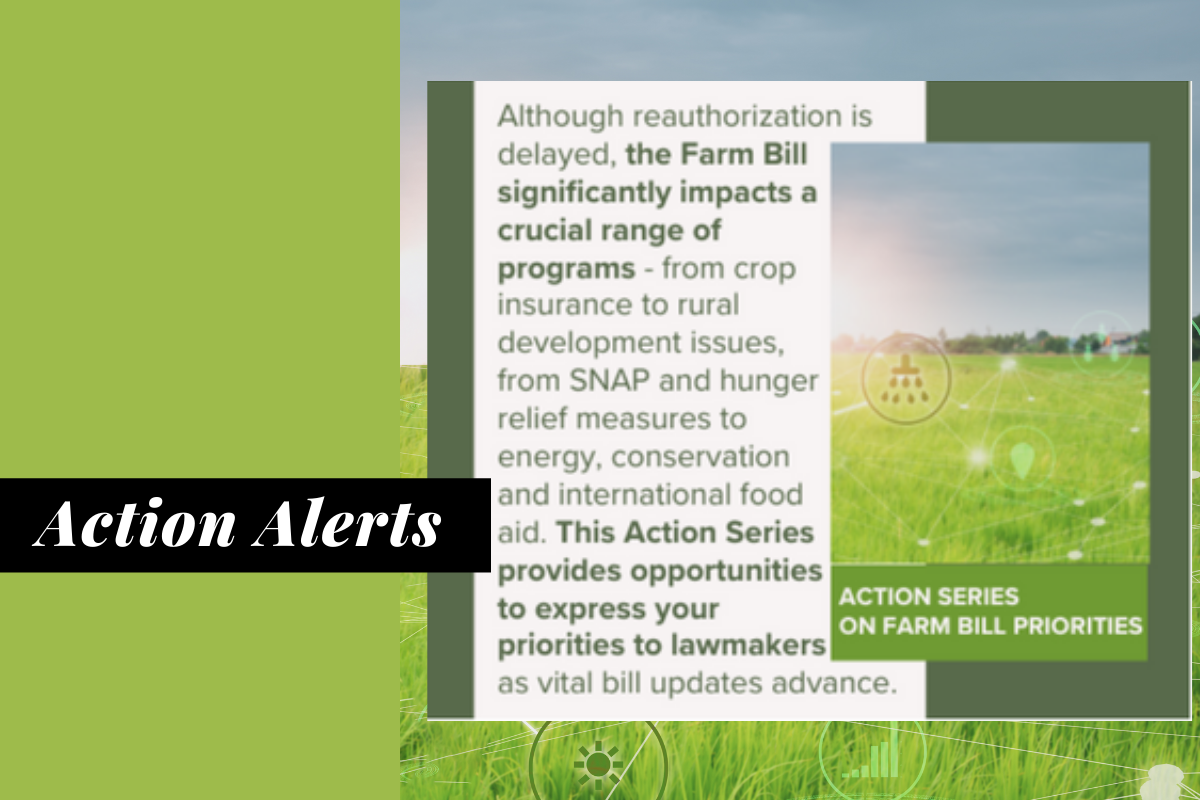
Future Farm Bill Action Alerts will be added to this page – but you can be notified directly by signing up for the ELCA Advocacy Network. New Action Alerts and monthly updates are sent to the network, which you sign up for📝here.

Take Action as Senate Considers Farm Bill Next
The Farm Bill is now being considered in the Senate, and sharing your experiences and values can help shape a result that meets rural and nutritional needs. [Posted: 5/27/2026]
 Resources & Webinars

- VIDEO: “Farm Bill Conversation” with presenter Alex Parker, ELCA Advocacy Coordinator (Recorded 6/19/24). ELCA Region 1 Conversation about the 2024 Farm Bill.
- RESOURCE PAGE: “H.R. 1 and the Supplemental Nutrition Assistance Program (SNAP): What Counties Should Know” (Oct. 31, 2025). From the National Association of Counties.
 Our Collective Voice
By raising our collective voice, we can help enact a more just Farm Bill that leaves no one hungry. In your location and federally, let’s act boldly to end hunger and poverty in our time and ensuring healthy creation to feed future generations.
Here are some other ideas for making your voice heard.
- Write a letter to the editor of your local newspaper on the importance of anti-hunger and pro-farmer policies in the Farm Bill.
- Attend town halls or public events with your members of Congress to ask questions about their Farm Bill priorities.
- Pray for those experiencing hunger and for our elected officials to have wisdom and compassion.
