
By Jeffery Jordan II [About the author]
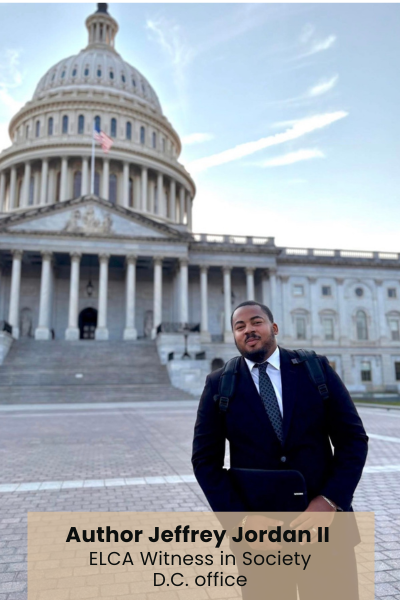 The halls of power can feel strangely dim. Not because of a lack of chandeliers or marble floors, but because of how easily human stories can be reduced to policy numbers, legal categories, and political calculations. Yet on an advocacy day on Capitol Hill this winter, representing the ELCA and walking alongside members of the National TPS Alliance, I realized some profound things.
Light does not need permission to shine. It only needs to be present.
In the words of Jesus to his disciples from Matthew 5:14–15, he does not say you should become light. He says you are light.
Advocacy is one of the ways that light becomes visible.
Temporary Protected Status (TPS) is a legal immigration status that allows citizens from other countries who are present in the United States during a catastrophe in their country to remain in the United States until it is safe to return home. TPS is often debated in terms of statutes, deadlines and executive authority. But sitting in those congressional offices – hearing TPS holders share their stories, their fears, their faith, their hope for stability – it became clear that advocacy is not just about influencing decisions. It is about refusing to let human dignity be hidden under the bushel basket of bureaucracy. It is about placing truth where it can be seen.
Light reveals what is real.
In the Hill visit conversations, there were moments when the atmosphere shifted – not necessarily because minds were changed immediately, but because hearts were confronted with presence. When someone speaks not as an abstract issue but as a neighbor, a parent, a member of the Body of Christ, the light shines. Even when outcomes are uncertain, the act of shining matters. Light does not measure its success by immediate transformation; it fulfills its purpose simply by illuminating.
This is where faith and advocacy meet.
 To advocate is to participate in God’s work of illumination, to testify that people are not invisible to God and therefore must not be invisible to the world. It is to stand on a hill, not for recognition, but for witness.
The light is not ours by merit.
It is entrusted to us by Christ, who calls us to reflect His justice, mercy and truth. There may be moments when the systems feel too large, the opposition too strong confirming our fears. But the promise of Jesus remains: a city on a hill cannot be hidden. When you speak, when you show up, when you advocate, you are already shining.
The question is not whether you have light.
The question is whether you will trust God enough to place it on the lampstand.
ABOUT THE AUTHOR
Jeffrey M. Jordan II is part of the D.C.-based staff of the ELCA Witness in Society office specializing in Policy. Jordan is an American lawyer and public policy researcher with a Juris Doctor from Tulane University Law School specializing in international law, a Master’s of International Affairs: Global Governance, Politics, and Security from American University School of International Service and Bachelor of International Studies and Public Policy from Sarah Lawrence College. Jordan also has a certification in Post-Conflict Resolution from Public International Law and Policy Group and from the Summer Program in International Affairs at Geneva Graduate Institute. He has several years of research, advocacy, and lobbying experience on domestic and international law and policy issues. Outside of work, Jordan enjoys spending time with his family, traveling, avidly reading and volunteering at church.
