
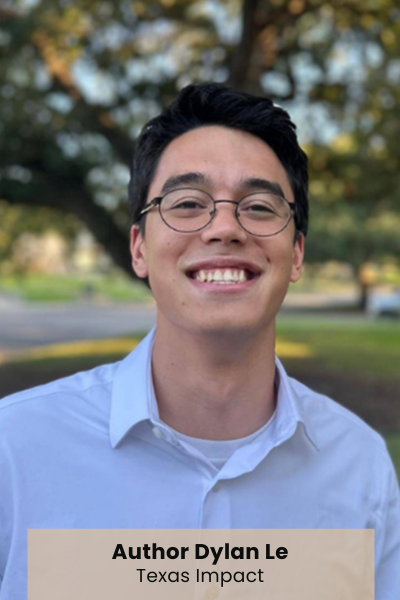
By Dylan Le [About the author]
 I came back from COP30, also known as the UN Framework Convention on Climate Change held in November 2025, with one thought in my head: the world is on fire and we aren’t doing enough to stop it. According to Pew Research Center, “Overall, 69% of Americans say large business and corporations are doing too little to help reduce the effects of global climate change. Six-in-ten also say state elected officials are doing too little on climate.” Inaction from our political and economic leaders has fostered hopelessness, a feeling I constantly encounter while speaking at events.
Yet at the same time, these statistics present a contradiction. Why is it that an overwhelming majority of Americans agree on an issue like climate change, yet often feel powerless to address it? It is not true to say that Americans are politically disengaged—the recent spike in primary election turnout would say otherwise.
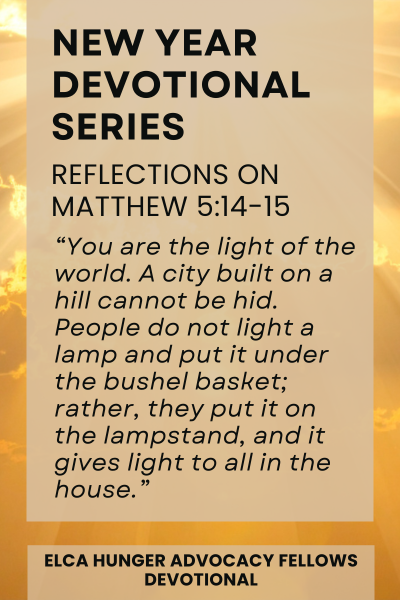 However, many Americans feel discombobulated by the complexities of our political system and are unaware of how to become politically involved beyond voting. To be an advocate that serves as “the light of the world” means serving as a beacon of hope and guidance for others.
In my time as an ELCA Hunger Advocacy Fellow, I’ve found that the light we provide to others can not only inspire hope, but action. Darkness often comes from a lack of information, and in Texas where I work, the darkness that fosters apathy and hopelessness necessitates the same illuminating light.
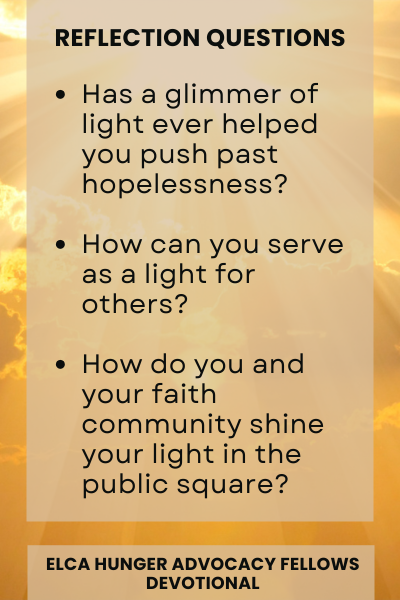 While I look forward to spending the coming legislative session in Texas fighting for justice, my time during the interim has been spent giving classes, writing articles and researching policy. Those who I encounter during Sunday post-service Lunch N’ Learns and during vigils honoring victims of gun violence are passionate and caring citizens. We should not pretend that advocates alone are the antidote to injustice.
Advocacy at its core means equipping the people with the tools they need to inspire the change they desire. At Texas Impact, we say that we help people live out their faith in the public square, moving the faith community from charity to justice.
While my time at COP30 left me determined by the awareness that we needed to do more, as I walked through the wide and bustling conference halls in Belém, Brazil, sweaty, hot and tired, I felt a tremendous sense of hope. I was surrounded by indigenous protestors, advocates, diplomats and activists from all over the world, all working towards a common goal—justice.
FROM THE EDITOR: Hear from Lutherans who attended the COP30 climate conference in video of the “Voices of Faith in Climate Action: COP30 and Beyond” post-event webinar, posted to the ELCA Advocacy YouTube channel.
ABOUT THE AUTHOR
Dylan Le is serving his ELCA Hunger Advocacy Fellowship as Public Policy Fellow with Texas Impact, an ELCA-affiliated state public policy office. Le holds a B.A. in Sociology and a certificate in Spanish from the University of Texas at Austin. As a son of a Vietnamese refugee and having specialized in Latin American Studies during his study abroad at the National Autonomous University of Mexico (UNAM), Mexico City, his work as a Public Policy Fellow is driven by his passion to promote legislation that protects and supports Texas’ diverse communities.
