Skip to content
ELCA Blogs

ELCA Advocacy

Flooding, Water Management and Budget Cuts

By Mary Minette, ELCA Director of Environmental Education and Advocacy

Fargo/Moorhead area

Flooding in the Fargo/Moorhead area. Photo Credit: Michael Nevergall

This month our series on the federal budget is focusing on how water programs may be affected by cuts in the federal budget.  The opening reflection focused on water quality and how proposed budget cuts will impact partnerships between the federal government and state and local communities. Those partnerships have made our nation’s waters substantially cleaner than they were 30 years ago

This spring and summer, several communities are struggling with a very different problem: too much water.  Higher than normal winter snowpack and greater than normal spring rain levels are overwhelming dams and levee systems throughout the Midwest and Southeast this year.  Communities in western Iowa, North Dakota and the Southeastern states along rivers from the Missouri to the Mississippi have been hit hard by flooding, with devastating impacts on farmland, homes and businesses.

As we pray for the recovery of these communities, we recognize the strain that rebuilding will place on the budgets of families and companies, and on the resources of local, state and federal agencies. As a church body, we do what we can through the work of ELCA Disaster Response

But we should also consider how the shrinking budgets of local, state and federal governments may impact the ability of communities to deal with flooding in the future. 

The Cedar Rapids (Iowa) Gazette recently reported that a critical monitoring system used by the National Weather Service to predict the path that floodwaters may take could be impaired because of federal budget cuts.  Stream gauges, operated by federal agencies working with states and local communities, track water flows in rivers and streams throughout the country.  Without this data it will be difficult to accurately predict when and where flood waters will crest.  But state and local governments are struggling to support these projects and federal budget cuts will endanger the monitoring system even further.

In a time of budget austerity, how do we decide which programs to save?

A Season of Prayer for Peace in Sudan

Season of Prayer Event in Chico at Faith Lutheran Church

Pastor Reg Schultz-Akerson quotes Matthew 5 at a Season of Prayer event held at Faith Lutheran Church in Chico, California. Photo credit: James Henson

In solidarity with our brothers and sisters serving, working, and living in Sudan, the ELCA encourages you to pray for peace for all of Sudan as South Sudan approaches its independence from the North on July 9th, 2011.

Here is a prayer shared by Faith Lutheran Church in Chico, Calif.:

Abba, heavenly Father,

On behalf of the community of Chico, California allow our voices to be heard in unison with others across this nation and across the world. We pray for peace and self-determination for our brothers and sisters in South Sudan as they begin the Good Works as people of a new nation.

Lord hear our prayers:

Let the land yield crops; not land mines.

Lord hear our prayers:

Grant that the people of South Sudan may dig wells for water; not graves for their children from violence and war.

Lord hear our prayers:

Grant that both adults and children may be free to pick up pencils to write rather than pick up guns to kill.

Finally, God may the words of your prophet Isaiah come true so that the South Sudanese and all peoples begin to “beat their swords into plowshares and their spears into pruning hooks.” (Isaiah 2:4)

In Jesus name we pray.

Amen

Human Dignity: LIRS’s Work of Welcoming Refugees to the United States

Guest blog posting by Eric Sigmon, director for advocacy, Lutheran Immigration and Refugee Service. This posting highlights the human dignity issues with regards to welcoming refugees into the United States.

On June 20th, the United States will celebrate World Refugee Day to raise awareness about the estimated 15.2 million refugees around the world and to celebrate the wonderful contributions refugees provide to communities across the country.

Lutheran Immigration and Refugee Service (LIRS), a nationally recognized organization based in Baltimore, MD, welcomes refugees and migrants on behalf of the Evangelical Lutheran Church in America, the Lutheran Church-Missouri Synod and the Latvian Evangelical Lutheran Church in America. LIRS partners with the federal government, local refugee resettlement partner organizations, and churches and volunteers to help refugees in the United States learn English, enroll their children in school, find jobs and become self-sufficient.  Since 1939, LIRS has welcomed over 372,000 refugees to the United States.

Here is a snapshot of the refugee populations LIRS currently assists:

Iraqis: LIRS has a long history of resettling Iraqi refugees, with a larger influx of arrivals in recent years. Many Iraqis have arrived to the United States through a special program to protect Iraqis who have been targeted as a result of their work and affiliation with the U.S. military.

Burmese: The Burmese are one of the largest and most diverse groups currently being resettled by LIRS. Since 1962 Burma has been under military rule. The oppression of minority ethnic groups has been brutal. Many Burmese refugees have lived in “temporary camps” for two decades or more. Many children and young people are born into these camps and do not know about life outside of these camps.

Bhutanese: Bhutanese refugees are mostly ethnic Nepalis from southern Bhutan, known as “Lhotsampas,” who have lived in camps in Nepal for more than 16 years. The Lhotsampas coexisted peacefully with the majority population, the Druk Buddhists, until the 1980s. Protests and clashes with the police culminated in the forced expulsion of Lhotsampas from the country in 1990.

Somalis: In 1990, after the civil war in Somalia, the Somali refugee crisis began and it continues today. Many Somali refugees have lived in camps in Kenya and Ethiopia for protracted periods with no durable solution available other than third country resettlement.

Eritreans: As a result of the Ethiopia-Eritrea war from 1998-2000, Eritrean refugees have sought protection in neighboring countries. Political tensions and increasing repression continue in Eritrea, with the targeting of independent evangelical groups. Most of the refugees LIRS currently serves practice Christianity or Islam.

LIRS also continues to serve refugees from Iran, Afghanistan, Sudan, the Central African Republic, the Democratic Republic of the Congo, Rwanda, and the former Soviet Union. In honor of World Refugee Day, please take time to pray, volunteer with a local refugee resettlement organization, or visit the LIRS website for further information:

LIRS Advocacy Page on Refugees

LIRS Work to Welcome Refugees

Frequently Asked Questions About Refugees

LIRS statement — Improving the Welcome for Refugees Resettled to the United States

LIRS statement — LIRS Supports Legislation to Provide Permanency to Liberian Migrants in the United States

LIRS statement — The Impact of Budget Proposals on Justice, Job Creation, Public Safety, and Civil Liberties

Prayers Still Needed for Sudan

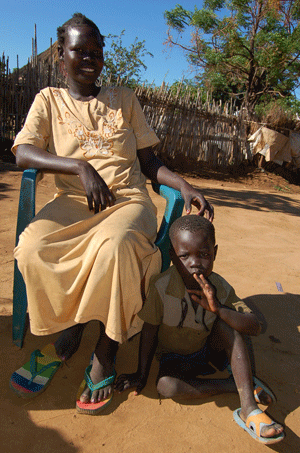
Sudanese woman with her son (Photo Credit: ELCA Washington Office)

Sudan has been plagued by internal conflict for nearly 40 years. A variety of complex factors, including race, ethnicity, religion and economic disparities fueled a 22-year conflict between the north and south and are also largely at the heart of the ongoing humanitarian crisis in Darfur that began in 2003.

Now South Sudan will be embarking on a new era. After a Comprehensive Peace Agreement ended this year, the people of Southern Sudan voted for independence from the rest of Sudan. On July 9, South Sudan will become an independent nation.

Recently, there have been reports of renewed violence in the contested area of Abyei. Abyei was to have its referendum to determine whether to be part of the North or South. However, the people in Abyei were not able to vote.

“Given the ongoing insecurity in Abyei, the Security Council believes that the security and prosperity of both parties would benefit from a continuing UN-mandated presence in Abyei after July 9, as well as from UN assistance for the parties’ management of their border after the independence of South Sudan. In this context, the Council urges the parties to reach agreement on a continuing UN-mandated presence.” (UN Security Council statement, June 3, 2011)

We invite you to pray with us as this ongoing violence continues to threaten humanitarian efforts and as the people of Sudan prepare for a new shift in political leadership. On every Friday from now until July 9, let’s give thanks to God and hope to the people of Sudan as they prepare for this significant step in securing peace for their country. These dates are June 10, June 17, June 24, July 1, and July 8. In the United States, we are called to pray at 11 a.m. (EDT), 10 a.m. (CDT), 9 a.m. (MDT), and 8 a.m. (PDT).


Here is a prayer from the Presbyterian Church (USA):

Our loving Heavenly Father,

We come before you to ask your forgiveness and seek your direction and guidance for South Sudan.

Lord, we know that bitterness and resentment are like toxic thorns in our soul, sapping our mental process, thought-life, will, motivation, and joy of our life.

Remind us that we will be the prisoners of our strongholds if we cannot forgive our brothers and sisters.

Help us to remember that forgiveness is the deliberate act of the will to pardon another individual or self whether we like it
or not.

Thank you for your word that we receive forgiveness in the same manner that we forgive others.

Help us to work out the torments of forgiveness with you alone our God and the other person, we are making the list of persons and situation causing troubles in South Sudan.

Intervene with the formation of the new Government and give us peace in South Sudan.

In Jesus Christ’s name, we pray. Amen.

Aliamma George
Presbyterian Church (U.S.A.) Mission Co-Worker
Malakal

Lutheran Day at the Capitol — Harrisburg, Penn

Guest Blog by Marissa Harris Krey, Advocacy Developer of Lutheran Advocacy Ministry in PA (LAMPa)

Lutheran Day at the Capitol in Harrisburg, Penn

Lutheran advocates participate in a workshop sponsored by Lutheran Advocacy Ministry in Pennsylvania (Photo Credit: LAMPa)

Last week, close to 140 Lutherans gathered in Harrisburg for LAMPa’s (Lutheran Advocacy Ministry in PA) annual Lutheran Day at the Capitol.  Torrential rain could not stop our advocates from gathering together to learn about issues facing Pennsylvania’s most vulnerable.

Why didn’t the rain stop them?  Why did so many travel so far? 

One advocate said, “Lutheran Day reminded me that I am not alone in my advocacy efforts on behalf of the poor and hungry”… together  1 + 1 + 1 can make a powerful difference.

Rev. David Beckmann, President of Bread for the World, was our keynote speaker and perhaps the biggest reason our advocates braved the storms. Several in attendance were amazed by his reminder that we have made progress on hunger in the past (in the U.S.) and that we are making progress RIGHT NOW all across the world. 

Matt, a resident of Lancaster, said, “I was struck by Beckmann’s comment that Americans have trouble seeing the dramatic progress.”  For many, Lutheran Day is about the opening of eyes:  to see the good, and to see the bad — but to see the bad together, and all the love and hope in the room that wishes it were not so, and believes in a God with transformative powers.

David Beckmann, keynote speaker at Lutheran Day at the Capitol in Harrisburg, Penn (Photo Credit: LAMPa)

David Beckmann, keynote speaker and President of Bread for the World, shared inspiring advocacy stories with the group. (Photo Credit: LAMPa)

This year’s keynote also reminded our advocates of the power in story telling.  Beckmann shared two stories, one of which I will tell again here.  Helpfully, Beckmann was open and honest about the feedback he gets from people who don’t believe in the power of faith-based advocacy. “I just don’t know who I’m really helping,” some say.  “You’re helping people like my son,” Beckmann said as he transitioned into his story.  The birthmother of Beckmann’s adopted son was on WIC (Supplemental Nutrition for Women, Infants, & Children) when she was pregnant. 

Stories such as this carry significant weight with lawmakers.  As faith-based advocates, one of our primary responsibilities is to help our elected officials see the faces behind the numbers on their spreadsheets; to help remind them who will really be affected by the policies they propose.

The value of coming together from many different places for a day like Lutheran Day may seem hard to measure, but it always shines through our evaluations.  This year was no exception: 

“Through networking, there seemed to be a proactive attitude emerging and a belief that we have an opportunity to be one strong voice in advocacy”.  Amen.

Comment Period Now Open for Proposed EPA Rule

The proper role of government—how big it should be, and what, exactly, it should be doing—is a hot topic in our country.  Some say too many government regulations are slowing economic growth and preventing companies from creating new jobs.  Others say government has a critical role to play in revitalizing our economy and protecting our families and our communities from harm.

So what if a regulation will cost businesses money and time in the short term, but will protect us from toxic pollution for years to come?

On May 3, the Environmental Protection Agency proposed a new rule under the federal Clean Air Act to limit emissions of toxic chemicals, including mercury, arsenic, lead and dioxin, from power plants.  The rules will also limit emissions of fine particles into the air. The public now has 60 days to comment on the proposed rule. Click here to provide your feedback.

Why is this rule needed now?  Power companies have fought these regulations for 20 years, arguing that they will have to raise rates in order to install the new equipment necessary to reduce emissions of mercury and other toxics. 

However, the pollutants the rule will reduce are extremely hazardous. Mercury, for example, affects brain development, making even small exposures dangerous for children and women who are pregnant or could become pregnant.  The EPA estimates that as many as one in every six women in the U.S. has blood mercury levels high enough to put a developing baby at risk.  All 50 states have mercury advisories for consumption of at least some of the fish found in their lakes, rivers and streams. 

According to the EPA, nearly fifty percent of the mercury in our air and water (and fish!) comes from emissions from coal-burning power plants. This new rule will ultimately reduce those emissions by 91 percent. More than half of U.S. power plants already have pollution control equipment that meets the new standards—these new requirements will level the playing field by requiring that all power plants protect the public’s health from harmful emissions.

Mercury is only one of the toxic pollutants that will be reduced by this new rule. Other pollutants affected by the rule are linked to cancer, heart disease, chronic asthma and other significant health problems.  These health problems cost all of us—in higher insurance rates, in loss of productivity, and especially in loss of lives.  Among other benefits, the EPA estimates that by 2016 the new rules will help to prevent more than 12,000 emergency visits annually and 850,000 days of lost work.  The agency estimates that the rule’s restriction on fine particle emissions alone could save between $59 and $140 billion in health care costs annually in 2016.

Martin Luther wrote that government is the means “by which most of all God preserves to us our daily bread and all the comforts of this life.”  It seems to me that reducing highly toxic pollution and thereby improving public health fits his definition of good government.  What do you think?

Advocacy and Ministry in the 21st Century

Kevin O’Hara is an intern with the Lutheran Office for World Community

Kevin O'HaraI just returned from two gatherings that focused on how ministry is changing, especially in the 21st century church, which may look a lot more like the church in the 1st and 2nd century than that of the 21st. This is a radical change, knowing that the church has come so far to embrace the 21st century, but it does not mean the church will abandon the good practices that have led it to today.

 What are some of these developing practices?  First, the church is becoming more relational within the community.  The apostles of the 1st century were sent out to new communities to preach God’s love. For advocacy, this might mean that models relying on people coming to the church/institution will integrate with churches living out their institutional beliefs through their work in the community as they may define it.  In addition, while internet and technology are the primary means of communication in much of today’s “developed” world, this is only a first line of communication for many people—nothing beats face-to-face encounters.

In this age, issues around social justice, racism, political, gender, sexual orientation, and disability are being reshaped in light of recent advancements. However, the biggest concern in the church for the 21st century will be over socio-economic barriers.  Lutherans are one of the most educated denominations and at times emphasizes an intellectual faith.  How might this impact how we do church and advocacy?

Lastly, church life could take on a diverse mystical experience.  Young adults long for connection to something greater than themselves (but claim spirituality over religiosity).  If there is a deep call to be connected to something greater than oneself, how might this shape advocacy?  One possibility is raising awareness through additional public events at the United Nations and in Washington D.C., where many people come together for a common cause.

Advocacy – There’s a book or two to write

Dennis Frado directs the Lutheran Office for World Community based in New York City. The advocacy office monitors the work of the United Nations.

Dennis Frado, Director, Lutheran Office for World Community

Dennis Frado speaks at an event in conjunction with the United Nations Commission on the Status of Women.

Among the current staff of the ELCA engaged in advocacy I definitely qualify as a “gray hair”.  Yes, the hair still left on my head is increasingly gray, but I’m really talking about having done this kind of work off and on for the past thirty-five or so years.

But the fact of the matter is Lutherans in the United States have been formally engaged in public policy advocacy since shortly after the Second World War II when the National Lutheran Council decided to establish an office in Washington, DC.  The Rev. Dr. Robert E. van Deusen oversaw that work for more than 25 years before he retired in the mid-1970s. 

Over the years the “Office for Public Relations” evolved from a stance of “eyes and ears” for the national Lutheran leadership to one of a more comprehensive public witness of the church to society as it carries out God’s mission and ministry in this nation and the world.  

Through this work, Lutheran leaders then, as today, have affirmed that “The witness of this church in society flows from its identity as a community that lives from and for the gospel. Faith is active in love; love calls for justice in the relationships and structures of society. It is in grateful response to God’s grace in Jesus Christ that this church carries out its responsibility for the well-being of society and the environment.” (The Church in Society: A Lutheran Perspective).

That’s why we are engaged in advocacy in Washington D.C., in state capitols, with corporations, and here with the United Nations.  I am grateful for the privilege of serving our church in this way.

Sick and Tired of Rising Gas Prices

Photo at http://www.1happilyevenafter.com

Do you feel like you're paying an arm and a leg when you fill up?

I don’t know about you, but the price at the gas pump is certainly hurting my pocketbook. I am sick and tired of paying over $50 each time I have to fill up. Quite frankly, I could use a break. In fact, I wouldn’t mind getting one of those tax breaks that the oil and gas companies get every year.

Our current tax law provides the oil and gas industry with more than $4 billion (yes billion) per year in subsidies. Why are they getting such high subsidies when oil prices are high and the industry is projected to report huge profits this quarter?

House Speaker John Boehner said on Monday that Congress should consider looking at the oil subsidies. President Obama, in a letter to Congressional leaders, wrote he was “heartened” to hear such openness. But shortly afterward, Boehner seemed to backtrack his statements.

Both political parties have talked about the need to make difficult cuts in the federal budget. We look at cutting non-defense discretionary spending, Medicare, Medicaid, Social Security, military spending. Why would we not look at subsidies to oil companies? What makes them exempt from cuts?

But I also wonder if instead of cutting the subsidies, we should take those dollars and invest them in clean energy to reduce our dependence on our planet’s dwindling stores of oil. We need to look at protecting our environment for future generations as well as finding a way to reduce our dependence.

And, to be honest, I wouldn’t mind lower gas prices.

Connect with Your State Public Policy Office

In Wisconsin, legislators are considering cutting state funding for the Earned Income Tax Credit, a proven anti-poverty initiative. The Colorado legislature is poised to cut health care funding for low-income children. In California, another round of funding cuts to K-12 education is being debated. And in New Mexico, funding for a state nutrition program for low-income seniors was just eliminated.

Similar state budget cuts are taking place all across the United States.

Christ Lutheran and Minnesota State Capitol

Minnesota's State Capitol Building and Christ Lutheran Church in St. Paul, Minnesota. Photo Credit: Mark Peters, director, Lutheran Coalition for Public Policy in Minnesota

In state capitols around the country, elected officials are required by law to balance their budgets. Unfortunately states are choosing to cut funding for key human needs’ programs due to decreased state tax revenues from the recession.

This current round of cuts for state-funded social programs comes on top of deep cuts already made over the last few years. Alarmingly, at the exact time states have been cutting funding for essential services, the need for these programs has risen as more and more families seek assistance due to unemployment and stagnant wages.

The ELCA has long recognized the importance of decisions made by state legislatures. Our State Public Policy Office (SPPO) network works to ensure that the needs of the country’s most vulnerable people are given high priority in state capitols.

The State Public Policy Offices speak to the biblical values of hospitality to strangers, care for creation, and concern for people living in poverty and struggling with hunger and disease. We encourage you to connect with your State Public Policy Office and advocate for just state policies for people in need. To see a list of our SPPOs and to learn more, click here.