Skip to content
ELCA Blogs

ELCA Advocacy

Living Earth Reflections: Protecting the Waters of the United States

Mary Minette, ELCA Director of Environmental Advocacy

April 2014


“I the God of Israel will not forsake them. I will open rivers on the bare heights,and fountains in the midst of the valleys; I will make the wilderness a pool of water and the dry land springs of water.”

Isaiah 41:17b-18

Water is a gift from God that is both essential to life and to our spiritual life as Christians. Water quenches our thirst, serves as a symbol of the beginning of our journey as Christians and nourishes and renews all life on earth. Stewardship of water resources is a critical part of our call to care for God’s creation.


The Clean Water Act

The Clean Water Act, which passed Congress in 1973, requires the federal government to protect the waters of the United States from pollution. Passed at a time in our national history when some rivers were so contaminated with industrial waste they could catch on fire, this landmark legislation is the reason that our lakes, rivers and streams can serve our communities as drinking water sources, support commercial and recreational fishing, and provide opportunities for swimming and other recreation. But many of our bodies of water are still under threat from pollution, and in recent years the scope of the Clean Water Act was called into question by two Supreme Court cases. These cases created uncertainty about whether small wetlands and streams are “waters of the United States” and deserving of the full protection of clean water regulations.

For more than four decades, the Clean Water Act protected the smaller streams and wetlands that feed into larger watersheds in our interconnected system of waters. According to the U.S. Environmental Protection Agency, about 60 percent of stream miles in the U.S. only flow seasonally or after rain, but have a considerable impact on the downstream waters. In fact, according to the agency, one in three Americans — more than 117 million people — get their drinking water from sources fed by these small and seasonal streams. But determining Clean Water Act protection for small streams and wetlands became confusing and complex following Supreme Court decisions in 2001 and 2006 that required the EPA to consider impacts on small and seasonal streams and wetlands on a case-by-case basis.

This month, the Environmental Protection Agency issued a draft rule that would provide clarity, protecting streams and wetlands that connect to larger watersheds and protecting the quality of the water that we depend on for drinking, washing, swimming and fishing. Under the proposed rule many of the streams and wetlands that were historically covered under the Clean Water Act will again be covered. The proposed rule works within the more narrow definition of “waters of the United States” given by the two Supreme Court rulings and clarifies that under the Clean Water Act:

  • Most seasonal and rain-dependent streams are protected.
  • Wetlands near rivers and streams are protected.
  • Other types of waters that have more uncertain connections with downstream will be evaluated on a case-by-case basis to determine if their connection to overall water quality is significant. However, to provide more certainty, the proposal requests comment on options protecting similarly situated waters in certain geographic areas or adding to the categories of waters protected without case specific analysis.

In addition, the proposed rule preserves a number of exemptions to permit requirements for farming practices that have been developed over the 40-year history of the Clean Water Act to protect water quality.


Learn more

The EPA will be inviting the public to comment on the proposed rule over the coming months — if you’d like to learn more, go to the U.S. Environmental Protection Agency page on the proposed rule.

This year’s Earth Day Sunday resource celebrates God’s gift of water and includes materials for use in worship as well as educational materials — use “Water, Holy Water” to plan an Earth Day service or other event in your congregation.


From Evangelical Lutheran Worship (page 71):

Holy God, holy and merciful, holy and mighty, you are the river of life, you are the everlasting wellspring, you are the fire of rebirth. Glory to you for oceans and lakes, for rivers and streams. Honor to you for cloud and rain, for dew and snow. Your waters are below us, around us, above us: our life is born in you. You are the fountain of resurrection … Satisfy all our thirst with your living water, Jesus Christ, our Savior, who lives and reigns with you and the Holy Spirit, one God, now and forever. Amen.

Living Earth Reflections: Choosing Your Fast

Mary Minette, ELCA Director of Environmental Advocacy

February 2014


“Is this not the fast that I choose: to loose the bonds of injustice, to undo the thongs of the yoke, to let the oppressed go free, and to break every yoke? Is it not to share your bread with the hungry, and bring the homeless poor into your house; when you see the naked, to cover them, and not to hide yourself from your own kin?”

Isaiah 58:6-7

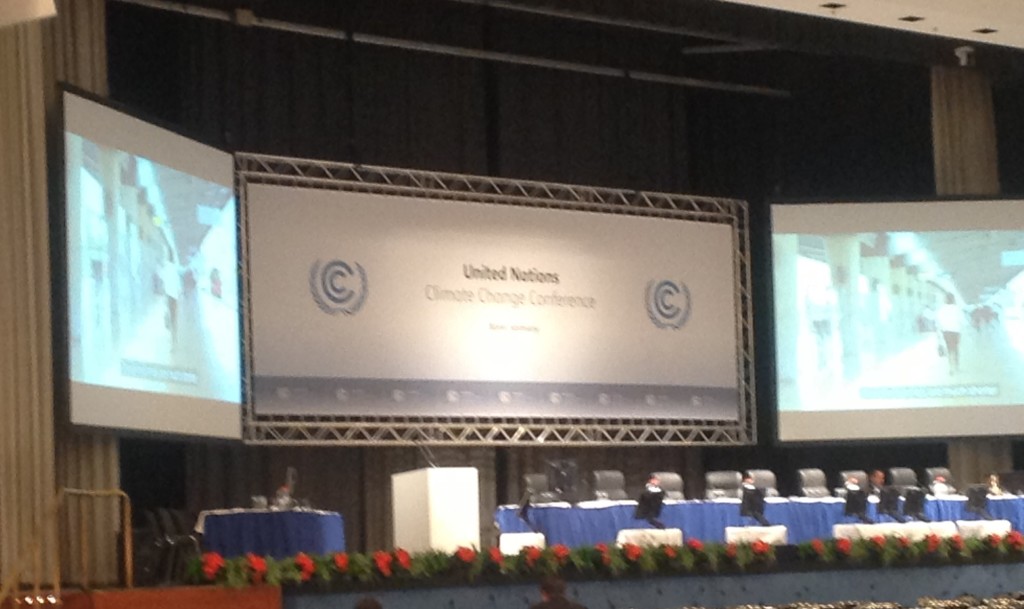
During the first week of the meeting of the parties to the UN Framework Convention on Climate Change in Warsaw last November, a delegate from the Philippines announced that he would be fasting for the duration of the meeting to call attention to the needs of those most vulnerable to climate change. This included the people of his own country, which had just been hit by the strongest typhoon ever recorded, causing massive losses of life and livelihood. Yeb Sano’s fast caught the attention of many of the people of faith attending the meeting — fasting is a practice that people of faith understand and connect to — and a number of the young adults who were part of The Lutheran World Federation’s delegation decided to join in the fast. Their gesture of support for the Philippines spread to others in the building, and by the time I arrived for the meeting’s second week, those who were fasting could be recognized by the red fabric dots they wore on their lapels as they hurried to plenary sessions and workshops.


Following the close of the meeting, the Lutheran World Federation delegates and others decided to continue their fast, selecting one day to fast each month until the next UN meeting in Lima, Peru, in December 2014. Their hope is that people will join the fast and tell friends and family that they are doing it to call attention to the need for global action and commitment to combat climate change. The UN process is working toward a new global agreement that would be signed in 2015 and take effect in 2020.


As I noted in my reflection post-Warsaw, what our neighbors need most from each of us is solidarity. They need our commitment to act and to urge our leaders to act to reduce emissions of carbon dioxide and other gases that are causing climate change. Fasting is a practice with deep roots in many religious traditions. However, an outside observer may not easily connect a fast from food with the very real difficulties faced by communities suffering from climate change, although food security and hunger are significant consequences of changing weather patterns.


A fast from food shows solidarity with those suffering from a changing climate, but doesn’t address the root causes of climate change. A fast from activities that contribute to carbon pollution highlights the fossil fuels that are at the heart of the problem and sends a strong message about the urgent need for individual and collective action. It also helps to name the responsibility that each of us bears for a global problem. But a carbon fast is challenging in ways that a food fast is not: refraining from eating for a day or a week is possible, but it is impossible to completely eliminate activities that involve using energy from fossil fuels. In recent years, a number of faith organizations have sponsored carbon fasts for Lent, with guides on what to give up (or stop doing) and why, but none of them suggests that completely cutting carbon emissions is a practical thing to do, or even a possibility.


So both types of fasting are flawed, but both are helpful tools for calling attention to the issue of climate change.


Which fast will you choose?

Sign up for daily emails during Lent to support your fast from the Massachusetts Conference of the United Church of Christhere.

Do you have questions or want to learn more about ELCA Advocacy? Visit our ELCA Advocacy News and Updates page or contact us at washingtonoffice@elca.org.

Advocating for compassionate and comprehensive immigration reform

This week, several ELCA bishops, pastors and leaders were in Washington, D.C., for the Lutheran Immigration Leadership Summit, hosted by our partners at Lutheran Immigration Refugee Service. The group visited more than 100 offices on Capitol Hill and the White House, advocating for compassionate and comprehensive immigration reform.

To read more about the summit, check out Linda Hartke’s (the president and CEO of Lutheran Immigration and Refugee Service) blog by clicking here or on the photograph below.

The Rev. Michael Wilker and Bishop of the ELCA Metropolitan Washington, D.C. Synod, the Rev. Richard Graham, meet with the office of Senator Barbara Mikulski

The Rev. Michael Wilker and Bishop of the ELCA Metropolitan Washington, D.C. Synod, the Rev. Richard Graham, meet with the office of Senator Barbara Mikulski


SNAP in South Dakota

By the Rev. Dr. Anna Madsen, OMG: Center for Theological Conversation in Sioux Falls, S.D.

The U.S. Census Bureau estimates that 824,082 people called South Dakota home in 2011.

In the last four years, the number of people receiving the Supplemental Nutritional Assistance Program (SNAP) — formerly referred to as Food Stamps — has increased from 63,655 in July of 2008 to 104,279 in July of 2012 (the last month on record). Not only do these numbers indicate that 12.65 percent — more than one in eight! — of my state’s population draw on food stamps for their daily bread, they also show that the need for assistance has increased 63.8 percent over the last four years.

These are shocking statistics.

Earlier this year, during an offering of letters at our church, our family wrote letters to our members of Congress, asking them to please retain funding for this key program. Our 8-year-old daughter put her own crayon to paper too, and sent off her request that our officials protect hungry children by protecting SNAP from budget cuts. While we were pleased that our daughter received a response from our Representative, we were stunned at what that letter told her. “Loopholes and fraud in the current program have lead [sic] to federal spending on SNAP to increase by 270 percent over the past ten years.”

My husband, an economist, and I, a theologian, were dumbfounded, not least of all because of our respective disciplines.

Based on both economic and basic moral grounds, this assertion couldn’t be more wrong.

December 2007 to June 2009 marked the greatest recession since the Great Depression, an economic event that clearly parallels the increase in families supported by SNAP. According to the Center on Budget and Policy Priorities there is almost no fraud in this program. Since 2008, despite obvious increase in SNAP benefits, the overpayment rate of 4 percent was reduced to 3 percent in 2011 (the last year on record); the underpayment rate went from 1 percent to 0.9 percent; the combined error rate in 2011 was only 3.8 percent; and the overpayment rates are counted as errors even when recouped. 

I wonder if our officials are aware that the non-partisan Congressional Budget Office points out that one-fifth of the increase in SNAP monies from 2007-2011 comes from the temporary allowance of higher benefits through the American Recovery and Reinvestment Act of 2009, and that higher costs of food and lower earned wages during the recession play a key role in the difference?

I also hope our officials realize that a wide range of religious leaders have converged from various traditions in a coalition called the Circle of Protection. They consider support of SNAP among its core commitments. These leaders and faith groups include our own church, the ELCA, and the U.S. Conference of Catholic Bishops, National Association of Evangelicals, Sojourners, Bread for the World, the National Council of Churches, the Salvation Army, World Vision and a long list of additional Christian clergy leaders from other traditions across the spectrum. The Jewish community, in a variety of forms, also advocates for SNAP, as does the Muslim community.

The inaccurate statement in the letter our daughter received back from Capitol Hill insults more than one-eighth of South Dakota constituents by suggesting that the primary reason for the increase to SNAP is because of loopholes in the system (loopholes which are then exploited), and fraud from the recipients. 

SNAP is part of the Farm Bill because it is not only a nutritional assistance program; it is also an agricultural assistance program. Feeding hungry people also means feeding farmers, by way of compensating them for their hard work in the fields and on the farms.

We have farmers in South Dakota. We have hungry people in South Dakota. 

I urge our officials in Washington, D.C., to protect SNAP from harmful cuts that would hurt farmers and the poor, not only in South Dakota, but across our nation.

Pastor’s daughter, social worker, advocate

By Erin Clark, MSW, LSW, Nachusa Lutheran Home (seen below with Illinois State Representative Don Moffitt at 2012 Lutheran Day in Springfield)

I am grateful to have grown up a pastor’s daughter (for all its craziness) because it generated the strong connection I have to advocacy, my church and the work I do now. Being the child of a pastor means that many people have known me and watched me grow up, often resulting in having to talk to people who are perfect strangers with a warm rapport. It also means I grew up in a family that valued service, volunteering and a sense of community. It is hard to ignore struggling around you when you identify an inherent connection within community.

Being “my father’s daughter” — something I hear all the time — means I grew up with a model of how to speak out and ask questions. I learned how meetings should function and that it is important to wrestle with the tough stuff because it makes us better. Wrestling with the tough stuff also means not ignoring the injustices around us.

As a young child growing up in our household, I was taken with the biography I read about Jane Addams and her work at Hull House. Once I entered Luther College, I began my studies in Social Work, moving further in my understanding of how to be an advocate. An interest in politics led to adding a double major of interdisciplinary Political Science/Sociology to Social Work. I completed my Masters in Social Work at the Jane Addams College of Social Work at the University of Illinois.

Now, I am working for Lutheran Social Services of Illinois, providing services to children and families in northern Illinois, I have served on the Northern Illinois Synod Social Ministry Committee, and I am a member of Lutheran Advocacy of Illinois. It is necessary to advocate for the needs of the children and families I serve on a daily basis. Sometimes it is small, working to link to a service that is needed. At other times, my advocacy looks much different.

Budget cuts always seem to plague social services. At the conclusion of the fiscal year in June, we look forward to the next year, wondering what resources or staff we will be without, and what services will no longer be available to our clients, and this ends up creating another opportunity to speak.

One summer when the state legislature proposed a 50 percent budget cut and I faced a layoff , my only outlet was to continuously write our legislators about the damage these cuts would do to the families in our state. I was concerned about what would happen to my colleagues and me, but my greater fear was what the result would be for the children and families we serve. My message to lawmakers was that these proposed cuts — which would reduce by half the stipend for foster parents along with eliminating all mental health and counseling services for children in foster care — were wrong and irresponsible. I noted to my officials that it was time to act responsibly and that we have a duty to children, elderly people and individuals with disabilities and mental health issues. I had many families tell me how they were unsure if they would be able to care for the children they loved, placed with them by the foster care system, due to the loss of state funding and mental health resources. Children, elderly people and those struggling with mental health issues are often the targets of state budget cuts for the services they require in order to survive. I had to use my voice, urging lawmakers to resist these devastating cuts.

Advocacy has many, many faces. Sometimes it is a big action, other times it is small, simply saying “this is wrong” or “this is what is needed.”

picture

The movement to end female genital mutilation

Rosemarie Doucette

Rosemarie Doucette

by Rosemarie Doucette, an ELCA delegate to the 57th Commission on the Status of Women

There was an awesome energy last week at the United Nations Commission on the Status of Women! Clearly times are changing for the better as issues of inequality, injustice and violence were brought to light with grace and power.  Women across differences of faith, race, gender identity, ethnicity and education united in the effort to bring truth and justice to those places where they are most needed. I was very impressed with the progress made in Mauritania in the movement to end female genital mutilation. Putting all girls at risk for their physical health, the deeper psychological damage that is done is often harder to assess and there are few resources for addressing it. While this is a harmful practice, it is nonetheless an integral part of the tradition of many cultures so its eradication must be approached with sensitivity and options must be introduced.

I was encouraged by the work of speaker Mariem M’bareck of Mauritania who has worked extensively with both the religious community and health care providers in order to educate and mobilize people from within their own communities instead of alienating them through a campaign waged from outside of their culture. First Mariem met with a few Imams who established that the Koran does not require female genital mutilation of any female, of any age, for any circumstance. The Imams, respected as wise religious leaders, will educate the people in their communities so that over time the misunderstanding that female genital mutilation is a requirement of Islam might be corrected. The group of Imams who have made this commitment has grown from two to over 200. Health care providers will approach the eradication of female genital mutilation from a health standpoint, highlighting the extreme and lifetime health risks involved while teaching women and men that the reasons used to justify it are based on misconceptions, superstitions and myths.

Another piece of the situation is that the women who perform the cutting will be left without a livelihood. It is important that their financial and social needs be met by the community because they are most often uneducated and this will be a difficult thing to process, that their service to the community will no longer be needed.

Finally, and perhaps the most uplifting and easiest transformation to make following the eradication of female genital mutilation will be to provide young girls with new rituals to mark their passage from babies to young girls and from young girls to young women. For thousands of years the passage of boys to young adulthood has been marked by circumcision, preceded and followed by communal celebrations and privileges. Girls, on the other hand, were more likely to be cut in private and would have to spend even more time in healing. Their passage to womanhood was generally not celebrated in community. In the new light of hope, equality and human rights, communities where female genital mutilation is being eradicated are now replacing this practice with healthy ways of celebrating and marking this life passage, thus ensuring better physical and psychological health, and more social equality.

Thanks be to God at CSW57

Hayley Bang

Hayley Bang

by Hayley Bang, an ELCA delegate to the 57th Commission on the Status of Women

The day before attending the United Nations Commission on the Status of Women, I read a news article that stated in 2012 one South Korean woman was killed by her intimate partner per three days. Around 120 women were killed by their intimate partners in one year.

“男尊女卑 女必從夫” has been the key concept for the gender hierarchy of Korea. The first four letters literarily mean men are higher than women, and the second half means women must follow or obey their husbands. I was also a victim of this concept which still is exercised unconsciously among Koreans and the first generation of Korean Americans. I always questioned why men and women are not equal and especially questioned the unfairness of a male dominant society where not only men but also women oppressed other women.

So, for me, the opportunity to be a part of the Commission on the Status of Women is a great opportunity to learn about women’s rights on a global scale. I was very nervous and excited about it. I was able to attend different side events and events that were led by The Lutheran World Federation and the World Council of Churches. I learned a lot of new things about different cases of violence against women. I was impressed by the quote that “Women’s Rights = Human Rights.” However, I was sad about the fact that we still talk about women’s rights rather than just human rights, in a sense of gender inequality. It is sad that what gender you are born into determines whether you have more rights compared to the other gender. It is not limited to one particular area in the world, but it is a global problem. Yes, we are all different, yet women were similarly oppressed by the other gender and also by other women.

However, I do not give up there. I believe in unity in diversity yet variety. I know that we need different approaches in different cultures to end the violence against women. However, we have one and the same purpose, we are united as one during the Commission on the Status of Women. We are shouting and acting together with one voice to end the violence against women. The Commission on the Status of Women was the place to gather those voices together, and act together, yet gave us wisdom and knowledge about how to contextualize in each culture to end the violence against women. Thanks be to God for the people that I met during this year’s Commission on the Status of Women, the experiences I had, and more importantly thanks be to God that God is working in us, with us and calling us to be God’s people and to look after each other.

“I can do all things through Christ that strengthens me”

by Candace L. Strand, an ELCA delegate to the 57th Commission on the Status of Women at the United Nations

Candace L. Strand

Candace L. Strand

Philippians 4:13 says, “I can do all things through Christ that strengthens me.” As I reflect upon my life as an African American woman who may have been a statistic of domestic violence myself during 1977 to 1983, I give God the glory, honor and praise for my deliverance. When I think back to that part of my life I know that it could have been worse. But God and the mercy and grace factor stepped in.

I had two wonderful daughters to raise while I went through mental and drug abuse situations. I was married twice. In the first marriage I was young and ignorant. There was fighting and an adulterous situation was present. Sex was often forced. In the second marriage, I came to know the Lord and our relationship went south. At first the drug issue was a part of my life, but when I became saved my ways changed and my companion’s life did not. There were women in the home when I was not there in that drug atmosphere during that time. I prayed a lot during that time period of my life. Life was hard financially and things were cutoff in the home. My two daughters and I were without heat and electricity during those difficult times in my life. Yet, I was very spiritual. This seemed to compensate for the ending of that marriage and that season in my life.

Presently, I am a minister of the gospel of Jesus Christ. I have survived from that sadness and oppression. I have remarried. I have been married for 17 years. My husband is a Christian. My daughters are grown and I have five grandchildren. I feel so blessed. I had to be humble during those years. I am still humble and I believe that the Lord took me through my adventure for a reason.

So many times life throws stumbling blocks into our path. I would have never thought that I would have gone the way that those situations locked me into. I was always a hard worker. I had several jobs and I was also on welfare at different times too. But God —

Oh, by the way, I did not mention that I am a college graduate with two bachelor degrees. I am presently a senior under the Master of Divinity program at Lutheran Theological Seminary at Philadelphia. Thank you, Lord! As you can see, life goes on.

What’s next for me? Well, the leading of the Lord is my guide. I have learned that weeping may endure for a night but joy comes in the morning. Through disappointments, regrets, pain and love, I have endured hardness as a good soldier. I have learned that I have to take one day at a time. Sometimes when I desire to be in a better financial state or be living in a better home or even be rich, I think about Jesus and the life that Jesus lived. How can I complain? God is good. Thank you, Lord! As a 58-year-old woman I feel stronger and wiser each day. Women are powerful too! Peace.

Eliminating violence against women is God’s work

Mary Hansen-Joyce

Mary Hansen-Joyce

by Mary Hansen-Joyce, ELCA seminarian and delegate to the United Nations Commission on the Status of Women

I am honored and pleased to submit my thoughts and impressions about the 57th United Nations Commission on the Status of Women. Four classmates and I were invited to attend the United Nations Commission on the Status of Women as The Lutheran World Federation delegates during its first week. We are seminary students at The Lutheran Theological Seminary at Philadelphia, taking an elective year-long course in Human Rights that is based on the United Nations Universal Declaration of Human Rights. We five female students of diverse ages, ethnicity and backgrounds chose to attend Commission on the Status of Women because of our individual interests in women’s issues.

As I attempt to say in this space what my experience has been, the words “universal” and “solidarity” stand out. Our unique personal stories and interests are obviously diverse, yet undeniably universal as female children of God. When we come together to share our stories and experiences, as well as our shared prayer for the violence to end, we find solidarity in our commitment to work toward the end of the violence. With one voice, united and emboldened through the history of ecumenism, we seek to remain strong and vocal about the reality of violence again women.

The numbers are staggering to me. Seven in ten women worldwide are affected by some form of violence in their respective cultures and communities. One in three members of every church community in the United States is affected in some way by domestic violence. Women and girls are dying daily because of the violence that has been embedded for generations in the culture and the religious traditions of their communities. No country is immune. This can, and must be, changed.

The facts are often overpowered by culture and faith traditions, social stressors, economic pressures and political tactics. There is clear evidence that the welfare of all individuals is improved when women and girls are educated and treated equally.

Nevertheless, it will take continued courage and determination, which is why I hope that this year is the first of many years that I will travel to New York City for the Commission on the Status of Women. As a result of attending the event this year, I am bringing back the book “When Pastors Prey” (published by the World Council of Churches) to be considered as part of the seminary curriculum in the future. I am bringing into my future ministry as an ordained pastor the undeniable need to remain connected to these issues, and the women and men involved in them. I also bring the belief that anything I can do to inform both men and women, and engage in dialogue and ministry with my community toward the elimination of violence, is God’s work.

Bringing a message home

Maria Murerwa is a young adult delegate from the ELCA to the 57th Commission on the Status of Women at the United Nations. Click here or the picture above to listen to Maria share insights from her experience at the Commission on the Status of Women, and how she can bring back what she learned to her congregation.