Skip to content
ELCA Blogs

ELCA Advocacy

Devotional: Using Voice for Justice and Human Dignity

By Abigail Raghunath [About the author]

Origins of the Declaration of Human Rights

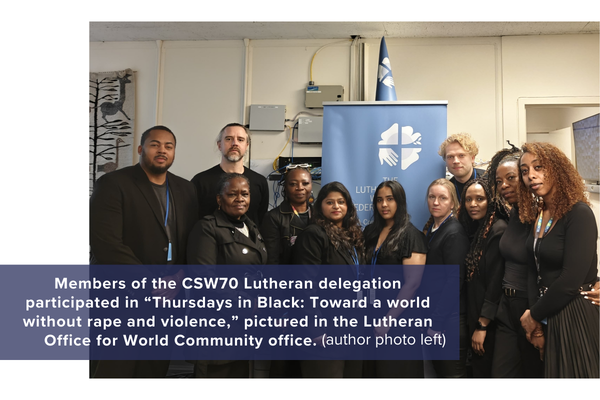
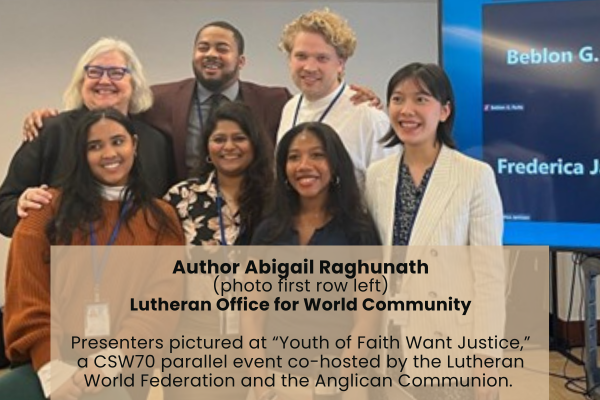
In the aftermath of World War II, the United Nations began to take shape, grounded in a vision of peace, dignity and shared responsibility. Its foundational document, A group of seven people smiling in a conference room with text overlay describing an event. Author Abigail Raghunath (photo first row left) Lutheran Office for World Community. Presenters pictured at “Youth of Faith Want Justice,” a CSW70 parallel event co-hosted by the Lutheran World Federation and the Anglican Communion.the Universal Declaration of Human Rights, was not just a promise; it was a global commitment that human rights are universal and must be protected.
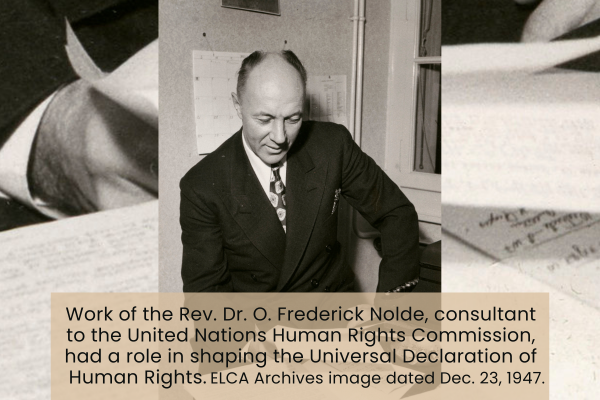
While the declaration was drafted by representatives from across the globe, it holds a special connection to the Lutheran community. The Rev. O. Frederick Nolde, a professor at the Lutheran Theological Seminary at Philadelphia, participated in the drafting through his work with the World Council of Churches. In collaboration with Eleanor Roosevelt, he helped shape Article 18, affirming the right to freedom of thought, conscience and religion.
Text overlaid on a bright cloud background with reflection questions.Given this history, it serves as a reminder to not only Lutherans but to Christians more broadly that advocating for justice and human dignity is part of our moral duty.


Experience in 2026 at CSW70

Each year, at the UN Commission on the Status of Women (CSW), UN entities, civil society organizations and Member States come together to assess both the progress made and the gaps that remain in advancing gender equality. These discussions are guided by the Beijing Declaration and Platform for Action, as well as the 23rd special session of the General Assembly (Beijing+5), and they continue to address emerging issues affecting women and girls worldwide.

In 2026, CSW70 looked quite different from previous sessions. Visa restrictions affecting participants from over 70 countries, disagreements over key terminology and rising geopolitical polarization all shaped the experience. In response, there was a stronger emphasis on virtual participation to ensure that voices unable to be physically present were still heard.

At the same time, conversations around issues such as armed conflict, sexual and reproductive health care and migration required thoughtful and careful engagement.
Despite these challenges, CSW70 ended on a hopeful note, with the adoption of agreed conclusions that renewed the global commitment to ensuring that all women and girls have access to justice.


Religion and Human Rights

Human rights are often framed as secular and sometimes even in tension with religion; but we know that this narrative falls short. The call to love our neighbor, to treat others with dignity and to stand against injustice is deeply rooted in scripture.

Today, churches and other faith-based organizations work tirelessly to advocate for human dignity, provide humanitarian aid and protect vulnerable communities. Churches like ours hold a unique role because we are trusted within our communities and carry a moral responsibility to speak out for what is right.
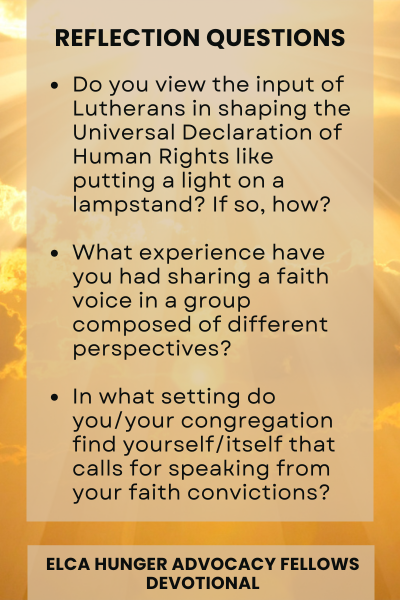
Within spaces like CSW and the United Nations, the Lutheran delegation shows up not just as another civil society organization, but particularly as a faith-based voice that reflects the values of the Christian tradition. That voice is demonstrating how our faith calls us to stand with and protect others.


Seeking Justice Together

At CSW70, we saw this in action. Through interfaith dialogue, ecumenical women’s engagement and youth participation, we were able to advocate for greater access to justice for women and girls. Together, we are stronger; and together, we continue the call to seek justice and serve others.


ABOUT THE AUTHOR

Abigail (“Abby”) Raghunath is an ELCA Hunger Advocacy Fellow placed with the Lutheran Office for World Community (LOWC), the Lutheran representation to the United Nations. Raghunath is a native New Yorker. She recently earned a master’s degree in International Security, Conflict Resolution, and Gender Public Policy from Columbia University’s School of International and Public Affairs, where her research focused on the impacts of climate and conflict on civilians. She also holds a bachelor’s degree in Political Science and International Relations from City College of New York. Earlier this year, Raghunath interned with the UN Department of Peacekeeping Operations, contributing to advocacy on women’s participation in defense and security reform.
Justice for Women and Girls Needs Ongoing Building

By Jeffery Jordan II, ELCA Hunger Advocacy Fellow (2025-26 cycle)

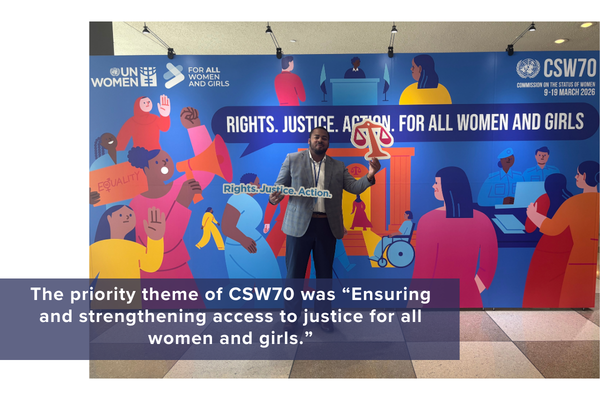
The experience felt both deeply personal and globally significant while at the United Nations Headquarters for the recently-concluded 70th session of the Commission on the Status of Women (CSW70). CSW70 gathered advocates, policymakers, attorneys, faith leaders and young people from around the world, all committed to advancing justice for women and girls. Walking into those spaces each day, I was reminded that justice is not just an idea we debate, it is something we build together, across cultures, languages and lived experiences.


Meaningful Touchpoints

One of the most meaningful moments for me was serving as a panelist during the Ecumenical Women CSW orientation. In that space, we welcomed new advocates into the movement, grounding them in both the purpose of CSW and the role faith communities play in advancing gender justice. I shared reflections on how faith traditions can be powerful tools for dignity, equity and liberation when they are rooted in compassion and accountability. It was inspiring to see so many individuals ready to engage not only with policy, but with the moral call to ensure that women and girls are seen, heard and protected.

Later in the week, I had the honor of being a panelist for “Youth in Faith Want Justice,” a conversation that centered the voices of young people who are actively shaping what justice looks like today. In that discussion, we explored how youth are reimagining systems that have historically excluded or harmed women and girls. We spoke about the urgency of addressing issues like gender-based violence, economic inequality and access to education, but also about the hope that comes from a generation unwilling to accept injustice as the status quo. For me, it was a powerful reminder that young advocates are not just the future, they are the present.

Another deeply meaningful moment was leading an African libation during morning worship. That act of honoring ancestors, grounding ourselves in history, and recognizing the spiritual dimensions of justice brought a different kind of depth to the week. In a space often focused on policy language and negotiations, the libation created room for reflection, connection, and reverence. It reminded us that the fight for justice for women and girls is not only political, but also spiritual, rooted in resilience and collective care.


Justice as Lived Reality

Throughout CSW70, the theme of justice for women and girls echoed in every session, conversation and gathering. But what stood out most to me was how justice was being defined as not just legal equality, but as lived reality. Justice means access to housing, healthcare, education and safety. It means building systems that affirm dignity rather than deny it.

As I left the United Nations at the end of the week, I carried with me a renewed sense of purpose. It was about being part of a movement. That movement is one that continues long after a CSW ends, calling each of us to act, to advocate and to believe that a more just world for women and girls is not only possible, but necessary, and men can support that change.

Big Dreams Beyond What Seems Possible

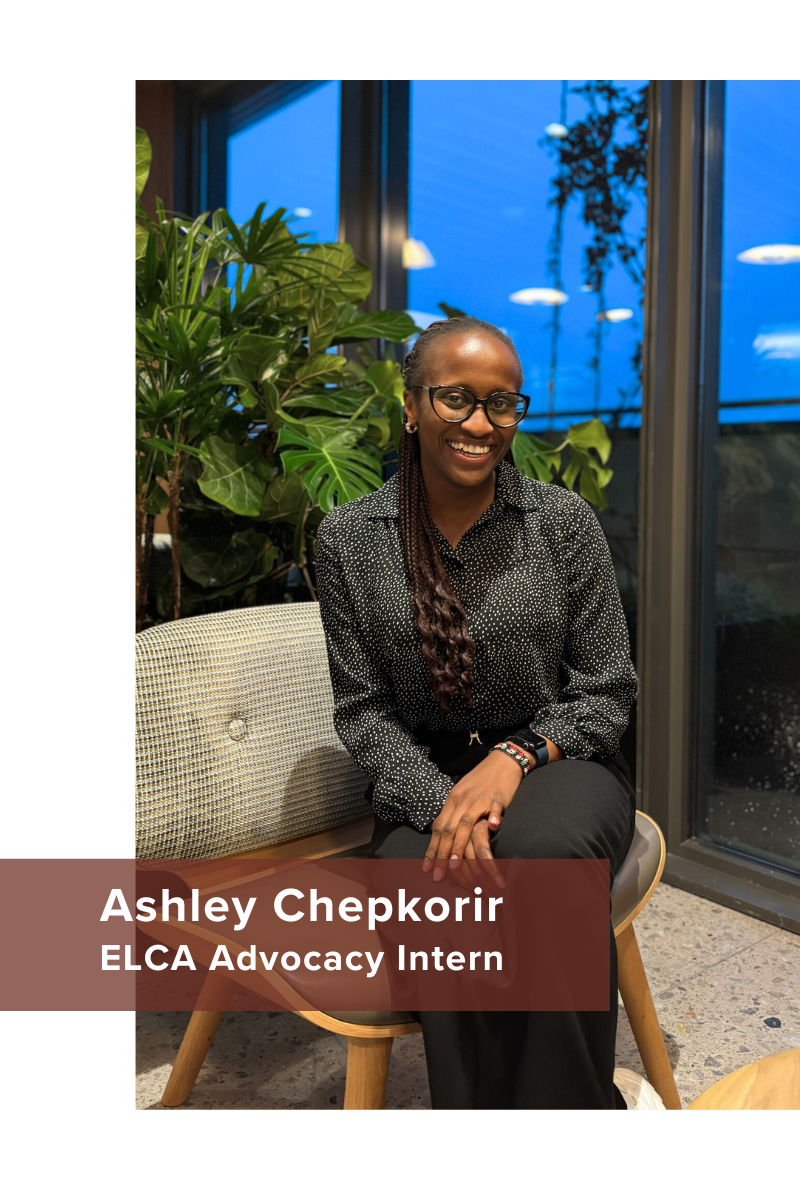
By Ashley Chepkorir [About the author]The author, Ashley, sits on a chair near a window, surrounded by green plants.

International Women’s Day, observed on March 8, is a moment to celebrate the existence, resilience and potential of women everywhere. It is also a reminder that every girl deserves the chance to imagine a future that may seem impossible in the moment.

When I was 12 years old, my grandmother, who had shielded me from a lot, passed away. Around the same time, I was beginning to notice something else in my community: girls were not always encouraged to dream as boldly as boys. Education and opportunity did not always reach us equally. At that age, I could not have imagined the path my life would take.The image features three individuals indoors, under bright lighting. In the center, a person wearing a blue school uniform, including a blazer and tie, holds a phone. On the left, another person in a black polo shirt with a visible logo is engaged in conversation. On the right, a third person is wearing a striped dress and glasses, attentively looking at the phone. Behind them, a group of people is seated, and colorful, decorative elements adorn the room's walls. Transcribed Text: Our author (photo center) in high school at Mpesa Foundation Academy.

But I decided to keep chasing my dreams anyway.

That decision led me to the Mpesa Foundation Academy, a leadership high school in Kenya, where I received a fully funded scholarship. From there, I was able to attend Concordia College, Minn. on a full scholarship as well, studying political science and global studies on the pre-law track while developing my leadership and advocacy skills. Today, as I prepare to graduate from Johns Hopkins School of Advanced International Studies in just a few months, I often think about that 12-year-old version of myself.

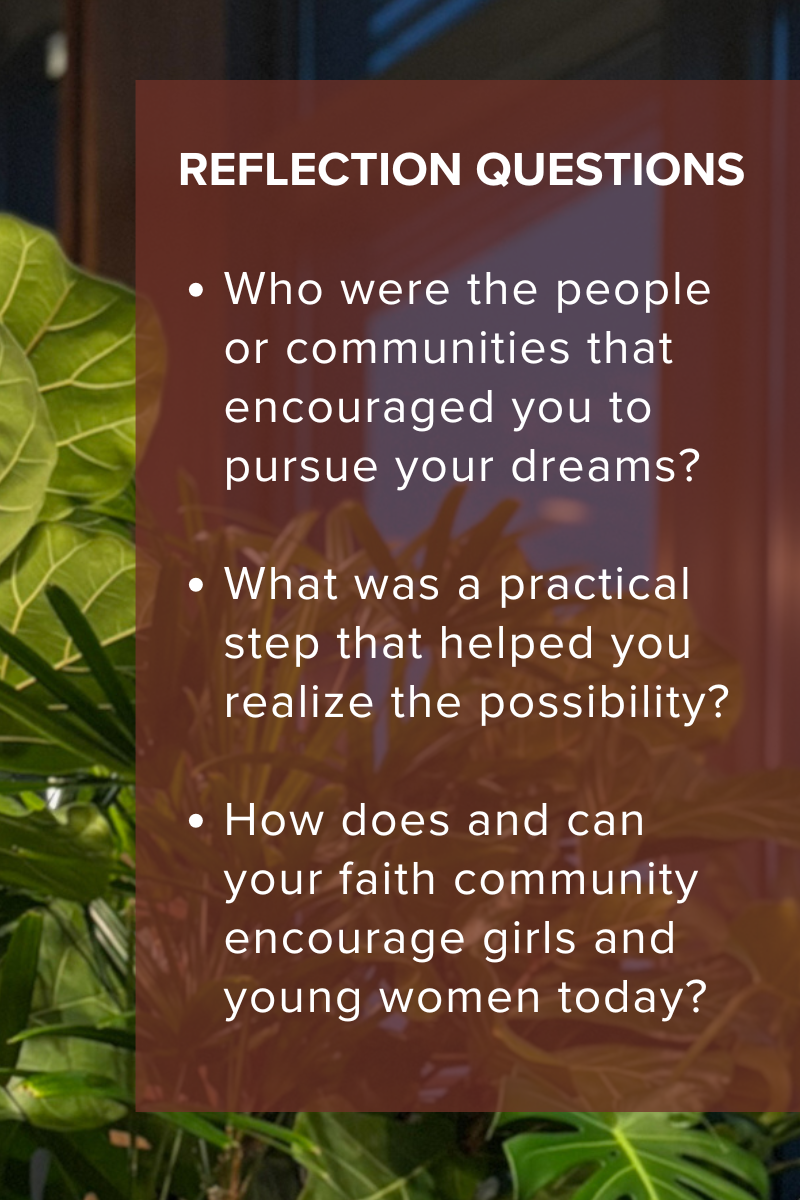
Reflection Questions: Who were the people or communities that encouraged you to pursue your dreams? What was a practical step that helped you realize the possibility? How does and can your faith community encourage girls and young women today?I would tell her that anything is possible.

The ELCA’s social teaching reminds us that every person is created with dignity and that society flourishes when everyone has the opportunity to contribute their gifts. Supporting women and girls is not only about fairness, it is about building communities where everyone can thrive.

The good news is that the world is changing. I now see more communities investing in girls’ education, leadership and potential than ever before.

My hope is that younger girls see stories like mine and realize that their dreams are not too big. They are exactly the size the world needs and that one day, they too will get to do what they love.


ABOUT THE AUTHOR

Ashley Chepkorir is an Advocacy Intern with the ELCA Witness in Society staff in Washington, D.C. Chepkorir is a graduate student at the Johns Hopkins School of Advanced International Studies (SAIS), where she is pursuing an MA in International Relations with a concentration in Governance, Politics, and Society and a regional focus on Africa. She holds a BA in Political Science and Global Studies (Pre-Law) from Concordia College in Moorhead, Minn., graduating magna cum laude. She is passionate about advancing equitable global policy and strengthening partnerships that support humanitarian, development, and governance outcomes.

Devotional: Gift of Being Unhidden

By Daniella Garber [About the author]

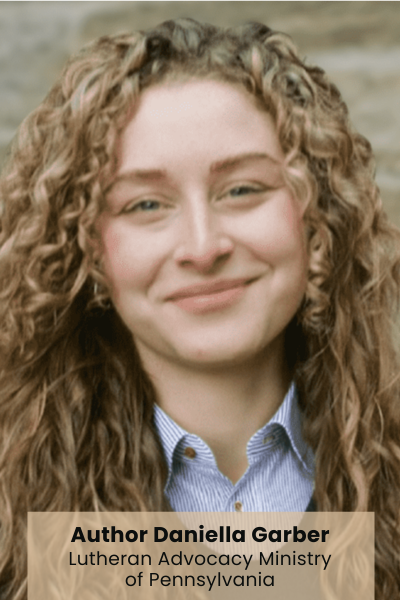
A person with long, curly hair wearing a blue, collared shirt, stands against a blurred background. I grew up in a small city nestled in the Allegheny Mountains. As a small child, I was fixated on a rock formation on the side of one of those mountains that, to me, looked exactly like Noah’s ark. I was certain that was where the ark had landed after the flood, and that it had been there so long it had disintegrated in a way that prevented any trees from growing where it had sat. Eventually, my brain caught up with my imagination, and I let go of that particular belief. To this day, however, when I visit my family in that city, I always take note of the formation. It brings me a sense of peace and comfort to see it there, unmoving and unobscured on the hill.

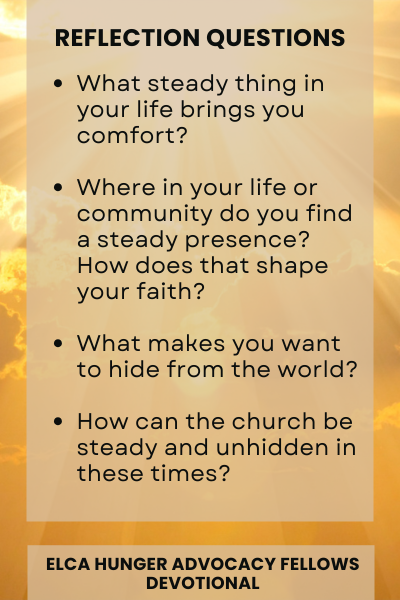
Text overlaid on a bright cloud background with reflection questions.That is what mountains do. They never move. Driving down any road, you can always find them on the horizon, always get your bearings. Their steady visibility is a gift.

Jesus describes a city on a hill that cannot be hidden, existing faithfully in plain sight. I think that image has something to teach us about what it means to be advocates for our neighbors and for God’s creation. This work is long. We don’t always see immediate results. Our advocacy can feel invisible, and progress is not always linear. But we are called to remain steady and unhidden, a constant presence of hope.

A card with reflection questions on a golden background. REFLECTION QUESTIONS: What steady thing in your life brings you comfort? Where in your life or community do you find a steady presence? How does that shape your faith? What makes you want to hide from the world? How can the church be steady and unhidden in these times?The mountain doesn’t move. It does not hide or disappear. Neither should we.

To be a faithful advocate is to be uncompromising on what we know to be true: that every neighbor bears the image of God, that creation is sacred and worth protecting. Sometimes being a light to the world means staying on the hill, not because the view is always encouraging, but because someone in the valley is looking for us. Someone needs to find us there, steady and unhidden, the same place we were last time they looked up.

When I was a kid, that rock formation brought me wonder. Now it brings me peace. The mountain never moved, but what it meant to me changed. A city on a hill cannot be hidden. As advocates and Christians, we are called to be that city—unhidden from the world and consistent in our values and our faith.


ABOUT THE AUTHOR

Daniella Garber is the ELCA Hunger Advocacy Fellow placed with the Lutheran Advocacy Ministry of Pennsylvania. Garber graduated from Bryn Mawr College with a math major and religion minor. Her background includes internships in data analytics and policy research focused on hunger and food access, as well as interfaith community building at Bryn Mawr College, and is excited to bring these experiences together in this faith-based advocacy role.

Devotional: Light on the Hill

By Jeffery Jordan II [About the author]

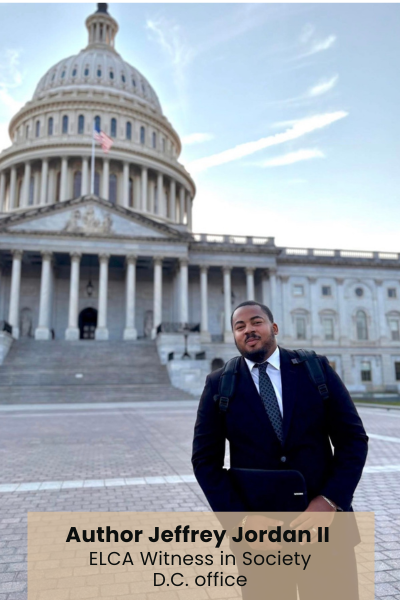
A person in a suit stands in front of the United States Capitol building.The halls of power can feel strangely dim. Not because of a lack of chandeliers or marble floors, but because of how easily human stories can be reduced to policy numbers, legal categories, and political calculations. Yet on an advocacy day on Capitol Hill this winter, representing the ELCA and walking alongside members of the National TPS Alliance, I realized some profound things.

Light does not need permission to shine. It only needs to be present.

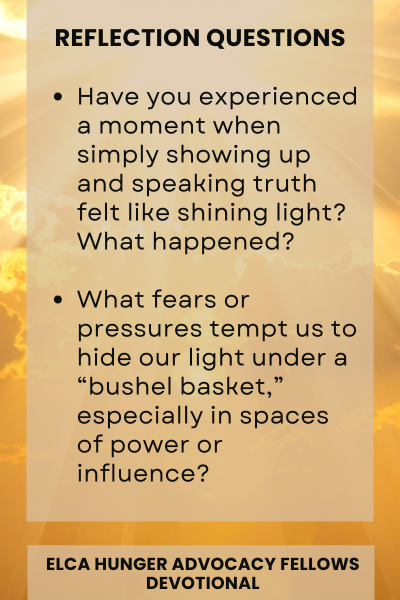
In the words of Jesus to his disciples from Matthew 5:14–15, he does not say you should become light. He says you are light.Text overlaid on a bright cloud background with reflection questions.

Advocacy is one of the ways that light becomes visible.

Temporary Protected Status (TPS) is a legal immigration status that allows citizens from other countries who are present in the United States during a catastrophe in their country to remain in the United States until it is safe to return home. TPS is often debated in terms of statutes, deadlines and executive authority. But sitting in those congressional offices – hearing TPS holders share their stories, their fears, their faith, their hope for stability – it became clear that advocacy is not just about influencing decisions. It is about refusing to let human dignity be hidden under the bushel basket of bureaucracy. It is about placing truth where it can be seen.

Light reveals what is real.

In the Hill visit conversations, there were moments when the atmosphere shifted – not necessarily because minds were changed immediately, but because hearts were confronted with presence. When someone speaks not as an abstract issue but as a neighbor, a parent, a member of the Body of Christ, the light shines. Even when outcomes are uncertain, the act of shining matters. Light does not measure its success by immediate transformation; it fulfills its purpose simply by illuminating.

This is where faith and advocacy meet.

To advocate is to participate in God’s work of illumination, to testify that people are not invisible to God and therefore must not be invisible to the world. It is to stand on a hill, not for recognition, but for witness.

The light is not ours by merit.

It is entrusted to us by Christ, who calls us to reflect His justice, mercy and truth. There may be moments when the systems feel too large, the opposition too strong confirming our fears. But the promise of Jesus remains: a city on a hill cannot be hidden. When you speak, when you show up, when you advocate, you are already shining.

The question is not whether you have light.

The question is whether you will trust God enough to place it on the lampstand.


ABOUT THE AUTHOR

Jeffrey M. Jordan II is part of the D.C.-based staff of the ELCA Witness in Society office specializing in Policy. Jordan is an American lawyer and public policy researcher with a Juris Doctor from Tulane University Law School specializing in international law, a Master’s of International Affairs: Global Governance, Politics, and Security from American University School of International Service and Bachelor of International Studies and Public Policy from Sarah Lawrence College. Jordan also has a certification in Post-Conflict Resolution from Public International Law and Policy Group and from the Summer Program in International Affairs at Geneva Graduate Institute. He has several years of research, advocacy, and lobbying experience on domestic and international law and policy issues. Outside of work, Jordan enjoys spending time with his family, traveling, avidly reading and volunteering at church.

Profound Concern Over EPA Rescinding of Endangerment Finding

In 2009, the Environmental Protection Agency (EPA) signed findings regarding greenhouse gases under Clean Air Act, including what is known as the Endangerment Finding – focused on the conclusion that current and projected concentrations of the certain greenhouse gases in the atmosphere threaten the public health and welfare of current and future generations. This finding served as the legal basis on which the federal government can regulate greenhouse gas emissions based on public health. In July 2025, EPA Administrator Lee Zeldin announced a proposal to rescind that finding. The ELCA gave testimony at an EPA public hearing in support of upholding the finding. The Rev. Kaari Reierson, ELCA Corporate Social Responsibility Program Director, delivered that testimony based upon ELCA social teaching, and several other ELCA ministers testified. Public comments were also recorded in the Federal Register.

Despite these efforts to bring forward concerns, plus an ELCA advocacy meeting with the EPA Office of Information and Regulatory Affairs, repeal of the Endangerment Finding was announced by the EPA on Feb. 12, 2026. “While this recent move is deeply disappointing,” said Christine Moffett, ELCA Program Director for Environment and Energy, “we continue to monitor legal challenges as well as any legislative opportunities to ensure public health protections for current and future generations.”

Upon announcement to rescind the Endangerment Finding, the following statement from the ELCA has been circulated.


February 12, 2026

ELCA Statement on EPA Decision to Rescind the Endangerment Finding

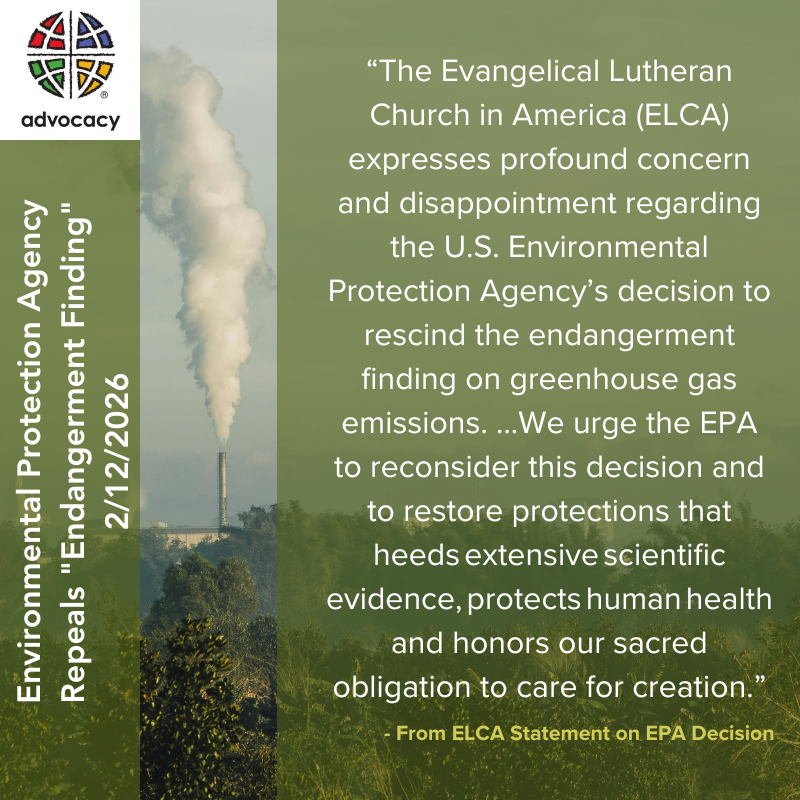
A graphic with a statement from the Evangelical Lutheran Church in America regarding concern over the U.S. Environmental Protection Agency's decision to repeal the endangerment finding on greenhouse gas emissions. The left side shows a vertical text, "Environmental Protection Agency Repeals 'Endangerment Finding' 2/12/2026," alongside a smoky factory.The Evangelical Lutheran Church in America (ELCA) expresses profound concern and disappointment regarding the U.S. Environmental Protection Agency’s decision to rescind the endangerment finding on greenhouse gas emissions. This action undermines our collective responsibility to care for God’s creation and protect the well-being of current and future generations.

As people of faith, we recognize the wisdom of science as a God-given gift that illuminates our path forward. The overwhelming scientific consensus on climate change compels us to act with urgency and moral clarity. We have declared this a “Kairos moment” – an ancient Greek term meaning a critical, decisive time when action is essential. The removal of this finding sets us back precisely when moving forward on climate action is imperative.

The ELCA’s social teaching on climate change is grounded in our understanding that creation is a gift from God, entrusted to our care not for exploitation, but for stewardship. We are called to share this gift equitably and preserve it for those who come after us. Removing the endangerment finding eliminates a crucial regulatory framework necessary to fulfill this sacred responsibility.

The ELCA has consistently called for increased regulation of greenhouse gas emissions. We have also clearly rejected approaches that prioritize short-term economic considerations over the long-term social, economic, and ecological well-being of future generations. We oppose any attempts to weaponize or distort scientific research or to misrepresent the intentions of those working to address this crisis.

This EPA decision does both of those things – it distorts scientific research and prioritizes the present over the future. We urge the EPA to reconsider this decision and to restore protections that heeds extensive scientific evidence, protects human health and honors our sacred obligation to care for creation.

The Rev. Amy Reumann
Senior Director, Witness in Society
Evangelical Lutheran Church in America