from the ELCA advocacy office in Washington, D.C. – the Rev. Amy E. Reumann, Senior Director
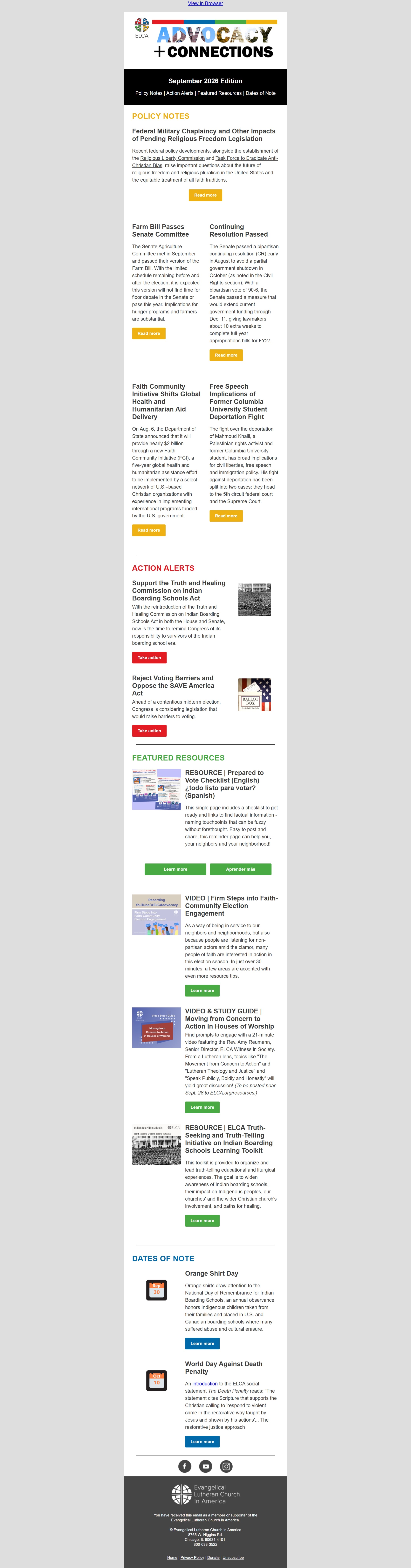
Partial expanded content from Advocacy Connections: September 2026
FEDERAL MILILITARY CHAPLAINCY AND OTHER IMPACTS OF PENDING RELIGOUS FREEDOM LEGISLATION | FARM BILL PASSES SENATE COMMITTEE | CONTINUING RESOLUTION PASSED | FAITH COMMUNITY INITIATIVE SHIFTS GLOBAL HEALTH AND HUMANITARIAN AID DELIVERY | FREE SPEECH IMPLICATIONS OF FORMER COLUMBIA UNIVERSITY STUDENT DEPORTATION FIGHT
 FEDERAL MILITARY CHAPLAINCY AND OTHER IMPACTS OF PENDING RELIGIOUS FREEDOM LEGISLATION: Recent federal policy developments, alongside the establishment of the Religious Liberty Commission and Task Force to Eradicate Anti-Christian Bias, raise important questions about the future of religious freedom and religious pluralism in the United States and the equitable treatment of all faith traditions. The questions have particular significance for service members and military chaplains following Department of Defense (DoD) reduction of recognized faith groups and by the introduction of the Military Chaplains Modernization Act in Congress. The Military Chaplains Modernization Act proposes changes to the military chaplaincy system that could affect how the DoD accommodates and supports service members from a wide range of faith traditions, raising important questions about equitable access to spiritual care across a diverse military. Taken together, these initiatives reflect a growing influence of Christian nationalist ideology that risks narrowing understandings of religious freedom.
Why It Matters in the ELCA:
ELCA social teaching affirms the “need for strong boundaries that limit government involvement in the core activities of religion— worship, instruction in faith, and proselytizing” (Faith and Civic Life: Seeking the Well-being of All, p. 45). With the proposed legislation set to alter federal chaplaincy roles within the DoD including expanded protections for proselytizing, ELCA ministries and individual members will continue to face the broader impacts of policies influenced by Christian nationalism. These developments raise concerns about the erosion of religious pluralism, threats to anti-discrimination protections, and efforts to privilege particular religious viewpoints in education and in education and other areas of public life.
What’s Next:
The ELCA advocacy team, in consultation with ELCA Federal Chaplaincy colleagues, will continue to collaborate on strategic avenues to amplify concern and preserve religious liberty protections. Potential language from the Military Chaplains Modernization Act is set for inclusion in the National Defense Authorization Act for Fiscal Year 2027 (FY27). Staff will continue to monitor and track wider policy developments in support of religious pluralism with particular concern for the advances of Christian nationalism. Of note is the St. Mary Catholic Parish v. Roy, a religious liberty case set to be heard by the Supreme Court, which is likely to have far-reaching implications for church-state relations and the interpretation of religious freedom protections.
 FARM BILL PASSES SENATE COMMITTEE: The Senate Agriculture Committee met in September and passed their version of the Farm Bill. With the limited schedule remaining before and after the election, it is expected this version will not find time for floor debate in the Senate or pass this year. Implications for hunger programs and farmers are substantial. While the Senate version had some minor improvements over the House version passed earlier this year, neither reversed the drastic cuts and changes made to SNAP in H.R. 1. As such, states would still be taking on the brunt of administrative cost shifts, benefit costs, and more. Impacts from H.R. 1 are already clearly visible throughout the country. To date, an estimated 5 million people have had their SNAP benefits revoked, or they have been dropped from the program.
Why It Matters in the ELCA:
The Farm Bill influences federal agricultural policy and critical nutrition assistance programs relied on by millions of people. Because it affects farmers, rural communities, and families experiencing hunger, it is of particular importance to the ELCA and its advocacy ministry. Congress has not enacted a new Farm Bill since 2018, making current deliberations especially significant.
What’s Next:
Reversal of drastic SNAP cuts is a key priority for ELCA advocacy. The ELCA boosted an Action Alert on Aug. 20 as part of a coordinated SNAP Week of Action, adding a Lutheran push alongside partners. To drive attention to the need for senators to amend the Farm Bill so that families can access nutrition and farmers receive the support they need, ELCA advocacy staff will keep this Action Alert available after the Senate mark up in September. The ELCA staff is preparing comments to submit to the Federal Registrar as rules continue to develop from H.R. 1 into direct departments. These comments will focus on challenging the policy assumptions underlying these rulings, particularly the conclusion that the cuts and changes made by H.R. 1 do not place financial pressure on states and cause no real harm to those who utilize the nations nutrition programs.
 CONTINUING RESOLUTION PASSED: The Senate passed a bipartisan continuing resolution (CR) early in August to avoid a partial government shutdown in October (as noted in the Civil Rights section). With a bipartisan vote of 90-6, the Senate passed a measure that would extend current government funding through Dec. 11, giving lawmakers about 10 extra weeks to complete full-year appropriations bills for FY27. The bill then moved to the House in the first week of September where it, too, passed. In addition to an extension of current government funding, this CR will extend, for two years, economic pacts with sub-Saharan African countries and Haiti, while allowing for quicker spending for food assistance and disaster relief.
Why It Matters in the ELCA:
ELCA advocacy staff have been working to advocate for FY27 appropriations to ensure that important programs that care for creation, the vulnerable and our siblings across the world. This CR keeps funding levels at current amounts, rejecting any call for a reduction of funding for these important programs.
What’s Next:
ELCA advocacy staff will continue to monitor the appropriations process in the House before the deadline at the end of September.
 FAITH COMMUNITY INITIATIVE SHIFTS GLOBAL HEALTH AND HUMANITARIAN AID DELIVERY: On Aug. 6, the Department of State announced that it will provide nearly $2 billion through a new Faith Community Initiative (FCI), a five-year global health and humanitarian assistance effort to be implemented by a select network of U.S.–based Christian organizations with experience in implementing international programs funded by the U.S. government. These organizations are expected to work with local faith-based partners and national governments. The global health consortium will be led by World Vision and will be operational in 16 African countries and the Philippines. It will provide support for the delivery of integrated, lifesaving health services for HIV, tuberculosis, malaria, maternal and child health, and nutrition. The initiative aims to strengthen and transition HIV/AIDS and other essential health services to sustainable local leadership by investing in faith-based health networks that already deliver critical services in underserved communities. Funding for global humanitarian assistance was announced to be channeled through Samaritan’s Purse and a joint-led consortium by Compassion International and World Vision, although Samaritan’s Purse turned down the $300 million grant from the State Department. This development comes after the Trump Administration dismantled the U.S. Agency for International Development (USAID), disrupting U.S. foreign assistance architecture, and cutting/withholding funds for lifesaving humanitarian programs.
Why It Matters in the ELCA:
This U.S. government recommitment to humanitarian assistance is welcome news. The ELCA recognizes the critical importance of U.S. foreign aid to communities most in need around the world and has consistently advocated for apportionment of U.S budget for these programs. When the administration dismantled USAID and proposed deep reductions in funding, ELCA members from across the country raised their voices in support of life-saving aid. ELCA advocacy staff have continued this advocacy on behalf of the church and its partners.
What’s Next:
ELCA advocacy staff are in conversation with members of the consortium to encourage them to ensure that local faith-based entities are given opportunities to co-create and implement programs benefiting their communities. Furthermore, ongoing budget advocacy will be needed to ensure availability of funds for this initiative and other vital foreign assistance programs.
 FREE SPEECH IMPLICATIONS OF FORMER COLUMBIA UNIVERSITY STUDENT DEPORTATION FIGHT: The fight over the deportation of Mahmoud Khalil, a Palestinian rights activist and former Columbia University student, has broad implications for civil liberties, free speech and immigration policy. His fight against deportation has been split into two cases; they head to the 5th circuit federal court and the Supreme Court. Khalil v. Blanche, which will go before the 5th circuit court assesses: “Can the government deport Khalil?” And, Khalil v. President of the United States, et al., which may end up before the Supreme Court, will determine: “Can Khalil go directly to a federal court to challenge the government’s detention/actions, or must he go through immigration court first?” Both cases, in their totality, will set a new legal precedent regarding free speech and the legal rights of LPRs moving forward.
More broadly, Khalil v. Blanche asks how far the federal government can go in using immigration law to punish or deter political expression by a lawful permanent resident. It tests how much First Amendment protection lawful permanent residents (LPRs) have, and what constitutional protections will apply to LPRs after this case is decided.
Why It Matters in the ELCA:
Through both the federal advocacy team and AMPARRO, the ELCA has advocated broadly for the rights of people living in the United States with various legal statuses, including asylum seekers, people with various migration statuses and lawful permanent residents. An adverse ruling in either of these cases would immediately impact members of the ELCA community and the communities various ELCA ministries directly serve.
What’s Next:
ELCA staff will continue to advocate for the constitutional rights of all people present in this country, irrespective of citizenship status, and for ensuring the American constitutional rights to freedom of speech and freedom of assembly are never abridged.
Receive monthly Advocacy Connections directly by becoming part of the ELCA Advocacy network – http://elca.org/advocacy/signup , and learn more from elca.org/advocacy .