
By Abigail Raghunath [About the author]
Origins of the Declaration of Human Rights
In the aftermath of World War II, the United Nations began to take shape, grounded in a vision of peace, dignity and shared responsibility. Its foundational document, 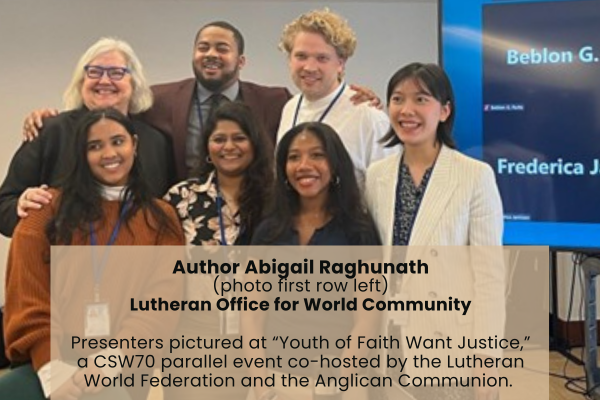 the Universal Declaration of Human Rights, was not just a promise; it was a global commitment that human rights are universal and must be protected.
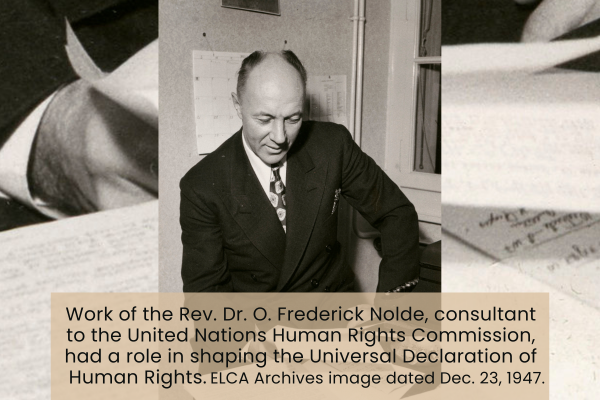
While the declaration was drafted by representatives from across the globe, it holds a special connection to the Lutheran community. The Rev. O. Frederick Nolde, a professor at the Lutheran Theological Seminary at Philadelphia, participated in the drafting through his work with the World Council of Churches. In collaboration with Eleanor Roosevelt, he helped shape Article 18, affirming the right to freedom of thought, conscience and religion.
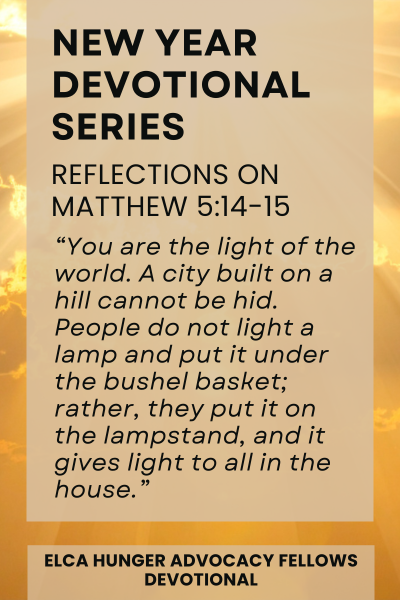 Given this history, it serves as a reminder to not only Lutherans but to Christians more broadly that advocating for justice and human dignity is part of our moral duty.
Experience in 2026 at CSW70
Each year, at the UN Commission on the Status of Women (CSW), UN entities, civil society organizations and Member States come together to assess both the progress made and the gaps that remain in advancing gender equality. These discussions are guided by the Beijing Declaration and Platform for Action, as well as the 23rd special session of the General Assembly (Beijing+5), and they continue to address emerging issues affecting women and girls worldwide.
In 2026, CSW70 looked quite different from previous sessions. Visa restrictions affecting participants from over 70 countries, disagreements over key terminology and rising geopolitical polarization all shaped the experience. In response, there was a stronger emphasis on virtual participation to ensure that voices unable to be physically present were still heard.
At the same time, conversations around issues such as armed conflict, sexual and reproductive health care and migration required thoughtful and careful engagement.
 Despite these challenges, CSW70 ended on a hopeful note, with the adoption of agreed conclusions that renewed the global commitment to ensuring that all women and girls have access to justice.
Religion and Human Rights
Human rights are often framed as secular and sometimes even in tension with religion; but we know that this narrative falls short. The call to love our neighbor, to treat others with dignity and to stand against injustice is deeply rooted in scripture.
Today, churches and other faith-based organizations work tirelessly to advocate for human dignity, provide humanitarian aid and protect vulnerable communities. Churches like ours hold a unique role because we are trusted within our communities and carry a moral responsibility to speak out for what is right.
Within spaces like CSW and the United Nations, the Lutheran delegation shows up not just as another civil society organization, but particularly as a faith-based voice that reflects the values of the Christian tradition. That voice is demonstrating how our faith calls us to stand with and protect others.
Seeking Justice Together
At CSW70, we saw this in action. Through interfaith dialogue, ecumenical women’s engagement and youth participation, we were able to advocate for greater access to justice for women and girls. Together, we are stronger; and together, we continue the call to seek justice and serve others.
ABOUT THE AUTHOR
Abigail (“Abby”) Raghunath is an ELCA Hunger Advocacy Fellow placed with the Lutheran Office for World Community (LOWC), the Lutheran representation to the United Nations. Raghunath is a native New Yorker. She recently earned a master’s degree in International Security, Conflict Resolution, and Gender Public Policy from Columbia University’s School of International and Public Affairs, where her research focused on the impacts of climate and conflict on civilians. She also holds a bachelor’s degree in Political Science and International Relations from City College of New York. Earlier this year, Raghunath interned with the UN Department of Peacekeeping Operations, contributing to advocacy on women’s participation in defense and security reform.
