ELCA Advocacy Office, Washington, D.C.
The Rev. Amy Reumann, director ELCA.org/advocacy
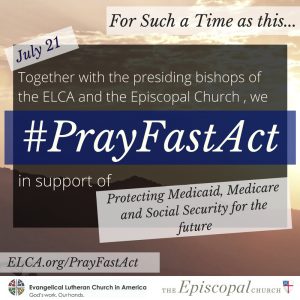
July 21, PRAY.FAST.ACT.: On Saturday, July 21, we join with The Episcopal Church in our monthly commitment to #PrayFastAct. This month, our focus is on protecting Medicaid, Medicare and Social Security for the future. Medicaid, Medicare and Social Security are the core of our nation’s medical and income safety net for the elderly, unemployed, underemployed and disabled. In recent decades, investments in programs that spur the economic potential of individuals has declined, which has led to an increase in the number of people needing the support of these programs. Together, these programs and other safety net measures represent a significant amount of annual federal spending. Recently, proposals have been made to change the programs by manipulating eligibility or coverage to reduce spending. Difficult, but responsible, changes require Congress and the nation to invest in programs that reduce the long-term need for these programs and minimize the individual impact of the economic cycle so that these programs can cost less because they are needed less.
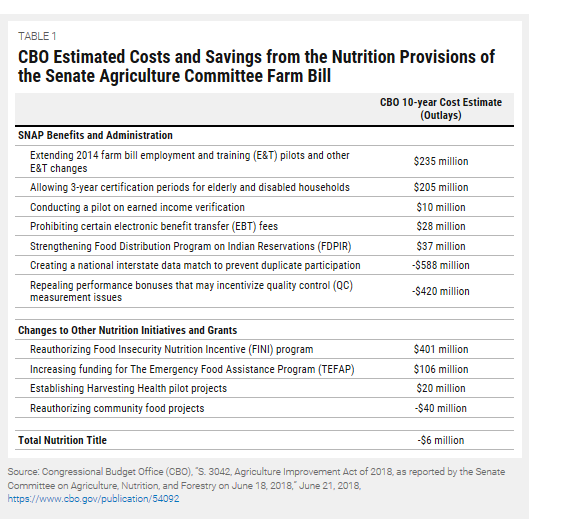
FARM BILL: The Senate passed a bipartisan 2018 farm bill last month that ELCA Advocacy supported. The bill will now go to a conference between the House and Senate. ELCA Advocacy plans to work to ensure that the Senate bill prevails over the House bill, which would make cuts to the Supplemental Nutrition Assistance Program (SNAP). Learn more about the Senate and House versions of the farm bill by reading “The Senate Farm Bill: What a Difference Bipartisanship Makes” on the ELCA Advocacy blog.
MIGRATION and AMMPARO: In June, the House rejected a hardline immigration bill introduced by Rep. Bob Goodlatte, R-Va. Securing America’s Future Act (H.R. 4760) would have drastically cut the nation’s legal immigration levels and provided funding for building a border wall, while also offering temporary status for “Dreamers.” ELCA Advocacy opposed the bill. The House has yet to vote on a proposed compromise immigration bill. You can take action on this issue by visiting the ELCA Advocacy Action Center.
President Trump signed an executive order to address family separation at the U.S.-Mexico border. The executive order fails to end the zero-tolerance policy that criminalizes parents and expands family detention. ELCA Advocacy will continue to stand against family detention, advocating instead for community-based alternatives to detentions. Lutheran Immigration and Refugee Service has piloted alternatives for families.
INTERNATIONAL FOOD ASSISTANCE: On June 20, the Senate passed the Global Food Security Reauthorization Act. The legislation calls on Congress to extend the authority of the Global Food Security Act of 2016 for a few more years. The act established a comprehensive U.S. global food-security strategy that has enabled the U.S. government to improve the way food and nutrition programs are implemented and accounted for. As a result, some developing countries have been able to increase agricultural productivity and education opportunities. These programs help farmers feed their families and communities and contribute to their countries’ economic growth. The House has yet to pass its version of the bill.
Lutheran Office for World Community, United Nations, New York, N.Y.
Dennis Frado, director
CONVENTION ON THE RIGHTS OF PERSONS WITH DISABILITIES: U.N. Secretary-General António Guterres spoke marking the start of this year’s Convention on the Rights of Persons with Disabilities on June 12 to a conference of signatories to the convention, which he described as one of the most widely ratified international human rights treaties. The convention reaffirms that people with disabilities are entitled to the same treatment as everyone else.
People with disabilities still often face overt discrimination, stereotyping and lack of respect for their basic human rights – with women and girls disproportionately affected. The secretary-general said that “every minute, more than 30 women are seriously injured or disabled during childbirth,” and that women and girls with disabilities face multiple barriers to accessing education, health services and jobs.

“Without women’s empowerment and gender equality, millions of women will continue to suffer from double discrimination based on both their gender and their disability,” he added. The secretary-general also spelled out the need for new approaches for and with people with disabilities, including mainstreaming disability in national legislation and development strategies.
Catalina Devandas Aguilar, U.N. special rapporteur on the rights of people with disabilities, noted that while progress has been made, it is not reaching everyone in the same way. “There is a great demand for public interventions of better and higher quality,” she said. “Only by working together will we fulfil our common goal of leaving no one behind.”
PILGRIMAGE TO PEACE PANEL FEATURES LUTHERAN EDUCATOR: On June 22 the Church Center at the United Nations was the site of Churches for Middle East Peace’s Pilgrimage2Peace panel discussion hosted by the U.N. NGO Working Group on Israel-Palestine, of which Lutheran Office for World Community is a member. “Peacebuilding and Constructive Conflict in Israel, Palestine, and the broader Middle East” featured Georgette Hazboun Rabadi, principal of the Evangelical Lutheran School in Beit Sahour, Palestine, and Mara Lee, global executive director of the OneVoice Movement. Kyle Cristofalo, director of advocacy and government relations with churches for Middle East Peace, was the moderator.
Rabadi works to empower students and families in the region from all religious, economic and social backgrounds. She educates children and young people about global issues, connecting them with their peers locally and internationally, and inspiring them to make a difference. Her school offers student exchange programs in Europe and a local school-to-career program with guest speakers offering Palestinian narratives along with the opportunity to work on projects. She reports that when Palestinians are asked what they want, the response is: “We want the right to live with dignity.”
Lee works with the OneVoice Movement, an initiative supporting grassroots activists in Israel, Palestine and globally who are working to build human infrastructure to create the necessary conditions for a just and negotiated resolution to the Israeli-Palestinian conflict. In conversation about conflict resolution, the initiative’s goal is to be pro-solution, pro-peace, and pro-humanity.
California
Mark Carlson, Lutheran Office of Public Policy loppca.org
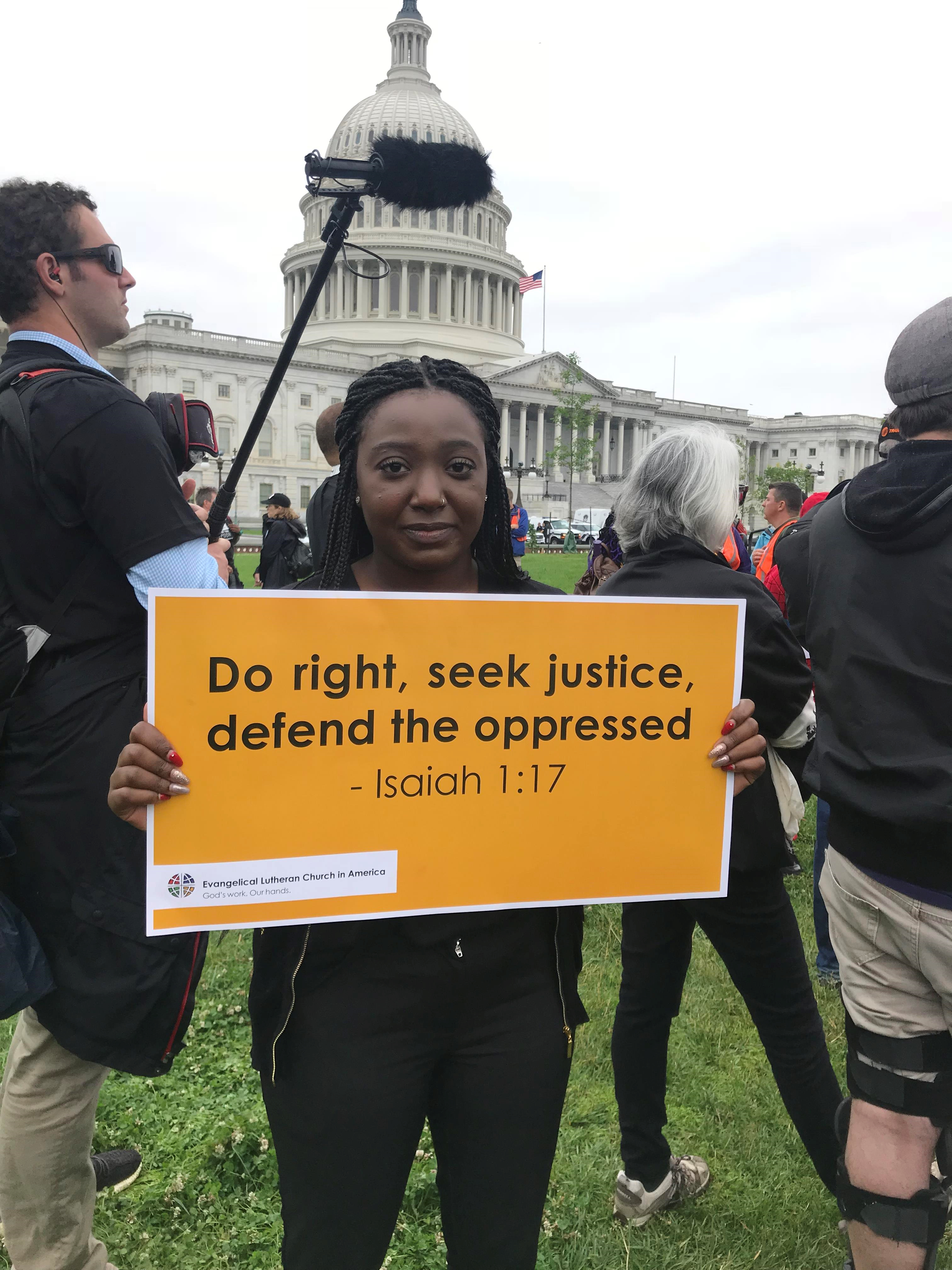
BUDGET UPDATE: With no line-item vetoes, Gov. Jerry Brown approved a General Fund budget of about $140 billion that includes items supported by LOPP-CA to increase the CalWORKS/Temporary Assistance for Needy Families assistance grants intended to relieve childhood poverty, increase 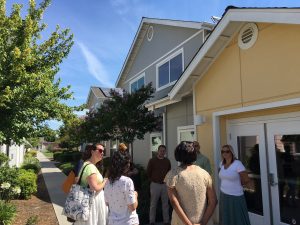 spending for child care, expand census outreach and make the state Earned Income Tax Credit available for more low-income taxpayers. Proposals to provide Medi-Cal (Medicaid) coverage for low-income young adults and seniors, regardless of immigration status, did not make it into the final budget. LOPP-CA Director Mark Carlson mixed with some of the Poor People’s Campaign participants and tried to connect some of the “outside” protestors with actual budget and legislative decisions being made “inside.”
LEGISLATIVE UPDATE: LOPP-CA was site host for a California Interfaith Power & Light Advocacy Day, supporting bills to set stronger goals for renewable electrical energy (SB 100), protect California’s coastline should the federal government seek to expand offshore oil drilling, and establish goals for carbon reduction from ride-sharing companies like Uber and Lyft. LOPP-CA also offered brief testimony in the Senate Elections Committee supporting stronger sponsor and funding disclosure in social media ads for ballot measures.
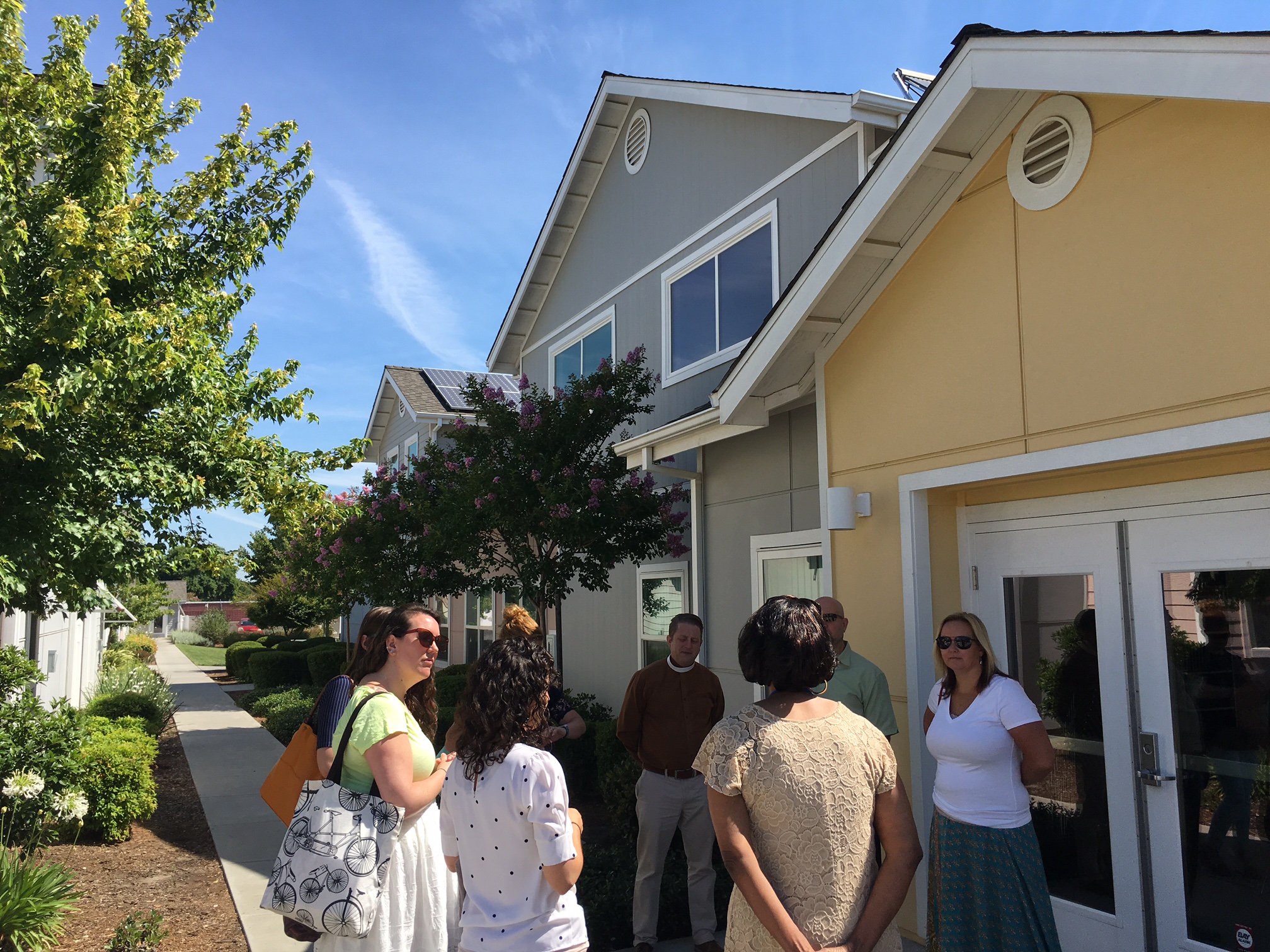
NOVEMBER BALLOT: California voters will decide on 12 measures, three placed on the ballot by the Legislature and nine that reached via the initiative petition process. Our priority continues to be the housing bond, cahahousing.org (Programs and Initiative). Carlson hosted the June conference of ELCA rostered leaders gathering at a permanent supportive housing site where Lutheran Social Services of Northern California provides services (photo).
North Carolina
Georene Jones, North Carolina Synod Social Justice & Advocacy Ministries
THE NORTH CAROLINA SYNOD ASSEMBLY PASSED A RESOLUTION ON IMMIGRATION AND REFUGEES: The first included provisions to demand a halt to detention and deportation of people not found guilty of a felony until comprehensive immigration policy reform is passed by Congress, permanent legislation providing full citizenship to “Dreamers,” and pathways to citizenship for non-felon resident immigrants without documentation, and for maintaining family unity.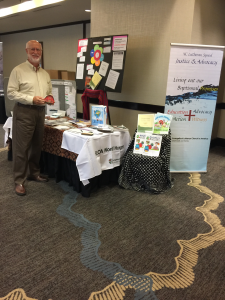
Additionally, the document demanded compassionate treatment of all who seek safety and hope in the U.S., as well as encourage increased individual and congregational support of Lutheran Immigration and Refugee Service, Lutheran Services Carolinas, and participation in the ELCA’s Accompanying Migrant Minors with Protection, Advocacy, Representation and Opportunities (AMMPARO).
A second resolution regarding refugees states that in the face of the largest displacement crisis since World War II, the U.S. must honor its commitment to accept no fewer than 45,000 refugees for resettlement through fiscal year 2018 and to increase the number admitted in 2019 to 75,000.
Full-text of the resolutions as adopted are available at:
18-03 Advocacy & Action for Immigration and 18-04 Acceptance & Resettlement of Refugees.
New Mexico
Ruth Hoffman, Lutheran Advocacy Ministry – New Mexico lutheranadvocacynm.org
LAM-NM WORKS WITH COMMUNITY PARTNERS: We recently attended an advocacy training for the Dental Therapy Coalition, which is working to enact a statute creating the mid-level profession of dental therapist. Having dental 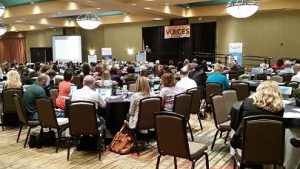 therapists would increase the number of dental providers particularly in underserved areas of our large state. We also attended the 2108 Kids Count Conference sponsored by New Mexico Voices for Children. Over 200 people networked and heard presentations about ways to improve the lives of New Mexico’s children. Our state ranks at or near the bottom in child well-being.
Ohio
Nick Bates, Hunger Network Ohio Nick@HungerNetOhio.org
A great synod assembly season! Hunger Network Ohio attended the Northeastern Ohio Synod and the Southern Ohio 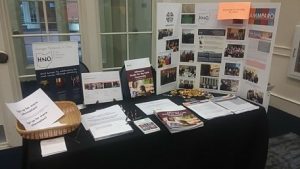 Synod assemblies this year. Between the two, we collected over 65 postcards for our congressional representatives to protect nutrition assistance in the farm bill. Both assemblies had a feature of justice.
The Northeastern Ohio Synod heard Amanda Silcox share her experience as an ELCA Young Adults in Global Mission participant and a Hunger Advocacy Fellow serving this year in the Virginia Interfaith Center for Public Policy, but originally from the Northeastern Ohio Synod. The assembly was moved by her passion and commitment to justice in our community. Likewise, the Southern Ohio Synod featured workshops on advocacy, hunger, immigration and racial inequality, including a powerful liturgy prepared by the synod’s race relations task force. Our synod assemblies are a great opportunity not only to accomplish the business of our synods but also a chance to come together to learn and grow in relationship and our understanding of the gospel.
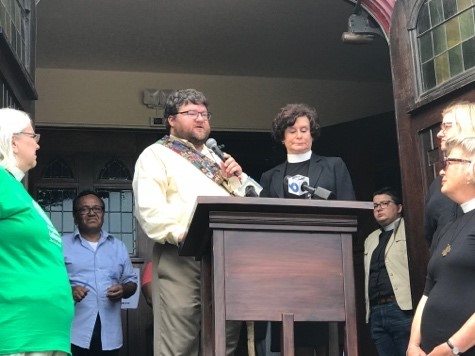
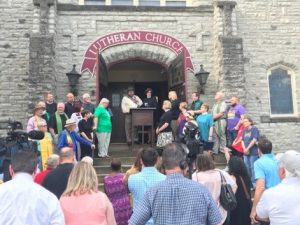
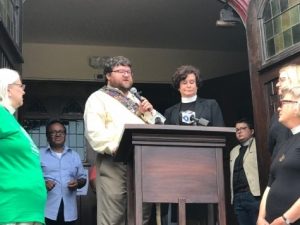
We would also like to mention First English Lutheran Church, which is now the second congregation in Columbus hosting a family in sanctuary. Bishop Dillahunt and many congregational leaders, fresh off the busses and planes from Houston, attended a news conference to support Miriam Vargas on July 2. We will continue to live into our synod resolutions, the ELCA AMMPARO initiative and our gospel calling to welcome and love the neighbor.
Pennsylvania
Tracey DePasquale, Lutheran Advocacy – Pennsylvania lutheranadvocacypa.org
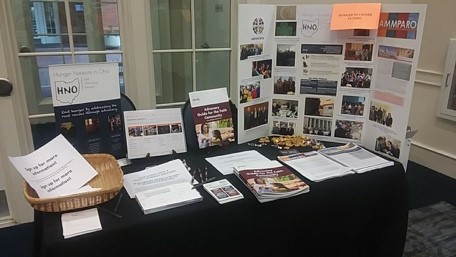
LAMPa AT SYNOD ASSEMBLIES: LAMPa staff shared displays, information and workshops at the Lower Susquehanna, Allegheny and Upper Susquehanna synod assemblies.
SYNODS PASS SOCIAL JUSTICE RESOLUTION AT ASSEMBLIES: The Lower Susquehanna Synod adopted a resolution regarding homelessness. The Northwestern Pennsylvania Synod adopted a resolution on migrant minors and family separation at the U.S. borders. The Southwestern Pennsylvania Synod adopted a resolution of concern for migrant minors separated from family. The Upper Susquehanna Synod passed a resolution regarding migrant children calling for humane, compassionate treatment of those designated as undocumented minors.
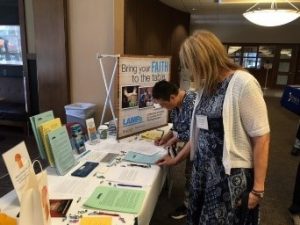
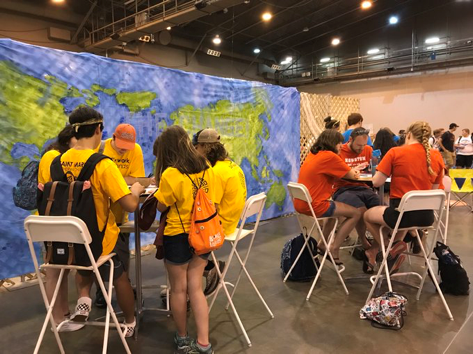
LAMPa PARTICIPATES IN ELCA YOUTH GATHERING : LAMPa partnered with ELCA Advocacy and Lutheran Outdoor Ministries sharing an interactive exhibit, “Be the Change: Means of Grace, Scenes of Grace.” Visitors entered a space set apart to connect with God’s good creation. They discovered the fun and profound ways faith is nurtured in nature and left transformed, prepared to be the change. 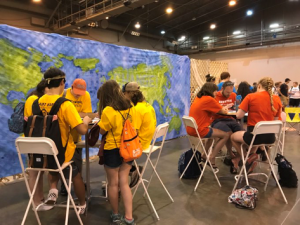
CONNECTING LUTHERANS WITH ISSUES: June was a busy month for LAMPa staff as they issued advocacy alerts to constituents for federal and state issues. Federal action on the House farm bill, two immigration bills and family separation at the border. State alerts were shared regarding the SNAP (Supplemental Nutrition Assistance Program) benefits and “Safe Harbor.”
BUDGET AND CLEAN-SLATE LAWS SIGNED: Gov. Tom Wolf signed the 2018-2019 budget and clean-slate bill into law making it easier for people who have committed crimes to move on with their lives. LAMPa has advocated for this bill for several years.
Virginia
WHAT’S NEXT?: After late May’s Medicaid expansion victory at the Virginia General Assembly, everyone has been asking “what’s next?” Although the Virginia Interfaith Center for Public Policy will be looking at overall policy priorities in upcoming weeks, it does plan to follow through on other priorities that need work, such as strengthening enforcement against wage theft and encouraging living wages, and making Virginia more welcoming to immigrants and others. We are also exploring what we should be doing in terms of making sure that people eligible for Medicaid expansion actually sign-up. There is no shortage of work to do.
Our staff has met with many chapters and affiliates in the last few weeks across the commonwealth. Although everyone is excited about Medicaid expansion, groups are ready and eager to continue their good work. Our chapters and affiliates are:
- making plans for how the faith community can assist with Medicaid enrollment;
- meeting with legislators about priority issues for the 2019 General Assembly;
- building Living Wage Certification programs (The Richmond program has launched and Alexandria should launch soon; Charlottesville is in the planning phase and a new planning group has formed in Harrisonburg); and
- talking with sheriffs about how best to work with immigrant communities.
Washington
Paul Benz, Faith Action Network fanwa.org
SUMMITS: FAN finished the last of four annual spring summits on June 10. Every year, we convene these regional gatherings across the state to hear our advocates’ policy priorities and share what FAN is doing. This is an important way to maintain and deepen relationships with our members. This year, we convened more than 175 advocates from many denominations and faiths at our Puget Sound Summit.
POLICY ISSUES: This time of year, FAN is focused on Congress, advocating on the farm bill, the Sentencing Reform and Corrections Act, immigration bills, and the related Public Charge rule. We are staying in touch with our Washington, D.C., faith-based lobbyists while educating and activating our network of almost 7,000 advocates organized in our 10 congress ional districts.
CANDIDATES FORUMS AND CIVIC ENGAGEMENT: FAN will be sponsoring, planning and conducting several candidate forums at faith communities in critical races in our state. Our state’s primary is in August, so most of these forums are in September and October. This is a great public witness for FAN and faith communities to play in the electoral process.
Wisconsin
Cindy Crane, Lutheran Office for Public Policy in Wisconsin loppw.org
SUMMER PLANNING FOR UPCOMING EVENTS:
- July 17: “Hunger, the Farm Bill, Immigration and the ELCA”: LOPPW is working with two hunger volunteers, Cindy Dobberke and Molly Riehle, who attended the ELCA World Hunger gathering in January, to organize an advocacy event in Milwaukee. Register today online.
- Oct. 6: Care for God’s Creation Conference: LOPPW and the South-Central Synod Care for God’s Creation team are planning to lift up the cutting-edge work on renewable energy in Dane County and a few other places in Wisconsin. We’ll make what’s working known and encourage grass-roots organizing to duplicate these efforts.
- Nov. 3-4 or 5: Overnight Lutheran Campus Ministry Retreat: LOPPW is working with campus pastors from Milwaukee and Madison to organize the event. We’ll encourage campus ministries from around the state and the UP and possibly beyond to attend. We’re grateful for a grant from First Lutheran Church Foundation in Gladstone, Mich.
CONSULTATION: LOPPW has been gathering information on Wisconsin ICE detention centers to offer to interested pastors and help them discern efforts they can take.
SYNOD ASSEMBLIES: LOPPW had a table and led a workshop at the La Crosse Area Synod Assembly. LOPPW was present at the Greater Milwaukee and the Northwest synod assemblies. Congratulations to the Rev. Laurie Skow-Anderson elected the Northwest Synod bishop!
HUNGER FELLOW: Candidates for the Hunger Fellow position were interviewed and LOPPW looks forward to introducing Kelsey Johnson next month!