We are deeply saddened by the Supreme Court’s decision today on Deferred Action for Parents of Americans and Lawful Permanent Residents (DAPA) and the expansion of Deferred Action for Childhood Arrivals (DACA+) programs. This 4-4 decision will result in the continued separation of families, forcing them to live life in the shadows. As a church with deep immigrant roots and ministry in migrant communities, we pray today for the safety and well-being of the young people, sons, daughters, and parents that will be affected by the Court’s ruling in United States v. Texas. The Supreme Court decision sends this issue back to lower courts, effectively preventing the implementation of an executive order that would have provided parents of U.S. citizen children and some young people relief from deportation.
The ELCA will continue to be in ministry with migrant communities and work towards policies that reflect our biblical calling to welcome all children of God into our communities. As we are reminded in Proverbs 17:17, “A friend loves at all times, and a brother is born for a time of adversity.” Let us strive ever to love at all times, and provide hope and comfort to our brothers and sisters in this time of adversity.
Learn more about the faith community’s response to today’s decision. Statements will be posted as they are made available:
From accompaniment to advocacy: Reflections on Central America migration
The reflections you will encounter are from Gettysburg seminarians who traveled to Honduras and Guatemala earlier this year in order to better understand the conditions driving so many to leave their communities. The words you will read are excerpts from reports the students wrote as part of the class that brought them on this trip. The videos were recorded for ELCA Advocacy. Each entry highlights something the author learned when they met individuals from communities the ELCA accompanies or is in relationship with. We hope these reflections show the amazing power that individuals have to move from accompaniment to action by walking and advocating alongside affected communities.
We would like to thank Gettysburg Seminary and all of the students who shared their stories with us.
(All names and locations referred to in these reflections have been changed to protect community members.)
A call that all Christians have – by Chris Schaefer
The power people of faith have to connect and listen
A reflection by Alaide Vilchis Ibarra, Assistant Director for Migration Policy
As a new(ish) U.S. citizen, I am always curious about what drives so many of us to be advocates in this country. These reflections remind me that when people of faith spiritually connect and truly listen to others, even those whose language we might not speak, God gives us an amazing power for good.
I am humbled that these seminarians chose to share faithful reflections about their trip to Central America, and I am proud that they viewed advocacy as part of their responsibility as faith leaders. I also know that there are thousands
of others who are out educating friends and neighbors about issues affecting their communities, visiting their elected officials to discuss their concern for brothers and sisters who live in poverty, and work in ministries that provide hope and support for people throughout the world.
As you read these reflections, I hope you take with you a sense of the amazing power that exists in sharing what we learn through accompaniment with others in community and with those in power so that we may live in a world where everyone is treated with the dignity and respect they deserve.
In the final reflection of this series, we will hear again from Chris Schaefer. Chris traveled to Washington, D.C. to speak with his elected officials about his experience in Central America. His movement from accompaniment to advocacy serves as a great example of the impact people of faith can have in affecting positive policy change.
Protecting our environment and protecting each other – by Kayla Edmonds
https://youtu.be/yQqbzYaqs7g
“La lucha” “The struggle”
…The most surprising part of our trip to Central America was the massive impact that climate change plays in migration. Due to climate change the communities that had two growing seasons now only have one…If the crop doesn’t come through then they either have to go without or take out loans.
What exactly does accompaniment mean?
A friend of mine explained it to me by using the story from the bible the Road to Emmaus. In the road to Emmaus story, two of Jesus disciples are walking along the road to Emmaus when Jesus appears to them and walks alongside them. We are not Jesus in this story. I don’t think I can emphasize this enough. We. Are. Not. Jesus. We are one of the disciples and our neighbors in Central America are the other disciple. And as we are walking along together, Jesus comes and walks along beside of all of us.
Statistics vs. the real story
We see statistics all the time on migration. Rarely though do we ever hear the stories of those who have migrated or tried to migrate. These people are not numbers; they are real people who are simply trying to provide for themselves and their families a better life. I wasn’t sure what to expect from our trip to Central America, I had never been out of the country or even on a plane for that matter…
Through this trip I realized just how small my world and my view of the world truly was. And for that I am truly grateful. I am more aware of the world outside of my little world and of the need to walk beside of our brothers and sisters in Central America and beyond. Nothing has ever impacted me as much as this trip did, and I look forward to seeing how this experience will shape and change my future ministry.
“I knew how much they were giving up” – by Ariel Williams
He wanted to be home – by Patrick Ballard
Reflexiónes de unaperegrina – Reflections from a sojourner – by Jennifer Crist
“El sacrificio” “Thesacrifice“
We began [our visit] by watching families and jovenes arriving at the end of their attempt to migrate…As we waited outside for the buses of deported migrants to arrive… I wondered who might arrive on the bus that had just been deported from the US due to increased ICE (Immigration and Customs Enforcement) raids…
There were many more families traveling together than I expected… One could transport these families to somewhere like Disney World, stepping off of the shuttle bus after a long day of lines and rides and eating; carrying backpacks and sweaters. But these families were not returning from any vacation. Instead of their backpacks carrying all that they needed for one day at the park, their backpacks were carrying all of their possessions, everything they needed to traverse multiple countries. I wonder what I would put in my backpack? What if my backpack got stolen? What would I do? Unfortunately, I imagine most of these families have faced these questions…
Our final visit of the day was to … a neighborhood claimed as a territory of the MS-18 gang… A twenty-five year old woman, named Luz, spoke about her journey north to Mexico, where she worked until she felt she could no longer be separated from her baby who remained in Honduras. As she talked, she often paused, expressing her gratitude to God. She spoke of the reasons she left, as being intimately interwoven with the violence of the neighborhood: “Here the colonia is very dangerous. Living here limits us. There is not work, because when they hear we are from this area, they don’t hire us. We can’t get a loan, because of our address here. One doesn’t LIVE like this, with insecurity and fear.”…Despite all of her negative experiences, she spoke of the hope she had felt when CASM [the Comisión de Acción Social Menonita] connected with her. She said, “Thank God….No one ever helped me like that before.”
“Arroz Blanco” “White rice”
Despite being tired from a long day and food preparation in the hot, dark kitchen, I was pleasantly surprised by a migrant passing through, named Marco…Both of our childhood families were very poor. My mother would prepare white rice with a little bit of milk and sugar for us for dinner; Marco’s mother would prepare arrozblanco with a little bit of coffee and sugar for him for dinner. We both only realized as adults that this was because our mothers were poor and couldn’t afford better dinners. To this day, he and I both adore white rice prepared the way our mother’s had prepared it when we were children. White rice is our comfort food. As I watched Marco depart the next day, I embraced him and whispered, “¡Te cuidas!” as I thought of his mother and of my oldest Guatemalan sons. Though our experiences had been similar in childhood, I was born in a different geographical location, not needing to make a perilous journey to a better future. While I could freely travel into and out of his country, he had to endure violence and hardship in order to enter mine. A wave of guilt washed over me as I watched him depart with his backpack…
“La Lucha“ “The struggle”
[I] found myself reading about Jesus in the desert being tempted by Satan. As I read about Jesus enduring many things (hunger, humiliation, etc.), I was reminded of stories that I had heard of hardship in traveling to El Norte….stories of hunger, violence, and violation of basic human rights. After Jesus endured the temptation, Luke’s version simply has Jesus returning home. And that is the reality of many migrants as well. I imagine when Jesus returned home, he was tired from his journey in the desert, but he was filled with the power of the Holy Spirit. According to the writer of Luke, Jesus did not go home to rest from his journey in the wilderness, but instead he began his public ministry of teaching. And as Jesus stood up in his “home congregation” and revealed his authority from God, he also announced his job description to those who were gathered: to bring good news to the poor and to liberate the oppressed. Jesus was focusing on justice and mercy.
After returning home…
As I finish this [reflection], the community I have been gathering as a mission developer, Communities of Hope, is preparing to gather in a coffee shop in Harrisburg, PA. We will sing, hear God’s Word, and share a meal together. However, we also intentionally decided that at every worship service we would have an advocacy component within our liturgy. I will share one of the stories from Honduras (listed below) with the community tonight.
¿Porquéestánaquí? – by Chris Schaefer
On our first full day of travel in Honduras, we had the opportunity to visit with a small Lutheran community that gathered regularly at a home in [a] small village. While there, several gentlemen shared their stories of attempts to migrate north to Mexico and the United States. They demonstrated great candor in relating many of the trials, hardships, and set-backs they had experienced before leaving their families and friends behind… After the gentlemen wrapped up their accounts, a patriarch of the village stood up and asked our group, “¿Porquéestánaquí?” or, “Why are you here?”
He continued by expressing some confusion as to our purpose because after all of the questions and answers exchanged between our groups he was still unsure why we would come all this way to ask about information that we already knew, particularly regarding why folks were migrating and what faced them on their journeys. Many of us had to admit that we were actually fairly ignorant about the causes of the immigration crisis… The patriarch’s question struck a chord with me, though, and forced me to reexamine my reasoning in accompanying this group, as well as why our group was there as a whole.
Seeing the faces of our neighbors
The staggering statistics that surround these stories are often too vast to comprehend and fully internalize, but the story of an individual allows and enables us to see the faces of our neighbors and better live out our calling as Christians to love and care for all of our neighbors, regardless of whether they live right next door or in a country far from our home.
As we continued on the trip, my preconceived notions about the intelligence and abilities of those living in the Northern Triangle were continually shattered and rebuilt in a way where I could better see the true nature of partnership in community and how these strangers living in a foreign land demonstrated true discipleship…
Kindling a stronger sense of love, compassion, and justice
I drew great inspiration and strength from our interactions, and because of that, a stronger sense of love, compassion, and justice has been kindled within me, and I am quite certain that the Holy Spirit was present and active in, with, and among us.
Their strength and courage and trust in God in all things has helped tear down walls of fear and anxiety that surrounded me. I feel strengthened and invigorated to live out mycalling as a Christian and I plan to take the stories that were so trustingly and generously shared with us and pass them to others so that the Spirit may work through them as the Spirit has worked in me.
ELCA Advocacy Statement on Ryan Poverty Plan
Today, Speaker Paul Ryan (R-Wisc.) and the House of Representatives’ Task Force on Poverty, Opportunity, and Upward Mobility released a plan that will launch a bipartisan discussion on hunger and poverty and the policies required to end them. ELCA Advocacy appreciates Speaker Ryan’s leadership, and that of all who make poverty in our nation a priority for conversation and action.
“As Christians, loving God and loving our neighbors includes commitment to any who suffer from hunger or poverty,” said the Rev. Amy Reumann, ELCA Director for Advocacy. “We are pleased that the plan doesn’t propose to cut or institute block-grants for anti-poverty programs, including the Supplemental Nutrition Assistance Program (SNAP), and that it focuses on areas of importance to ELCA hunger work, including housing, childhood education and criminal justice reform as part of the larger picture.”
As a member of the Circle of Protection, a coalition of Christian denominations and anti-poverty organizations, the ELCA was part of meetings with Speaker Ryan’s office leading up to today’s release. Circle of Protection leaders offered this letter recommending key principles to include in the House committee’s plan.
ELCA Advocacy supports the plan’s intent to emphasize the importance of job training and the need to reduce barriers to employment. “We support adequate funding for poverty programs and encourage strong linkages between job training, work and support for families,” said John Johnson, ELCA Program Director for Domestic Policy.
ELCA Advocacy will continue to work with our advocates across the country to engage Speaker Ryan and members of Congress in this important discussion during the election year and beyond. As a church committed to racial justice, our participation will address areas not explored in the plan, including the disparate impact of poverty on people of color and the reality of individuals who face serious barriers to employment.
“In our meeting with Circle of Protection leaders prior to the plan’s release, Speaker Ryan’s staff noted that his Catholic faith led him to consider the whole person in addressing poverty,” noted Reumann. “ELCA Advocacy looks forward to working with our leaders to address hunger and poverty in a way that acknowledges the God-given dignity and worth of all persons.”
June Advocacy Update
Lutherans are taking action across the country! Below you will find our monthly State Advocacy Newsletter. Share with your friends!
____________________
Washington, D.C. – Amy Reumann, Director of Advocacy
CENTRAL AMERICA BLOG SERIES: Gettysburg seminarians traveled to Honduras and Guatemala earlier this year to better understand the conditions driving so many Central Americans to leave their communities. Several of the students shared their experiences with ELCA Advocacy in a three-part blog series released last month. Each entry highlights something the author learned when they met individuals from communities the ELCA accompanies or is in relationship with. These reflections show the amazing power that individuals have to move from accompaniment to action by walking and advocating alongside affected communities. Help share the series now on the ELCA Advocacy Blog!
PRESSURE BUILDS ON FLINT, MICH: After months of divisive debate, members of Congress are still working to pass legislation to provide emergency aid for Flint, Mich. Flint’s residents have spent nearly three years dealing with lead contamination in their water. The U.S. Senate at the beginning of May proposed substantial federal funding for Flint in the draft Water Resources Development Act. Sen. Jim Inhofe’s, R-Okla., bill would enable federal resources to help Flint fix its failing water infrastructure and assist other cities facing similar crises. ELCA Advocacy sent an action alert on Flint in early May as President Obama was visiting the city, but action is still needed to prompt Congress to act. Take action now!
SOUTHEAST SYNOD LAUNCHES NEW ADVOCACY OFFICE: The Southeast Synod celebrated the opening the newest ELCA state public policy office during Southeast Synod Assembly in May. John Johnson, ELCA program director for domestic policy, was invited to make the announcement during Bishop Julian Gordy’s synod address. The Southeast Synod Advocacy Office will receive an initial grant of $30,000 to begin the coordinating work of this first regional (states include Georgia, Tennessee, Mississippi and Alabama) to address hunger and poverty and to equip ELCA members for advocacy.
____________________
New York, NY – Dennis Frado, Lutheran Office for World Community
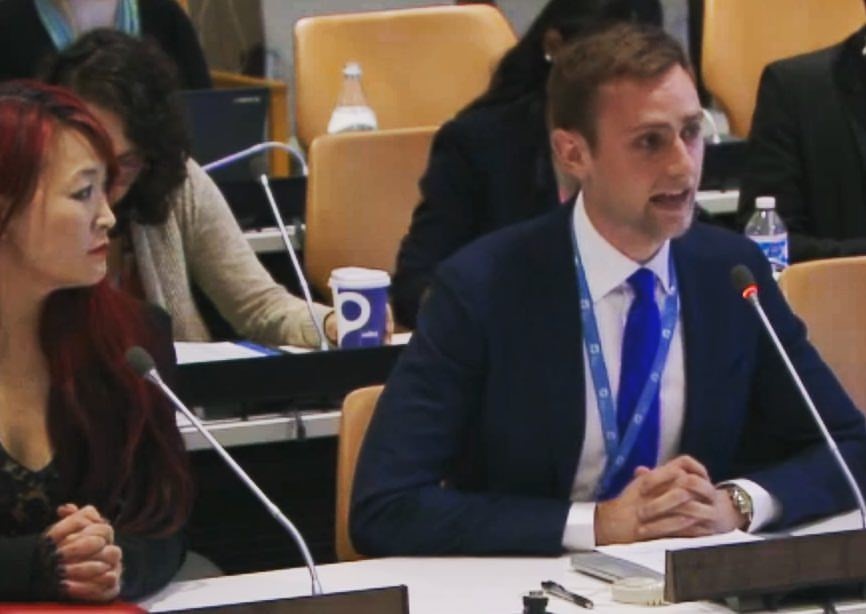
LUTHERAN PARTICIPATION IN HIV and AIDS “LOBBY WEEK”: In preparation for the High Level Meeting on HIV and AIDS (June 8-10), members of the United Nations are negotiating the text of the “2016 Political Declaration on HIV and AIDS.” Every five years this declaration, outlining a political framework for ending the AIDS epidemic, is drafted and considered by the members. From May 16 to May 20, the Lutheran Office for World Community (LOWC) participated in a civil society-led “Lobby Week” to ensure that key components of the AIDS response are included in the document. These components include: the inclusion of “key populations” (men who have sex with men, sex workers, drug users, transgender people and prisoners), using sex education as a tool for HIV prevention, and integrating sexual and reproductive health into the AIDS response. During the week, LOWC met with a number of governments that are providing forward-thinking leadership in these negotiations and reminded them of the HIV-related statements and positions of the Ecumenical Advocacy Alliance – a global network of churches of which the ELCA is a member. This culminated in LOWC Program Associate Nicholas Jaech making a formal intervention on behalf of the alliance at a U.N. briefing on the declaration. LOWC will continue to follow the negotiations and will participate in the AIDS and HIV meeting.
BRIEFING ON THE REFUGEE CRISIS IN ETHIOPIA: On May 19, Charlotte Mildenberger, a new program associate at LOWC, attended a meeting at the International Peace Institute addressing the refugee situation in Ethiopia. Speaking at this event was Clementine Awu Nkweta-Salami, the U.N. High Commissioner for Refugees representative in Ethiopia. She noted the grave situation in Ethiopia: As of April 30, the refugee population has risen to 734,931. This number includes refugees from South Sudan, Somalia, Eritrea and other nationalities. In addition, the number of unaccompanied minors and separated children is 38,422. There have been some strides in education of refugee children – a total of 153,589 (86,981 males and 66,608 females) have been enrolled in schools within and outside the refugee camps, marking an increase of 16 percent in the average gross enrollment rate from the same time last year. However, school attendance in some of the camps in Gambela showed a marked decrease during the fourth quarter of April following the recent security incidents in the region. LOWC will continue to monitor the humanitarian situation in Ethiopia at forums and briefings at the United Nations.
____________________
California – Mark Carlson, Lutheran Office of Public Policy
STATE BUDGET – Maximum Family Grant for TANF/CalWORKS: Efforts to eliminate the Maximum Family Grant rule, which prohibits additional aid for a baby born into a family currently receiving public assistance, are paying off. It appears the Legislative Budget Conference Committee will include elimination and send it to both houses for adoption by the budget deadline of June 15. The focus on Gov. Jerry Brown, who urged fiscal caution in his budget presentation (using Aesop’s fable of the ant and the grasshopper), is intensifying. An interfaith coalition, of which LOPPCA is a part, produced a short video, that includes ELCA Pastor Leslie Welton appealing to the governor and legislative leaders. The president pro tem of the Senate co-authored an op ed in the May 29 Sacramento Bee.
LEGISLATIVE UPDATE: The 20thAnnual Immigrant Day at the Capitol was May 23, and the legislative agenda included the Maximum Family Grant. Priorities included funding for naturalization assistance, health coverage for undocumented residents, improved transparency in local law enforcement, immigration and Customs enforcement deportation proceedings, and transparency in gang registries.
AB 2590, a bill sponsored by faith groups to place restorative justice principles in the penal code, passed the Assembly.
SYNOD ASSEMBLIES: LOPP-CA Director Mark Carlson will shuttle between the Sierra Pacific Synod Assembly in Reno and the Southwest California Synod Assembly in Los Angeles. Lutheran Episcopal Advocacy in Nevada hosts an advocacy breakfast in Reno with the Chief Public Defender, while Mark has breakfast with the Southwest California Synod Justice Team and those interested in its work groups.
____________________
Colorado – Peter Severson, Lutheran Advocacy Ministry Colorado
LEGISLATIVE UPDATE: The 70th Colorado General Assembly officially recessed on Wednesday, May 11. Lutheran Advocacy Ministry-Colorado priorities fared moderately well, with six of 12 bills supported by LAM-CO ending up on the governor’s desk and two bills we opposed dying in committee.
Our major late victories include SB 190, a bipartisan bill from the Joint Budget Committee that will improve public services, particularly food assistance programs, by incentivizing better administrative practices and hiring additional state-level staff to increase enrollment of eligible families. Another win was SCR 006, which will go on the fall ballot and ask Colorado voters to strike the exception to slavery and involuntary servitude from the state constitution (Article II, section 26). This resolution passed both chambers unanimously.
Unfortunately, several bills we supported did not cross the finish line, including HB 1388. The bill would have given ex-offenders a better shot at being hired, thereby reintegrating into society and reducing recidivism, by “banning the box,” which means removing the question about an applicant’s criminal history from an initial job application form.
COLORADO PRAYER LUNCHEON: Rocky Mountain Synod Bishop Jim Gonia and LAM-CO Director Peter Severson attended the Colorado Prayer Luncheon on May 19, alongside partners in ministry from Lutheran Family Services Rocky Mountains. Speakers included Gov. John Hickenlooper and Denver Mayor Michael Hancock.
CONGREGATIONAL VISITS: Recent advocacy visits by the director include Our Savior’s, Denver; Glory of God, Wheat Ridge; and Shepherd of the Mountains, Estes Park.
____________________
New Mexico – Ruth Hoffman, Lutheran advocacy Ministry New Mexico
The Rocky Mountain Synod Assembly was held in Loveland, Colo., the last weekend in April. Lutheran Advocacy Ministry-New Mexico and Colorado presented a well-attended workshop. Issues and activities of both ministries were shared and discussed. Mikka McCracken with ELCA World Hunger was the ELCA representative at the assembly. Mikka’s presentation to the assembly, in which she gave a shout out to LAM-NM and LAM-CO, can be found here: https://vimeo.com/167437574
LAM-NM Director Ruth Hoffman was invited to a private roundtable in Albuquerque with federal Consumer Finance Protection Bureau staff, including Director Richard Cordray. The roundtable was attended by leaders, advocates and attorneys who work to protect New Mexicans from predatory lending and foreclosures. Cordray and his staff were in New Mexico to announce proposed regulations to remove mandatory arbitration from loan and credit card contracts in order to allow class actions against lenders.
On May 18, the ELCA and LAMPa announced the appointment of Tracey DePasquale as LAMPa’s new director. DePasquale had served as interim director since January, following the departure of the Rev. Amy Reumann to head the advocacy office in Washington, D.C. “I am both humbled and excited to be called to serve as LAMPa’s director,” DePasquale said. Read more.
LAMPa welcomes Kent Zelesky, a junior communications conflict resolution major at Juniata College, who is beginning a 10-week internship at LAMPa, focusing primarily on fair education funding. His first day saw a major victory, as the General Assembly passed a bill making permanent the funding formula for which we and partners had been advocating for two years. Now the work remains of securing adequate funding to run through the formula to undo the worst-in-the-nation disparities between wealthy and poor school districts. Kent will attend assemblies in the Allegheny, Northwestern and Southwestern Pennsylvania synods in the coming weeks. Read more about Kent.
Tracey connected with partners, including Policy Council member Annette Sample and synod Women of the ELCA President Joy Grace at the Southeastern Pennsylvania Synod Assembly, working together on federal child-nutrition and state human-trafficking legislation. She will teach at the Lower Susquehanna Synod Assembly and meal-packing event in June, where the theme is “Hungry for Justice and Mercy.”
April’s “Stirring the Waters” event connecting a canoe trip, thanksgiving for baptism and environmental justice focus was followed up with a similar event by the Northeastern Pennsylvania Synod Creation Care Task Force.
____________________
Virginia – Kim Bobo, Virginia Interfaith Center for Public Policy
As part of the Virginia Interfaith Center for Public Policy and its programs, Virginia Consumer Voices for Healthcare has increased efforts to get Virginia to take the $4.4 million daily federal Medicaid funding to close its health insurance coverage gap.
Members of the Virginia Consumer Voices for Healthcare team attended a hearing on May 25 at the Virginia State Corporation Commission, which was called to evaluate the impact on Virginia residents of the proposed merger of health insurance giants Anthem and Cigna. A number of people testified, all but one of whom spoke in opposition to the proposed merger, which would reduce the choices consumers will have on health insurance coverage in the commonwealth.
Representatives of the Medical Society of Virginia and the Virginia Hospital & Healthcare Association both spoke against the merger, noting the anti-competitive marketplace that would result in an already highly concentrated health insurance market in Virginia, where Anthem dominates.
Virginia Consumer Voices for Healthcare Director Karen Cameron testified, pointing out the narrowed networks and lack of consumer choice that would result from the merger would reduce access to quality, affordable health care for people across Virginia.
The Virginia State Corporation Commission’s Bureau of Insurance still has to submit its report to the commission on the implications of the merger for the state’s health insurance market.
The Virginia Interfaith Center continues to prepare resources for its faith communities to use in organizing support for expanding health care and registering voters.
ORGANIZING SUMMITS: Faith Action Network (FAN) is in the midst of its four regional organizing summits around our state, where FAN is doing something new: issue work groups! FAN has established four work groups in the areas of economic justice, criminal justice, environmental justice and health care. Each group now has convenors, and the economic justice group is focused on getting signatures for a minimum-wage initiative to qualify for the fall ballot. The intent is to organize and activate our advocates by the issue groups that they select at our summits. The goal is to increase FAN’s effectiveness in creating the change that we all desire for our state and nation.
CONGRESS: The two key issues before Congress that FAN is working on are supporting the Senate Sentencing Reform and Corrections Act and opposing the child-nutrition bill in the House. The sentencing reform act is a bi-partisan effort to reduce mass incarceration by shortening sentences for low-level offenders. The child-nutrition bill in the House will roll back years of good work to increase access to nutritious meals year-round.
SUPPORT FOR OUR MUSLIM NEIGHBORS: FAN is involved in two on-going efforts to support the Muslim community in our state. One is to encourage congregations to post signs at their church that say: “Blessed Ramadan to our Muslim neighbors” or “Love your (Muslim) neighbor as yourself.” The Minnesota Council of Churches has been an inspiration for this. The other is working with the Council on American Islamic Relations and local mosque leaders to negotiate an apology from the leader of an anti-Muslim campaign to keep a local mosque from being built. The response has seen amazing community support for the mosque. An ELCA congregation hosted a recent forum that had standing room only.
____________________
Wisconsin – Cindy Crane, Lutheran Office for Public Policy in Wisconsin
IT IS SYNOD ASSEMBLY SEASON! In May, LOPPW was present at four synod assemblies. LOPPW led two workshops at two of the assemblies and had displays at each event.
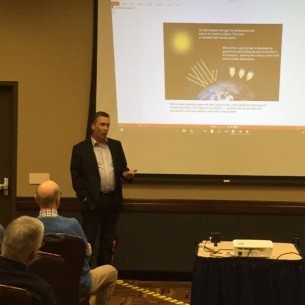
SOUTH-CENTRAL SYNOD: (picture center-right) Bob Lindmeier, well-known television weatherman and member of the Care for God’s Creation/Hunger team (in partnership with LOPPW), co-led a workshop on climate change with Pastor Nick Utphall and Intern Kyle Kretschmann.
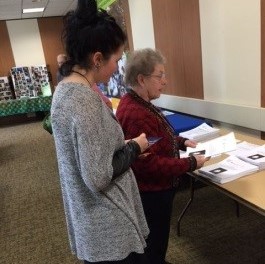
NORTHERN GREAT LAKES SYNOD: (picture far-right)Participants looking over LOPPW’s new resources on Money & Politics and human trafficking.
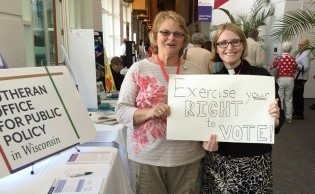
EAST CENTRAL SYNOD: (picture far-right)Debbie Doney & Pastor Anne Edison took the pledge to vote.
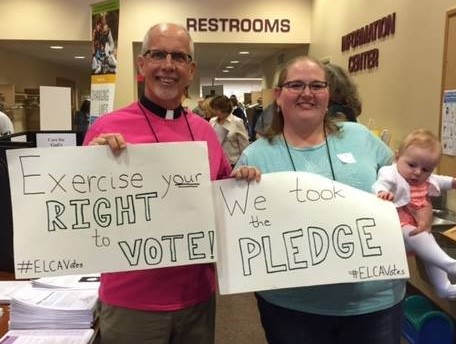
NORTHWEST SYNOD:(picture center-right) Bishop Rick Hoyme and Rev. Mara Ahles-Iverson took the pledge! Elizabeth helped hold the sign but needs to wait a few years to vote.
CONGRATULATIONS TO LUTHERAN SOCIAL SERVICES of Wisconsin/Upper Michigan for its grant to offer a place for healing for youth victims of sex trafficking. LSS will receive a grant from part of the $2 million the state budgeted to help sex-trafficked youth in a rural area of Wisconsin. We appreciate everyone who advocated for this funding via our rally, in response to action alerts, and through our letter-writing campaigns. The state requested proposals several months ago, and LOPPW is are proud of LSS for being the agency chosen. LSS will manage a facility.
____________________
What advocacy efforts are going on in your synod or state? We want to hear about it!