Skip to content
ELCA Blogs

ELCA Advocacy

Between the Gaps: A story of Advocacy and Success

By: Ali Brauner

Associate director, Cathedral in the Night

The reality of affordable housing in America today is far less positive than most of us would like to believe. Agencies are understaffed and case managers are overworked. Underfunded and overstretched, the programs designed to help people get back on their feet and achieve self-sufficiency have far too many gaps through which a person might fall, with virtually no built-in safety nets to catch those who do. There are mountains of paperwork, tedious, long hours in crowded waiting rooms filled with small children who can’t receive the attention they need from their stressed, anxious parents. I know this because I was there myself.

In truth, I cannot write from the point of view of the stressed parent, nor as the child fussing over the long hours sitting still under the florescent lights. I was there as an advocate, at once empowered and helpless. The mother of two young children sat next me to in the unflattering light of yet another waiting room, with its peeling paint and stained, warped floorboard. Stacy and I were the first to arrive at the Department of Transitional Assistance (DTA), but by noon the room was filled with people.

It is Stacy’s story that I want to share today, with her permission. Her name has been changed to protect her privacy, but all other details are true.

Stacy is strong and powerful, well spoken and incredibly well organized. While other mothers in the room barked at their toddlers to sit still, keep quiet and behave, tasks impossible for a person who is only 2, Stacy calmly responded to her child’s request for attention with patience and affection. She came prepared with snacks and distractions, books and crayons, coloring books and Legos. He stayed happily on the floor by her feet, indigo and violet swirls covering Mickey Mouse’s smiling face.

I accompanied Stacy to the DTA office because she was facing eviction. Her story is remarkable. A physical disability makes movement and travel hard on her body, leaving her in a fair amount of pain. Once homeless, she lived in a motel for a short time before being placed in an apartment with her young child. At the time, a state-funded program paid the portion of Stacy’s rent that she was unable to afford, allowing her to scrape by with her minimal income. Her disability has left her currently unable to work.

In addition to the physical pain, years of hardship and traumatic experiences have left emotional scars on Stacy’s spirit, which she is strong enough to acknowledge, but she doesn’t let them slow her down. She explained that the process of finding housing, getting swept off the street and into supportive programs required countless hours of paperwork. At an unstable time in her life, she is unclear what paperwork was signed, what information was given, who she even spoke with. The fog of trauma combined with the near impossible task of filling out the required paperwork for things like housing, health care, day care vouchers, food stamps, etc., leaves a person feeling exhausted, drained and even punished. It’s exhausting to be poor.

For a few years, the program in which Stacy was enrolled kept her safely housed, but over time, the budget for the program was slashed and a time-limit was placed on the assistance. Her housing voucher expired on Jan. 31. Without intervention, she would be homeless by the end of March.

I met Stacy at Cathedral in the Night, an outdoor church in Massachusetts. In December, she came to us, anticipating the end of her voucher and the chaos that would follow. When she asked us for help, she surprised us. Her hope was not so much for a resolution to her own housing crisis. What she really wanted was to help those like her, to tell her story to people in positions of power so that the system might be changed for the better. I continue to be impressed and inspired by Stacy’s spirit.

I was able to set up a meeting quite quickly between Stacy and U.S. Rep. Jim McGovern, her representative in Congress. In the weeks prior, we helped Stacy write out her story in detail, shaping it into a clear, powerful narrative of struggle and survival, one that moved the congressman during our meeting. Not surprisingly, Stacy spoke in a clear, calm voice as she told her story to him, advocating for herself in a way she had been unable to do before. Her young son sat on my lap as Stacy spoke, crayons strewn across the table, and McGovern seemed perfectly at peace in the chaos.

We expected him to respond like most politicians might, with promises to work harder to make the country better, but then he looked at his staffer, sitting behind him at the table, and said, “Now, who do we need to call?” We continue to be pleasantly surprised by his commitment to not just his community as a whole but to the individuals within it. A few days after our meeting, he had written Stacy a letter of support and had called the directors of several housing organizations trying to find a solution to her crisis.

On the day of the DTA meeting, I was able to give Stacy a ride to the office, sitting with her in her meetings and keeping her child occupied. By car, the journey takes 30 minutes. By bus, it would have taken more than two hours, each way. Being poor is a terrible waste of time. After a phone call from McGovern’s office, armed with a letter signed by him, we still waited more than two hours before being seen, only to be told there was nothing the agency could do.

In spite of this, Stacy told me on the way home that my presence in the room made her feel supported and visible. She said that she had never been treated so well by a housing agency. I was there only as an advocate, helping to keep tones of voices low, asking clarifying questions, and taking good notes. When the young child got antsy, I would walk with him in the halls, allowing Stacy to focus on the meeting.

Even though we didn’t walk away that day with a solution to her housing problem, it did feel like a win. For me, I felt like the reality of the housing world had hit me in the face and opened my eyes wide. For Stacy, she felt visible and seen, supported and cared for by her church.

Eventually, Stacy was able to find an organization to help her stay afloat until a Section 8 voucher becomes available for her. Having a place to live is so important for her and her two children.

Cathedral in the Night is proud to have walked with Stacy and her family through this difficult journey, never speaking for but simply keeping watch and bearing witness to the hardship of poverty and disability. We are so grateful to McGovern for all his work on behalf of this family and look forward to new ways that members of Cathedral in the Night will be involved in advocacy.

Lenten advocacy reflection: Good Friday

By the Rev. Cindy Crane
Director, Lutheran Office for Public Policy in Wisconsin

Cindy CraneA photo of birds perching on telephone lines fills the front cover of the book, “Mobbing,” by Maureen Duffy and Len Sperry. The small creatures look as innocuous as notes resting on lines of music. However, the birds get center attention because of their tendency to join together to overtake larger animals. Recent studies show that if two particular birds have bonded to mob their prey once, the likelihood of their banding together in the future to gain advantage over another target grows exponentially. But the book isn’t about birds. It’s about human beings.

Mobbing is bullying that involves more than one person and has institutional buy-in. At least that’s one definition. When an entire agency, school, condo association, workplace, club, place of worship, government, or a political leader with followers condones abuse, validity is added to actions we would normally find abhorrent. There is something seductive about getting in line with a crowd even when it is moving in a questionable direction.

We stay alert to public policies that could add or diminish lawful layers of discrimination or violent behavior in general. Lessons from history add urgency to our advocacy when we notice disturbing trends repeating themselves. How will we engage?

Some mobbing is almost invisible, but the harm can have devastating consequences for the target, at times even leading to suicide. Duffy and Sperry refer to mobbing as a legal way to commit murder. Survivors often suffer from post-traumatic stress syndrome and are left with a changed worldview; it becomes harder to trust, have hope in transformation, and to not see life through a lens of cynicism. The treads in a brain of someone recently bullied or mobbed are most similar to those of someone who was just raped. Whether we have witnessed mobbing or have only read about overt forms of it in the news, the story on Good Friday seems familiar. We don’t talk about it, but people sometimes mob. It happened to Jesus.

A band of soldiers, police and religious leaders swooped in to overpower the Messiah. As the abuse intensified, Jesus didn’t struggle with his worldview or faith. Instead, we hear about Pilate having no power over him and of Scripture being fulfilled. At this point, it’s easy to think about this story being about the glorification of suffering, of Jesus dying because he wanted to die. These interpretations have fostered misunderstandings that victims of abuse or oppressed groups should acquiesce to oppressors just like Jesus did, missing Jesus’ resistance to injustice that led him to the cross. His profound love and forgiveness went hand in hand with his challenging parts of society that were legally designed to ostracize certain people. And his defiance of the distorted messages hurled at him up to his death was entrenched in God’s love.

Knowing what mobbing does to a person, Jesus’ air of resistance is remarkable. If there is a context in which to say, “I’m not like Jesus,” this is it. The vision that St. John lets us in on is of the Jesus who was in complete control. He wasn’t a warrior, but he didn’t act like prey either. Facing the soldiers, he exuded calm and told them to leave his disciples alone, protecting and loving them even though he knew most would desert him. He was unwavering with Pilate, one of the most powerful people in Israel. He carried his own cross. And in this gospel from the cross, Jesus didn’t express a sense of abandonment.

The Jesus whom John experienced was steady while the people around him displayed a whole array of responses. Judas betrayed him. Peter denied his discipleship. Pilate was agitated by the injustice the mob demanded but in the end went with the crowd. His mother, aunt, Mary Magdalene, and the beloved disciple stayed close to the cross.

How do we respond to Jesus? By grace, the gospel gives us courage to have a public voice when facing powerful systems that frame our society. And we discern between organizing out of love and ganging up on others to exert abusive power. This lesson teaches us that God in Jesus walks with those who are mobbed; they/we never have to journey alone. The story reminds us of Christ’s love, even when we falter and move against justice.

People sometimes mob, but that is not what defines the drama in John’s lesson. God incarnate in Jesus, Jesus’ authority and love shape the story of Good Friday. The story shapes us. For now, for this part of Holy Week, that is the hope revealed.


You can learn more about the work of Lutheran Office for Public Policy in Wisconsin by visiting their website at loppw.org/.

Our ELCA Advocacy initiatives are made possible through support from ELCA World Hunger. As we near the end of this Lenten season, register yourself or your congregation for ELCA World Hunger’s 40 Days of Giving to ensure that we can continue to work for systemic change that truly supports our brothers and sisters facing poverty and hunger.

Lenten advocacy reflection: On our own processions toward justice

By the Rev. Paul Benz, Director, Faith Action Network

PaulBenzOn Palm Sunday (the Passion of our Lord Sunday) it is very common across denominations to have a processional in order to remind us of Jesus’ triumphal entry into Jerusalem – the political and religious “capital” of Israel. The people were enthralled and excited about this as Jesus walked in procession into Jerusalem, riding on the crest of his popularity as a miracle worker, truth teller and son of God.

When we read the texts recounting what Jesus did after his triumphant procession, we learn about how he spoke “truth to power” and how he touched and transformed lives. Jesus’ mission was to not only cleanse the temple but to “cleanse” people’s lives and all of creation through the ultimate sacrifice of giving his life on the cross. As advocates, we can use the mission of Jesus’ procession into Jerusalem as a guide for actions that we can take as part of our own “procession” toward justice and peace.

One such action might be to exercise our public voice by speaking to those in power about the necessary reforms we need in order to help our brothers and sisters who face hunger and poverty. The most effective way to affect this policy change in the long-term is to first build relationships with our own community members that are affected by the public policies enacted by our government and then create platforms with them so that they are able to speak their truth directly to these decision-makers.

Today in this country we are in the midst of a moment where competing popular public figures promise to improve people’s lives and move America in a positive direction. Our nation and we the people have many key decisions before us this year, and our faith tradition compels us to be engaged. Another action that can help us walk in procession toward justice is to engage in our electoral process and ensure that all citizens are provided the opportunity to participate. (You can join fellow Lutherans as we pray and act together this year by joining our #ELCAVotes initiative!)

As we continue through Holy Week, the Easter season, and the rest of this year, may we remember our baptismal calling and vocation as it directs us to walk in procession into the halls of power AND into our neighborhoods using our voices to speak out (and our ears to listen), empowering our neighbors, and using our hands to touch and transform.


You can learn more about the work of Faith Action Network by visiting their website at http://fanwa.org/.

Our ELCA Advocacy initiatives are made possible through support from ELCA World Hunger. As we near the end of this Lenten season, register yourself or your congregation for ELCA World Hunger’s 40 Days of Giving to ensure that we can continue to work for systemic change that truly supports our brothers and sisters facing poverty and hunger. 

Lenten advocacy reflection: What Jesus never teaches

By the Rev. Sara Lilja
Director, Lutheran Episcopal Advocacy Ministry of New Jersey

saraThis line from the Gospel of John, “you always have the poor with you,” has been often misquoted. I hear this text cited as justification for inadequate public policy efforts to eradicate poverty. But it is a misread of the text.

Lazarus hosted a dinner six days before Passover. After the meal, Judas criticized Mary for having spent nearly a year’s wages to purchase beautifully perfumed oil to anoint Jesus’ feet.  Jesus defended Mary’s actions; he reminded the gathered disciples that he would not be with them much longer (knowing that his arrest was near). So Mary’s anointing was appropriate. Continuing, Jesus added that there would be many more opportunities to address the needs of the poor in Bethany.

The narrator of this story, John, comments that Judas was mad because he kept the “common purse,” which was money to be used to care for the poor. John asserts that Judas had been stealing money from this purse. Judas would have liked Mary to make a large donation into the purse rather than spending it on oil, so that he could skim more for himself.

Jesus never teaches that God intends or is pleased with an economically stratified society where some are wealthy and some poor. Jesus’ acknowledgment of the needs of the poor should never be understood that he condoned poverty. No, over and over again we learn of Jesus’ intention to close the wealth gap by paying workers a fair wage, forgiving debt, and welcoming the disenfranchised into community.

The conversation that might appropriately grow from this text is: What are the opportunities to serve the poor in Bethany and within my neighborhood so that all people might be economically self-sufficient? A pastor friend of mine recently wrote to his senator, “I’m hoping to work my way out of the food pantry business. Not because I don’t care, but because I believe finding a solution for hungry families is not to continue sharing food, but to help all people buy their own. Equity, love and unbiased fairness are essential to ending the gap between those [who] eat and those [who] don’t. We are committed to feeding families, but we are also committed to advocating for policies and legislation that work for the good of the whole.”

A prayer for people:

For people in poverty, who live in a state of illiteracy and frustration.

For men whose labor is less valued and exploited because they are unskilled.

For boys who have migrated to cities, other countries and continents in search of  jobs to improve the economic conditions of their families, but they are landed in the most strenuous, the dirtiest and lowest paid jobs.

For women who suffer at the hands of their in-laws, because of her dowry and other cultural and family traditions.

For children who are suffering in pain and misery because of illness and malnutrition due to poverty.

For couples who are deprived of mutual love and close bonds of fellowship because of separation and divorce.

For the differently abled who struggle for dignity, equality and for meaningful work.

For public officials who are working in affairs of policy and decision making.

For all people who endeavor to eradicate poverty.

Amen.

Based on Beulah Shakir’s prayer, who lives in Pakistan


Our ELCA Advocacy initiatives are made possible through support from ELCA World Hunger. As we near the end of this Lenten season, register yourself or your congregation for ELCA World Hunger’s 40 Days of Giving! to ensure that we can continue to work for systemic change that truly supports our brothers and sisters facing poverty and hunger. 

Lutheran leader speaks out against methane pollution

Earlier this month, the Rev. Nelson Bock, co-director of Wartburg West,  testified at a Bureau of Land Management (BLM) hearing in Colorado. At the hearing, Pastor Bock voiced the faith community’s concern for God’s Creation, and his support for a proposed rule that would reduce Methane Emissions on Public and Tribal Lands. You can learn more about the BLM proposed rule at the Dept. of Interior by clicking here. 

Lakewood,  CO  March 1, 2016

I am a Lutheran minister, and I teach on the subject of religion and the environment for a Lutheran college. I am also a GreenFaith fellow, having graduated from the GreenFaith program for religious environmental leadership in 2008. And I am a member of the Board of Directors of Colorado Interfaith Power and Light, one of 40 IPL state affiliates working with communities of faith to lessen the impacts of climate change through education, through taking action to reduce their own carbon footprints, and through advocacy for more environmentally responsible policies at every level of government. We do this out of our conviction that we human beings have a divine calling and responsibility as caretakers of the creation– the beautiful, intricate, interdependent web of life and natural resources upon which all life, including our own, depends.

We cannot pretend that our activity on the earth has no impacts and no consequences. Indeed, our own well-being as a human community is dependent on the well-being of the ecosphere of which we are a part.

In addition to what we know about the emission of carbon dioxide by the burning of fossil fuels, including natural gas, and its affect on the climate, we also know that methane is itself a greenhouse gas at least 25 times more potent than CO2, and that the increasing leakage of methane into the atmosphere in connection with drilling and fracking activities has become a growing problem as we seek ways to limit emission of greenhouse gases. We must have strong regulations by which we can enforce the need for such limits.

I also have personal testimony on the topic of methane leakage. My wife and I own property in the North Fork Valley on the western slope of Colorado. Last year, as we were driving through the national forest on Stevens Gulch Road south from County Road 265, we turned off on a Forest Service Road. As we drove along, we began noticing a strong smell of fumes. We rolled down the windows, but the smell was coming into the car from outside, so we rolled the windows back up.Soon we came to a place where the road was blocked and a man who was not wearing a Forest Service uniform told us the road was closed and we had to turn around. When we asked why the road was closed, he told us they were drilling a mile or so down the road. So we turned around and drove back to 265. The strong smell persisted, and we began experiencing headaches and nausea. As we continued to drive away, about 15 minutes later both the smell and the symptoms of illness were gone. Our suspicion was and is that they were caused by hydrocarbons leaking from that well, and we will do whatever we need to in order to prevent further drilling for oil and natural gas without those stringent safeguards.

Thank you.

The Rev. Nelson Bock


Interested in hearing more faith perspectives on the BLM Methane Rule? Read more, including thoughts from Lutheran Pastor David Nichols, by clicking here

March Advocacy Update

Lutherans are taking action across the country! Below you will find our monthly State Advocacy Newsletter. Share with your friends!

​​​_________________​​___​

Washington, D.C. – Amy Reumann, Director of Advocacy

www.elca.org/advocacy

LOGUMLENTEN ADVOCACY REFLECTION SERIES: During Lent, ELCA Advocacy is sharing weekly advocacy reflections from state and national policy staff. You can read the first Lenten Advocacy Reflection on Ash Wednesday and other weekly reflections at the ELCA Advocacy Blog.

INTERNATIONAL HUMAN TRAFFICKING: On Feb. 1, the House of Representatives passed the Trafficking Prevention in Foreign Affairs Contracting Act (H.R. 400), a bill that seeks to ensure the U.S. government does not contract with companies and organizations that employ trafficked people at U.S. embassies and other governmental posts.

The legislation would require the U.S. Agency for International Development and the State Department to give recruiters and contractors clear guidelines so that our government’s employment practices overseas do not support debt bondage, one of the tools traffickers use to trap people into this appalling and illegal practice. The bill has been referred to the Committee on Foreign Relations of the Senate for further consideration.

#ELCAVOTES: With the 2016 elections right around the corner, we are called to conversation and prayer around our role as U.S. residents and as people of faith in ensuring our election systems promote dignity and respect for all. As part of this initiative, the ELCA is involved in planning and implementing the 14th annual Ecumenical Advocacy Days gathering April 15-18. People of faith will speak against the suppression of political and economic rights and the corporate undermining of the voice of ordinary people in the U.S. and around the world.

Through prayer, worship, advocacy training, networking and mobilization with other Christians, the gathering will face the reality of racism, class and power impacting politics and policies and will advocate for the liberty of “Every Voice!” – all culminating with Congressional Lobby Day on Capitol Hill. Interested advocates can sign up for the ELCAvotes updates here, and join ELCA Advocacy in Washington, D.C., for the Ecumenical Advocacy Days at advocacydays.org/.

UPDATES AND ACTION ON FLINT, MICH.: Last month, the Rev. Jack Eggleston of the Southeast Michigan Synod shared his experience of visiting Flint, Mich., which has an ongoing water crisis. With some government support and generous response from the synod, ELCA World Hunger, and people around the ELCA, Salem Lutheran Church is now one of the largest distributors of fresh bottled water in the city. Michigan Democrat Sen. Debbie Stabenow and several Midwest Republicans have since proposed legislation that would procure funding for Flint and cities facing similar lead crises. You can take action on the Flint assistance bill at the ELCA Advocacy Action Center, and read the full version of Pastor Eggleston’s reflection at the ELCA Advocacy Blog.

____________________​

New York, NY – Dennis Frado​, Lutheran Office for World Community

COMMISSION ON THE STATUS OF WOMEN: The 60th session of the Commission on the Status of Women will take place at the United Nations in New York March 14 – 24. The theme is women’s empowerment and its link to sustainable development. Delegates will also review the 57th session agreed conclusions on the elimination and prevention of all forms of violence against women and girls.

LOWC will host 35 Lutheran delegates, including representatives from The Lutheran World Federation  member churches in Brazil, Indonesia, Democratic Republic of Congo, Malawi and the U.S., as well as the Geneva communion office. LOWC will also co-sponsor several side events with the World Council of Churches, ACT Alliance, Islamic Relief Worldwide, World Young Women’s Christian Association (World YWCA), and the Greek Orthodox Archdiocesan Council.

DPINGO BREIFING ON GLOBAL MIGRATION: On Feb. 18, Nicholas Jaech of the Lutheran Office for World Community attended a briefing by the U.N. Department of Public Information/Non-Governmental Organizations on the current global migration crisis. This briefing aimed to educate NGOs on refugees fleeing conflict and war, but emphasis was also made on people displaced as a result of climate change and natural disasters.

The U.N. High Commissioner for Refugees representative reiterated some sobering statistics: 60 million people are currently forcibly displaced, which is the highest number since World War II. In 2014, 42,500 people were forced to flee their homes every day, and there were a total of 13.9 million newly displaced people, which is four times higher than in 2013. The European Union representative noted Europe’s “legal and moral obligation” to provide protection to these refugees and called on the European Union to reform its migration management systems.

The UNICEF representative noted that of the 4.7 million refugees in Syria, half are children. She also noted that in 2015, 39,000 unaccompanied children were apprehended at the U.S./Mexico border. She outlined UNICEF’s support, including technical assistance for coordination, access to education, reuniting children with parents and psychological support for children.

ZIKA BRIEFING: On Feb. 16, LOWC attended a briefing on the Zika virus by the U.N. Economic and Social Council. The World Health Organization announced that 34 countries have reported cases of the  virus, while an additional six countries have indirect evidence of local transmissions. They noted that the virus is spread by the Aedes mosquito and the geographical spread of the virus will continue in countries where this mosquito is found. In addition, the Centers for Disease Control and Prevention spoke about efforts to work with international public health partners to detect and report cases and support diagnostic testing and the development of new technologies.

____________________​

California – Mark Carlson, Lutheran Office of Public Policy

www.loppca.org

EARLY CHILDHOOD EDUCATION: February opened with an Early Childhood Education Advocacy Day at the Capitol. Sponsors included the California Association for the Education of Young Children and the California Alternative Payment Association, two professional organizations that relate to services provided by many ELCA-affiliated preschools and child care centers. Other sponsoring organizations represented providers who lease church facilities for Head Start and State Preschool. LOPP-CA Director Mark Carlson’s legislative-visit team members were private providers from San Luis Obispo and San Diego and appreciated the “tour guide” services and “moral” support. A briefing from the speaker-elecact and legislative budget staff provided context for Gov. Jerry Brown’s proposal to consolidate early childhood funding in block grants to local education agencies, potentially threatening the diverse mix of providers. Although $276 million of the $1 billion in recession era cuts was restored last year, the governor’s proposal is mainly seen as a cost-containment strategy and not a commitment to reach the tens of thousands of unserved eligible low-income children.

Late in February, the annual Watercooler Conference of early education stakeholders drew about 400 people to Sacramento, sponsored by First Five California, the state Department of Education, and The Advancement Project, a civil rights organization. Attendees heard from legislative leadership, administration officials, authors and academics, including a keynote by the director of the Stanford Center on Poverty and Inequality. Early brain development and the toxic effects of poverty were once again emphasized, along with the importance of wealth redistribution programs like the earned income tax credit.

____________________​

Colorado – Peter Severson, Lutheran Advocacy Ministry Colorado

www.lam-co.org

FAITH ADVOCACY DAY: Faith-based advocates from across Colorado joined together at Colorado Faith Advocacy Day on Feb. 20. Under the theme “Income Inequality: Who Gets Left Behind?,” the attendees were addressed by keynote speaker Rep. Faith Winter, who shared her experience working in public policy at the municipal and state levels trying to ensure that low-income women and families aren’t left behind.

coPanelists from the Colorado Fiscal Institute, 9to5 Association of Working Women, and Family Promise of Greater Denver helped illuminate different aspects of the issue. Thanks to all who attended! Be sure to join us again next time.

LEGISLATION: Lutheran Advocacy Ministry-Colorado is working hard on our legislative advocacy agenda as the session nears its halfway point. We are supporting HB 1050, which creates a task force to identify child care barriers for low-income parents returning to school; HB 1004, which creates measurable goals for the state’s climate action plan; HB 1227, which exempts teen parents and victims of abuse and violence from the requirement to pursue child support from non-custodial parents in order to receive child care assistance,and several other proposals yet to be introduced, including renewal of the state’s low-income housing tax credit. LAM-CO testified with a broad coalition against SB 64, which would have removed the requirement for jury unanimity to impose the death penalty. The bill was defeated by a bipartisan vote.

____________________​

Illinois – Lutheran Advocacy Illinois

www.lutheranadvocacy.org

Lutheran Advocacy – Illinois closed in February.  A message sent out to its network made the following announcement: Lutheran Social Services of Illinois (LSSI) has been put in the challenging position of responding to the extended state budget impasse and continuing to provide services to those in need. A plan was created to restructure services for the viability and continuation of the organization, resulting in the closure of more than 30 programs and the elimination of more than 750 positions. As a result of these closures, approximately 4,700 people will no longer receive services from LSSI.

One of the positions eliminated was Jennifer De Leon’s, who was the LSSI director of government relations that included being the director of Lutheran Advocacy-Illinois, the ELCA’s public policy office in Illinois. We want to thank Jennifer for the tireless work she did advocating for the most vulnerable in the state. She has been a powerful voice bridging the gap between legislators and the church for more than 11 years. Jennifer has been a true asset and blessing not only to LSSI, but to Lutheran Advocacy-Illinois. From this point forward, Lutheran Advocacy-Illinois will be disbanded. We encourage you to continue to reach out to your legislators and continue to advocate and pray for those whom Jesus called the least of these.

____________________​

New Mexico – Ruth Hoffman, Lutheran advocacy Ministry New Mexico

www.lutheranadvocacynm.org

NMOn Feb. 4, Rocky Mountain Synod Bishop Jim Gonia hosted the LAM-NM Bishop’s Legislative Luncheon and Issues Briefing. In the morning briefing, more than 100 advocates gathered to learn more about legislative issues, and about 140 attended the luncheon. Lutherans were joined by many ecumenical partners at both events.

The 2016 session of the Legislature is history. Sessions in even-numbered years are so-called “short sessions” in which the passing of the state budget is the main focus. As the price of oil continues to tumble, the budget passed and sent to the governor made cuts of more than $100 million and used one-time funds to avoid deeper cuts. New Mexico is overly dependent on oil and natural gas revenue after slashing personal and corporate income taxes over the last 12 years. While Medicaid received about $20 million in additional funding, the program was directed to take cost-containment actions, which could impact benefits and enrollment. LAM-NM was able to successfully advocate for a small increase in the state-funded SNAP supplement program for seniors and people with disabilities.

A constitutional amendment to reform the state bail system passed and will be on the general election ballot in November. LAM-NM particularly supported changing the state constitution so that non-dangerous defendants cannot be detained pre-trial because they can’t post a bond. LAM-NM was also part of a coalition that successfully supported the passage of driver’s license changes, which maintained the authorization for undocumented immigrants to retain and obtain driver’s licenses.

____________________​

Pennsylvania – Tracey DePasquale, Interim-Director

www.lutheranadvocacypa.org

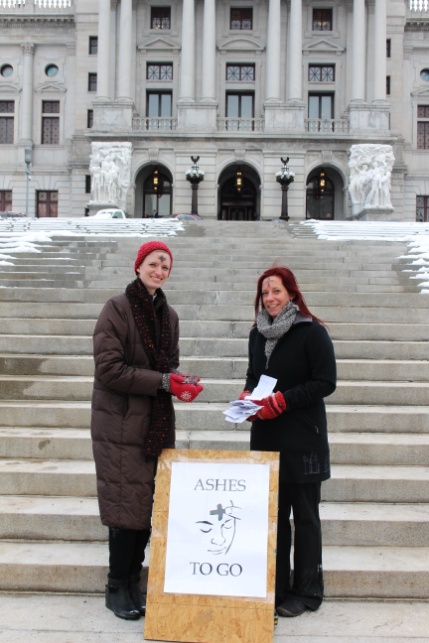
PA1Eight months into a fiscal year with no budget and in the midst of a debate over ousting Pennsylvania’s embattled attorney general, LAMPa and ecumenical partners offered “Ashes to Go” at the state Capitol. The prayer and marking of the start of Lent was met with gratitude, even by those who did not receive. See coverage here and here.

On Feb. 17, Interim Director Tracey DePasquale and Alaide Vilchis Ibarra of the D,C, office taught a class of first-year field education students at Lutheran Theological Seminary at Gettysburg about advocacy in the ELCA.

On Feb. 22, Tracey accompanied Lutherans from the West Berks Mission District and LIRS at a rally to protest the continued operation of the Berks County Family Detention Center, whose state license had expired the day before. The facility houses undocumented immigrant families. She also participated in environmental advocacy training with PA-Interfaith Power and Light held at the Northeast Pennsylvania Synod offices. pa3

On Feb. 23, Tracey accompanied Joyce Ray, Lower Susquehanna Synod Women of the ELCA president, to meet with Senate Judiciary Committee Chair Stewart Greenleaf about Safe Harbor legislation.

Registration has opened for Lutheran Days in the Capital: “Stirring the Waters – Faith, Science and Action!” The event is part of the Gettysburg seminary’s Spring Academy Week and features advocacy training and celebration, an ELCA Glocal event in the Capitol Rotunda, and a canoe trip guided by the secretary of the state Department of Conservation and Natural Resources.

____________________​

Virginia – Kim Bobo, Virginia Interfaith Center for Public Policy

Neill Caldwell, Communications Director

http://www.virginiainterfaithcenter.org/ 

The Virginia Interfaith Center for Public Policy and the Virginia Consumer Voices for Healthcare co-sponsored a press conference on Feb. 17 at the General Assembly Building in Richmond, featuring several faith leaders who had signed a letter to the legislators asking them to close the Medicaid coverage gap. They were only a representation of the nearly 300 religious leaders who signed the letter. “How is it that living in this great and blessed commonwealth of ours, Virginia, that in the midst of all of this greatness, we are giving consensus to allowing more and more of our citizens to fall into vulnerability?” said Imad Damaj, founder of the Virginia Muslim Coalition for Public Affairs.

An estimated 400,000 Virginians fell into an insurance coverage gap created when the state did not expand Medicaid as the Affordable Care Act intended. A 2012 ruling from the U.S. Supreme Court made Medicaid expansion optional for states. Advocates say the lack of Medicaid expansion has left some of the most vulnerable people out of luck when it comes to health insurance coverage, as they are not poor enough to qualify for Medicaid and they don’t earn enough to qualify for subsidies to buy insurance on the health insurance exchanges. Virginia’s Republican-controlled House and Senate have rebuffed attempts by Gov. Terry McAuliffe to expand Medicaid. The House of Delegates instead has offered additional funding to free clinics around the state. “Funding for more clinics is a woefully inadequate response” to the crisis, Kim Bobo, the new executive director of the Virginia Interfaith Center for Public Policy, said in response.

____________________​

Washington – Paul Benz, Faith Action Network

www.fanwa.org

Our Legislature’s 60-day session began on Jan. 11 and will be over soon; the last day is March 10. Three weeks ago, Faith Action Network (FAN) gathered 270 advocates together from 39 of our 49 legislative districts for Interfaith Advocacy Day, during which advocates attended 108 meetings with legislators or their staff.WA1

Some of FAN’s key bills that are still alive include:

  • Breakfast After the Bell, which increases access to breakfast for kids from economically disadvantaged households.
  • The Voting Rights Act, which will address disenfranchisement within communities of color caused by broken election systems and will allow jurisdictions to find solutions that work for that community.
  • The Use of Deadly Force Task Force will bring recommendations for better police-community standards.
  • School vouchers for homeless youth.WA2

FAN coordinated a meeting of religious leaders with the governor, where a main topic was about the divisiveness between parties in the Legislature. Afterward, the group issued a statement on the need for civility in the political process.

After the legislative session, FAN staff look forward to denominational spring assemblies and beginning our issue work groups (economic justice, the environment, and health care, etc.) at our four regional summits in Spokane, Seattle, Vancouver, and Yakima.

____________________​

Wisconsin – Cindy Crane, Lutheran Office for Public Policy in Wisconsin

www.loppw.org

February was a significant month in the Wisconsin Legislature.

PROTECTING CHILDREN: The Assembly and Senate passed a significant anti-trafficking bill LOPPW supported. AB 737 has about two-thirds of the Safe Harbor bill, including sex trafficking added to the definition of child abuse, a mandate that law enforcement report suspected child abuse by non-caregivers to the state Department of Children and Families, and additional funding to support victims of sex trafficking. LOPPW was present for the governor’s signing of SB 308, which will help fill gaps in child protection related to the appointment of a successor guardian for a child in need of protection or services.

FOOD SECURITY: We opposed AB 222 that would require recipients of FoodShare to use a photo ID. It passed the Assembly several months ago but recently stopped in the Senate (for now).

PRISON REFORM: We supported SB 280, which would return first-time, nonviolent 17-year-old offenders to the original juvenile justice system. An amendment was added in February, but the bill is still on hold. We supported SB 322, which would increase compensation for those wrongfully imprisoned and provide assistance for them after their release. The bill recently passed in the Assembly but has been referred to the Joint Committee on Finance.

WATER: We spoke against SB 432, which would streamline corporations’ ability to privatize public utilities and diminish our public voice in the process. We had concerns about costs, especially for people in poverty, and water safety. The bill died in the Senate.

____________________​

 What advocacy efforts are going on in your synod or state? We want to hear about it!

Contact us at washingtonoffice@elca.org ​​

Lenten Advocacy Reflection: Poverty and Grace

By: Peter Severson, Director, Lutheran Advocacy Ministry-Colorado for the Rocky Mountain Synod

peter

Few of Jesus’ parables are as familiar or artistically resonant as the parable of the prodigal son. Rembrandt immortalized it on canvas. Benjamin Britten set it to lyrics and music. Henri Nouwen wrote a spiritual autobiography around it. Of the multitude of literary and linguistic artifacts that the Bible has deposited into Western culture, the idea of the “prodigal son” is among the most well-known and well-trod.

All of which sometimes makes it hard to hear the parable with fresh ears. Those who grew up in the church will know the beats by heart. The son asks for his inheritance early. He travels to a distant land, squanders it all, and ends up destitute. He comes to his senses (or as the King James and NRSV say, “he came to himself,” Luke 5:17) and realizes that even his father’s servants have enough to eat, so he beats a quick retreat back to the old homestead and begs his father’s forgiveness. Whether the son’s plea is sincere or not, the father welcomes him back joyfully and promptly throws a huge party, fatted calf and all. The brother returns from the fields, sees the party in progress, and is more than mildly piqued at the excess of it all. Jesus wraps it up with the heart of the parable: The father has forgiven this son, who was dead and now has come back to life.

It’s a model of reconciliation and forgiveness, an almost staggering display of generosity of heart that is hard to imagine playing out in modern Western culture. In our culture, those who would presume to ask for an inheritance early would be looked on with suspicion and probably scorn. Anyone who would squander their resources in profligate depravity certainly deserves to live in destitution. And a son who would come home after all that and beg forgiveness, well … certainly no one is obligated to forgive him, even his own parents. These are the messages we’d most likely hear in the contemporary cultural moment.

As an advocate, I find myself hearing something new in the parable this time, and it comes from the juxtaposition of those culturally defined reactions with the beats of the story. Typically, this is read as a story that is principally about forgiveness and reconciliation. I still read it that way. But what if we read it also as a story about generosity and solidarity? A story where a person who has reached the depths of destitution is treated as still human, still worthy of welcome, still worthy of “caritas,” still worthy of grace?

Many advocates who work with and on behalf of people living in poverty will tell you that familiar tropes arise time and again among opponents who don’t want to change the system. Many people are comfortable with our economic status quo, and many believe in the ideology that our position in life is determined almost exclusively by our relative merit and skill in society. The poor, the argument continues, are largely in that condition by their own fault, and so a social program to assist them is predicated on a false assumption that they don’t actually deserve their destitution. This is the “bootstraps” mentality, which is especially prevalent here in the American West.

As I read this parable, however, I encounter something amazing: Here is a person who actually does create his own economic reality, and actually does squander all his resources and land himself in poverty – a far cry from the circumstances of virtually any impoverished family in the United States today, but with the same endgame of penury. And yet this son, who by all rights deserved to be mucking about in the sty with pigs, who deserved no “helping hand” up, is welcomed back with joy anyway. It doesn’t matter that he “brought it on himself” – grace and welcome and “caritas” are given freely. The older brother’s rage then becomes newly familiar, perhaps, as we see him frustrated that someone so reckless would be given help to be restored and made whole. Doesn’t he deserve to get left behind and trampled underfoot? How dare he be welcomed back? When we read with this lens, the parable becomes an even more deeply and radically counter-cultural message. It does everything that our modern competitive capitalist economy tells us not to do.

How rich in compassion is the father for his prodigal, profligate son. And how rich are we called to be with our impoverished neighbors, whose circumstances deeply resemble that of the son and yet did not arise by “squandering [their] property in dissolute living”? (Luke 5:13) Rather than viewing our neighbors as competition to be defeated, as discardable, as somehow less-than-human beings, what if we chose the way of Jesus? He asks us instead to be reconciled through him to all our neighbors, to be restored to right relationship. He asks us instead to be vessels of grace and mercy. May it be, on earth as it is in heaven. Amen.


Our ELCA Advocacy initiatives are made possible through support from ELCA World Hunger. As we enter the season of Lent, register yourself or your congregation for ELCA World Hunger’s 40 Days of Giving! to ensure that we can continue to work for systemic change that truly supports our brothers and sisters facing poverty and hunger.