ELCA Advocacy
Lutherans are taking action across the country! Below you will find our monthly State Advocacy Newsletter. Share with your friends!
Washington, D.C.
Mary Minette,
Interim Director of Advocacy
 EPA CLEAN POWER PLAN ANNOUNCED: This week, President Obama unveiled details about a new EPA Clean Power Plan. The plan will work with states and industries to reduce carbon emissions, improve air quality, and help combat climate change. Following the release of the rule, ELCA Advocacy’s new interim director, Mary Minette, released the following statement applauding the announcement:
“Reducing carbon emissions from power plants must be a top priority for the U.S. and the world if we hope to prevent the worst impacts of climate change and protect communities around the world.
The rule released today by the Environmental Protection Agency is a critical step in reaching that goal. It provides individual states the flexibility to implement the rule in ways that make the most sense for their economies and power needs while still reducing overall emissions and demonstrating our country’s leadership in combating climate change.
Climate change is already affecting all of us. Most importantly, it will cause countless problems for our children, our grandchildren, and our most vulnerable neighbors if we fail to take bold action now to curb its worst impacts. We have a moral obligation to leave our children a healthy and safe world, and to care for our neighbors. The rule released today is an important step on the path to meeting that obligation.”
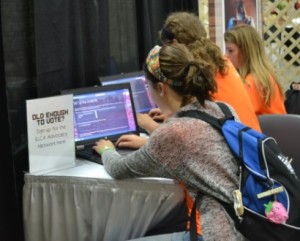 ADVOCACY AT THE ELCA YOUTH GATHERING: ELCA Advocacy joined with ELCA Young Adult Ministry for engagement and action at the ELCA Youth Gathering this July in Detroit. Youth took action in support of Child Nutrition reauthorization, called on the United States to lead in addressing climate change, and learned about how to continue connecting with the ELCA as young adults. We are excited to build our partnership with ELCA Young Adult Ministry by supporting efforts to foster connections and engage on important issues in our communities. Watch for important social media conversations by following @elcayoungadults and #elcayoungjustice!.
RESTORING RELATIONS WITH CUBA: On July 23, the Senate Appropriations Committee approved three amendments on Cuba. The first amendment lifts the travel ban to Cuba for one year. The second amendment repeals the costly and outdated requirement that any ship entering Cuban ports shall not load/unload cargo anywhere in the United States within 180 days without a license from the secretary of the treasury. Lastly, the committee voted to allow the private sector to provide financial services to Americans for sales of permitted agricultural goods to Cuba. While these amendments have yet to pass the full Senate, it is indicative of the growing bipartisan consensus in Congress and around the country for our government to normalize relations with Cuba. Through advocacy and high-level dialogue, the ELCA continues to support all efforts to fully restore relations with Cuba.
 CHILD NUTRITION REAUTHORIZATION: The Senate Finance committee will consider child nutrition program legislation starting Thursday, Sept. 17. This legislation will determine the continuation of cost-effective federal programs that are critical to the wellbeing of children in schools across the nation. Take action today to support these programs at the Advocacy Action center. NOTE: For advocates who collected and shared ELCA child nutrition postcards on this issue, please send in all signed postcards to the ELCA Advocacy office as soon as possible! (Mail to: 122 C Street NW, Suite 125, Washington, D.C. 20001).
U.S. MIGRATION: In late July, Judge Dolly Gee ruled that the U.S. government must stop detaining families because it violates a 1997 agreement that upholds the best interest of children. The U.S. government has until the week of Aug. 10 to appeal the decision. However, in a move signaling their willingness to appeal, the Department of Justice has already asked the judge to reconsider her decision. The faith community has stood together asking the administration to release families as soon as possible and not appeal the decision.
CENTRAL AMERICA/MEXICO: The Senate released their version last month of the funding bill that would address migration from Central America. Their version focuses on addressing poverty, violence and corruption. This stands in contrast to the House version, which incentivizes stopping children and families at all costs by releasing funding only if Central American and Mexican governments increase border security and stop migrants. Although neither bill is expected to be approved, the ELCA is advocating for the continuous resolution, which keeps funding levels the same as the previous fiscal year, to contain the provisions in the Senate version of the bill.
____________________
New York, NY
Dennis Frado, Lutheran Office for World Community
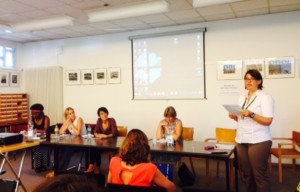 TRAINING WORKSHOP ON ADVOCACY FOR FAITH-BASED ORGANIZATIONS WITH A SPECIAL FOCUS ON WOMEN’S HUMAN RIGHTS: The Lutheran World Federation Women in Church and Society program organized a training workshop from July 6 to July 11 in Geneva on women’s human rights advocacy. It was held jointly with the World Council of Churches, Finn Church Aid, the ACT (Action by Churches Together) Alliance, and the World YWCA. The workshop’s aim was to help participants from member churches or other faith-based organizations to better understand and use U.N. mechanisms and treaties, such as the Convention on the Elimination of All Forms of Discrimination Against Women, the Universal Periodic Review, and the U.N. Commission on the Status of Women to advance gender quality. Submitting “shadow” reports is one of the avenues faith-based organizations can report on human rights situations in the countries being reviewed. The Lutheran Office for World Community’s Christine Mangale presented and moderated a workshop that explored the linkages between Convention on the Elimination of All Forms of Discrimination Against Women, the Universal Periodic Review and the proposed U.N. Post-2015 Development Agenda, including the proposed Sustainable Development Goals.
LUTHERAN WORLD FEDERATION GENERAL SECRETARY VISITS LOWC: In early July, the general secretary of The Lutheran World Federation, the Rev. Dr. Martin Junge, visited the Lutheran Office for World Community. The primary purpose of his visit was to attend a donor-faith-based organizations-U.N. consultation and reflect together in depth on three areas: governance and democratization, peace and security, and gender equality and women’s empowerment. They will be included in the Post-2015 Development Agenda. While in New York, he also visited the offices of U.N. Women, UNICEF, the U.N. Development Program, and the U.N. Population Fund to discuss possible future areas of collaboration. LOWC staff accompanied him to all of the meetings.
____________________
California
Mark Carlson
Lutheran Office of Public Policy
STATE LEGISLATURE: The California Legislature is on summer recess until Aug. 17, when it will reconvene for three weeks of final activity for the year. Before recess, LOPP-CA expressed support in the Assembly Human Services Committee for a bill, SB 23, to repeal the Maximum Family Grant rule that prohibits additional cash assistance for a new pregnancy and birth in a family already enrolled in CalWORKS/Temporary Assistance for Needy Families, except for reported rape and incest, or specified, medically documented contraceptive failure. Ending this harsh, “thin the soup” policy based on demeaning stereotypes, which contributes to one-quarter of California’s children living in poverty, is a high priority for women’s advocates. A coalition is planning a “Stronger Together” action day at the Capitol on Aug. 26.
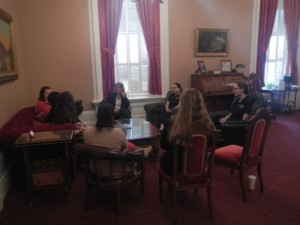 Director Mark Carlson’s activities included a half-day briefing by the California Pan-Ethnic Health Network (focus on health access for undocumented immigrants); attendance at the funeral of the Rev. Richard Bowley, a leader in justice and anti-racism ministry; anti-racism training offered by Faith Lutheran, Meadow Vista, and Bethlehem Lutheran, Auburn; panelist at a forum on police-community relations at Our Redeemer, Sacramento; and hosting a Day at the Capitol for participants in the Lutheran Episcopal Volunteer Network, sponsored by Lutheran Episcopal Campus Ministry at UC Davis (see photo with legislative director for Senate majority leader). A highlight was viewing a Senate hallway press conference by about eight senators who condemned the anti-immigrant rhetoric of Donald Trump.
____________________
Colorado
Peter Severson, Lutheran Advocacy Ministry – Colorado
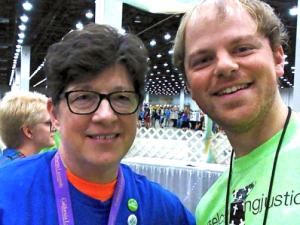 ELCA YOUTH GATHERING: Director Peter Severson was present at the Youth Gathering in Detroit to raise the profile of advocacy, partnering with ELCA Young Adult Ministry and ELCA World Hunger to create action stations in the Interaction Center. The advocacy offices in Colorado, Pennsylvania and Washington, D.C., were represented. Hundreds of youth and group leaders filled out child nutrition postcards for members of Congress and signed the Interfaith Climate Petition, and even Presiding Bishop Elizabeth Eaton came to visit us!
You can see more pictures and updates from the Youth Gathering by searching for #RiseUpELCA and #ELCAYoungJustice on Twitter and Facebook. Follow us @LutheranAdvoCO and like us on facebook.com/LutheranAdvocacyCO to hear more about what we’re up to.
CHILD NUTRITION: LAM-CO has been deeply involved in raising the profile of child nutrition issues in Colorado this summer. As Congress looks ahead to working on the Child Nutrition Reauthorization Act this fall, LAM-CO has joined members of the anti-hunger coalition in planning events for the Colorado delegation during the August recess to highlight the importance of summer meal programs, especially for low-income households.
In addition, pastors and lay leaders in rural counties are preparing to attend town hall meetings this month hosted by the Colorado Department of Human Services in order to speak out on hunger issues.
____________________
Minnesota
Tammy Walhof, Lutheran Advocacy – Minnesota
tammy@lcppm.org
KIDS COUNT: The new KIDS COUNT report ranks Minnesota No.1 for well-being of children, based on education, economic well-being, health, and family and community. However, significant concerns still exist for Minnesota children: 14 percent live in poverty; one-third live in households with overly high housing costs; more than 3,500 (half under age 6) are homeless with their parents on any given night. The report confirms that “children in low-income families that have limited access to affordable housing are more likely to live in crowded housing or become homeless, and are more likely to be food insecure and have to postpone accessing health care.” [Emphasis added.]
MN KIDS Count report
National KIDS COUNT Data Center
National website and links to report(s)
AFFORDABLE HOUSING AND HOMELESSNESS: The Homes for All Coalition has started the process to determine priorities for the 2016 legislative focus. Over several previous months, more studies on housing and homelessness have shown the importance housing stability plays for families, especially in hunger and health (reaffirmed in the new KIDS COUNT). Also, senior homelessness is increasing at dramatic rates. LA-MN will push to address these concerns.
CLEAN ENERGY: Analysis following the difficult 2015 session suggests a significant lack of knowledge around clean energy and the damage coal burning causes to people and the environment. LA-MN fall education will try to address this deficit.
Director Tammy Walhof also fulfilled her civic responsibility of jury duty this month, serving on one trial and jury pools for two others.
Twitter: @LuthAdvocacyMN Facebook
____________________
New Mexico
Ruth Hoffman, Lutheran Advocacy Ministry – New Mexico
 Lutheran Advocacy Ministry-New Mexico joined with many other groups and individuals to urge that new work requirements not be imposed for families receiving SNAP benefits. The Martinez administration through the New Mexico Human Services Department intends to institute work requirements for recipients from the age of 16 to 60 and for families with children over the age of 5. LAM-NM Director Ruth Hoffman was member of a panel that presented to the Legislative Health and Human Services Committee on July 16 in Las Cruces. Ruth emphasized that over 30 percent of New Mexico’s children live in poverty and that our economy is lagging far behind in the recovery from the great recession. She also stated that there is little or no evidence that the Human Services Department is prepared to or able to administer such a new program that will involve tens of thousands of recipients. Because LAM-NM now is in a covenant advocacy relationship with the NM Conference of Churches, LAM-NM spoke on behalf of that ecumenical organization as well. Here is a link to an interview that Ruth did (along with our advocacy partner, the NM Conference of Catholic Bishops) with KUNM radio about the proposed requirements.
____________________
Ohio
Nick Bates, The Faith Coalition for the Common Good
Happy fiscal new year from the state of Ohio! On July 1, 2015, fiscal year 2016 began with Ohio’s new budget. It’s a month into the new fiscal year, and advocates and faith leaders continue to scratch their heads at missed opportunities to expand food access, help low-income families through a refundable earned-income tax credit, and help rural poverty-stricken school districts. Recent reports continue to show Ohio’s unacceptable infant mortality rate and child poverty rates. While Capitol Square has quieted down this month, faith advocates continue to ask what does it mean for us to do justice, love mercy and walk humbly with our God.
If you would like to get involved with faith-based advocacy in Ohio, contact Diaconal Minister Nick Bates atBatesyep@gmail.com.
____________________
Pennsylvania
Amy Reumann, Lutheran Advocacy Ministry in Pennsylvania
Tracey DePasquale, Associate Director
The state budget is now more than a month overdue. Rank-and-file lawmakers are in summer recess as their leadership and the Wolf administration negotiate in the wake of last month’s vetoed spending plan. The budget impasse has begun tohurt nonprofits and ministries.
LAMPa continues to help Lutherans connect with Harrisburg lawmakers through email advocacy, editorial writing and congregational postcard campaigns on the key issues of housing trust fund expansion and fair education funding. LAMPa acted with  75 other organizations to urge the Consumer Financial Protection Bureau to address loopholes in its draft payday lending rules.
Tracey joined advocacy colleagues at the Youth Gathering, engaging Pennsylvania youth in advocacy on the Interfaith Climate Petition, federal Child Nutrition Reauthorization bill and the ELCA Day of Service and inviting them to connect with LAMPa upon their return. LAMPa is inviting youth to bring their #Proclaim Justice Day activities home with resources for youth to combat blight and act on clean water in Pennsylvania.
 LAMPa connected the State Education Association with the state’s food security coalition, resulting in training more than 100 teacher leaders on poverty and hunger and their connection to learning. That partnership, which will be ongoing, has also yielded the association’s August newsletter devoted to child hunger and nutrition.
Check out our resources for preachers during Six Weeks of Bread Texts: Preaching on John 6.
We bid a fond farewell to Pastor Paul Lubold as he leaves LAMPa staff – but not Lutheran advocacy! We are grateful for his friendship and his entire ministry.
____________________
Virginia
Charles Swadley
Virginia Interfaith Center for Public Policy
The Virginia Interfaith Center for Public Policy (VICPP) provided support for an ELCA Hunger Summit with Bishop Jim Mauney on July 25. It was well attended by interdenominational partners from across Virginia. At the summit, presentations on feeding programs were provided by state government representatives. With lively discussion, strategizing, and a focus on the future, a follow-up meeting will be held in Charlottesville on Nov. 18 to include interfaith leaders.
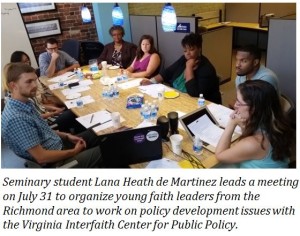 Seminary student and Public Policy Fellow Lana Heath de Martinez is leading VICPP’s organizing efforts to expand ethnic, age and faith diversity through the statewide chapters. VICPP is partnering with a new coalition of agencies called RISE for Youth with the intention of closing juvenile prisons in Virginia. A partnership with the Center for American Progress continues and will culminate with the co-hosting of a Poverty Summit in Hampton Roads in September.
VICPP and its health care program, Virginia Consumer Voices for Healthcare, met with Ben O’Dell, a representative of the White House Faith and Community Relations Office, to discuss working together on advocating for Medicaid expansion during the forthcoming General Assembly session. The health care program supported two events on July 29 and 30 in the Hampton Roads area to celebrate the 50th anniversary of Medicare and Medicaid. The regional director for the Department of Health and Human Services presented at both events, noting the impact of these programs on improving Americans’ lives. VICPP is assisting the Chesapeake Foundation in organizing an interfaith conference focused on the environment at the Living Waters retreat center in Hampton Roads this September.
____________________
Washington
Paul Benz, Faith Action Network
POLICY UPDATE: Washington’s Legislature, after three special sessions and 176 days, finally adjourned on July 7, with its final decision being the suspension of a class-size reduction initiative approved by voters last November. All three budgets (operating, transportation and capital) were signed just before midnight on June 30 by the governor to avoid state layoffs. (The 2015-2017 biennium began July 1.) A summary of the issues we worked on this past legislative session can be viewed at http://fanwa.org/2015-end-of-session-report/.
CONGRESSIONAL UPDATE: FAN’s goal every year is to meet with as many of our congressional delegation (12) as possible. Our latest meeting was with key staff of Sen. Maria Cantwell in her Seattle office, where we discussed the Green Climate Fund, I-VAWA, Child nutrition/summer hunger bills, and recognition for the Duwamish tribe (first peoples of Seattle).
PROGRAMMING AND ORGANIZING: FAN is now in its third programmatic season of the year, convening our 17 geographic clusters that make up our Network of Advocating Faith Communities, which now numbers 101 faith communities around the state. The purpose is to deepen relationships and discuss ways to better advocate individually and collectively on issues FAN is working on. FAN is planning two forums on taxation called “What Kind of State Do You Want to Live In? A conversation and mobilization about our state’s regressive tax structure.” Washington state has the most regressive tax structure in the nation.
____________________
Wisconsin
Cindy Crane, Lutheran Office for Public Policy in Wisconsin
PAY DAY LENDING: LOPPW has a history of trying to protect Wisconsinites, especially those living in poverty, from predatory lending. Recently our constituents responded to the sudden state budget addition to allow payday lenders to provide more services, such as insurance, annuities and financial advice. The proposed addition created bipartisan resistance. We are pleased that Gov. Scott Walker responded to the advocacy against the measure and vetoed it.
LIVING WAGE COALITION: The coalition initiated by Wisconsin Faith Voices for Justice is made up of faith-based and secular partners. We recently met for a second time and explored broader issues beyond raising the minimum wage, including predictable, stable hours (Hours that Work); paid sick leave; paid family leave; affordable, quality child care; access to public transportation; and pension protection.
ANTI-HUMAN TRAFFICKING CONSORTIUM: At the most recent statewide meeting we discussed the newly formed Safe Harbor Bill; consensus is that this bill will have more of a chance of passing than previous bills related to Safe Harbor.
DIALOGUE WITH BISHOPS: The director contacted all the Wisconsin bishops to introduce the idea of creating a project that would focus on one of the root causes of hunger – money in politics impacting public policies. She will and all six bishops will meet at a Region 5 gathering at the end of August to discuss the project further. LOPPW’s director also participated in two half-day trainings for our advocacy office’s new database.
____________________
What advocacy efforts are going on in your synod or state? We want to hear about it!