Skip to content
ELCA Blogs

ELCA Advocacy

Living Earth Reflections: December 2014

Mary Minette, ELCA Director for Environmental Education and Advocacy

“I consider that the sufferings of this present time are not worth comparing with the glory about to be revealed to us. For the creation waits with eager longing for the revealing of the children of God; for the creation was subjected to futility, not of its own will but by the will of the one who subjected it, in hope that the creation itself will be set free from its bondage to decay and will obtain the freedom of the glory of the children of God.”

                                                                        –Romans 8:18-21

Late on December 14, the annual meeting of the UN Framework Convention on Climate Change (UNFCCC) finally concluded; two full days after it was scheduled to end. The parties adopted a final document that will guide the negotiation of a new global climate change agreement over the next year, with final results next December in Paris. As the negotiators, delegates from environmental organizations, churches, businesses and other interested groups headed home, the assessments of the outcome began in the media, blogs, social networks, and in conversations amongst colleagues.

Many of the delegates returned to communities preparing for Christmas. I returned from Lima to a family and church community celebrating Advent with a children’s pageant (my son was a sheep) that told the story of the coming of the son of God to a world where misery reigned and hope was in short supply.

The world we live in today often lacks hope, and this season gives us a chance to reflect on the God’s gift of light and hope to humanity, and creation through Jesus Christ. The four weeks of Advent allow us to find hope in the midst of difficulty and despair, to look for the coming of the light in our dark world.

As a church engaged in the global discussion about climate change, our task during Advent and beyond is to tell the stories of those who are suffering and to point to solutions that will provide our world with hope and a chance for a more sustainable future. Following the People’s Climate March in New York this past September, many hoped that our leaders would note the interest and commitment of millions of people around the globe and find the courage and the will to act decisively to address climate change.

The results of Lima are not the decisive actions marchers demanded in New York, but they do not preclude a good outcome in Paris if countries can come to agreement on some significant issues over the next year. How and when will developing countries reduce their emissions? Will they be given financial and technical assistance to do so? What will be done about climate change impacts that are already happening, and can’t be adapted to? How much will developed countries pledge to do over the next decade to help developing countries adopt clean energy technologies and move away from polluting fossil fuels?

All of these questions can be answered. We can have an agreement that moves us towards a sustainable future if we continue to let our leaders know that action is critical, and that we will support them as they negotiate a strong climate deal for Paris.

As we look to the New Year, let us pray for an effective agreement and encourage our global leaders to address the critical questions left unanswered in Lima in a way that truly fulfills our collective call to care for our neighbors and for all of God’s creation.

Breaking down the firewall

Mary Minette, ELCA Director for Environmental Education and Advocacy

 photo 3 (2)

“It always seems impossible until it’s done.”

-Nelson Mandela

It’s midway through the final week at the 20th conference of the parties to the UN Framework Convention on Climate Change (UNFCCC) in Lima, Peru. With a limited amount of time left, it seems impossible that parties will agree on a framework for a new global climate change agreement which will need to be finalized next year in Paris. Countries are very far apart on some key points: will the agreement be a legally binding treaty or something less stringent? What issues will the new agreement cover?  Will adaptation to climate change and the related issue of “loss and damage” (impacts that can’t be adapted to) be accorded as much attention as the all-important issue of emissions reductions?  Will there be sufficient funding to help the least developed nations adapt and adopt low carbon technologies needed to sustainably develop their economies and reduce poverty?

One of the most contentious issues is whether the “firewall” between developed and developing countries will continue to allow countries like China, Brazil and India to shoulder fewer emission responsibilities. The firewall has stood since the beginning of the UNFCCC convention in 1992, and places much of the emission reduction responsibility on historically large emitters such as the U.S. and European Union.  In the original UNFCCC document, large historic emitters of carbon dioxide and other greenhouse gases were listed as “Annex I” nations in the convention, and were designated to take on greater responsibilities for reducing emissions.  Under the Kyoto protocol, for example, Annex I countries agreed to mandatory emissions reductions as part of their ratification of the treaty, while non-Annex I countries were only asked to make pledges for voluntary reductions.

In the years since the UNFCCC first took effect, China, a non-Annex I country, has surpassed the United States as the world’s largest emitter of greenhouse gases (although the U.S. still emits the most per capita). India is now the third largest emitter.  Although both of these countries still have significant levels of poverty, it is hard to see how they can take on less responsibility for reducing emissions if we hope to stabilize global temperatures and stay within the 2 degrees Celsius limit required to avoid the worst impacts of climate change.

Currently, in the draft document that the UNFCCC Co-Chairs have proposed to govern negotiations over the next year, there are two versions of the introduction.  One version calls for emissions reductions to be guided by the “provisions and principles” of the UNFCCC (including Annex I), and the other refers to “evolving responsibilities and capabilities.”  This issue may not be resolved by the end of this week, but if we hope to see a global agreement to tackle climate change by the end of next year in Paris, the impossible will need to become possible.

Breaking down the firewall

 photo 3 (2)

“It always seems impossible until it’s done.”

-Nelson Mandela

It’s midway through the final week at the 20th conference of the parties to the UN Framework Convention on Climate Change (UNFCCC) in Lima, Peru. With a limited amount of time left, it seems impossible that parties will agree on a framework for a new global climate change agreement which will need to be finalized next year in Paris. Countries are very far apart on some key points: will the agreement be a legally binding treaty or something less stringent? What issues will the new agreement cover?  Will adaptation to climate change and the related issue of “loss and damage” (impacts that can’t be adapted to) be accorded as much attention as the all-important issue of emissions reductions?  Will there be sufficient funding to help the least developed nations adapt and adopt low carbon technologies needed to sustainably develop their economies and reduce poverty?

One of the most contentious issues is whether the “firewall” between developed and developing countries will continue to allow countries like China, Brazil and India to shoulder fewer emission responsibilities. The firewall has stood since the beginning of the UNFCCC convention in 1992, and places much of the emission reduction responsibility on historically large emitters such as the U.S. and European Union.  In the original UNFCCC document, large historic emitters of carbon dioxide and other greenhouse gases were listed as “Annex I” nations in the convention, and were designated to take on greater responsibilities for reducing emissions.  Under the Kyoto protocol, for example, Annex I countries agreed to mandatory emissions reductions as part of their ratification of the treaty, while non-Annex I countries were only asked to make pledges for voluntary reductions.

In the years since the UNFCCC first took effect, China, a non-Annex I country, has surpassed the United States as the world’s largest emitter of greenhouse gases (although the U.S. still emits the most per capita). India is now the third largest emitter.  Although both of these countries still have significant levels of poverty, it is hard to see how they can take on less responsibility for reducing emissions if we hope to stabilize global temperatures and stay within the 2 degrees Celsius limit required to avoid the worst impacts of climate change.

Currently, in the draft document that the
UNFCCC Co-Chairs have proposed to govern negotiations over the next year, there are
two versions of the introduction.  One version calls for emissions
reductions to be guided by the “provisions and principles” of the
UNFCCC (including Annex I), and the other refers to “evolving
responsibilities and capabilities.”  This issue may not be resolved
by the end of this week, but if we hope to see a global agreement to tackle
climate change by the end of next year in Paris, the impossible will need to
become possible.


Advocacy Summary of FY15 Spending Package

This week, Congress prepares to pass a bill to fund the government. ELCA Advocacy is working to support funding proposals and legislation focused on justice and love for our neighbor. Together with you, we strive to create room for practical solutions, open respectful bipartisan dialogues, fulfill our Biblical values, and avoid scenarios which foster a government shutdown.  

Appropriation legislators recently released a $1.1 trillion spending agreement on Fiscal Year 2015. This proposal  would fund all of the government, with the exception of the Department of Homeland Security, until September 2015. As legislators work to pass the new budget before December 11, the ELCA remains focused on issues that affect our faith communities and neighbors:

Nutrition: The ELCA has long advocated for food security and access for all. As part of our call to speak for a just society and love for our neighbor, we are pleased to see Congress is isupporting funding that provides supplemental food and nutrition education to new mothers in the WIC program. After facing intense threats of cutbacks, we are also pleased that work requirements for the SNAP nutrition program were not tightened.  However, we are concerned by the implications of a policy rider which would give schools a one year waiver to bypass nutritional meal requirements. Nutrition standards in schools affect children’s health, their educational achievement and economic security. As a church called to strive for justice, we will continue to advocate in 2015 for policies that care for the health and nutrition of all our brothers and sisters, including the Child Nutrition Reauthorization Act..

Environment: In 2014, ELCA Advocacy joined Lutherans in the People’s Climate March in New York and advocated for policies that care for God’s creation. We are deeply concerned by funding cuts that will significantly reduce EPA agency staff to the lowest number since the 1980s and will ban contributions to the international Green Climate Fund for one year. In 2015, we will continue to push for policies that care for the earth, our neighbors and all of God’s creation.  After contentious debates, Senate appropriators succeeded on limiting large cuts to the EPA’s environmental programs, including language for the new proposal on Power Plant Carbon Emissions, which ELCA Advocacy championed over the summer.

Abortion: Appropriation bills maintained nearly all pro-life policy riders, with the exception of a rape and incest exception added to the Peace Corps program. Additional funding was provided to abstinence education. New language was also added which will make the Affordable Care Act disclose abortion coverage.

International Affairs: ELCA Advocacy welcomes the addition of $2.5 billion in emergency funding to help address the Ebola epidemic in West Africa. However, this amount is less than the $6.18 billion needed for immediate needs, as requested by President Obama. Through Lutheran Disaster Response and other partnerships, the ELCA has worked to provide over $100,000 to containing and addressing the Ebola crisis. We will continue to work with Congress and the Administration to ensure that more funding resources are available to help address the Ebola emergency. In the Middle East, Jordan will receive $1 billion to help the country with hosting Syrian refugees and fighting the extremist group calling itself The Islamic State.

Immigration: This summer, ELCA Advocacy took action to support the rights of all migrants– including children and families, and ensure that they are treated with dignity and compassion. We are happy to see Congress acknowledge the need for a holistic approach to the influx of migrant children and families seeking refuge in the United States.  Proposed funding levels will help finance agencies that take care of children, and help the State Department address the root causes of migration. We look forward to continue our work in 2015 with the Administration, Congress, and partner organizations to ensure that the programs and policies supported by these funds acknowledge the humanity in all of God’s children and concentrate in effectively supporting those who are vulnerable.

Money in Politics: Among the other policy riders, a surprise piece of legislation affecting money in politics is stirring new controversy. As it stands, the proposal would increase an individual’s maximum campaign contributions from $64,800 to nearly $1.6 million. If the wealthiest can continue to overwhelm the voices of ordinary Americans, we not only cease to be a democracy, but also  silence the most marginalized members of our communities who cannot afford to make large campaign contributions. This year, hundreds of Lutheran advocates voiced their concerns on the overwhelming increase of money and special interests in politics to the Senate. As advocates who work to empower all voices, we will continue to challenge social systems which weaken our democracy.      


To take action, sign up for ELCA Advocacy Action Alerts (e-Advocacy Network) by visiting: www.ELCA.org/advocacy

Stay up to date on ELCA Advocacy by following us on social media!

Facebook: ELCA Advocacy     Twitter: @ELCAadvocacy


ELCA State Advocacy Update: December 2014

ELCA Advocacy

​Lutherans are taking action across the country! Below you will find our monthy State Advocacy Newsletter. Share with your friends!

———————————————

Washington, D.C.
Advocacy Director, Stacy Martin
www.elca.org/advocacy

1Seeking Justice and Reconciliation in this season of Advent: This month, ELCA Advocacy released two statements expressing our sympathies for the families of Michael Brown and Eric Garner and our grief for our failures to address racism. As a Church, we look to reaffirm our commitment to the hard work of racial justice and reconciliation. Drawing from the biblical witness to God’s rich forms of love and justice for all humanity, the ELCA is compelled by a “holy yearning” to take action and address the need for reforms in policies and practices in the criminal justice system.

The ABLE Act: On Wednesday, December 3, the ELCA Advocacy office urged followers to support the ABLE Act, which passed in the US House of Representatives by a 404-17 vote. The ABLE Act would allow people with disabilities to set up savings accounts for housing, transportation, educational opportunities, and other expenses without jeopardizing their eligibility for Medicaid and Social Security benefits. ELCA Advocacy continues to urge support for this legislation as it moves through the Senate later this month.

Executive action on immigration: President Obama announced historic action late November aimed to stabilize the lives of millions of migrants living in the United States. ELCA Advocacy welcomed the announcement with the firm hope that actions taken by the president do not inhibit the ability of our elected officials to fulfill their call to work across the aisles toward shared values and common ground.

The new Congress: Following Election Day, the number of Lutherans in Congress grew—from 23 members to 28. ELCA Advocacy looks forward to connecting with our new Lutheran public officials and continuing advocacy with the new Republican majority in the Senate. In the lame-duck session, Director of Advocacy Stacy Martin and faith partners visited several congressional leadership offices and head appropriation legislators to discuss budget priorities and prospects in 114th Congress. Visits included meetings with both sides of the aisle, including the office of Speaker John Boehner, Majority Leader Kevin McCarthy, and Dem. Leader Nancy Pelosi.

A message of thanks to Uruguay for opening its doors to Guantanamo detainees: ELCA Advocacy and Lutherans throughout the country give thanks to the country of Uruguay for “welcoming the stranger” by opening its doors to six Guantanamo Bay detainees who, after 12 years of imprisonment without charge, were finally resettled as refugees in Uruguay. Click here to read our message of thanks to Uruguay.

News from the UN Climate Change Conference in Lima, Peru: ELCA Director for Environmental Advocacy, Mary Minette, traveled to Lima as part of a delegation from the ACT Alliance and updated us from the UN Climate Change Conference. This meeting is expected to end with world leaders agreeing to a framework for a global agreement to address climate change. The faith community’s goals for the framework include a strong commitment from parties to reduce global greenhouse gas emissions and address the needs of vulnerable people who are already suffering the impacts of climate change.

———————————————

California
Mark Carlson, Lutheran Office of Public Policy- CA ​
www.loppca.org

A New Legislative Session: The 2015-2016 session of the California Legislature began Dec. 1, with new members comprising over one-quarter of the 120-member body.   Bills getting attention from LOPP-CA for early analysis and possible support include a raise in the minimum wage to $13, expansion of preschool to serve all children from low-income families, eligibility for Covered California (health insurance exchange/Obamacare) regardless of immigration status, and post-2020 greenhouse gas reduction goals.  LOPP-CA is part of California Delivers (on its carbon reduction goals), which will be opposing new legislation to stop the Jan. 1 scheduled inclusion of gasoline and diesel fuel in the existing the cap-and-trade program, which has already generated over $700 million for reinvestment in pollution-impacted disadvantaged communities, transit, clean-fuels, etc.

Embracing the Executive Order on Immigration: On the Monday before a Friday attack on the Mexican Consulate and other targets in Austin, TX, by a right-wing extremist linked to the white supremacist Phineas Priesthood, LOPP-CA Director Mark Carlson and Sacramento Conference Dean Rev. Jason Bense participated in a press event at the Sacramento Mexican Consulate supporting President Obama’s executive order on immigration.  Consul General Carlos González Gutiérrez listed specific actions that the consulate will take to support the process, and warned against scam artists seeking to exploit this opportunity for families to come out of the shadows.  LOPP-CA shared the ELCA Conference of Bishops’ statement, the LIRS response to the Order, and a compelling story of congregational assistance for undocumented families in a mountain resort community.

———————————————

Colorado
Peter Severson, Lutheran Advocacy Ministry – Colorado 

This month, the Policy Committee of Lutheran Advocacy Ministry-Colorado met to discuss and approve the LAM-CO Policy Agenda for 2015. The agenda is focused on hunger, poverty reduction, and affordable housing. Among the agenda items is supporting an increase to the state minimum wage, which is currently set at $8.00/hour for 2014. The rate is below the self-sufficiency standard for one adult in Colorado, and well below the standard for one adult with a preschool-age child. Other items on the agenda include: improving access rates for SNAP and TANF benefits and adding incentives to the Colorado Housing Investment Trust Fund to encourage developers to build more affordable housing.
2

In November, LAM-CO hosted an adult forum at Our Savior’s in Greeley and also visited the campus ministry at University of Northern Colorado. Director Peter Severson preached at the Thanksgiving service for the Prairie Parish, a collection of five congregations on the eastern high plains, held at Eben Ezer Lutheran Care Center in Brush. Peter was also present with colleagues at the national ELCA State Public Policy Office convening in Baltimore.

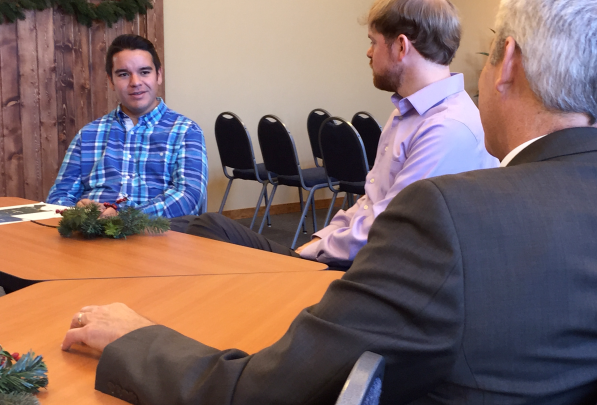
LAM-CO recently hosted Rep. Dominick Moreno of HD-32, the district encompassing our neighborhood, in a meeting at the Rocky Mountain Synod office. Peter Severson, Bishop Jim Gonia, and other synod staff joined Dominick for a discussion of issues facing the neighborhood and insights into the upcoming legislative session. Rep. Moreno will serve as Assistant Majority Leader in the Colorado House of Representatives for the upcoming session, which begins January 7, 2015.

———————————————
Illinois
Jennifer DeLeon, Lutehran Adovcacy – Illinois

Savings Program: We are happy to report that last week one of the bills we have been working on was approved by the Illinois General Assembly; SB2758 will give millions of private sector workers in our state the opportunity to save their own money for retirement by expanding access to employment-based retirement savings accounts.  More than 2.5 million workers do not have access to a retirement savings account through their employer, according to a report from the Woodstock Institute. The report found lack of access is most serious for low-wage workers, of whom 60 percent lack access, but even for workers making $40,000 or more, 49 percent do not have access to an employment-based retirement savings plan.

Immigration: We have joined the Illinois Coalition for Immigrant and Refugee Right’s “IL is Ready Campaign” to educate and prepare the immigrant community on the administrative relief for undocumented immigrants.  Our first information workshop was held this Sunday at Sagrado Corazon Lutheran church in Waukegan. Thank you to Pastor Hector Carrasquillo Director of Latino Ministries for the invitation. To request an information workshop contact Jennifer.deleon@lssi.org to receive updates and learn more about Il is ready sign up here!

———————————————

Minnesota
Tammy Walhof, Lutheran Advocacy – Minnesota 

EPA Clean Power Plant Plan: Lutheran Advocacy: Minnesota collected “photo messages” for the EPA and the Minnesota senators in support of the EPA Clean Power Plant Plan. Some of the people participating agreed to allow their photos to be used for media. Some of those photos, with street addresses removed, are available here!

Clean Energy & Jobs Campaign: Given significant changes in the MN House of Representatives following the election, campaign members, including LA-MN, are trying to rework the message points for the Renewable Energy Standard and Energy Efficiency Standard to make them more rural, ag, and small business-focused.

Homes for All Coalition: As part of the Community Engagement Team, LA-MN is involved with some of the other partners in developing some creative tools around which groups & churches can organize and educate. LA-MN Director, Tammy Walhof, and others on the team originally tried to remake a game like Monopoly or Life, but those ideas were dropped upon learning of challenges that groups in other states had with copyright issues. The focus is now leaning toward the development/rewrite of a song & music video.

Payday Lending: Many groups that are part of the Fairness in Lending Coalition, including LA-MN, sent a letter to Minnesota’s U.S. senators encouraging action at the federal level on Payday Lending. The coalition plans to continue the legislative effort in Minnesota. LA-MN will continue to have it as a second tier issue.

———————————————

New Jersey
Sara Lilja, Lutheran Office of Governmental Ministry, New Jersey

Lutheran Office of Governmental Ministry co-sponsors the Anti-Poverty Summit in New Jersey.  Legislatures from both parties, clergy, non-profit organizations and leading policy experts attended a sold out conference on Dec. 4th that was themed, “Changing Attitudes, Changing Laws, Changing Lives.” Rev. Sara Lilja led a standing room only workshop entitled “Community Conversations”, this session was a skill building opportunity that focused on shaping Public Opinion as the beginning place for Advocacy.

Criminal Justice Reform: A bill has just been filed in the Senate (S2588) that would limit the use of Solitary Confinement in New Jersey’s State and Country Jails.  LOGM will be working with other coalition partners to have this bill enacted into law.

Earned Sick Days: LOGM is participating in a statewide campaign that will provide Earned Sick Days for all New Jersey Workers.  This legislation has passed in 7 municipalities, and now is moving on to the entire State.  We will be speaking at a Press Conference this week.

​———————————————

New Mexico
Ruth Hoffman, Lutheran Advocacy Ministry – New Mexico 
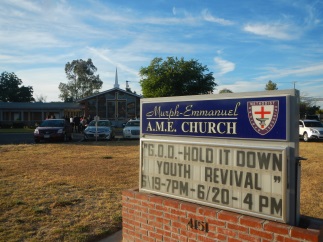
3In early November, Lutheran Advocacy Ministry-NM hosted our annual advocacy conference at St. Timothy’s Lutheran Church in Albuquerque.  Almost 100 advocates from around New Mexico attended.  A number of Lutherans traveled over 600 miles round trip to participate, coming from Las Cruces and from Alamogordo.  All of the current volunteers from the Border Servant Corps, a border ministry of Peace Lutheran Church in Las Cruces, attended.  Pr. David Vásquez, currently a campus pastor at Luther College and upcoming president of Pacific School of Religion, was the featured speaker and lead participants in two bible study sessions relating to faith and immigration. Breakout session topics included hunger in NM, the importance of early childhood education, local immigration issues and the 2015 LAM-NM Advocacy Agenda.  The conference was attended by many of our ecumenical and interfaith partners, including Presbyterians, Methodists, Roman Catholics, Episcopalians, Unitarians and others.

4LAM-NM director, Ruth Hoffman has been busy attending interim legislative committees as they work toward the 2015 legislative session.  The committees are preparing legislation for consideration during the session.  Ruth testified at the most recent meeting of the Economic & Rural Development Committee about the Individual Development Accounts program and need for increased funding for that low-income matched savings account program.

​———————————————

Pennsylvania
Amy Reumann, Lutheran Advocacy Ministry in Pennsylvania 

Access to healthy, affordable food and fair education funding will be top issues for Lutheran Advocacy Ministry in Pennsylvania next year. LAMPa’s policy council and 7 bishops spent a day in early December prayerfully discussing concerns in their communities before adopting an agenda for 2015. The work will be carried out in a capital with divided government following November’s election that saw the nation’s only defeat of an incumbent governor, replacing Republican Tom Corbett with Democrat Tom Wolf. The election also grew Republican margins in the legislature and raised new leadership in both the House and Senate.
5

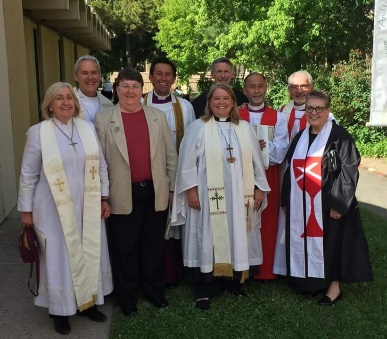
Environment: LAMPa launched its creation care work group with a statewide conference call that included Mary Minette from the D.C. advocacy office, sharing areas of interest in state environmental issues, with clean water being identified as a primary concern.

Immigration: Following President Obama’s announcement on immigration relief, LAMPa connected our synods and interested congregations with partner organizations looking for sites to provide information and assistance to immigrants who might be eligible.

Service: Lutherans might expect to be approached by housing advocates to connect on the ELCA “Day of Service” in September.  The Center for Community Change recently spotlighted the connection between service and advocacy on the Pennsylvania housing trust fund on God’s work. Our Hands. Sunday.  The network urged its members to reach out to Lutherans to add our voices to the work of our hands on behalf of our neighbors struggling with shelter.  Read the article here.

———————————————

Virginia
Marco Grimaldo, Virginia Interfaith Center for Public Policy 


The Virginia Interfaith Center for Public Policy is working on several bills and policy changes to implementation of SNAP in Virginia. We are working to get a minimum wage bill introduced that would take Virginia up to $10.10 per hour over three years and a bill to make Virginia’s Earned Income Credit at least partially refundable. We are also part of a coalition effort to change the income test for who can qualify for SNAP benefits.

We met this week with faith leaders that are part of the Virginia Council of Churches and the Virginia Interfaith Center who together welcomed First Lady Dorothy McAuliffe to talk about her new role chairing a commission named, “Bridging the Nutritional Divide,” that will help address hunger in Virginia. She announced her push for a pilot program for Breakfast in the Classroom programs in Virginia. Finally, we met with Lutherans from various parts of Virginia as part of Bishop Mauney’s Childhood Hunger Task Force and that work is now underway.

​———————————————

​Washington
Paul Benz, Faith Action Network 

6Policy Updates: Faith Action Network’s (FAN) governing board approved our 2015 legislative agenda. Our five “policy buckets” are: Reducing Wealth Inequality (FAN’s lead issue), Forging a Sustainable Biennial Budget, Dismantling the Culture of Violence, Protecting Housing & Preventing Homelessness, and Sustaining Washington’s Environment

Advocacy Days: FAN will once again sponsor three advocacy days during our legislative session:

  • January 31st in Spokane, with the theme “Raising Prophetic Voices:  Faith Communities Advocate for Justice”
  • February 7th in Yakima, held at the Unitarian church
  • February 19th in Olympia (our main event at the state capital), with the theme “Act on the Dream:  Invest in the Common Good”

Annual Dinner (Nov. 16th): FAN’s annual dinner, Acting on the Dream: The Movement Continues, was a wonderful event where we filled over 40 tables with faith advocates and labor and community allies.  One of the tables hosted ELCA Bishop Kirby Unti, DEM Rev. Jerry Buss, and ELCA DC office’s John Johnson. We exceeded what we raised last year. You can view video clips from the event, including the inspiring keynote speech by travel expert and activist Rick Steves (ELCA—Trinity-Lynwood, WA). Photos from the event are on our Facebook page.

​———————————————

Wisconsin
Cindy Crane, Lutheran Office for Public Policy in Wisconsin 

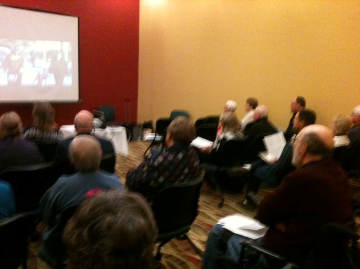
Poverty Summit:  20 ELCA adults and youth gathered in Marinette for an inter-generational poverty summit focused on youth.  In the photo is LOPPW Council Member Eric Larson, who helped to plan and lead the event, and State Representative John Nygren, who 6shared his journey struggling with his daughter’s heroin addiction and moving from his personal experience to advocating for public policies.  LSS Case Manager Mary Busick from Escanaba, MI tied together local youth homelessness, drug addiction and trafficking. LOPPW included an hour of advocacy exercise.  Feedback confirmed that it would be worthwhile to repeat the summit in other locations.
BadgerCare:  LOPPW’s director attended a meeting with partners to discuss next steps for encouraging the Wisconsin legislature to receive federal funding for BadgerCare.  73% of the people who voted in the 20 counties with the referendum said Yes to take the federal dollars.
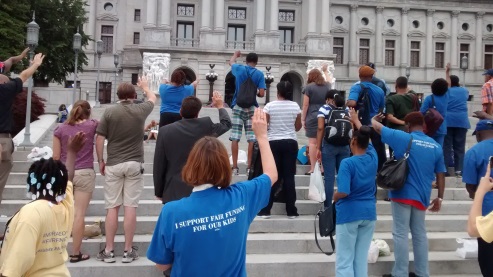
7Prison Reform for Youth:   LOPPW’s director and Council Member Rev. Jay McDivitt met with Senator Jerry Petrowski’s legislative aid to encourage the senator to again present a bill supporting 17 year old offenders of non-violent crimes to be tried as juveniles.

Anti-Sex Trafficking:  The director made contact with three anti-trafficking groups to help determine statewide coalitions in place and discussed building a campaign with Tia.

Education:  LOPPW’s director met with colleagues from around the country in Baltimore deepening our efforts of working together as a team.

Other Advocacy:  Council Member Rev. Sue Schneider is explaining advocacy to middle school youth in Madison at Confirmation Extravaganza.

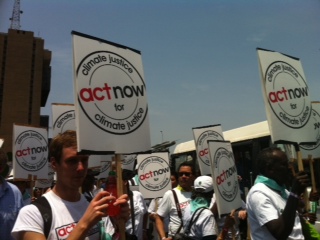
From Lima, Peru: The faith community stands ready for a real commitment to addressing climate change

ELCA Director of Environmental Advocacy, Mary Minette
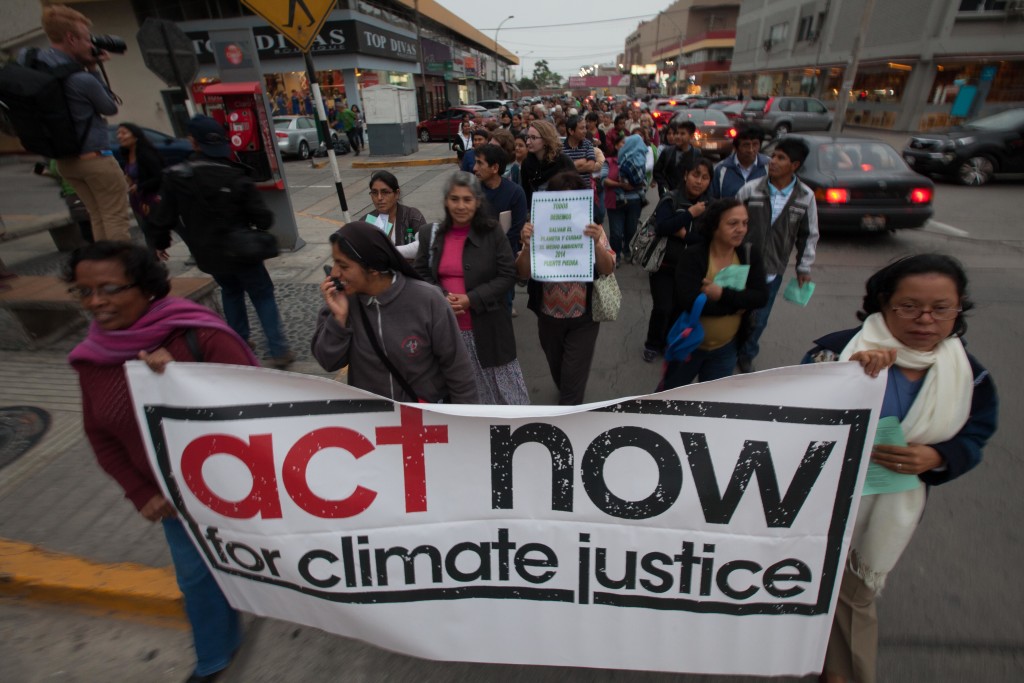
On the eve of the first day of COP20, the UN climate talks in Lima, a Vigil for the Climate was held near the Pentagonito where the UN talks are to be held. Christiana Figueres, the head of the UNFCCC and Manuel Pulgar-Vidal the Peruvian Minister for the Environment and President of the UN meeting, spoke to the crowd and a symbolic lighting of candles began the celebration that marks the end of one year of monthly fasting by religious and environmental groups around the world in the Fast for the Climate.

On the eve of the first day of COP20, the UN climate talks in Lima, a Vigil for the Climate was held near the Pentagonito where the UN talks are to be held. Christiana Figueres, the head of the UNFCCC and Manuel Pulgar-Vidal the Peruvian Minister for the Environment and President of the UN meeting, spoke to the crowd and a symbolic lighting of candles began the celebration that marks the end of one year of monthly fasting by religious and environmental groups around the world in the Fast for the Climate.

Photo courtesy of LWF/Sean Hawkey, ©2014 Sean Hawkey, all rights reserved

In December 2015, the UN Framework Convention on Climate Change (UNFCCC) will meet in Paris to discuss and launch a new international climate agreement. Last week and this week, leaders from around the world gather in Lima, Peru for the last high-level round of negotiations before Paris discussions. Representatives from faith traditions around the world, environmental groups, youth, business representatives, and labor unions are also present in Lima and are working together to ensure that the framework for the new agreement reflects their priorities.

I write today from Lima, where I am representing the Evangelical Lutheran Church in America (ELCA) as part of a delegation from the ACT Alliance– a faith-based global relief and development network. The increasing involvement of people of faith in the UNFCCC meetings each December, as well as the massive presence of people of all faiths at the People’s Climate March in New York this past September, reflects our common concern about the future of the world that we believe God created and calls us to tend. This shared sense of stewardship leads us to be concerned by the changes that all of us can observe, changes that scientists tell us are the result of human-caused climate change. Another common element shared by numerous faith traditions is concern for our neighbors, and particularly for the most vulnerable—children, the elderly, those who live in poverty. We see that climate impacts such as more severe storms, long term drought, flooding and sea level rise are falling hardest on these vulnerable populations.

This meeting in Lima is expected to end with parties agreeing to a basic framework for the new climate agreement which would take effect in 2020. Faith goals for the framework include a strong commitment from parties not only to reduce global greenhouse gas emissions but also to address the needs of vulnerable people who are already suffering the impacts of climate change in the new agreement. Building climate resilience for vulnerable communities, particularly in least developed nations, is a key point for the faith community. This will require that countries with means commit to financial and technical assistance for low carbon development, adaptation to climate change, and climate impacts that can’t be adapted to, such as sea level rise that leads to permanent loss of lands.

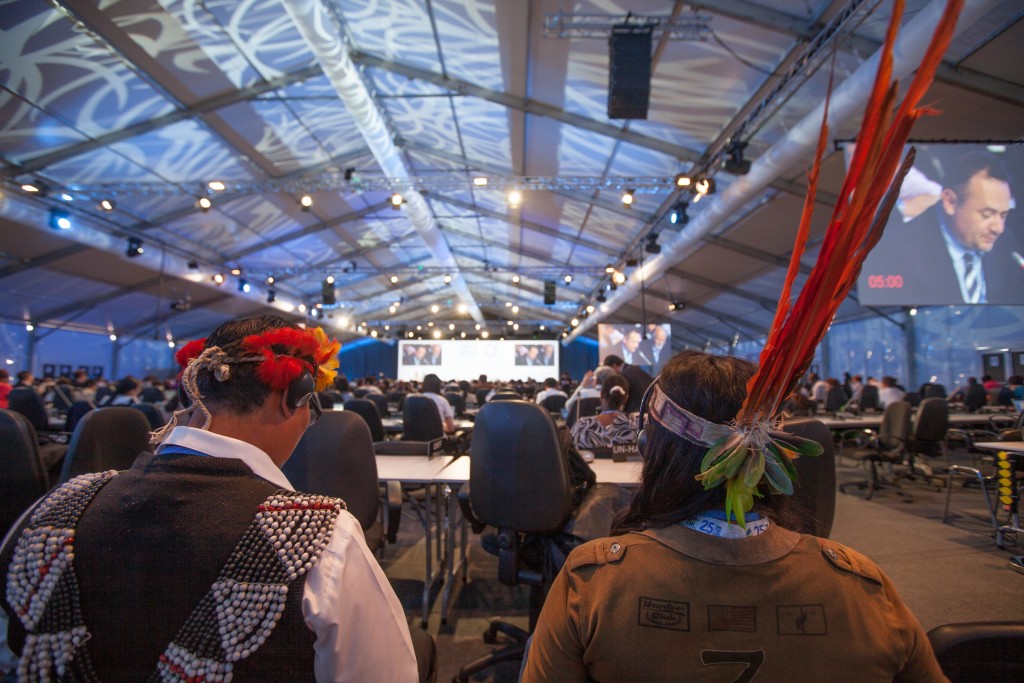
Indigenous participants sit in a plenary hall of COP20. The UN climate talks began on Dec 1st in Lima Peru, billed as the most important meeting in the history of the world, mechanisms for reducing climate change are being negotiated. The Fast for the Climate movement, with participation of environmental and faith-based groups such as the Lutheran World Federation, is reminding diplomats of the real dangers of climate change and urging them to take immediate action.

Indigenous participants sit in a plenary hall of COP20. The UN climate talks began on Dec 1st in Lima Peru, billed as the most important meeting in the history of the world, mechanisms for reducing climate change are being negotiated. The Fast for the Climate movement, with participation of environmental and faith-based groups such as the Lutheran World Federation, is reminding diplomats of the real dangers of climate change and urging them to take immediate action.

Photo courtesy of LWF/Sean Hawkey, ©2014 Sean Hawkey, all rights reserved

Before the end of the meeting in Lima, we expect that parties will announce a process for countries to come forward over the next year with their emissions reductions pledges for the new agreement. This action must come with a process to evaluate these pledges for adequacy and long term impact. Some countries have already announced the basic outlines of their pledges. The U.S. made an initial pledge of future action several weeks ago when President Obama announced the terms of a bilateral agreement with China. This agreement will reduce U.S. emissions 26 to 28 percent below 2005 levels by 2025, with China agreeing that its emissions would “peak” by 2030.

Finally, faith communities are looking for significant financial commitments from the U.S. and other developed countries, together with pledges from other parties with means, to fund both low carbon development and climate resilience, particularly in the least developed countries. The recent U.S. pledge of $3 billion over 4 years to the Green Climate Fund is a step in the right direction. Other countries are also slowly announcing their pledges and we hope for more to come.

At the end of the first week, many participants and observers expressed a sense of hope for the process, and a draft text released early Monday morning showed progress on some key points. Significant issues still are unresolved, but as people of faith we agree: this meeting in Lima must set us on the path to a strong, equitable and fair international agreement that will help us to avoid the worst impacts of climate change, for the sake of our children and future generations and for all of God’s creation.

Remembering the Bhopal disaster of 1984

Mary Minette, Director of Environmental Advocacy
​The earth dries up and withers,

the world languishes and withers;
the heavens languish together with the earth.

​The earth lies polluted under its inhabitants;

for they have transgressed laws,
violated the statutes,
broken the everlasting covenant.

– Isaiah 24:4-5

Today marks the 30th anniversary of the worst industrial disaster in history, a disaster that many have forgotten in the years since.

On December 3, 1984 residents of Bhopal, India awoke to a cloud of toxic methyl isocynate gas that had been accidentally released from a nearby pesticide manufacturing plant operated by the Union Carbide Corporation.  

Poor maintenance practices at the barely operational plant led to the release, which ultimately killed more than 15,000 people in the largely low income communities surrounding the plant, and led to severe long-term health consequences for many of the more than half a million people exposed to toxic gas.  Although Union Carbide ultimately paid nearly $500 million in settlement to the Indian government, this has not been adequate to address the continuing health problems of those who lived through the disaster. ​ In addition, the chemical plant, though closed, has never been fully cleaned up and continues to pose a threat to nearby residents.

India is one of the most rapidly industrializing nations on earth, and although the Bhopal disaster led to some reforms of how chemical plants are permitted to operate in that country (and around the world), its policies tend to reflect a greater concern for economic growth than for environmental and public health protections.  More remains to be done, both in India and globally, to ensure that companies that manufacture toxic substances operate safely and to ensure that low income communities do not bear the majority of the risks associated with those manufacturing operations.​

Today, as we remember the dead and the survivors of the Bhopal disaster in our prayers, we also pray for the leaders and advocates around the world who are working hard to ensure that chemical companies operating in our midst are safe and accountable.