Skip to content
ELCA Blogs

ELCA Advocacy

Living Earth Reflections: Do We Really Need to Choose?

Mary Minette, Director of Environmental Advocacy

June 2014​

“Neither economic growth that ignores environmental cost nor conservation of nature that ignores human cost is sustainable.  Both will result in injustice and, eventually environmental degradation.  We know that a healthy economy can exist only within a healthy environment, but that it is difficult to promote both in our decisions.”

Caring for Creation: Vision, Hope and Justice (1993) 

In early June, the U.S. Environmental Protection Agency proposed a rule that will require states to work with power companies to reduce the emissions of carbon dioxide from power plants.  Power plants are a major source of carbon pollution, which scientists say is causing the earth’s climate to change, posing a danger to the future of God’s people and to all of God’s creation.

ELCA Presiding Bishop Elizabeth Eaton joined with Presiding Bishop Katherine Jefferts-Schiori of the Episcopal Church in issuing a statement praising the new rule, noting that it will help to protect many of our neighbors and ensure a safe and healthy world for future generations.  The ELCA Advocacy office is also working to engage our network over the course of this summer to speak out in support of these rules by sending comments to the EPA, speaking at a hearing, sending a letter to the editor of a local paper, or teaching others about the importance of this rule.

But we’re getting some questions about the potential impact of this rule on the economy and on jobs.  Some groups, including the U.S. Chamber of Commerce, argue that this rule will eliminate jobs in the power sector and in fossil fuel industries, particularly coal mining.  They say that electricity prices will increase dramatically, harming low income people and businesses.

Their argument is not a new one: frequently when new environmental rules are announced business and industry representatives claim that the harm to the economy will be enormous and that the cost is not worth the impact.  The power industry made that claim in the 1990s, when the EPA moved to regulate power plant emissions to reduce acid rain.  They made that claim two years ago when the EPA finalized a rule to reduce mercury emissions.  These arguments are based in a belief that we need to choose between a healthy future for our children and economic growth.

But this is not only a tired argument, it also poses a false choice.  For example, between 1970 and 2011, emissions of common air pollutants dropped 68 percent, primarily due to the federal Clean Air Act.  At the same time, U.S. gross domestic product grew 212 percent and total private sector jobs increased by 88 percent. Because of the Clean Air Act, our air is cleaner, our economy has grown, jobs have been created in new and innovative industries, and dire predictions about the high cost and economic impact of environmental regulation have proven to be false time and time again.  In fact, according to a report from the Economic Policy Institute, historically the cost of complying with environmental regulations is nearly always less than estimated at the time the regulation is proposed.

Under this proposed rule, states will have flexibility in meeting the emissions standards for carbon dioxide—they will have the option of investing in renewable energy sources, promoting energy efficiency measures, and switching from coal to less polluting fossil fuels (such as natural gas) to generate electricity.  They will be able to work regionally to reduce emissions, which will help states with a heavy reliance on coal to reduce their emissions over time.  And many states are already taking these steps to reduce their emissions of carbon dioxide and other greenhouse gases, such as California and many of the northeastern states.  Many of the states that are already reducing their emissions have actually seen their economies grow since taking those steps, even in the midst of a global recession.

Arguments that energy costs for low income Americans will increase dramatically are equally questionable—one way that power companies will be able to comply with the carbon rules is by increasing the energy efficiency of homes and businesses.  This means that they will need to provide incentives for landlords to make rental properties, including those in low income neighborhoods, use less electricity.  Businesses, including manufacturers, will also have incentive to reduce energy use, which will keep costs to consumers from rising significantly as well.  Under the rules it’s certainly possible that electricity could cost somewhat more, but we will be using less, and our air will be cleaner.

Assertions that these regulations will be too costly today also ignore the future economic costs of climate change.  A recent, bipartisan report outlines the significant future economic risks associated with climate change and extreme weather.  Sea level rise, changes in temperature and rainfall, and increases in hurricanes and other extreme events will wreak havoc on the economies of coastal states and farm states alike; increased heat across the U.S. will reduce worker productivity and require significant investments in increased energy production.  Failure to act now is a recipe for billions in economic impacts in the future.

Finally, the E.P.A. estimates that the carbon rule will have significant public health benefits, worth an estimated $55 billion to $93 billion per year in 2030. This includes avoiding 2,700 to 6,600 premature deaths and 140,000 to 150,000 asthma attacks in children. These climate and health benefits far outweigh the estimated annual costs of the plan, which are $7.3 billion to $8.8 billion in 2030.

Climate change poses a threat to our most vulnerable neighbors, as well as to the future of God’s children and all of Creation.  Unless emissions of carbon dioxide are reduced dramatically and soon, the threat of climate change will only grow worse; power plants account for nearly 40 percent of U.S. carbon dioxide emissions, and the U.S. is the second largest emitter of carbon dioxide in the world.  Unless our country acts, along with other major emitters, the rest of the world will suffer the consequences, and so will our children.  This rule is a key way to show leadership on a critical problem and deserves our strong support.

Tell the EPA what you think! Register your comments in our Action Center​!​

—–

Want to learn more about ELCA’s commitment to advocating for public policy that supports the care for creation?  

Visit our website

Like us on Facebook

Follow us on Twitter

My 7- and 9-Year-Old Gurus

Rev. Stacy Martin, Director of Advocacy

June 23, 2014

“Mom, are you mad at me?” my 7-year old asked, a little cautiously. The way I’d been communicating – terse sentences in a not-so-warm tone – her question was a legitimate one. And she was a brave little soul to even ask the question.

Except I wasn’t angry. And certainly not with her.

Stacy

In answering, I apologized for making her feel that way and told her that I wasn’t angry, just annoyed. “At me?” she asked with worry. “No, no, love bug.” “At what, then?” she asked in an exasperated tone that reminded me a bit too much of myself.

This second question gave me more pause than the first. For the life of me, I couldn’t put my finger on the source of my general state of annoyance. And, well, that just annoyed me all the more.

Why was I so annoyed? After all, it was the weekend.  The weather was perfect and the forecast promised pleasant weather for the remainder of the weekend. I’d gotten most of the tasks I’d set out to do accomplished.

And then it occurred to me. I’d gotten my list accomplished at an expense. Both of my girls had asked me at some point over the weekend to play with them. There had been a time when I took playing with them for granted, but as they have gotten older, I’d thought I knew better than to squander those precious opportunities, as they get fewer and fewer.

I was annoyed that I had chosen to use my time in the opposite manner I had hoped I would.

When my daughter pressed me, I realized I had yet to heed the advice of the wise grandparents in our lives — who constantly remind us to slow down – to take those opportunities as they come. Even if it means a few more dust bunnies in the corners of the living room and a few more chores left undone on Sunday evening.

It occurred to me that I let the momentum of the too-busy work week get the best of the days set aside to rest, rejuvenate, reconnect. I try to make up for lost time, just not with the most important people in my life. It’s cliché, I know. But I suppose it’s cliché for a reason.

So, I went from feeling annoyed to feeling guilty. And guilt does very little in the way of making one more amicable.

I happen to be a member of a Lutheran church and it was at this point in our weekend that I reminded myself how grateful I am for my faith heritage and life. Lutherans have a thing or two to say about guilt. Mainly that guilt makes for bad company, so get over yourself and move on so that you can love and serve. Lutherans also have something to say about the fullness of the human experience. In short, Lutherans say you’re more than your profession and certainly more than a perfectly-kept house, so, again, get over yourself so that you can love and serve.

At my most frail and selfish moments, I find that my children lead me with the kind of perceptive and valuable questions I’d expect from a guru. I just hope I don’t let the frenzy of the work week and all those bothersome dust bunnies keep me from hearing and learning from them over and over again.

This blog was originally posted by the Religious Action Center of Reform Judaism​. 

2014 UN Convention on Climate Change in Germany

Mary Minette, Director of Environmental Advocacy

Backsliding

​​Fri. June 6, 2014

My hotel in Bonn has a “green roof”–this is the view out my window of the tiny plants that are keeping stormwater from running off the roof and polluting the nearby Rhine River.  Germany has a lot of environmental initiatives underway–I’ve seen tons of solar panels on rooftops, for example–but a German colleague tells me that the laws and policies that have encouraged investment in solar and other renewable energy technologies are under fire from politicians who consider them a waste of taxpayer dollars. Sounds familiar!

Green RoofEarth


Although a number of U.S. states have led the way in pushing for wider adoption of renewable energy technologies like solar and wind, efforts are underway to undermine state renewable standards. Just last week in Columbus, the Ohio legislature passed legislation that proposes to freeze all the state’s renewable energy and energy efficiency standards.  A similar effort to roll back a state renewable standard is underway in Minnesota, which has been a regional leader in fighting climate change. ​

Renewable energy standards like Ohio’s are one way that states could implement the carbon standards for power generation that were proposed this week by the U.S. Environmental Protection Agency–expanding sources of clean, renewable energy is one way to reduce the use of coal and other fossil fuels to generate power.  The proposed carbon rule is getting a lot of positive attention in Bonn this week–it’s seen as the U.S. showing real leadership in the fight against climate change and a positive step as parties begin to negotiate a new climate treaty.  However, if states (and countries like Germany) scale back their commitment to renewable power it sends an unfortunate message–that we don’t consider renewable energy an important investment in our future–and jeopardizes our leadership on climate change.

bonn

​​​Skyline of Bonn, Germany

​—

The “High Level” Meeting That Wasn’t

Wed. June 4, 2014​

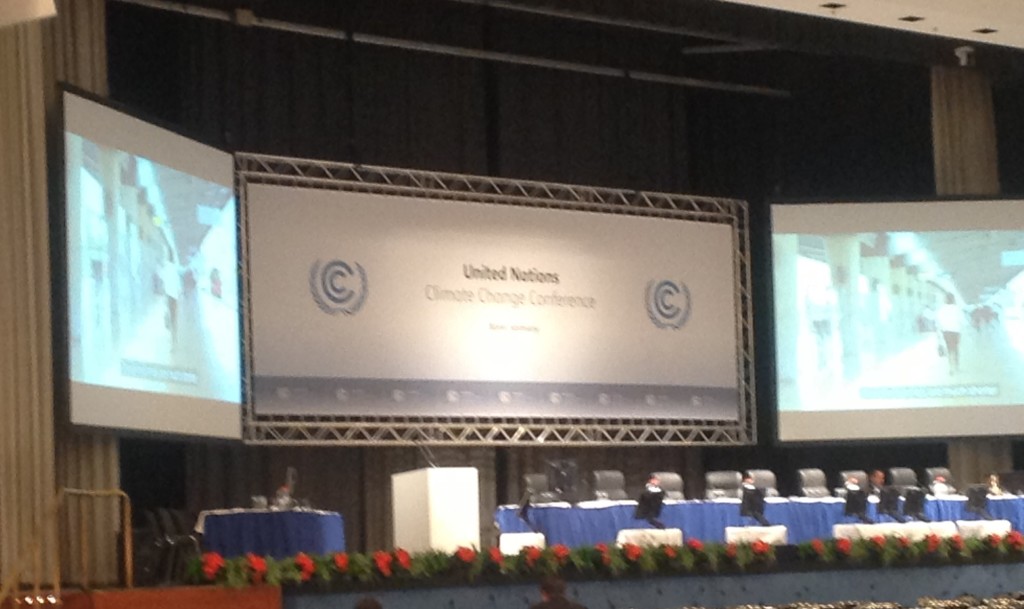
​Today marks the beginning of what’s known as an intersessional meeting of the UN Framework Convention on Climate Change.  Generally the annual Conference of the Parties to the convention is held in December and the location varies; these intersessional meetings happen in Bonn, where the UNFCCC secretariat has its offices.  This meeting is considered critical because the parties need to begin to agree on targets and measures for a new climate change agreement by the end of 2015, so these interim meetings are taking on a greater role.

​Or are they?

Conference Room

This meeting was supposed to begin with a two day “high level” meeting of ministers–senior government officials who are able to make pledges on behalf of their countries.  However, it turns out that very few ministers will be in attendance and many of the people gathered here in Bonn for the next two weeks are concerned that this signals a lack of commitment to the ongoing negotiations.  Oh, and the U.S. is one of the list of countries that hasn’t sent a minister (or minister equivalent) to Bonn–Special Envoy Todd Stern will not be here.

Does this signal a lack of commitment to global action on climate change by the U.S. government?  In a week where the U.S. Environmental Protection Agency announced its strongest proposal to date to cut US carbon dioxide emissions, maybe not.  But it certainly means that people who are concerned about climate change need to continue to push our leaders to make the issue a priority.