Skip to content
ELCA Blogs

ELCA Young Adults

The Wolf Shall Lie Down With the Lamb: #NoPlasticsforLent

The Word

Genesis 1:29-30

29 God said, “See, I have given you every plant yielding seed that is upon the face of all the earth, and every tree with seed in its fruit; you shall have them for food. 30 And to every beast of the earth, and to every bird of the air, and to everything that creeps on the earth, everything that has the breath of life, I have given every green plant for food.” And it was so.

Being with the Flock

It was a sunny, unusually warm, winter afternoon in pre-pandemic 2020 when I had what I can now see as an “a-ha” moment. I had been having an inner struggle of sorts; I couldn’t see where God was calling me. That afternoon I had done what I usually did when the weather broke, go for a short stroll to clear my mind through the Kentish pastures of southern England that I love. A stone’s throw away from my university was a small farm where sheep graze. A baby had just been born, and as the sun warmed me, that precious lamb, and everything else in that slice of creation, I had the strongest desire to leap over the fence and lay down with the flock. I didn’t (that would be trespassing), but I really wanted to.
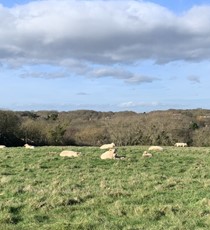
The sheep in the pasture that I would often walk by in Canterbury, England

My Lenten Fast

Something clicked for me that day. People close to me pushed me to think about that impulse, and to appreciate the Biblical imagery that it harkened to, shepherding to be specific. I always loved animals. My junior year of undergrad I went vegetarian for Lent after taking a course called “Environmental Ethics.” I learned how our choices as consumers, including the foods we choose to eat, contribute to environmental degradation or wellbeing. The diets we follow have an impact. A report by the Yale School of Forestry shows animal agriculture takes up about 80% of farmland but provides only 18% of the calories we consume. Now three years later, my Lenten practice is to go vegan. For me and many other Christians around the world and throughout history, Lent is a time to enter into a fast in an effort to bring oneself closer to God and become immersed in creation.


Living for Creation

Prior to my graduate studies in England, I thought I was meant to be an academic. Being abroad, however, gave me time and opportunities to distance myself from what I had been accustomed to. My eyes and ears opened to the “labor pains” of creation, as St. Paul calls it, and I felt the pull to live my life for God and God’s creation. I hope that through my fasting, study, and work that I might bring about a shred of Isaiah’s vision of the kingdom of God into existence in this time and place.

Isaiah 11:6-9

6 The wolf shall live with the lamb,
the leopard shall lie down with the kid,
the calf and the lion and the fatling together,
and a little child shall lead them.
7 The cow and the bear shall graze,
their young shall lie down together;
and the lion shall eat straw like the ox.
8 The nursing child shall play over the hole of the asp,
and the weaned child shall put its hand on the adder’s den.
9 They will not hurt or destroy
on all my holy mountain;
for the earth will be full of the knowledge of the Lord
as the waters cover the sea.

Looking Beyond Lent

Now as a soon-to-be seminarian and aspiring ordained minister in the ELCA, I look beyond Lent, to how I can bring others into the radical vision of this future world; a kingdom we can only glimpse but know that it is there. Diet and fasting are not always options; economic insecurity, food deserts, and certain disabilities limit options, but there’s still much to be done. For me, a diet based in nonviolence and answering a vocational call in pastoral care and advocacy are how I can contribute to creation care. I pray that this season of Lent may be a time for us all to consider how we might, in our own ways, take a step toward a world in which all God’s creatures may “lie down together.”

A calf I’ve befriended near my home in central Pennsylvania

Discussion Questions:

  1. How do the choices you make as a consumer impact your local environment? How do they impact environments around the world?
  2. What sacred texts or Biblical passages inspire you to work to be a good steward of creation?
  3. What could fasting for creation look like to you, your congregation, and your community? Is fasting something that everyone can participate in equally? Why or why not?
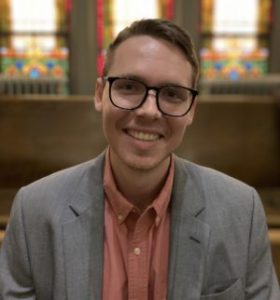
 

Larry Herrold is the ELCA Hunger Advocacy Fellow with the Lutheran Advocacy Ministry in Pennsylvania (LAMPa) office in Harrisburg, Pa. A native of Sunbury, Pa., where the east and west branches of the Susquehanna River meet, he graduated from Susquehanna University in 2019 with a BA in History and Religious Studies. He received a MA in Modern History from the University of Kent in England, where he completed a Fulbright Scholarship. Herrold is deeply committed to the intersection between ecclesiastical service, social justice, and tradition. He will be attending Pacific Lutheran Theological Seminary beginning Fall 2021 to earn his MDiv, pursue rostered leadership, and learn more about incorporating eco-justice into ecclesial ministry.
Creation Care on Campus: #NoPlasticsforLent

A Starting Place

Creation care looks different at different stages of our lives. College is a transitional time for many of us. We are in the process of figuring out our independent adult lives outside of the family we grew up in. This means not only determining what values and ideas to prioritize, but also figuring out what resources we have to put towards those priorities. It can also be hard to figure out what that looks like.

Making A Change

When I (Sandra) first started at UMD in 2017, I became involved in the Humble Walk, UMD’s Lutheran Campus Ministry, because my faith was important to me. Being part of this community opened my eyes to a number of topics that I became more passionate about as I learned more. I’ll admit, when I was in high school, the environment wasn’t too high on my priority list. My freshman year at UMD, Hurricane Maria hit Puerto Rico.

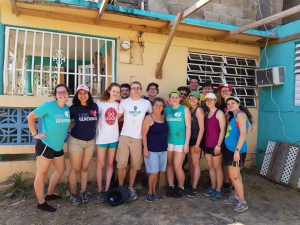
Humble Walk volunteer crew in Puerto Rico Spring 2018

That year for spring break, the Humble Walk led a trip to Puerto Rico to work with Lutheran Disaster Response and the Caribbean Synod to help with disaster relief. It was being in Puerto Rico and seeing the destructive effects of climate change that opened my eyes to taking creation care more seriously, and it was being in community with other students that helped me recognize that caring for creation is something we are called to do in faith. 

Taking the Next Step

Understanding that call was only the first step though. The next part, I am continually working on. What does creation care look like given my current circumstances? Sometimes, it looks like having discussions in my German classes about Germany’s policies towards sustainability, and the impact of refugees, specifically climate refugees, in Europe. Other times it’s something that seems small, like making sure a plastic bottle goes in recycling rather than the trash. It’s the ways to do creation care in community with others that excite me the most though, which is why I got involved in the Friends of Guilford Run.

Friends of Guilford Run

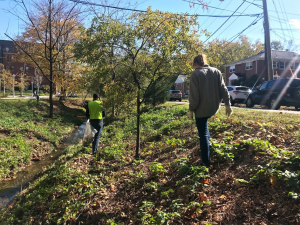
The Friends of Guilford Run began with a stream clean up led by student leaders Laura Tiffany (’19) and Dan LeKites (’19) in 2016. As members of the Humble Walk, UMD’s Lutheran Campus Ministry, these students felt called to take care of the stream that runs in front of their worship space. The Friends of Guilford Run has since adopted the stream and hosts at least four stream clean-ups a year in addition to removing invasive species and replacing them with native plants.

Stream Clean up volunteers Fall 2019

Once a semester, Friends of Guilford Run also does stream clean ups and educational sessions about caring for the environment with the CARing Kids program, a mentoring program between college students and elementary and middle school students from Langley Park. Sandra Roper (‘21) and Jordan Kreh (‘24) are the current student leaders, working with their talents and faith community to take care of the stream. More recently, Jordan and Sandra have been able to connect with others in College Park who care about the stream, including a freshwater biology graduate studies lab and local community members.

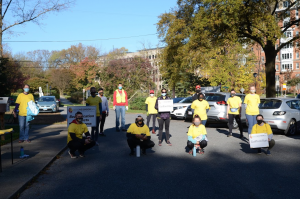
Volunteers for Good Neighbor Day stream clean up and invasive species removal Fall 2020

Called Forward into the Future

God has called us to care for the environment, but more than that, He has provided us with plants and animals, habitats and ecosystems to learn from.

Job 12: 7-11 reads “But ask the beasts, and they will teach you; the birds of the heavens, and they will tell you; or the bushes of the earth, and they will teach you; and the fish of the sea will declare to you. Who among all these does not know that the hand of the Lord has done this? In his hand is the life of every living thing and the breath of all mankind.”

Growing up, I (Jordan) participated in many activities to help the environment, but still felt a disconnect between myself and creation. Reading these verses helped me realize that I had settled into a reactionary role, believing humans knew what was best for the environment and we just had to convince enough people to recycle and save water. In the past few years, I have sought out opportunities to learn from the world around me.

I visited farms to understand the relationship between crops and soil health, read about the ways nature works to maintain balance, and marveled at the hand of God present through it all. I joined the Friends of Guilford Run because I believe the stretch of stream we sponsor has something to teach me. Already in my first semester I have learned how much life teems in the small spaces between roads, and realized I don’t have to go to a forest or ocean to find an ecosystem worth protecting.

Job 12:7 starts with ‘ask,’ so I will continue to ask questions and practice being still to listen for the answers. 

Discussion Questions

  1. Many parables from the bible use creation to teach us how God wants us to live our lives. Jesus often sought out nature (gardens, lakes, mountain tops) to teach and pray. In what ways can you challenge yourself to learn from the environment?
  2. Thinking about how the global health crisis intersects with environmental issues, and ways that accommodating for public health safety have affected initiatives to care for the environment, within your circumstances, what are ways you can advocate for the environment in community with others? 
  3. How can you continue to support essential workers and show up for your community now and as we transition into a post pandemic normal?
  4. In what ways invite people into conversation with you about environmental justice? What do those conversations look like given your current circumstances and resources?


Sandra Roper is a senior at the University of Maryland, originally from Massachusetts. She expects to graduate in May with degrees in English Literature and Germanic Studies. She has been an active member in the Humble Walk, UMD’s Lutheran Campus ministry, since her freshman year and has worked on a number of projects motivated by her faith focusing on environmental justice, queer justice, and racial justice.
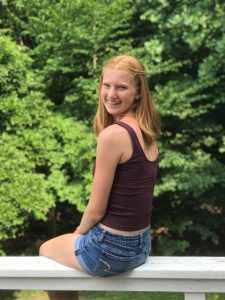


Jordan Kreh is a freshman at the University of Maryland, College Park studying aerospace engineering. Intersecting her major, faith, and care for the environment, she is a student leader of Friends of Guilford run, Engineers Without Borders, and the Humble Walk, UMD’s Lutheran campus ministry. Her hope is to push for environmentally sustainable practices in the aerospace industry and continue to utilize her engineering skills with creativity and compassion.

Local is Global: #NoPlasticsforLent

The Word

“And let us consider how to stir up one another to love and good works, not neglecting to meet together, as is the habit of some, but encouraging one another, and all the more as you see the Day drawing near.”

Hebrews 10: 24-25

Local Is Global, too.

If you have found yourself overwhelmed by the scope and scale of the climate crisis, you are in very good company. A problem that spans the atmosphere, oceans, and the body of every living being on the planet is overwhelming. The good news, though, is that a problem that is so relentlessly global also has to be local.

The Long Haul

Pra. Andrea Baéz from Argentina spoke to us on the Second Sunday of Lent about her community’s seventeen years-long work to protect their environment from toxic mining run-off. Everything that Pra. Baéz had to say showed a deep love for her people and the ecosystems around her home in the city of Esquel, and at the same time brought an awareness and concern for everyone and thing downstream of her own community, all the way to the Atlantic coast. Her work protecting Esquel and the province of Chubut is also work protecting people many miles away, and even around the globe as she keeps toxins out of migrating fish who would carry them all the way across the ocean.

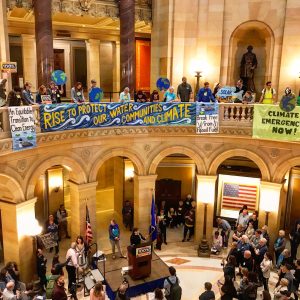
Community action to protect the climate, Minneapolis, 2019

Every Action Matters

There is no local climate action which is not also global, it’s the nature of the beast. That’s a hopeful thought for me. No one acting alone is up to the task of addressing the climate crisis, and no one’s work is insignificant. Wherever you are, however you begin, your work matters to the whole.

As Hebrews tells us, we are made to work together, to be together, to “stir up one another to love” and “not neglect to meet together”.

You are not alone. Your Lenten practice, your consumer choices, your political organizing makes a bigger difference than you can know. Thanks be to God.

Discussion questions:

  • What seemed most relatable from Pra. Andrea’s story? Least relatable?
  • How does the text from Hebrews encourage or challenge you today? Who has “stirred you up” to love? What communities encourage you when you feel overwhelmed?
  • What climate solutions have you been curious about? Passionate about? Intimidated by? What seems like a tangible step toward sustained climate action that you can take on/foster?
  • Andrea’s spirituality is fed by the collective action of her community taking care of one-another. How might your spirituality be fed by caring for creation?


Baird Linke is a candidate for Word and Sacrament Ministry with the ELCA, studying at Wartburg Theological Seminary. He’s passionate about ecotheology and good food. He lives in Minneapolis, MN and tries to spend as much time outside and moving with his dog as he can.