Skip to content
ELCA Blogs

ELCA Young Adults

Forward in Peace: #AdventinPalestine

Searching for Peace

In life we tend to always be on the search for peace. Peace of mind, peace and quiet, stop to violence, and more. While searching for this peace I find myself wondering if this “peace” we are in search of actually exists. If it does exist where is it located and how do I obtain this peace? That is where faith comes into the picture. At some point in my life I had to decide if I would allow faith to lead me to peace.
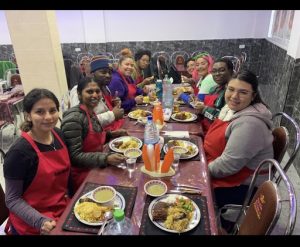
Peace Not Walls trip participants and leaders (including Xavier) enjoying a meal that they prepared and cooked during a cooking class in Aida Refugee camp in Bethlehem in January 2020.

Palestine and Peace

Palestine is a very dear place to my heart. It’s everything to me – the food, the people, the land, this list can go on forever. Visiting Palestine became a reality for me when I was trained to be a Peace Not Walls trip leader. Through that travel experience I have learned that there are many similarities with my life and the lives of Palestinians. As a Black man in America I have experienced a great deal of oppression. While in Palestine I quickly learned that their oppression mirrors my own on many levels.

When I arrived I noticed separation. It wasn’t hard to see while in Bethlehem, that is probably because there is a large wall to maintain the separation between Bethlehem and Jerusalem. I live in Milwaukee, Wisconsin –  right now we are the most segregated city in the USA. There isn’t a physical wall up but you can definitely imagine the wall that separates the oppressed and the oppressors. In moments when I see this type of oppression I start to wonder: How can people be happy in these conditions? How does one plan for a future? What hits me hardest is how can one believe in God or see God when hate is all around?
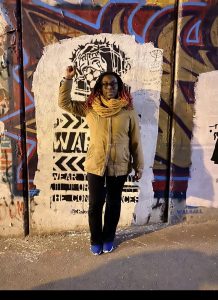
Peace Not Walls trip participant, Kayla, stands in solidarity with Palestinians, along the wall that separates Israel from Palestine

Faith and Peace

I am a faith based person. Most anything I do is done within the realm of my faith. I have a belief that everything will work out somehow. I have a three year old son. I have faith that if “Peace on earth” does not happen for me, the work that I put in will help create a more peaceful world for my son.

In Proverbs chapter three we are told to “Trust in the lord with all your heart, and do not lean on your own understanding”.

With that scripture in mind I used that energy to find God in the West Bank. It took me three visits to the West Bank to finally see God. I had to stop trying to understand it for myself and started trying to understand it through the people. Although my faith was tested beyond it has ever been, after gaining an understanding through the people and not of the people, I was able to see God. I was able to see “peace”: I saw kids playing, families eating, friends hanging out. 
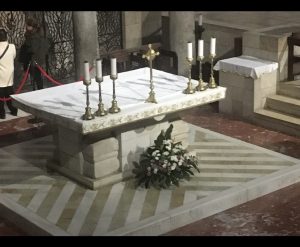
Often my place of peace is in quiet space with a symbol of God to ground me and remind me why I do the work I do.

Forward in Peace

Faith for me is the answer, being able to find God in a country where I see so much pain showed me that I needed to make some adjustments back at home. I no longer needed to feel or think “why me” or “I wish”. I gained the power to stop trying to understand my oppression and start taking actions to relieve my oppression. I was able to gain peace within myself through someone else, and in turn I took that peace within and built it so I can create peace outward. I truly believe if we can all find peace within ourselves we will all see and help build the peace that we need in this world to thrive. 
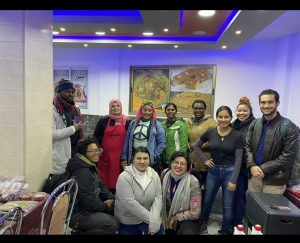
Peace Not Walls January 2020 trip participants moments before departing home with peace and love on their face and in their hearts. Ready and prepared to spread that peace and love to the areas surrounding them.

Reflection Questions:

  1. Xavier talks about how his faith has impacted his understanding of peace. How are faith and peace related in your understanding? How is this different from the way peace is talked about in other contexts?
  2. When faith + peace seem hard to come by, Xavier leans on Proverbs Chapter 3 “Trust in the Lord with all your heart and lean not on your own understanding”. What scripture are you leaning on in these days?
  3. Peace is not only a lack of violence. When we hear about peace from our Palestinian siblings, we hear about a “just peace”. What have you learned this season about what a just peace in Palestine might look like? How are you committed to playing a role in this?
  4. Where is your community in need of a just peace? How are you committed to playing a role in this?

Additional Resources:

Learn more about how you can advocate for a just peace in Palestine by signing up for ELCA Advocacy Action alerts here: https://www.elca.org/Our-Work/Publicly-Engaged-Church/Peace-Not-Walls

Give financially to Opportunity Palestine, a Lutheran and Palestinian-led organization bringing peace and justice to Palestine through education here: https://www.opportunitypalestine.org/secure-online-giving.html
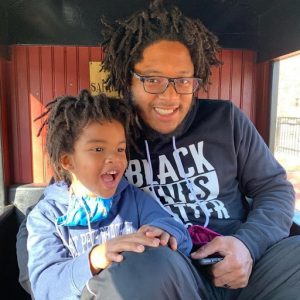
My Name is Xavier Thomas and I was a trip leader for Peace Not Walls in January 2020. I was born and raised in Milwaukee Wisconsin. I am the youth director at All Peoples Gathering in Milwaukee. I have the unique opportunity to serve the same church I grew up in. I have been married for 5 years and we have one son, and we foster as many children as we can fit in our house. I would say that Fatherhood and Palestine have become my passions but I will always love my Xbox!
Bird in Flight: #AdventinPalestine

What I thought I knew

My childhood connection to nature was effortless. It was filled with state park camping trips, summer camps, Minnesota lakes, and my roomy backyard. It informs my adult life in countless ways– including my environmentalism, political beliefs, and faith. So when I peered out the window of our ELCA Young Adults in Global Mission (YAGM) van as it climbed for my first time to the Environmental Education Center (EEC) atop a blustery peak in Beit Jala, Palestine – a place I would spend much of the next year – I imagined myself having quite the grip on environmentalism and anything it might entail.

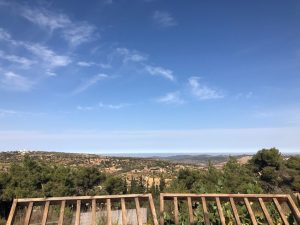
The view from the EEC’s outlook

I had not expected to learn many things. I was quickly proved wrong. 

I learned more at the Environmental Education Center (EEC), a ministry of the Evangelical Lutheran Church in Jordan and the Holy Land, than I could ever have imagined.

What I learned

I learned that access to water is not guaranteed to any Palestinian living in the West Bank, as it is controlled by Israel, who often diverts it to Israeli settlements. 

I learned that the occupation wall tears through land people and wildlife have called home for tens of thousands of years, disrupting migration patterns, habitats, and agriculture.

Israel controls the allocation of funds available for Palestine’s waste management. While Israel’s landfills take up several areas previously used by Palestine, it has severely restricted landfill capacity for Palestinian waste, resulting in a significant amount of  litter.

Some land-grabbing in Israel entails the rapid planting of non-native, fast-growing trees, creating a makeshift forest to hide remains of pillaged Palestinian towns. It is not uncommon that these “protected forests” are planted with funding from American Christians concerned about the holy land’s environmental health. It is also not uncommon that after 10-15 years, these trees are again uprooted to make room for a new Israeli settlement.

My shiny American Environmental Studies major suddenly made the world of plastic straw bans and buckthorn pulls seem utterly insignificant, if not naïve. 

What it means

Christians, Muslims, and Jews around the world lay a sentimental claim to the Holy Land, the land in which Jesus sat beneath olive trees, where the prophet Muhammed ascended to heaven, and where the Israelites were led to freedom. “The land of milk and honey” rang through my head sometimes as I stared out the EEC’s window amidst editing grant proposals and publications. Everyone clamors for this land, but they use the word “land” in a hollow way. People seemingly refer to the bare minimum of the word — the lifeless chunk of earth that sits in that particular spot on the planet, worthy only because of who has walked and what was written there, not the life present and reliant upon it today.

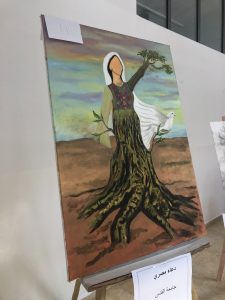
Art submitted by a student on the olive tree as a piece of Palestinian identity

What God desires

Matthew 6:25-26 says, 25 “Therefore I tell you, do not worry about your life, what you will eat or drink; or about your body, what you will wear. Is not life more than food, and the body more than clothes? 26 Look at the birds of the air; they do not sow or reap or store away in barns, and yet your heavenly Father feeds them…”.

I could write novels about how my time at the EEC taught me more about environmental justice than I ever learned from any college course, but I will instead share a memory with you.

For context–the EEC holds the first bird-ringing (often called bird banding in the U.S.) station in the Middle East. Mostly volunteer-run, much important research has come from the ringing work done here. This includes documenting various species of native Palestinian birds, piecing together native Palestinian ecosystems, and observing the occupation’s effects on migration patterns and those same ecosystems.

Bird in flight

As the EEC holds youth at the center of their ministry, bird ecology is an important way they connect students with the Palestinian biodiversity. According to their mission, this connection is inseparable from the ever-coveted land itself. Student groups who tour the EEC often get the memorable chance to release a freshly “ringed” bird under the loving supervision of EEC researcher Michael Farhoud and his devoted college volunteer, Bashar Jarseyeh. 

Students are always timid when the bird is first placed in their hand, palm stretched flat to provide a stable takeoff platform. Sometimes the bird will stand there an extra second or two, cautiously taking in the circle of awestruck seventh-graders. This moment is beautiful — student taking in bird, bird taking in student. Then, a flutter of wings and the bird is off, quickly becoming smaller and smaller as it soars above the Al Makhrour Valley.

Photo from the EEC Facebook page–student releases bird after ringing

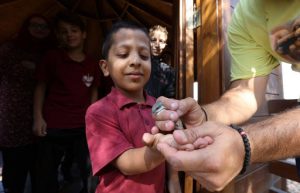
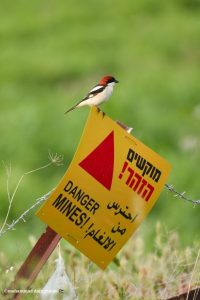
Photo by Mohammad Daraghmeh, submitted to the EEC 2020 Spring “Palestinian Biodiversity” photography competition

As they release the birds, students marvel that checkpoints, walls, and borders will not be on the mind of this avian Palestinian. Yet the students know these barriers can never leave the mind of the human Palestinians their bird friend flies over.

Still, maybe this bird sows a small seed of hope that one day things will change. One day, maybe the students, maybe all Palestinians will be as free to move as the “birds of the air” Jesus describes in the text from Matthew.

Additional Resources

Learn more about the Environmental Education Center supported by the Lutheran Church in  Jordan and the Holy Land here:

https://www.eecp.org/

Read more about the environmental impact of the Occupation of Palestine here:

https://time.com/5714146/olive-harvest-west-bank/

https://www.amnesty.org/en/latest/campaigns/2017/11/the-occupation-of-water/

Reflection Questions

  1. Maddi challenges us to consider those who rely on the earth in the present-day in the Holy Land, not just the religious figures who have walked there. How does thinking about the environmental impact of the occupation of Palestine today challenge the way you have thought about the Holy Land in the past?
  2. Maddi and the Palestinian students she worked with learned about faithfulness and freedom and joy from the birds at the Environmental Education Center. What have you learned from the creation around you? How has your relationship to the earth shaped your relationship with God?
  3. The Environmental Education Center in Palestine taught Maddi that care for the land and all creation is a central part of our call as people of faith. How have you considered your relationship to creation this Advent? In this period of waiting, how might you better care for creation?
  4. Matthew 6:25-26 says, 25 “Therefore I tell you, do not worry about your life, what you will eat or drink; or about your body, what you will wear… 26 Look at the birds of the air; they do not sow or reap or store away in barns, and yet your heavenly Father feeds them”. How have you experienced God providing for you or community? Who in your community needs to experience God’s freedom? How is God calling you to respond?

My name is Maddi Froiland and I was a 2019-2020 Young Adults in Global Mission (YAGM) volunteer in Jerusalem and the West Bank. I grew up in Milwaukee, WI, and graduated with a major in Environmental Studies and a concentration in Women and Gender Studies from St. Olaf College in Northfield, MN. I am currently serving as an AmeriCorps member in Palm Beach County, FL, where I am a reading tutor and teach a nightly ESL class for adults.

Loving Hospitality: #AdventinPalestine

Matthew 25:35-40

[Jesus said] ‘For I was hungry and you gave me food, I was thirsty and you gave me something to drink, I was a stranger and you welcomed me, I was naked and you gave me clothing, I was sick and you took care of me, I was in prison and you visited me.’ Then the righteous will answer him, ‘Lord when was it that we saw you hungry and gave you food, or thirsty and gave you something to drink? And when was it that we saw you a stranger and welcomed you, or naked and gave you clothing? And when was it that we saw you sick or in prison and visited you?’ And the king will answer them, ‘ Truly I tell you, just as you did it to one of the least of these who are members of my family, you did it to me.’

Room in the Inn

If Mary and Joseph showed up on the steps of an inn in Palestine today, they would’ve had a bed, some coffee, and probably three servings of a home cooked meal. At least, this is what my YAGM (ELCA Young Adults in Global Mission) program cohort (a group of young adults who serve in one country together) and I decided about one month into our year of service there. I felt like I was walking into my grandma’s house every time I stepped into a Palestinian home. I was greeted automatically with a kiss on the cheek that was quickly followed by Arabic coffee, sweets, and eventually an invitation to lunch or dinner.

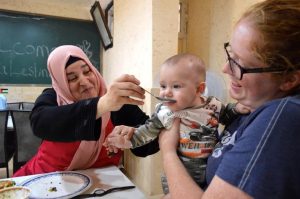
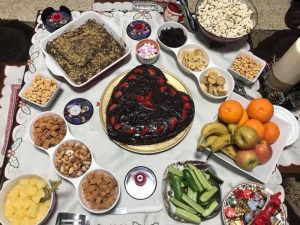
Sharing a meal in Aida Refugee Camp in Palestine

It didn’t matter who I was or what was happening in the world around us. I was always welcomed in with joy. In this way, Palestinian hospitality was an example of God’s radical love. This fact was made clear to me one rainy, Sunday afternoon.

Holy Water

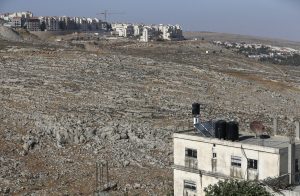
I was invited to another volunteer’s host family for a big lunch. When we got there, we discovered that even though rain was falling all around us, there was no more water in their water tank. In the West Bank, one way you can tell the difference between a Palestinian home and an illegal Israeli settlement is to look at the roofs. Palestinian homes will have a water tank on top of them. If this tank runs dry, families could be out of water for weeks. Meanwhile, illegal settlements have access to unlimited water piped from reserves found in Palestine.

Upper left: Israeli settlement supplied with plenty of water
Lower right: Palestinian home reliant on rooftop water tanks due to Israeli control of water supply

In the midst of these forces of occupation, Palestinians still show love through their hospitality. When I found out that Sunday that our hosts did not have water, I was ready to call it a day, to walk back home in the rain or make something simple instead. However, our Palestinian hosts were determined to have the lunch they planned for themselves and their guests. We took turns carrying in buckets from the garden cistern, boiling it in a tea kettle so we could drink it or use it to make rice. Then after our collective efforts, we sat down to a big, delicious meal. It was moments like these that felt most holy to me.

Unconditional Love

During my year as a volunteer with ELCA Young Adults in Global Mission in Palestine, I felt God’s unconditional love through the hospitality of my Palestinian friends and family. It was in the big hug my host aunt always gave me as I walked in the door. It was there in the third helping of stuffed grape leaves that my host grandma piled on to my plate, ignoring my protests that I was too full to eat another bite.

Surprise birthday meal made for me by my Palestinian host family!

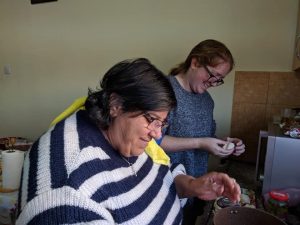
Learning how to cook with Teta Rose

When I felt this love from Palestinian families, it challenged me to take a hard look at my own life. How do I welcome others unconditionally, and not just when it’s most convenient for me? Just as I see hospitality as God’s love, I also understand it to be a call to action. Calling us to take a look at our churches and think who would feel that radical welcome as soon as they walked in the door or joined the Zoom chat. My Palestinian hosts gave me a greater understanding of hospitality. The understanding of how a welcoming smile or a shared meal is a holy act spreading God’s love to all. The kind of love that isn’t conditional to where and when it works best for me. Love that envelops a stranger the same as an old friend.

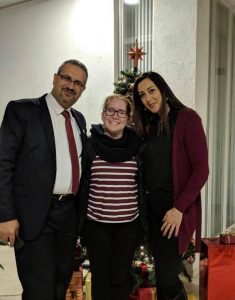
Celebrating Christmas in Palestine with my host family

For me, Advent is the perfect time to put their example into action in my own life. Advent, much like a host preparing for visitors, is about the preparation for the birth of Jesus. This year hospitality will have to look different in the midst of a global pandemic. However, it also provides an opportunity to break from our normal routines and to do what the scripture above asks of us. An opportunity to reach out to the stranger and share the radical love and hospitality that all people deserve.

Reflection Questions

  1. What is one way you – like Katie’s Palestinian neighbors – might welcome others unconditionally, and not just when it’s most convenient?
  2.  Who in your community is being told they are not welcome? Your neighborhood? Your church? Your country? How do you understand God’s call to respond?
  3. What was a time you received the kind of care we hear Jesus talk about in Matthew 25 / Katie talked about receiving in Palestine? What did you learn about God in that experience?
  4. In the midst of advent in a pandemic, what are some creative ways we can still offer hospitality (to friends, neighbors, strangers, at church, in the public square)?

Katie Evans (she/her) served as an ELCA  Young Adult in Global Mission in Jerusalem/West Bank from 2018-2019. While there, she taught English at Dar Al Kalima Lutheran School in Bethlehem. Since returning, she worked with Lutheran Campus Ministry at the University of Maryland, and she is currently an administrative assistant in the Metro D.C. Synod Office. Katie is a member of Hope Lutheran Church in College Park, MD.

To learn more about the ELCA Young Adults in Global Mission program click here

To learn more about the Lutheran Schools of the Evangelical Lutheran Church of Jordan and the Holy Land (including the school where Katie worked in Palestine), check out the work of Opportunity Palestine here