Skip to content
ELCA Blogs

ELCA Young Adults

All (REALLY DOES NOT FEEL LIKE IT) Shall Be Well

The Word

“All shall be well

And all shall be well

And all manner of thing

Shall be well.”

  • Julian of Norwich | 1342-1416

“I am convinced that neither death, nor life, nor angels, nor rulers, nor things present, nor things to come, nor powers, 39 nor height, nor depth, nor anything else in all creation, will be able to separate us from the love of God in Christ Jesus our Lord.”

  • Romans 8: 38-39

My friend Julian

I’ve loved Julian (which may not be hear real name!) of Norwich for the past few years. This is probably in part because when I came across her work at 23, I was tired of learning exclusively about male theologians from any time before the last 100 years. It is probably also in part because she introduced me to Christian mysticism. This seemed like the most magical of the Christian traditions and so appealed to my Harry-Potter-loving heart.

Regardless, her words sang to me.
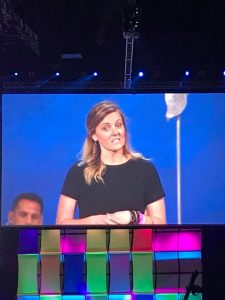
(Me, speaking at the 2018 ELCA Youth Gathering. Also the face you make @ pandemics.)

At the ELCA Youth Gathering in Houston in 2018, I told the story of being immunosuppressed and going to Rwanda. What I didn’t say was that in Rwanda, when I was 23, I got typhoid fever. About six months after that, I got malaria.

I thought I was going to die.

Laying in hospital beds across the world for two weeks, Julian’s words wrapped me up.

They laid on my heart, not a trite dismissal of my suffering, but a defiant hope in the face of a situation that was MARKEDLY unwell.

“All shall be well

And all shall be well

And all manner of thing shall be well”
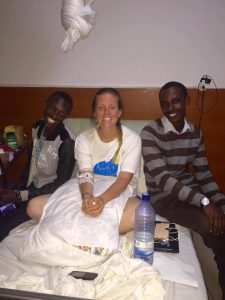
(my Rwandan friends, Frank and Fred, visiting me and bringing me snacks in the hospital in Kigali.)

Turns out, I didn’t know her that well.

The REAL Julian of Norwich

In a place of deep anxiety and fear this week, I came across these words again and learned more about Julian’s history.

I didn’t know that when she was a child, her town was overcome by the Black Death, killing about a third of its inhabitants from 1348-1350. I didn’t know she lived through two wars.

I didn’t know that when she was 30 she was so ill she thought she was going to die.

(Julian AND HER CAT. An icon (literally).)

This has been strangely comforting to me in the past few days.

Not the fact that she was sick or survived a pandemic or war, I am not comforted by unnecessary suffering.

I am comforted by the fact that, while it may feel like it sometimes, Julian of Norwich and other Christian Mystics did not live in a world outside time. Julian lived in times of fear and doubt and STILL. Still, her songs persist. Just like so many faithful Christian women before and after her.

Being Kept

Our songs persist, too, loved ones.

Already we have joined together online. We have sung together, prayed together, encouraged each other.

And we have been scared together.

We live in the suffering and struggle of our own time.

But our sister, Julian, has a fierce song of hope in Christ for us, still.

She saw visions of Jesus and wrote:

“If there is anywhere on earth a lover of God who is always kept safe, I know nothing of it, for it was not shown to me. But this was shown: that in falling and rising again we are always kept in that same precious love.”

Friends, we MUST do the best we can to keep ourselves and our neighbors safe. This is holy work.
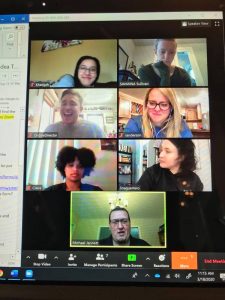
(look at these friends and colleagues safely meeting online for the health of their neighbors!)

But we know that as humans living in the world, we cannot always be kept safe.

We may feel anxiety.

We may not feel well.

Y’all, we may not BE well now.

We don’t have to pretend we are!

But in our falling an in our rising, we are kept in love.

Across the street and across the world, you are kept in love.

And nothing, NOTHING, can separate you from that. 

So now I pray that we be generous and patient and just and kind, that we breathe deeply the peace of God (she wrote to herself), and that we remember the promise in Christ we have hoped in for centuries, a promise that stands even and maybe especially when we don’t feel it:

“All shall be well.

And all shall be well.

And all manner of thing shall be well.”

Discussion Questions:

  1. What things in your life have brought you peace? What songs or poems or art pieces? What spiritual passages?
  2. Who are people you look up to spiritually?
  3. Where can you offer yourself grace this week?
  4. Where have you experienced hope this week? Where have you experienced God this week?

Savanna Sullivan (she/her/hers) serves as the Program Director for ELCA Young Adult Ministries at the ELCA Churchwide Office in Chicago, IL. She was a main stage speaker at the 2018 ELCA Youth Gathering in Houston, TX and gives presentations about Young Adult culture and empowerment in the church to ELCA and ecumenical groups around the country . She is passionate about helping young people connect to their own spirituality and pushing the church to equip, amplify, and respect the voices of young leaders. She loves banana pudding, the Clemson tigers, and memorizing poems.

Aspire to Inspire: #NoPlasticsforLent

The Word

“In their hearts, humans plan their course, but the Lord establishes their steps.”

-Proverbs 16:9-

Seasons and Seasons

Lent is a season in which many strive for reflection, to make new experiences and achieve rest. It’s also a time in which we see God’s creations of nature change and show their seasonal differences. As nature’s seasons change, so do the seasons of the human life. We are deeply connected to the Creation around us. Different in the seasonal human change, unlike nature, especially Lent when all things appear new again, our bodies age. Hopefully, our minds are renewed each season to the point of maturity revealing the beauty of Godly wisdom.

Focusing on nature’s seasonal changes – identify your current season of human life. What elements of the Lent’s seasonal beauty, reflection, and shedding of old ways are on display in your current season of life? In this season of Lent, what your life’s aspiration? Are you inspired for the next season? Who are you inspiring in their season?  What’s your plan and how in each season are you ordering your steps? What does this look like in terms of our communal relationship with the earth?

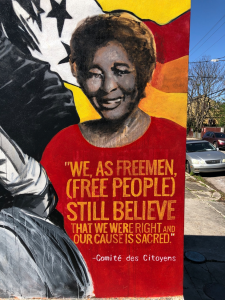
Plessy V. Ferguson Site in New Orleans, LA

Chronos and Kairos

Proverbs 16:9 reminds us that we could work and try to do everything on our time (Chronos), but the Lord provides in the Lord’s time (Kairos). Some events and opportunities that occur in winter, spring or fall may seem overwhelming and intimidating because of climate and mobility limitations. I suggest that Lent is a time where we can let go and allow God to guide our hearts to best fit into God’s plan of action. Allowing God to plan removes the obstacles of time, stress, failure and other limitations which transcend into opportunities for peace, restoration, and understanding.

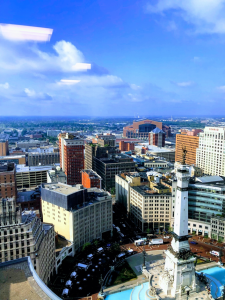
Monument Circle in Downtown Indianapolis, IN

Aspire to Inspire

Incorporating the meaning of the quote “Aspire to Inspire before you Expire” into whatever season of life in which we find ourselves, we can identify pain, the need for power, and hope for promises fulfilled.

There is recognizing the pain experienced in past seasons – the pain that has allowed you to become the person God created you to be. Then comes the pain of anticipated trauma and dilemmas that are in store and unknown. One must go through this pain to move to the next season.

The power of our testimonies changes who we are as servants. We are changed for the work of the risen Savior.

Then there’s the best part – the promise, the promise(s) fulfilled from a lifetime of holding on to God’s unchanging hand amid both chaos and celebrations.

When living out the true existentialism of this quote, we can see how only God can transform our pain into power and how God always delivers us promises within a Kairos moment.

Overview of Dallas, TX

All of this is what we could try to do before the time that we leave this season. However, this is not limited to only this season, but this journey is for a lifetime. Imagine what we could do as a powerful group of people when we serve the kingdom with the mindset to aspire to inspire before we expire.

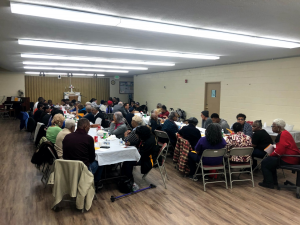
A gathering of 82 disciples representing 9 different congregations in inner city Baltimore, MD to worship for a Lent Service held at St. Philip’s in East Baltimore on March 4, 2020. To God be the Glory!

Discussion Questions

  1. What elements of the Lent’s seasonal beauty and newness are on display in your current season of life?
  2. In this season of Lent, what your life’s aspiration? Are you inspired for the next season? Who are you inspiring in their season?
  3. How has the Lenten fast from plastics newly inspired you? How might your next season look different because of this Lenten practice?


Rev. Louis Tillman is the Pastor of St. Philip’s Evangelical Lutheran Church in Baltimore. This congregation is the oldest African American Lutheran Church in North America. It was started as an African American church by a pastor who was recently freed out of slavery. St. Philip’s Evangelical Lutheran Church will be celebrating their 130th Anniversary on October 18, 2020.



A slam poem: #NoPlasticsforLent

God of Justice

As I mulled over how to respond to the topic of climate and racial justice, I knew that if I merely wrote out a response it would become a piece of academic prose with facts. But in this time of Lent, we already know the facts: we already know that our Earth is in trouble, that racism plays out in systems and structures that disembody black and brown lives and the body of Christ itself, that we as human beings can’t seem to get along, that there is evil embedded in every single system of our country and our world, and yet God intends for this world to be one committed to justice-seeking love rooted in the promise of the resurrection. 

Instead of writing out a response in succinct, beautiful paragraphs, I have decided to write a poem in order to lament, fast, and give alms this Lent.


The Word

1 Corinthians: 12 – 27

12 For just as the body is one and has many members, and all the members of the body, though many, are one body, so it is with Christ. 13 For in the one Spirit we were all baptized into one body—Jews or Greeks, slaves or free—and we were all made to drink of one Spirit.

14 Indeed, the body does not consist of one member but of many. 15 If the foot would say, “Because I am not a hand, I do not belong to the body,” that would not make it any less a part of the body. 16 And if the ear would say, “Because I am not an eye, I do not belong to the body,” that would not make it any less a part of the body. 17 If the whole body were an eye, where would the hearing be? If the whole body were hearing, where would the sense of smell be? 18 But as it is, God arranged the members in the body, each one of them, as he chose. 19 If all were a single member, where would the body be? 20 As it is, there are many members, yet one body. 21 The eye cannot say to the hand, “I have no need of you,” nor again the head to the feet, “I have no need of you.” 22 On the contrary, the members of the body that seem to be weaker are indispensable, 23 and those members of the body that we think less honorable we clothe with greater honor, and our less respectable members are treated with greater respect; 24 whereas our more respectable members do not need this. But God has so arranged the body, giving the greater honor to the inferior member, 25 that there may be no dissension within the body, but the members may have the same care for one another. 26 If one member suffers, all suffer together with it; if one member is honored, all rejoice together with it.

27 Now you are the body of Christ and individually members of it.


A slam poem for racial and environmental justice

In these 40 days of Lent

we take up the disciplines of alms giving, prayer, and fasting.

You see, as a kid

These seem so easy and maybe because I was only focused on 

Myself

I was focused on my own prayers, my own fasting, my own giving to “the poor”

Now, having broken through childhood innocence, I, first of all, realize the privilege of childhood innocence

As I talk with youth today, I hear palatable devastation and anger in the same breath.

You see, our young people are growing up in a time where their lives and the ecosystems of this world are not guaranteed.

And it’s not like there is a “Planet B”

Young people grow up in a time where they do not suffer the effects of climate change, 

they will operate within frameworks of fear as they muster up 

enough courage to go to school every day 

and pray there is not another school shooting, or a shooting at a place of worship, or a shooting late at night with a ricocheted bullet that claims the life of a child. 

Black and brown youth are forced to grow up in un-maintained and uncared for “affordable housing.” 

Oh, and to remind them who they are in the US of A, 

structures of whiteness put toxic and nuclear waste sites, landfills, plastic, 

oil refineries, lead, and gas-guzzling semis in their communities.

In other words, we disregard black and brown people like we discard our trash, our dispensables, our by-products of greed and self-centeredness.


In this increasing movement for environmental justice, as people of faith, 

let us take seriously the disciplines of Lent 

as a beloved community beyond our tendency to do so as individuals.

It is this collective alms giving, prayer, and fasting 

that we might discern 

God’s Spirit and

guidance.  

As a church deeply committed to anti-racism work and creation care,

May Lent serve as a time for us to follow the Spirit’s dance 

in weaving these stories together. 

You see, 

It’s not climate justice 

OR

Racial justice.

Rather, it’s 

racial, climate, gender, queer, economic, global justices.


As an “older youth,” in this season of Lent,

We repent.

I repent of my complicitness and desire for plastic and fossil fuels.

We repent that we have not lived up to our covenant in Genesis to maintain and preserve creation.

I repent that I have not understood environmental justice as a matter of racial justice 

We repent that we have not listened to our youth 

And to indigenous ways of knowledge with regards to living in balance with creation.

We repent we have degraded our earth just as we have degraded our neighbors through systemic injustice and oppression.

I repent that I have only fixated on sources of knowledge in the environmental justice movement who are white.

We repent that structures of power maintain white supremacy in order to keep us from witnessing the oppression of black and brown lives.

I repent that I have only listened to Greta Thunberg. 


As an “older youth,” in this season of Lent,

I also take-up the practices of prayerfully listening and expanding my creation of justice worldview.

We will listen and pass the mic to young black and brown environmental and racial justice activists.

We will listen to Jamie Margolin, Mari Copeny, Xiye Bastida, Isra Hirsi, Kevin J. Patel, Elsa Mengistu, Nadia Nazar, and other youth activists of color.

We will seek racial justice as a matter of climate justice and climate justice as a matter of racial justice.

We will listen and cultivate authentic relationships of solidarity.


Discussion Questions

  1. How does your faith compel you to work towards racial and climate justice?
  2. What have /  will you let go of and take-up in this season of Lent with regards to racial and climate justice?
  3. How do you understand the relationship between racial and climate justice? What is happening in your local community or congregation that addresses these?
  4. Who are leaders of color you listen to in the environmental movement? Theologians? How are you taking time to deepen this practice of listening during Lent?


Wylie Cook (they, them, their’s) is currently a seminarian attending Pacific Lutheran Theological Seminary in Berkeley, CA. Wylie has advocacy experience in various areas but specifically, the gender and racial nuances of policy. Wylie interned at the ELCA Advocacy office in Washington, D.C. and has most recently come from working with the Lutheran World Federation’s delegation to the United Nations Climate Change negotiations in Poland. While studying to become a Lutheran pastor, Wylie engages in advocacy and activism that is rooted in and informed by Lutheran liturgy, theology, ethics, and tradition. Wylie also serves on the policy council for the Lutheran Office for Public Policy- California. In their free time, Wylie loves to travel and visit family and friends around the nation, sing in choir, and cuddle with their Miniature Pinscher, Cosmo. 

A Modern Gethsemane: #NoPlasticsforLent

Expanding Lament

A great practice for expanding language is to read the definition of a word that you already understand.

I’ve heard the word lament plenty of times—I was an English major who loved Gothic novels—but I had never actually taken the time to really define it.

The definition didn’t hold any surprises, but as I researched definitions, I also researched Bible verses. And as I read Bible verses, I thought about lament in the context of my own life. And as I thought about lament in my own life, I realized that I have several memories that fit this vision before the word was even in my vocabulary.

Lament was the tears at 6 years old watching my grandfather baptize my sister in the hospital because we knew she wouldn’t live long enough to see anything outside of that building.

Lament was the fear when, later that year, I saw that same grandfather with yellow skin and no hair. Lament was understanding that those things were not good.

Lament was the work put into making a colorful picture with the words “Greif is a token of love” and presenting it, spelling mistake and all, to my fifth-grade classmate at his father’s wake.

Our lives are made up of moments of lament even before we grasp what grief is. No one is exempt. Perhaps we are lucky enough to have less of these moments than others; perhaps we are not. Not even Jesus Christ was immune its power:

The Word

They went to a place called Gethsemane; and he said to his disciples, “Sit here while I pray.” 33 He took with him Peter and James and John, and began to be distressed and agitated. 34 And he said to them, “I am deeply grieved, even to death; remain here, and keep awake.” 35 And going a little farther, he threw himself on the ground and prayed that, if it were possible, the hour might pass from him. 36 He said, “Abba,[a] Father, for you all things are possible; remove this cup from me; yet, not what I want, but what you want.”

21st Century Lamentations

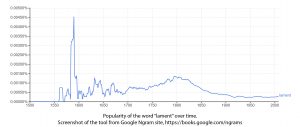
Lament is an old word, dating back to the 16th century, and clearly one that is not often part of our written vocabulary anymore. It involves a demonstration of grief, an intensity of sorrow that cannot be stored inside of the body. Yet, even as the word itself slowly recedes from our attention, we still perform it.

Today I feel a different grief, that of an unformed and uncertain tomorrow, and I lament this dying future with others of my generation and beyond.


We lament with our reusable bags and bulk bins.

We lament with metal straws and bamboo forks.

We lament with washed out salsa jars now serving as containers.

We lament with empty refillable water bottles through airport security.

We lament with our voices in the street instead of our voices in the classroom.


I read Jesus’ lamentations in Gethsemane often because this is when he seems the most human to me, right before he transitions to becoming the most divine by being nailed to a cross for our sins. It is the passage where I can begin to even try to understand his humanity and divinity in one body.

This season of Lent I have chosen my lamentation, my demonstration of grief, to be to give up single use plastic, but it is not restricted to this. We all have different lives and different sorrows, and whatever form your lamentation for the degradation of the environment takes, we join in support together as the Children of God, each crying out in our own Gethsemane.

Discussion Questions

  1. How does lament tie into your sustainability practices this season? How do you make your action more intentional?
  2. How have your experiences of lament affected you throughout your life? Are you currently mourning something?
  3. How does Jesus’ pain in the scripture open you up to your own?
  4. How might your #NoPlasticsforLent lament affect your relationship to creation during this season? Beyond?


Tessa Comnick is serving in Washington D.C. as the Hunger Advocacy Fellow with ELCA Advocacy. She comes from Cleveland, Ohio with a bachelor’s degree in English from Baldwin Wallace University in Berea, Ohio and a master’s degree in Global Environment, Politics, and Society from the University of Edinburgh in Scotland. The granddaughter of a Lutheran pastor, Comnick has attended an ELCA church since she was born and is immensely touched by the support of her home congregation, Prince of Peace Lutheran Church in Westlake, Ohio. She is grateful for this opportunity with the ELCA to explore her passions for food security and waste reduction, along with the opportunity to expand her knowledge in other areas such as environmental economics and climate induced migration. Comnick is a staunch believer that good things will come in the future, both in terms of altruism as a society and in Cleveland sports.