
My Story
When I was growing up on a small 3 acre farm in Tacoma, Washington with my two parents and three siblings, I HATED going outside and doing yard work. It was the last thing I wanted to do.
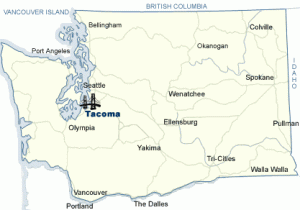
Tacoma, Washington
I would rather have been inside the house watching movies on our VHS player. On top of the mandatory all-family yard work on the farm, we lived frugally getting everything second-hand, including my school outfits which did not fit my fashion standards. At all.
Skip to college where I studied pre-med and needed to declare a major, realizing the only realistic option was Environmental Studies, an open major. Taking classes in this program, I finally found something that fit my educational needs. Learning what the environment was ecologically, socially, and locally gave me a new lens to understand and see the world in a deeper way.
My Learning
I learned how my actions could affect my local community, and communities internationally who I had never even considered. I learned how my desire for brand new material goods affected what I now know and fear as Global Climate Change, and that it is occurring at a pace that exceeds what humans have ever experienced before. I learned how this global change is hurting the natural environment, the plants and animals that live in it, and people who are marginalized because of their socioeconomic status, race, location and more. I found my passion. And it’s a shared passion with anyone who wants to self-reflect on who they are and what they do and how they affect their neighbors, communities, and the world in ways that may not be so obvious. It’s a shared passion with anyone willing to be more intentional with their actions towards the environment.
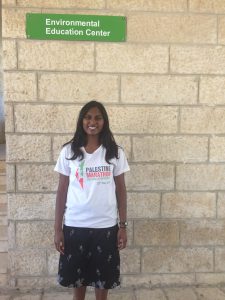
Hannah at the Environmental Education Center in Palestine!
After graduating with a degree in Environmental Studies, I volunteered in Palestine for a year with Young Adults in Global Mission (YAGM), an international service program through the ELCA. It was my first time over the Atlantic and my first time witnessing the joys and hardships of another culture for such a long period of time. I volunteered at the Environmental Education Center in the West Bank. It was the perfect accompaniment to my undergrad studies. Suddenly, I was observing one of the international communities I learned about – one that suffers the impact of my environmental actions at the hands of an unjust and oppressive system. Environmental Sustainability quickly shifted to Environmental Justice. I saw how product consumption in America driven by capitalism, materialism, and greed coupled with living under occupation can devastate countries like Palestine who are trying to keep up in a high-consumption world. Reflecting during my year I thought “I can do better than this”.
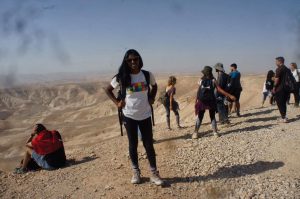
Hannah in the desert during her year serving with Young Adults in Global Mission in Palestine!
Word
2 Corinthians 5:20-6:10
20 So we are ambassadors for Christ, since God is making his appeal through us; we entreat you on behalf of Christ, be reconciled to God. 21 For our sake he made him to be sin who knew no sin, so that in him we might become the righteousness of God.
6 As we work together with him,[a] we urge you also not to accept the grace of God in vain. 2 For he says,
“At an acceptable time I have listened to you, and on a day of salvation I have helped you.”
See, now is the acceptable time; see, now is the day of salvation! 3 We are putting no obstacle in anyone’s way, so that no fault may be found with our ministry, 4 but as servants of God we have commended ourselves in every way: through great endurance, in afflictions, hardships, calamities, 5 beatings, imprisonments, riots, labors, sleepless nights, hunger; 6 by purity, knowledge, patience, kindness, holiness of spirit, genuine love, 7 truthful speech, and the power of God; with the weapons of righteousness for the right hand and for the left; 8 in honor and dishonor, in ill repute and good repute. We are treated as impostors, and yet are true; 9 as unknown, and yet are well known; as dying, and see—we are alive; as punished, and yet not killed; 10 as sorrowful, yet always rejoicing; as poor, yet making many rich; as having nothing, and yet possessing everything.
Ashes to ashes
We are called to be ambassadors of Christ, stewards of the Earth here and now! Now is the acceptable time. We are asked to care for creation as well as our neighbors around us. We can practice being more mindful and intentional with our efforts to preserve our environment and lessen negative impacts on plants, animals, and marginalized communities that are merely trying to survive.
Ash Wednesday is near and it reminds us that like the earth that clings to our feet each day, we are dirt. We are ashes. We are dust. We are creation, we are earth itself.
Ash Wednesday marks the beginning of Lent and of a tradition in the Lutheran Church where we take time to self-reflect, repent, and remember what Jesus did for us before he laid down is life for us.
Ash Wednesday reminds us that we are called by Christ to prayer for, lament for, and care for the earth to which we all will return.
Reflection Questions
1. How can we hold ourselves and the people around us accountable in treating the environment with care, love, and respect? What does it mean to be Christ’s ambassador in this context?
2. What are your consumption habits? How often are you purchasing things with plastic? Where do you put your old electronics?
3. How do you mark Ash Wednesday? What do the words “ashes to ashes” mean to you?
Bio
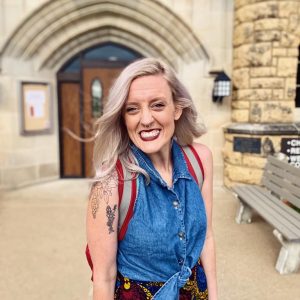
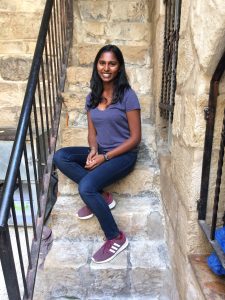 Hannah Wright Osborn (She/Her/Hers) is a living Lutheran currently residing in the DC Metro Synod where faith and politics are ever present. Her studies in college helped her to understand the value of the farm she grew up on and the recycling of second-hand products. Her year in Palestine further fueled her passion for social justice work. She came back and was invited to lead a trip back to Palestine for other Young Adults of Color near and within the church and to give them space to lead in a white and marginalized society. She has returned back after a successful trip in January 2020 and continues social justice work in her local community through Luther Place Memorial Church.
 Savanna Sullivan (she/her/hers) serves as the Program Director for ELCA Young Adult Ministries at the ELCA Churchwide Office in Chicago, IL. She was a main stage speaker at the 2018 ELCA Youth Gathering in Houston, TX and gives presentations around the country to ELCA and ecumenical groups about Young Adult culture and empowerment in the church. She is passionate about helping young people seek the Divine in themselves and pushing the church to equip, amplify, and respect the voices of young leaders. She loves banana pudding, the Clemson tigers, and memorizing poems.