

Skip to content
ELCA Blogs

ELCA Worship

Daily Prayer in the Home


“I arise early in the morning and I  cry out to you, I hope for your word.
My eyes are open in the night watches, that I may meditate upon your promise.” (Psalm 119:147-148)

During this time of pandemic many are seeking resources to support daily prayer in the home. As we are physically separated from supportive Christian communities, it becomes increasingly important to mark our days and hours with prayer. As noted in Keeping Time, “Prayer is a gift of access for all the baptized and those seeking to live in a relationship with the God who has spoken, is speaking, and has promised to speak through Jesus, the living Word, and the Spirit, who helps us pray with sighs too deep for words as we ponder the scriptures, which still speak to us” (Using Evangelical Lutheran Worship: Keeping Time, p. 148).

These daily prayers may be prayed together as a family or as individuals. Prayer at morning and evening are the primary times for common prayer in various faith traditions. You may want to create a space in your home for such prayer, being aided by lighting a candle or having a vessel of water nearby to remember your baptism. Several short collects for various situations could be used throughout your day, keeping with St. Paul’s guidance to “pray without ceasing… for this is the will of God in Christ Jesus for you” (1 Thess. 5:17-18).

To support prayer practices in the home, we have provided these simplified forms of  Morning Prayer, Evening Prayer, and Night Prayer. In addition to these three times of day we have provided Responsive Prayer, a simple order that may be adapted to a variety of times and contexts. Each of these services are adapted from Evangelical Lutheran Worship. In addition, a resource of other Prayers and Blessings for Daily Use including a collection of table prayers and prayers for various situations is also available.

Daily prayer can be supported by including scripture passages from the daily lectionary. These readings that include an Old Testament text, a New Testament text, and a Psalm, provide a helpful pattern that bridges the previous Sunday to the next Sunday. Readings on Monday through Wednesday build upon what was heard the previous Sunday while Thursday through Saturday look forward to the upcoming Sunday. The list of readings can also be found in Evangelical Lutheran Worship, p. 1121­–1153.

Other published devotional materials such as Christ in Our Home and The Word in Season are available from Augsburg Fortress. Daily devotionals from Christ in Our Home can be received to your email through June 30. Bread for the Day, an annual publication that supports daily prayer, can currently be purchased as an eBook. More Days for Praise, a resource for the church’s festivals and commemorations is designed for home devotions. Remembering those saints who have lived through a host of challenging times and situations reminds us of our connection to a great cloud of witnesses.

You may also wish to sing hymns during this time. To purchase copies of Evangelical Lutheran Worship and All Creation Sings for the home, visit the Augsburg Fortress website or call 1-800-328-4648. These and other hymnals have a topical index where you may search for hymns for time of day or season of the church year.

More on hymnody resources in this time can be found through The Hymn Society.  For your devotional time, you might be interested in knowing about the Community Video Hymn Sing Facebook page led by Paul and Elizabeth Damico-Carper.

It is our prayer that these resources can be an aid to your daily prayer time. May the Spirit fill you with the peace of the Risen Christ in these days and always.


 

All Creation Sings: Liturgies

It is an odd time to be looking ahead. In our lives at church, work, and home, we are taking things one day at a time. Our worship has moved to the home and our gatherings with our fellow members of Christ’s body is often mediated through a screen. Our hope, of course, is that this physical separation from one another is temporary, that we will indeed be able to see one another in person and pray and sing together before too long.

In the many months prior to our current situation, the worship team of the ELCA and Augsburg Fortress—in consultation and review with many others throughout the church—has been preparing a resource to support ongoing renewal across the church’s worshiping communities. 2020 brings us almost fifteen years since the introduction of Evangelical Lutheran Worship (ELW). A blog post in March described features of the assembly song portion of All Creation Sings, the forthcoming supplement to ELW. In addition to hymns and songs, this resource will include three new liturgical settings.

Setting 11 (following the numbering sequence after the ten settings in ELW) will be a bilingual service in Spanish and English. As many of our congregations and leaders have the need for resources in Spanish, this setting will be laid out in a side-by-side column format, allowing the assembly to alternate languages within a service if desired. The liturgical music, most of it new to the ELW family, will be bilingual as well.

Setting 12 will be a setting for Holy Communion with options for evening use. Some assemblies gather around word and table at times other than Sunday morning, perhaps on Sunday or Saturday evening. Some prayer options include language specific to this evening setting; others can be used any time of day. Much of the liturgical music is newly composed for this resource.

All Creation Sings will also include a service of word and prayer. A future post will explore this liturgy in more detail, but this is a more contemplative service that can be adapted for various contexts. The pattern includes suggestions for hearing the word, prayer, silence, and song. A number of contemplative, short songs are included in the assembly song section and would be especially fitting for this service.

The title of this resource, All Creation Sings, evokes a celebrative image that permeates the scriptures. As so much of our human activity comes to a halt right now, many have noted how the natural world has come to life in unexpected ways: clearer water, cleaner air, more abundant wildlife. Even as we struggle in these days, Easter has come. Christ is risen indeed. We place our hope in the God of creation and new creation, the Spirit who brings life in unexpected places and in unexpected ways.


To learn more about All Creation Sings, visit http://www.augsburgfortress.org/AllCreationSings.

Helping People Make Ritual at Home after a Death


Today’s post is written by Elaine Ramshaw, PhD, an ELCA laywoman, the author of Ritual and Pastoral Care and The Godparent Book (just out in a revised edition). She has studied the literature on ritual for transitions in the fields of liturgical studies, anthropology and family therapy.

There’s a fair amount of advice out there on what to do about funerals or memorial services during the current “stay at home” shutdown, including this. Often people are encouraged to plan for a memorial service whenever that becomes possible. The process of planning for such a service later on in bereavement can itself be an opportunity for doing some of the work of grieving. Pastors and others can participate in this planning through conversations with family and friends of the deceased, possibly by conference call or videoconference call.

There’s another piece to ritual care for grieving people in the current situation, though: helping them create home ritual that fills some part of the need for more immediate ritual. This would be especially helpful when there is not any church-based ritual right away, or when a service is held but mourners you’re caring for cannot attend due to distance, illness, possibly having been exposed, susceptibility to infection, or the limitation on how many can gather.
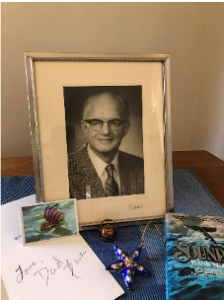
The possibility of having an informal memorial service at home would not occur to many in your congregation who think of after-death ritual as something that happens only in church or a funeral home, led by professionals. While they might come up with innovative ways to ritualize a birthday or other happy event, they are less likely to imagine that they are capable of creating a rite of mourning. In some cases, all you have to do is bring up the possibility and people will run with it!

To assist those who are grieving create a rite of morning for the home, you’ll need to provide them with two types of guidance:

  • Flexible suggestions for ritual actions they might do at home
  • Elements of the church’s ritual they can incorporate into their home ritual.

This second aspect—bringing elements of the church’s ritual into the home—likely comes more naturally to many of us than the first. Provide them with suggestions for suitable prayers, biblical readings and songs. In addition to favorite, comforting hymns and hymns from the “Hope, Assurance” section of Evangelical Lutheran Worship (ELW), consider hymns from the “Holy Baptism” section and the “Lament” section. (Note that ELW 698 and 703 are set to familiar tunes even if the texts are not well-known). If you can make and they can play recordings, a hymn/played by a musician they know will connect them to their local congregation in more immediate ways than a recording found on YouTube. For a repetitive song like “Come and fill our hearts” (ELW 528) or “Calm to the waves” (ELW 794), the accompaniment can be repeated five or six times. Biblical readings could combine the promises of God with some image that reflects the life of the deceased, e.g., Zechariah 8:3-6 for a kids’ sports coach. Prayers could include psalms and prayers from the funeral service, including perhaps the comforting and familiar “into your hands” commendation (ELW p. 283).

Under the current strange circumstances, though, the first category of resources—ritual actions at home— may be even more important, since people are often denied the usual ritual ways to say goodbye. Below are three simple ritual activities that could help mourners symbolize their loss, begin to come to terms with the reality of the death, and embark on their grief work.

  • Hold a simple at-home memorial service. Ask everyone to come up with a favorite memory of the person who died and select an object that represents that memory. Place a photo of the person who died on a table with a candle next to it. Begin by lighting the candle as someone leads a prayer. Each person tells their story and places the object on the table next to the photograph. When all the stories have been shared, close by singing a favorite song or sharing a food that recalls the one who died.

If a mourner lives alone or if one household wants to join virtually with another for this ritual, each household could have its own photo and candle. This could be done on videophone; videoconferencing (e.g. Zoom) is also possible, though you can’t sing or speak together due to the time offset.

  •  If the mourner(s) didn’t get a chance to say goodbye as the person was dying, they might be invited to write a letter to the one who died, saying those things they wish they had been able to say. Young children may draw a picture of what they’d like to say. These letters may then be destroyed in some way, as a way of letting go of at least a piece of the regret. (Make sure the child knows and is OK with this!) Depending on what’s possible in the home situation, the letters may be burned or buried. An adaptation of the second prayer for peace on ELW p. 76 might fit here:

Gracious and holy God, lead us from death to life, from falsehood to truth. Lead us from despair to hope, from fear to trust. Lead us from shame to grace, from regret to peace. Let peace fill our hearts, our homes, our world; through Jesus Christ, our Savior and Lord. Amen.

Again, the ritual can end with a song or with eating a food that recalls the one who died. This ritual is one that a person could do alone or with others.

  •  Another ritual of goodbye suitable for a solitary mourner as well as for a small group involves finding two physical symbols of the deceased, one the mourner wants to keep and one they are willing to let go. The symbols could be possessions of the one who died or gifts or cards which the mourner received from them.

This two-part ritual embodies the necessity of letting go of the person as we knew them in this world while underscoring and treasuring what remains. During the first part of the ritual, one of these symbols is destroyed (torn up, burned, buried, set adrift) with a prayer and/or song of farewell. The farewell song could be, for example, ELW 222 or 223, a hymn from the “lament” section, or a favorite lullaby.

The second part of the ritual involves taking the other of the two symbols and placing it in a place of honor in the home—perhaps a prayer place set up for the purpose with a candle and other symbols—or if it’s something that can be worn, on one’s person. This could be accompanied by playing/singing one of the favorite songs of the person who died.

These home ritual suggestions at the time of death are not intended to replace the church’s funeral/memorial service. The church didn’t invent the human action of gathering to say goodbye to the dead; there is a deep human need to say goodbye and to be reassured that there will be a way to move on. When we cannot do this with the body of the deceased and/or in community, we are helped by other ways to make the loss real and begin the work of mourning at home.