Skip to content
ELCA Blogs

ELCA Worship

Beyond the Christmas Program: Engaging Young People in Worship

Today’s post is by Pastor Janelle Rozek Hooper, Program Director for Ministry with Children, ELCA.

I often hear that children participating in the Christmas story, whether rehearsed or spontaneous, holds strong emotions and memories for family, friends and especially grandparents. The time, energy and availability of children, family and youth leaders has changed over the years but the desire to have children participate in worship during the Advent/Christmas season has not. We can’t even fathom only hearing the Christmas story with words; we want to see donkeys in fur and angels with glitter piping. We can’t imagine not using as many of our senses as possible or the beauty of the imperfect perfect telling of the Good News that happens when real people tell this amazing story.
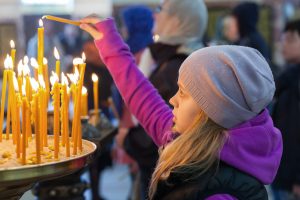
So why not the rest of the year?  How come we can only handle kids voices leading worship or acting out scripture once a year? Were the kids engaged in worship of God? Yes! Were the adults? Yes!

How can we involve children in such leadership throughout the church year, trusting the Holy Spirit is imparting spiritual gifts at all times? Not every Sunday has to have the same high production value. If our places of worship would commit to even one more way of engaging young people in worship over the course of a church season and then be open to another way the next season, I truly believe the engagement of all ages would double.

Here are seven suggestions to get you prayerfully thinking about what might be the “one thing” to continue past the Advent/Christmas season for engaging young people in worship.

  • Songs accessible for children who can’t read, such as repetitive choruses, Taizé, camp songs.
  • Scripture reading geared toward children’s learning style, such as a children’s Bible with lots of verbs
  • A senior and a young person co-reading a lesson or leading the prayers
  • Experiential aspects of worship, such as a youth pouring water into the font
  • Children’s artwork for slideshows, bulletin covers, or other places in the worship space
  • Adults and youth working together on Audio/Visual (AV) ministry
  • Congregations with SundaysandSeasons.com can download and print “pre-reader” and “reader” versions of children’s bulletins

And many more! I offer a whole host of ideas about how to offer intergenerational worship and engage young people in worship at www.ministrylinks.online. In fact under the tab “Ministry” there is a drop down for “Seasonal Resources” that begins with the liturgical calendar. Wonderful and yet easy Christmas Plays can be found there. As Program Director for Ministry with Children for the ELCA, I’m also available to chat about your specific needs in your context. Janelle.Hooper@ELCA.org. Please be in touch!
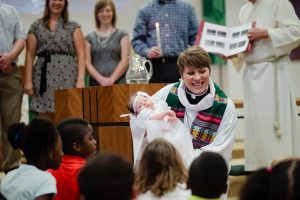
Photo courtesy of Amanda Faucett Photography

A November Song Spotlight: On Jordan’s Stormy Bank I Stand

Today’s post is by Linnéa Clark, pastor of St. John’s Lutheran Church in Melrose Park, Pennsylvania.

One of my favorite features of Evangelical Lutheran Worship is its “End Time” section (#s 433-441). When the end of the lectionary year arrives, I find myself turning to beautiful, timeless hymns that long for the fulfillment of God’s reign and the coming of Jesus. Many of the “End Times” hymns hold longing in tension with joy as they celebrate God’s promises and proclaim that God’s reign is already at hand.

Lately, I have been drawn to “On Jordan’s stormy bank I stand” (ELW 437). The text, drawn from a longer hymn written in 1787, describes the contrast between where we are – waiting on “Jordan’s stormy bank” – and God’s promised kingdom, where there is no sickness, sorrow, pain, or death. The text refuses to resolve: with a pair of questions, the final stanza voices a deep yearning to see the face of Christ. Each stanza of the hymn culminates in a refrain that empowers us to join in God’s work ourselves: “Oh, who will come and go with me? I am bound for the promised land.”

This hymn lives a parallel life outside the pages of hymnals like Evangelical Lutheran Worship in the Sacred Harp community which sings traditional a cappella American shape-note music. Originally developed in North America and England in the late 1700s, shaped notation was intended to help congregations sight-read hymns and sing well in harmony. Shape-note “singing schools” quickly acquired a life of their own outside the church. Today, Sacred Harp groups can be found around the world, and they welcome first-time participants.* “On Jordan’s Stormy Bank I Stand” appears as “The Promised Land” (128) in the 1991 revision of The Sacred Harp.

In Sacred Harp performance practice, the melody of this song is carried by the tenor part, a mixture of high and low voices. It is surrounded by bass (low), alto (high), and treble (mixed low and high) voices. When sung, the melody weaves in and out of the six-part harmony. The most striking feature of the song is its minor key, a sharp contrast to the major key printed in ELW and other hymnals. When Sacred Harp singers sing “The Promised Land” in its customary minor key, they tend to sing it quickly. It has a powerful forward energy, as though the singers are already pressing onward through the storm toward the promised land. You can listen here to a video from the singing community in Cork, Ireland.

If you choose to sing “On Jordan’s Stormy Bank I Stand” this season, I invite you to lean into its longing for God’s coming reign by experimenting with your interpretation. Alternate interpretations help to illuminate different aspects of the text. Try singing it faster, interpreting its time signature as 2/2 rather than 4/4. You might even choose to read its key signature as E minor instead of E-flat major, adding an air of conviction and resolve. The stormy bank, the wide extended plains, the longing, and the journey toward the promised land come vividly to life.

As Advent approaches, may love and longing for God’s promised reign of justice and peace enrich your shared song.

*Interested in exploring this hymn in its Sacred Harp context? Visit fasola.org to find a regular singing near you. No experience is necessary, and people of all ages, abilities, and experiences are welcome to sing and lead songs.