
Skip to content
ELCA Blogs

ELCA Worship

Worship at Fort Leonard Wood

Today’s post comes from Rev. Christopher Laughlin, chaplain at Fort Leonard Wood, Missouri.

I was an Army Reserve chaplain and a parish pastor; I served a small, rural parish in Michigan. I currently serve as a basic training battalion chaplain at Fort Leonard Wood, Missouri; I’m one of three chaplains who lead worship at the “Liturgical Protestant Service.”

Attendance at this service fluctuates between 50 and 200, and it’s the youngest, most diverse congregation I can imagine; it is truly representative of “every nation, tribe, people and language” (Revelation 7:9). While there are a few soldiers and families who are permanently assigned to Fort Leonard Wood in attendance, most are trainees who will attend our service for less than 22 weeks (many for only 9) while they complete Basic Combat Training (BCT) and/or Advanced Individual Training (AIT). They hail from every state and nearly every continent.

Some attend because this service is the most comfortable for them, coming from a liturgical or sacramental background (this was why I attended a similar service while in BCT and AIT). Others attend because they prefer hymns over praise music. Still others attend because of the relationship that they form with their chaplain, or because they are exploring different Christian traditions of worship. The singing fluctuates wildly in quality, as trainees are often hoarse from “being motivated” (yelling) all week.

Then there are those trainees who attend because congregations and individuals from all over the North/West Lower Michigan Synod send me cookies for the fellowship time which follows worship each week. This has been a real gift to the trainees – those cookies are a taste of home and comfort in what is, for many of them, the most difficult and trying time in their lives.


My opinions are my own and do not reflect those of the 2ndBattalion, 48thInfantry Regiment, the 3rdChemical Brigade, the Maneuver Support Center of Excellence, the Training and Doctrine Command, the Chaplain Corps, or the United States Army.


Sacred Self: A Holy Trinity Reflection

Today’s post is by artist Robyn Sand Anderson.

Painting has become a very spiritual practice in my life. And, I believe it can be for you, even if you aren’t an artist. 

My friend, Pastor Kathie Nycklemoe (ELCA, St. Stephen, Bloomington, MN), and I sometimes lead a retreat we call “Art & Soul.” She leads a couple of sessions on different ways of praying, like Centering Prayer and Lectio Divina. I lead a session using art as a way to pray or meditate and a hands-on session where everyone uses watercolors to paint their prayers. The movement of your brush and the swash of color across paper become a vehicle to open yourself up, to listen and to release. Color, movement and texture can speak of the Mystery that words can’t explain.

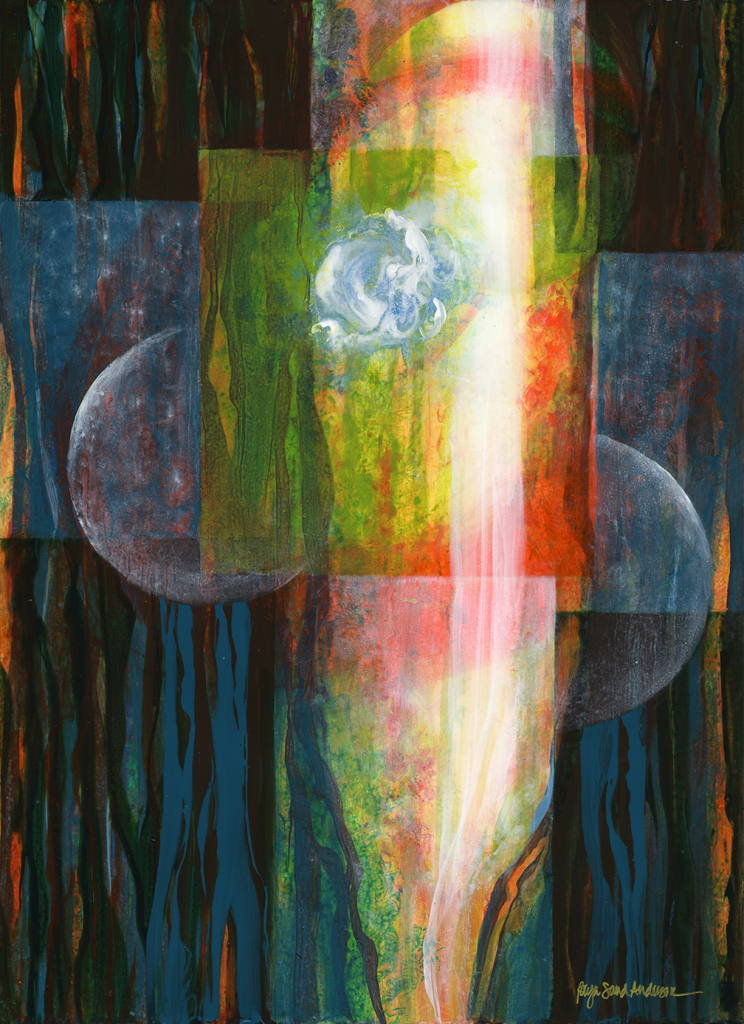
“Sacred Self” was created in 2012 for my exhibit called “The Suffering of Becoming.” This body of work explored what I had learned from living through my diagnosis of rheumatoid arthritis. RA is a chronic disease of great physical pain, exhaustion and muscle weakness. I painted four exhibits working through my experience of suffering and finding threads of hope. This painting began with a sense of deep, dark, primordial forest. In the midst of this darkness, pain and sorrow, I wanted to convey the presence of God that I experienced in the midst of my own suffering. Light in the darkness. 

Robyn Sand Anderson © 2018 All Rights Reserved.

The presence of the Trinity became apparent in the steps I was taking to convey the Mystery of it all. Creator, Redeemer, Sanctifier. In the center of the Holy Trinity, I placed a small, moving blue and white sphere of sacred life. Sacred Self. I knew God’s presence in my darkest moments and I knew in that Presence that we are all a precious, holy creation of God. God was with me in my suffering. Jesus, who suffered great pain, was with me in those darkest of moments. Finally, God’s Holy Spirit surrounded me and lifted me from my dark forest. In the creation of this painting, I experienced the thread of hope I needed.

www.RobynSandAnderson.com

Mothering God: A Reflection on Mother’s Day in Worship

Today’s post is by Amanda Highben who serves as Pastor at Prince of Peace Lutheran Church in Dublin, Ohio.

Mothering God, you gave me birth

in the bright morning of this world.

Creator, source of ev’ry breath,

you are my rain, my wind, my sun.

–  “Mothering God, you gave me birth,” Evangelical Lutheran Worship, #735

When I gave birth to our daughter Cecilia, I was still in seminary and serving as the youth director at St. John’s Lutheran Church in Zanesville, Ohio. Needless to say, it was a full and challenging time as my husband Zeb and I balanced our jobs, my education, and our halting, on-the-job education in parenting. One of the clearest things I remember is the exhaustion. In the first months of Ceci’s life, I was convinced I’d never sleep again.

Thankfully, our St. John’s community was a great source of strength and support for us. The parishioners delighted in Cecilia’s birth and helped us in countless ways, from simply holding her during worship to bringing us meals and offering to babysit. The congregation nurtured us through this time of transition and we will be forever thankful for such a gift.

Still, St. John’s is not unique in this regard. Many churches do a wonderful job of welcoming and supporting families. As Mother’s Day nears, congregations are once again preparing to bless and honor the mothers in their midst. Because I’ve served five different churches, I’ve seen mothers recognized in worship in various ways. I have even heard entire sermons devoted to Mother’s Day, though there is nothing in the lessons to warrant such preaching.

It is critical to be aware that Mother’s Day is not joyful for everyone. Remember the diverse and complex life stories of your people—The couples struggling with infertility. The children and adults whose mothers have died tragically. Those who have been hurt by or have strained relationships with their mothers. Women who cannot or chose not to have children, but have been endlessly told by contemporary culture that only motherhood can truly fulfill them. Families with two fathers. Women struggling with post-partum depression. All of this is complicated by our cultural determination to “romanticize” motherhood, which makes it difficult for mothers to talk openly about their challenges without feeling ashamed. In other words, if we fail to be thoughtful in our worship planning, a variety of women, men, and children might feel hurt or excluded when we intend exactly the opposite.

Yet: The commandments tell us to honor our parents, and the desire to bless mothers is good and Christ-like. It is an impulse that springs from a place of love. If we ignore it altogether in worship on the grounds that it is a secular holiday and not part of our liturgical calendar, then we risk conveying the implicit message that reasons for celebration in people’s everyday lives don’t matter to the church; we risk conveying the harmful belief that the Christian faith is disconnected from the world beyond our sanctuary walls.

This year, then, as we celebrate Christ’s resurrection on the seventh Sunday of Easter consider how your congregation might recognize mothers in ways that are sensitive, inclusive, and faithful to your context. Perhaps this means focusing more on the act of mothering, or lifting up Biblical images of our mothering God (see Isaiah 49.14-16 and 66:13, or Luke 13:34). The petition for mothers in the Prayers of Intercession is also appropriate and poignant (Sundays and Seasons, Sunday May 13, 2018). Above all, pray that everyone who gathers for worship on this day will encounter Jesus’ unfailing, all-embracing love.