
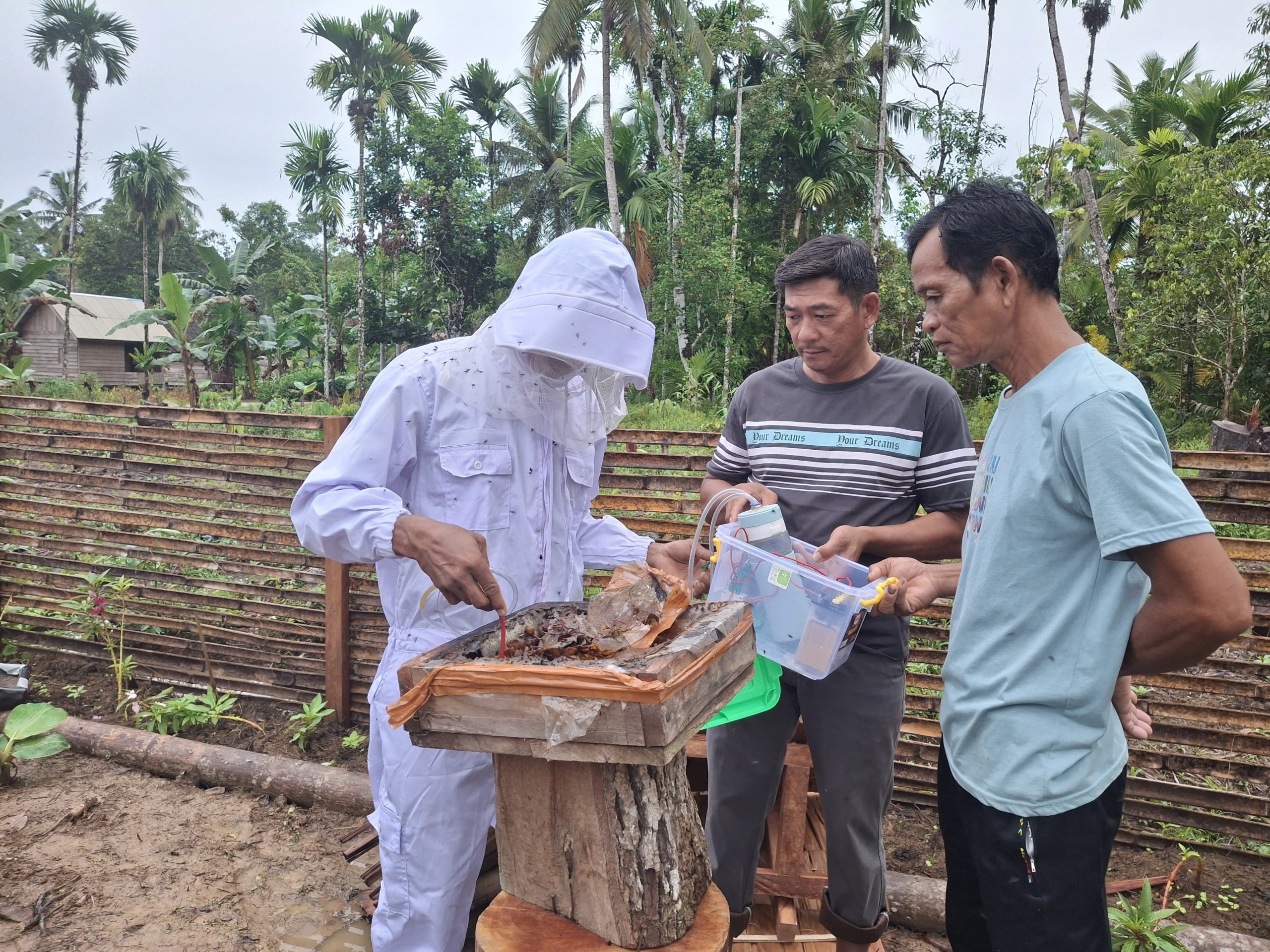
Pak Esli lives in a small hamlet called Sua, located in Saibi Samukop Village, Mentawai Islands, off the western coast of Sumatra in Indonesia. On a daily basis, he works as a fisherman as well as a log collector used for making rattan. He lives with his wife and two sons, the second of which is currently in his first year of high school.
As the head of the family, Pak Esli is responsible and always tries hard to fulfill his family’s needs. The big change in his life began when he participated in a forest bee farming program sponsored by the Indonesian National Committee of the Lutheran World Federation (KN-LWF).
Initially, he had absolutely no knowledge about how to raise bees, let alone about the process of how honey can be produced. The world of beekeeping was completely new to him. However, through the training and mentoring provided in this program, he began to understand the whole process-from getting to know the bee colony, taking care of the hives, to harvesting honey sustainably.
Pak Esli says that this program has brought a very positive impact, not only for him personally, but also for the Sua Hamlet community as a whole. “Forest bee farming has opened up new avenues in improving our economy,” he said. “The harvested honey can now be sold to various places, thus becoming a very meaningful source of additional income for families in the village.”
He adds that all this has opened up new opportunities for bee colony development. As the number of colonies increases, more hives can be harvested, and this means more activities for the community, both to fulfill their daily needs and to supplement their income.
“I am fortunate to take part in this program,” said Pak Esli. “I hope that this activity can continue to grow and reach more residents in other areas.” For Mr. Esli, forest bee farming is not just an economic activity, but also a tangible manifestation of changes in people’s way of life that are more independent, productive, and care for the surrounding nature.
