
(A version of this post previously appeared on the Huffington Post Impact blog – http://goo.gl/L3MtiH.)

New reports suggest climate change could push more than 100 million people into poverty in just the next 15 years. “Climate change hits the poorest the hardest,” says World Bank Group President Jim Yong Kim, “and our challenge now is to protect tens of millions of people from falling into extreme poverty because of a changing climate.”
The impact is a “two-way street.” Climate change makes it harder for farmers to grow crops, on the one hand, and some farming practices, on the other hand, damage soil, pollute water supplies, and create harmful emissions. But change is happening in small farming communities around the world, especially in communities of faith. Here are three ways poor communities around the globe are adapting to climate change with the support of ELCA World Hunger.
Cleaner Cooking
Ramoni Rani and her husband, Nor Uttam Hawlader, live in the village of Rajakhali in Bangladesh with their two sons. Like many Bangladeshi farmers, Ramoni and Nor use wood-burning stoves to cook food in their homes. The cost for fuel is steep, and the continued need for it threatens the country’s already-depleted forests. Ramoni, Nor and their children suffered from respiratory illnesses and eye problems because of the carbon emissions and smoke in their homes. In fact, a 2009 profile of Bangladesh from the World Health Organization found that indoor air pollution contributes to nearly 50,000 deaths every year.
“Bondhu chula,” a more efficient cookstove, was developed to combat some of these problems. But many Bangladeshis have been reluctant to use them, mostly because they don’t know how. Lutheran Health Care Bangladesh has stepped in by working with over 250 women to help them get familiar with the cookstoves and the positive impact they can have. For Bangladeshis like Ramoni and Nor, efficient cooking in the home means better health and more money for themselves and a path away from deforestation for their rural community.

In this picture, a man holds biomass pellets similar to those that will be used in the project in Padhar.
Cleaner cooking also makes good economic sense for families in Padhar, India. To address some of the problems older cookstoves create, Padhar Hospital is helping households get access to smokeless stoves that use biomass pellets. The program will not only train the people to use the stoves but will also help them turn their biomass into profit by providing it to a processing plant. Since no such plant currently exists in Padhar, one will be built. Thus the program will provide cleaner stoves, help residents earn income, and create jobs for people in Padhar, all while protecting the environment.
“Green-er” Coffee
Farmers in the Rachuonyo District of Homa Bay County in western Kenya know the daily realities of climate change. They see it in the shortened periods of rainfall, prolonged dry seasons, and increased flooding that washes away valuable crops and seeds.
Most of the farmers in this region focus their attention and limited investment on subsistence farming, trying to grow enough food to feed their families but often not producing crops that they can use for income. This leaves them with little savings to weather the kind of volatility that comes with climate change. One bad season can mean a year of hunger for a smallholder farmer.
One group is working to change that. Members of the smallholder famers’ collective group, APOKO, partnered with Lutheran World Relief (LWR) in 2014 to launch the Kinda Coffee project. Farmers in the project learn how to maintain the nutrient levels in soil, prevent erosion and increase water retention at model demonstration plots. This will not only help them increase their resilience to the droughts and flooding but will also help them protect the environment while earning a sustainable income. Support for this project from ELCA World Hunger will continue into 2016 and will improve the quality of life for hundreds of households.
Smarter Farming
Thanks to the collective efforts of the last decade, over 90 percent of the world now has access to clean water. Unfortunately, climate change threatens to undermine much of that progress. Longer, more intense droughts for farmers affect everything from what kinds of crops or animals they can raise to the yield they get from their fields. When families are already teetering on the edge of poverty, these are serious risks.
But communities in Nicaragua and Bangladesh aren’t just waiting around for something to change. They are adapting to the changes already sweeping their regions and doing what they can to steward their resources sustainably.
In Bangladesh, air pollution and deforestation aren’t the only problems. The country faces huge disparities in access to safe water, and more work is needed to provide irrigation to the agriculture industry that employs nearly half of the labor force. RDRS, a locally-run associate program of the Lutheran World Federation, is helping train farmers in Alternate Wetting and Drying (AWD), a technique that can reduce by up to 30% the amount of water needed to grow rice. As a result, they are able to preserve groundwater and reduce risk of contaminating their crops with unsafe water. And some studies indicate that AWD can actually increase the yields from rice fields, so the process is a win-win.
With an abundance of water on the ground and under the ground, Nicaragua seems like a place where there is enough to go around. But a 2014 drought – the worst in the country in 40 years – reduced crop yields by more than 70%. In the area of Somotillo, most of the wells ran dry, and the people worry about another drought down the road. “In this place,” Pastor Gerzan Alvarez of the Lutheran Church of Faith and Hope (ILFE) in Nicaragua says, “we’re only able to survive.”
With support from LWF and ELCA World Hunger, ILFE is taking steps to manage the crisis. Since the drought, the community has improved wells in the area, led trainings in proper water usage and management, set up irrigation systems, and planted yard gardens. Pastor Emperatriz Velasques of ILFE says now, “Each day we’re learning about nature’s behavior, and we need to keep on working and teaching so we can grow our crops with the little water we have and keep home gardens with water from our wells. This way, we can provide food for the households.”
Policy changes that reduce emissions and change the way we relate to the environment are necessary, long-range solutions to a changing climate, and the recent agreements about climate change and hunger give some hope. But there is also a lot we can learn from those on the margins, in local communities throughout the world. In Bangladesh, India, Kenya, and Nicaragua, families are doing what they can to protect their environment and make themselves less vulnerable to the changes that are still to come.
Ryan P. Cumming, Ph.D., is program director of Hunger Education with ELCA World Hunger. He can be reached at Ryan.Cumming@ELCA.org.
Like us on Facebook: www.facebook.com/ELCAworldhunger

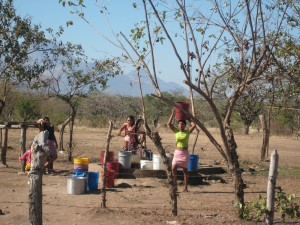 Mark 14:7 has always been one of those really problematic verses for me. In this short verse, it appears as though Jesus is rather pessimistically predicting that there will always be poor people (and he may very well be). I fear that such a hopeless sentiment might breed apathy on the part of the Church–we don’t have to worry about those who are hungry, they’re always going to be around. For this reason, I’ve often thought (and a few times said out loud) that this would be one of those verses that I would like to surreptitiously remove from our Christian Bible.
 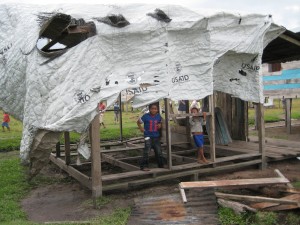 I just returned from the Atlantic coast, where we visited two communities impacted by Hurricane Felix in September of 2007. The experience was, to say the least, heart wrenching. On the NW coast, in spite of the poverty we saw, I had the sense that there was possibility for adaptation. The dry spells could be countered by digging wells, creating irrigation systems, and so forth. With good planning and an infusion of resources, the insecurities brought about by the changing weather patterns could be mitigated.
 I just returned tonight from NW Nicaragua where we saw firsthand some of the impacts of climate change on poverty and a couple of the projects that ELCA World Hunger has supported. We also had the chance to talk to the municipal authorities in Villa Nueva and the Assistant Director of the Millenium Development Corporation in Nicaragua. I saw and heard much more than I have time to share. Tonight, allow me to share briefly about one project we visited that encapsulates my experience thus far.
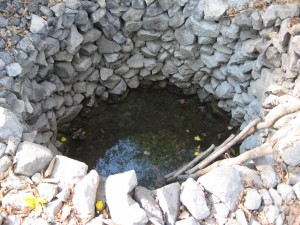
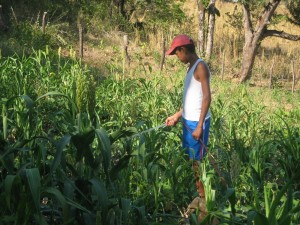 In the community of Las Jolotas, LWF has dug a well (pictured above) for a family who is now experimenting with irrigation, so that they can plant in the dry season and use gravity to irrigate their crops. This is the first dry season with the well, and, as you can see from the picture here, things are looking very good.