Skip to content
ELCA Blogs

ELCA World Hunger

Ears…our most appropriate technology

Cellphones are everywhere in Guatemala. You might see one peeking from the skirt of a girl in beautiful, traditional traje, on the dashboard of a bus, or in the shirt pocket of the man collecting quetzales from passengers squeezing out of an overstuffed microbus. Cellphones and texts intensify connections in a society that is already very communal. Ipods, which I only see used by young tourists from Europe and North America, sever us from the surroundings we paid so much to reach.  And when we are lost in our music, what are we missing? The late poet Bill Holm wonders in this little poem, which appeals to my luddite side.

EARBUD

Earbud–a tiny marble sheathed in foam
to wear like an interior earring so you
can enjoy private noises wherever you go,
protected from any sudden silence.
Only check your batteries, then copy
a thousand secret songs and stories
on the tiny pod you carry in your pocket.
You are safe now from other noises made
by other people, other machines, by chance,
noises you have not chosen as your own.
To get your attention, I touch your arm
to show you the tornado or the polar bear.
Sometimes I catch you humming or talking to the air
as if to a shrunken lover waiting in your ear.

Bill Holm. Playing the Black Piano. Milkweed Editions, 2004.

Enjoy your old-fashioned ears today, and all that they bring you.

Anne Basye, Sustaining Simplicity

What are We Fighting? Post 7.

This is the seventh and final post in a series considering the root causes of hunger. The Millennium Development Goals serve as a helpful framework.

Millennium Development Goal 8: Develop a Global Partnership for Development

Because everyone lives on a single planet and participates in a global economy, poor countries and hungry people can’t solve their problems alone, and shouldn’t have to. There are too many ways the problems and solutions are connected to – and in some cases caused by – the rest of the world. Much of Goal 8 has to do with issues of  debt, trade, and aid, and all countries have a role in implementing changes that will give developing countries a better chance at success. Honestly, I’m feeling like I should have an advanced degree in economics to do this topic justice. Since I don’t, I’ll treat it briefly, point to other sources of information, and welcome your comments!

Debt

The debt crisis facing many developing countries is severe. Governments owe billions of dollars of debt to developed countries, and they have no way of paying it. With widespread poverty and insufficient economic output, some indebted governments do not generate even the funds to pay the interest (which is substantial). With so much of their limited money going to developed countries in debt payment, developing countries have little left over for infrastructure like roads and sanitation, or economic development policies like job creation plans and education. That such large amounts of money were loaned in the first place is the fault of both borrowers and lenders, and sometimes go back decades to corrupt regimes that no longer exist. The situation today is that many countries are facing debilitating debt that they have no way of paying and which ensures their continued national poverty. The solution includes working with developed nations on policies of debt relief and cancellation.  Jubilee is an organization doing lots of work on this front, and I recommend checking out their website if you’re interested in learning more.

Trade

Trade is another area where global partnerships between developed and developing nations is needed. Exporting goods is one way developing nations can generate more income. However, there are many barriers to their doing so successfully. First, many developed countries protect their own markets and citizens through tariffs and subsidies. Tariffs on imports increase the purchase cost of foreign goods and therefore make them less desirable than cheaper, domestic goods. The result for the developing country is that, while their production costs may be the same or less, few people in developed nations will buy their products because the final price is higher than competing products. Subsidies are another trade barrier, and agricultural subsidies are especially problematic. American farmers receive government payments for some crops, which encourages them to overproduce.  With lots of, say, wheat available, the price drops. Since American farmers get paid more than the market price through subsidies, low wheat prices aren’t much of a problem for them. But low prices and lots of wheat mean that others in the world who are growing wheat without payments from their governments can’t compete with our low prices. Not only can they not sell it to other countries, they may not even be able to see it in their own. In this example, individuals certainly won’t make a living as wheat farmers, and the country won’t make money as a wheat exporter.

So, some would say, don’t grow wheat. Make and export something else the world needs. That can work, but for a country to move into new or different industries, they need things like investment money, skilled employees, marketing knowledge, and infrastructure. If the country is already poor (and spending much of their GDP in interest on their debt), funding this type development isn’t realistic. Providing assistance for trade development and reducing trade barriers are ways wealthy countries concerned about poverty can and should help developing  countries gain entry into the global economy. Developing countries, in turn, have a role in creating governmental structures and financial policies that encourage and sustain investment and assistance.

The issues surrounding global trade and its effects on developing nations are complex. A few starting places for more information include the One Campaign website’s overview of “the issues,” Bread for the World Institute’s 2009 Hunger Report titled, “Global Development: Charting a New Course, and Paul Collier’s book titled, The Bottom Billion.

Aid

Obviously, the partnership of wealthy countries is required to funnel enough aid money to developing nations to make a difference with things like economic development. But Goal 8 goes beyond sending money. It considers other assets of the developed world and how to more equally distribute them. Of particular interest is developed countries’ possession of technology, especially in the area of computers, and pharmaceuticals. As the developed world continues to advance in these areas, its people live longer and become more sophisticated, educated, and competitive in global markets. Meanwhile, the developing world continues to suffer with preventable and treatable diseases, and lacks the benefits that mobile phone, computers, the Internet, and other technology provides. To end poverty and hunger, the partnership of developed nations must incorporate these less traditional forms of aid.

More information about pharmaceutical assistance, telecommunications, and actually all of Goal 8 – as well as the other MDGs – is available at this UN website.

Conclusion

I started this series of posts by saying that the reasons world hunger exists are complex and interrelated. While that’s very true, the upside is that it also means there are many points of entry and leverage in making a difference. ELCA World Hunger is committed to taking a comprehensive view of the problem of world hunger and tackling it from many directions, including relief, development, education, and advocacy. We hope you’ll join our efforts. To make a donation and/or learn more about how to get involved with ELCA World Hunger, please visit our website at www.elca.org/hunger.

-Nancy Michaelis

Whose side are you on?

A while back I expressed concern about the way in which some of the biblical identity texts could be divisive.  I made particular reference to Paul’s letter to the Galatians that on the one hand so beautifully declares that “There is no longer Jew or Greek, there is no longer slave or free, there is no longer male and female; for all of you are one in Christ Jesus ” (Gal 3:28) while on the other hand wishing that those who disagree with him would just go ahead and castrate themselves (Gal 5:12).  (Elsewhere in 5:2-4 he declares that if anyone is circumcised, Christ is no use to them, they have fallen from grace.)

A similar situation is present in the Johannine literature.  The Gospel and the epistles of John have some of the most inspiring language around love for one another (see, e.g., John 13:34-35 or 1 John 3:16). At the same time, the Gospel has some of the fiercest vitriol in the whole New Testament aimed at Jews (John 8:44) and 2 and 3 John make it clear that the community is to show no hospitality to leaders of rival factions.

For me, texts such as these are uncomfortable.  I want every one to get along.  Picking sides and anathematizing certain groups and/or individuals challenges my ecumenical and pluralistic proclivities.

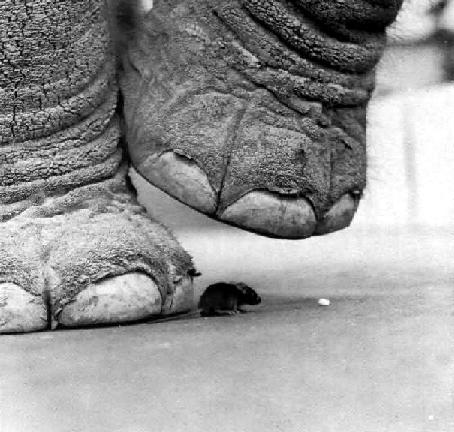
Bishop Desmond Tutu perhaps helps  with this dilemma.  He reminds us that “If you are neutral in situations of injustice, you have chosen the side of the oppressor.  If an elephant has its foot on the tail of mouse and you say that you are neutral, the mouse will not appreciate your neutrality.”

Maybe picking sides is not such a bad thing…

– David Creech

Sustainability Part 1: Design

I was at a coffee shop with my brother, Krister, a few weeks ago sitting next to the window and drinking out of some more-or-less sustainable “for here” cups when we got talking about energy usage and good lighting. A designer by profession, he began to talk about lighting and how giving up the ambiance of warmer, more energy expensive lights isn’t the only answer to conserving energy through lighting. Apparently when it comes to lighting design, there are many ways to think about energy usage, and this got me thinking about sustainability practices in basic design in general.

As design is a huge industry, and we are seeing LEED certifications become the trend, it seemed to me that there was also something intrinsic to good design that was more sustainable than, well, not-so-good design. I started by asking the question – how does sustainability play a role in Plank Island Studio’s business practice? Well, it turns out that being a designer in a small town means necessary supplies aren’t always easy to find. So first off, when Krister buys something for his work, he only wants to buy it once. Though it may be more expensive, a quality tool or product lasts longer, works better and reduces both shipping and manufacturing costs and emissions in the long run. He also likes to reuse and repurpose. His desk is a good example. The glass top is actually the door of an old downtown candy shop which has been recently renovated into a vintage ice cream parlor. His studio has been created in the forgotten location of an old labor union office, slowly renovated over the past few years to bring back the history of the building. He adds that a friend once made the point to him that beautiful buildings are the greenest buildings because they never get torn down, thus a new building won’t be needed to replace it. (Though efficiency updates may be in order.)

So how can we tie elements of design sustainability into hunger? Let’s focus on lighting. Energy consumption affects natural resources and pollution levels. According to an ELCA Shareholder resolution filed in 2009, “U.S. power plants are responsible for nearly 40% of the country’s carbon dioxide emissions, and 10% of global carbon dioxide emissions.” Carbon dioxide is a greenhouse gas. Greenhouse gases contribute to climate change which plays a role in shifting water levels and rain patterns globally. According to ELCA Advocacy, “as the earth’s climate gets warmer, droughts will grow more frequent and more severe in many parts of the globe, particularly in areas that are already water-stressed.” Droughts negatively affect crop production and access to clean, drinkable water. Yet in good design, lighting is everything. So what are we to do? Here are a couple of interesting examples of how good lighting design can help a normal home become more energy efficient, thus working toward sustainable emissions levels to keep our climate change impact low.

The subject of our coffee conversation that day was how to use lighting better. Track lights, dimmer switches and task lighting, Krister believes, make all the difference. You can dim incandescent bulbs always, and you can buy dimmable compact fluorescents (CFL). So whether you prefer the warmth of an incandescent or are just as happy with an energy saving CFL, dimmers help to keep energy consumption low no matter the type of bulb. Additionally, accent lights and track lights are commonly halogen, a form of more efficient incandescent light. You can also use CFLs for many types of accent lighting. Check out Krister’s offering of 5 Tips for Better Living through Better Lighting on The Table. (Note: incandescent bulbs require the use of the metal tungsten – while the majority of the tungsten used in the US comes from abroad, one-third of our supply comes from our own recycling of the metal1. Additionally, CFL bulbs contain small amounts of mercury which can be released if broken, however, they cause considerably less mercury to be released into the atmosphere through power production than incandescent bulbs.)

Next, as lighting technology continues to transform, LED is hitting the scene. LED lights are cool to the touch and require incredibly low levels of energy to function. They also outlast any competition. Plank Island Studio recently teamed up with a local furniture maker to design a commissioned bedroom side table that doubled as a night light. It utilized a low impact LED light to shine through Japanese shoji paper without heat concerns. It serves as an example of energy efficient task lighting. Plus, LED lights contain no mercury2 and because of their efficiency, expend little in power production as well.

To be truly sustainable we would probably all need to buy 100% renewable energy or install a windmill on our roof to produce the electricity which lights our homes. Kudos to those of you who do so, and to the rest, please consider good lighting design as a step in the right direction. Proper lighting for proper places means sustainable energy usage and sustainable, happy ambiance.

Lesson 1: When possible, buy tools and supplies that last.

Lesson 2: Design (and restore when possible) beautiful buildings that stand the test of time.

Lesson 3: Utilize good lighting design and you’ll be on your way to a more sustainable energy consumption level. This will be good for the environment and your pocket book.

Next book in cue: Strategies for the Green Economy, by Joel Makower

Today’s favorite link: http://www.ted.com/talks/lang/eng/dan_barber_how_i_fell_in_love_with_a_fish.html

~Lana

1: http://www.mii.org/Minerals/phototung.html

2: http://www.newmoa.org/prevention/mercury/imerc/factsheets/lighting.cfm

In Praise of Extravagance

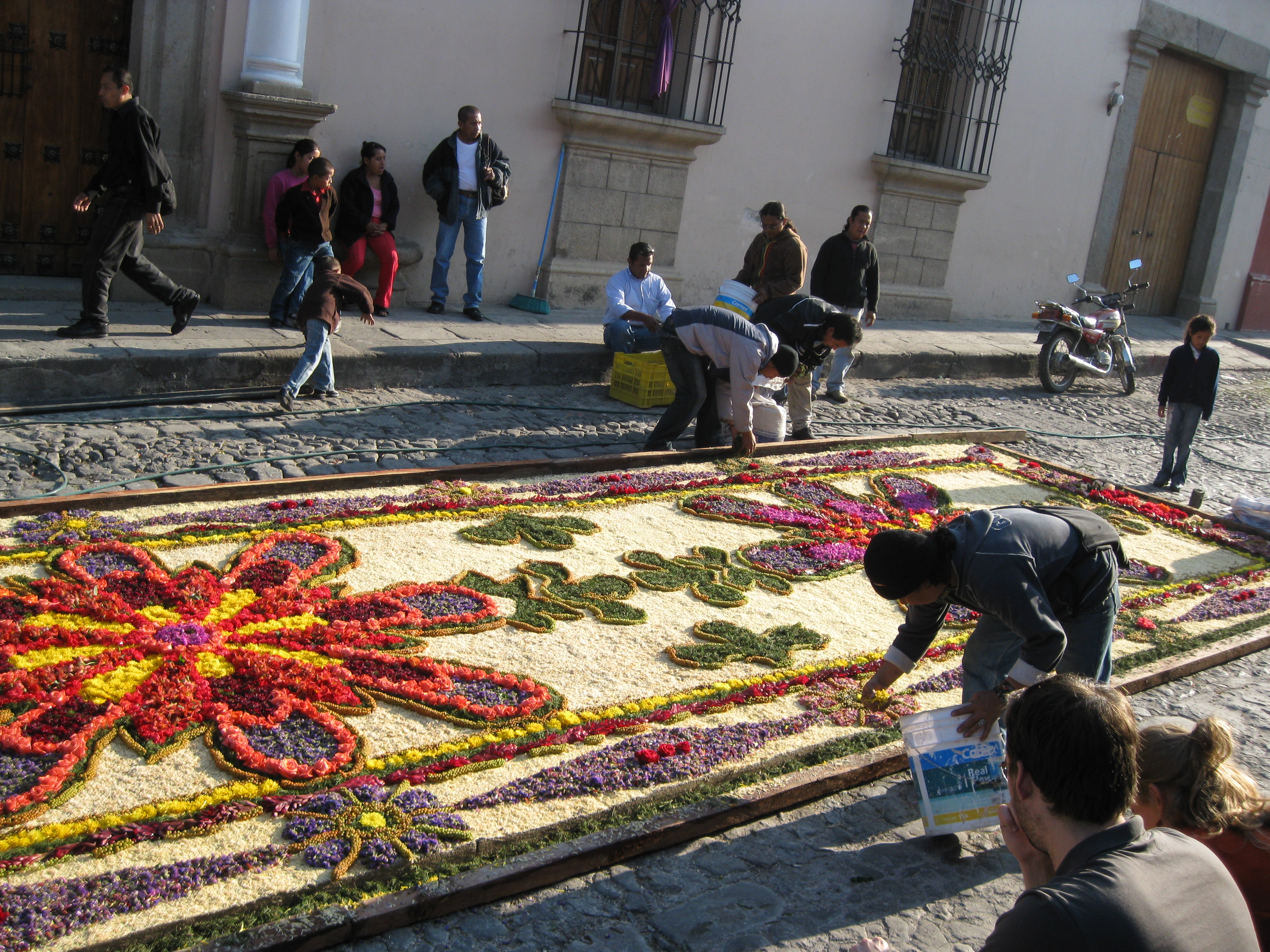
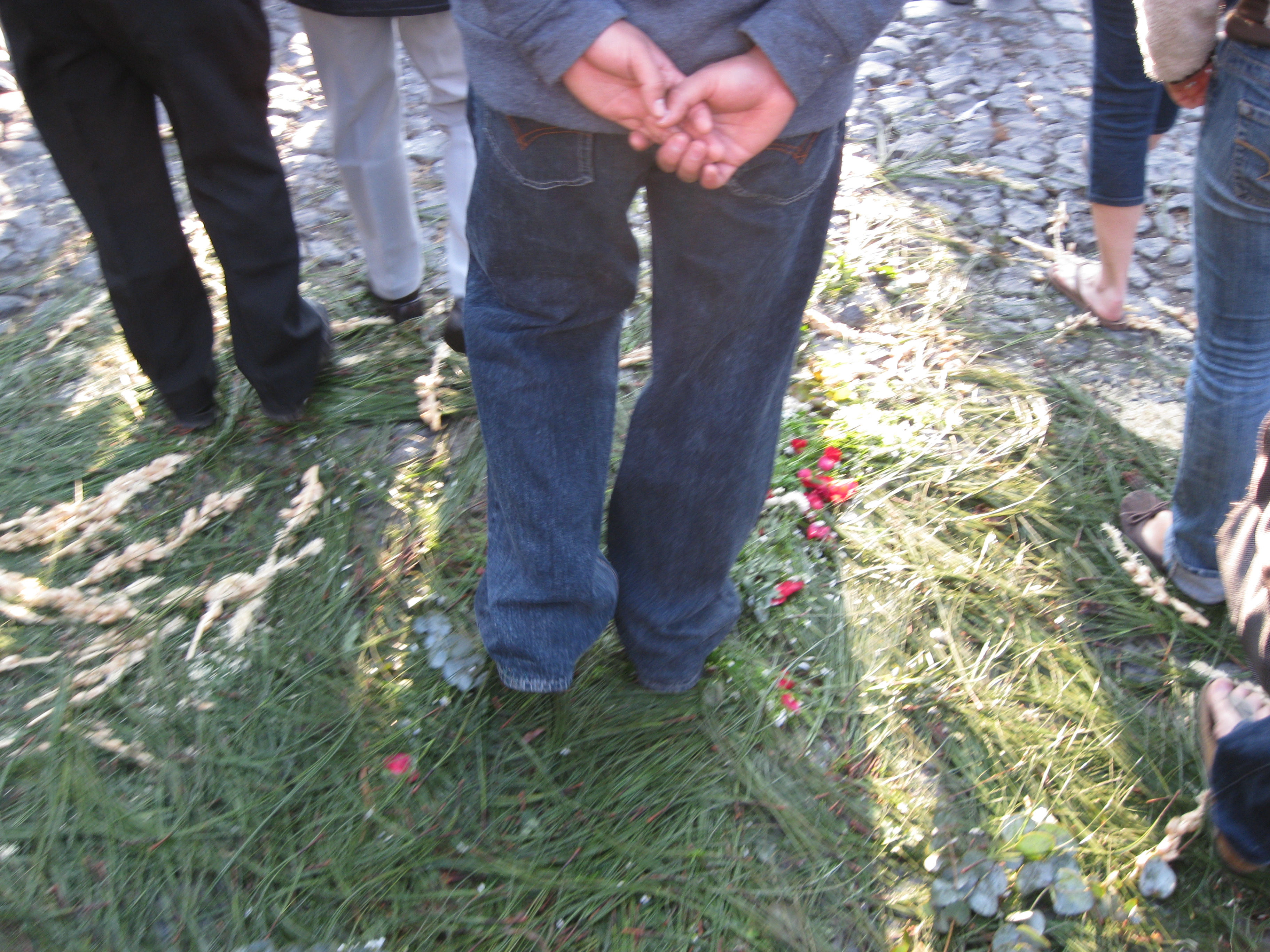
An alfombra made of pine needles and flowers

I know, I know. It’s my job to point out all the ways we Americans have too much, spend too much, drive too much, eat too much, cram too much into our days, and leave too little space for concerns about God and the state of our souls, the planet, or other people.

 
But I love excess. Like last week, for example, when I shared the extravagant spectacle of Holy Week with half a million others in Antigua, Guatemala.
 
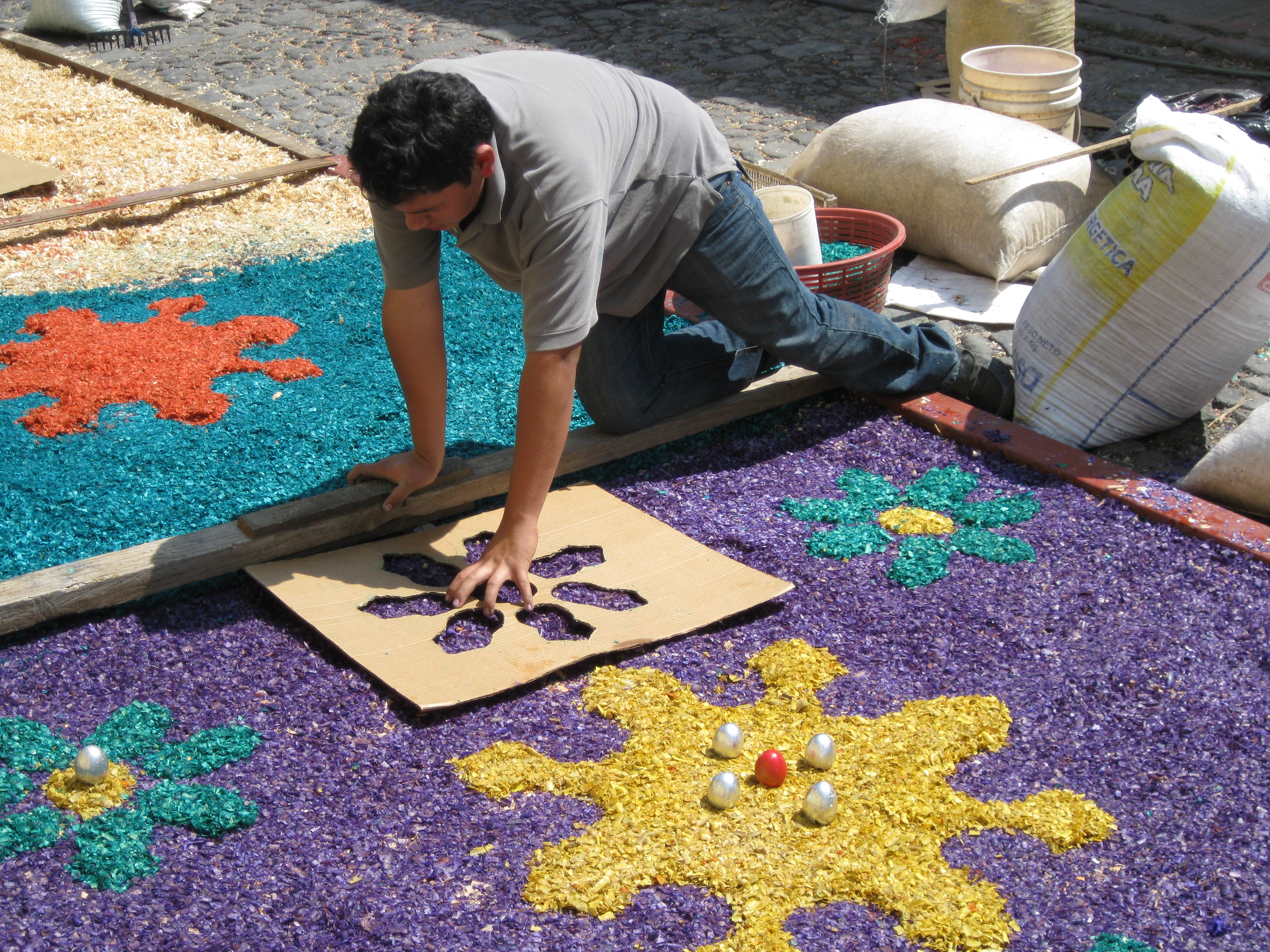
Antigua and its residents celebrate the Triduum and Easter with processions honoring Jesus’s crucifixion and resurrection. Twice a day, one or two immense floats, carried by 80 male or female cargadores, pass through the streets while a band marches behind playing dirges. Hundreds of others accompany them so that everyone has an opportunity to carry the float during its eight-hour journey. People who live along the route create alfombras or carpets of colored sawdust or pine needles, fruits, and flowers. It can take hours to construct a carpet that is destroyed in minutes as Jesus, his carriers, and his musicians walk across it.  
 

Alfombras of colored sawdust take hours to create

Two processions, hundreds of carpets, thousands of participants, and hundreds of thousands of observers each day added up to a very intense celebration. How boring life would be if it were simple all the time. Excess is part of life; it’s what our festivals and celebration are all about. And every now and then–like at the end of 40 days of Lent–how wonderful it feels to pull out all the stops and celebrate Jesus’s gift to us.
Anne Basye, Sustaining Simplicity
 

After the procession, destroyed!

Lipi’s Chickens

A woman in Cambodia raises chickens through a project supported by ELCA World Hunger. Credit: Rachel Cook/LWF.

This Easter season, as we give thanks for the resurrection of Jesus Christ and a chance to be born anew, let us recommit ourselves to God’s call for us to love and serve our neighbors both near and far.

One of our global neighbors whom we support through ELCA World Hunger lives in Bangladesh.  And because of a custom many of us take part in at Easter—painting Easter eggs—I am reminded of her story, which will appear in the summer issue of LifeLines newsletter due out in late April. Here’s a sneak preview:

“Lipi Bergum lives in Bangladesh in a small hut with her husband, two children and elderly mother-in-law. With no land of their own, Lipi’s family used to get by on what meager pay her husband—a day laborer for nearby farmers—could earn. They often struggled, especially in the rainy season.

During the rainy season in northwest Bangladesh, when rice fields traditionally lie dormant, there is no work or wages for farm laborers. Day laborers and their families are often reduced to begging or worse—going hungry. For a long time, that was the reality Lipi and her family faced.

That changed when Lipi joined a local Farmer Field School run by RDRS, a long-established rural development organization supported by ELCA World Hunger.  RDRS understood her situation and gave her some ideas. Before long, with the help of a microloan, Lipi built a little shed on the family’s homestead and began raising a flock of 200 chickens to generate income.”

Lipi’s chickens yield countless eggs, and because of these chickens Lipi and her family no longer go hungry during the rainy season.  When you or the children in your life collected those Easter baskets, reflect on the importance of eggs not only for nourishment but for the life-saving difference chickens and eggs make in other parts of the world.

If you didn’t get around to buying that special Easter gift for someone you care about, consider giving 10 chicks for $10 or another truly meaningful gift and putting a special gift notice in someone’s post-Easter card or upcoming birthday or special-occasion card.

Hallelujah!  He is risen!  He is risen indeed, hallelujah!

-Aaron Cooper is writer-editor for ELCA World Hunger

Introduction to a sustainability series

This is an introduction to a new series that I’m going to be writing. The focus will be on sustainability, specifically as it has to do with business, industry and its link to hunger and poverty.

Why sustainability? The old saying goes, give a man a fish and he’ll eat for a day, teach him to fish and he’ll eat for a lifetime. But what if the fish run out? If we overfish to the point of extinction, what will we eat in ten years? Sustainability is important because it helps our resources continue from one generation to the next. If we build sustainable lives we sustain a world for the future.

Why business and industry? Because they are big! Whether a business is a small, family-owned farm or a huge corporation selling products, they have a far larger impact than me going to the farmer’s market. I want to learn more about businesses who are making a point to be sustainable and/or sell sustainable products, and why they have made that choice. Is it due to ethics, profits or a niche market? Maybe it’s all of the above. I’d like to find out, and I am excited to share what I discover.

This blog series is going to be a journey. I hope that it will ask unexpected questions, make sustainability’s connections to hunger and poverty reduction more clear, and most of all, be informative as it introduces new ideas and topics for conversation.

Off I go to read and interview! See you next week.

Lana

p.s.  Currently reading: Making Globalization Work, by Joseph E. Stiglitz.

Today’s favorite link: http://www.fastcompany.com/1603979/infographic-of-the-day-the-seasonal-food-calender

What are we fighting? Post 6.

This is the sixth post in a series considering the root causes of hunger. The Millennium Development Goals serve as a helpful framework.

Millennium Development Goal 7: Ensure Environmental Sustainability

How carefully we manage our natural resources and environment has a direct impact on hunger, especially through issues of employment and health. Here are a few examples:

If we remove fish from our oceans, lakes, and rivers faster than they can reproduce, catches get smaller. As catches get smaller, fisherman make less money and eventually may be driven out of the job altogether. With less income and/or uncertain employment, it is harder to buy food and other necessities. In addition, as we deplete one or more species of fish, it can change the whole ecosystem in that location, affecting additional industries, animals, and people.

When we cut down too many trees too quickly, it exposes soil to erosion. Some of the soil washes away in the rain, causing silting in waterways. Some of it is picked up by wind and carried to other places. In Beijing this month, the sky was orange with dirt. Soil in the air led to a level-five pollution warning, the highest level, with people advised to wear masks and stay indoors. Those with respiratory illnesses were at especially high risk, and people suffering from illness have a difficult time making it to work. In the meantime, where there used to be trees, top soil is lost and root systems no longer hold water, making the land drier, less nutrient-rich, and less able to grow things (like food).

How much garbage did you throw away today? Where will it go? In addition to removing natural resources from the environment, we add many unnatural ones back in. The chemicals. metals, and minerals in our discarded products find their way into the soil and water, which find their way into what we eat and drink. Those who live in poverty and hunger are most vulnerable, as they have fewer resources for acquiring healthier options, and less power to prevent contaminants from being dumped near their homes.

These are just a few examples and a few of the impacts. If you’re interested in learning more, here are some suggestions for additional information that I particularly appreciated:
The Story of Stuff – a video about consumption and its effects on the environment.
– Collapse, by Jared Diamond – a book that looks at how and why civilizations have caused significant damage to their environments.
– The End of Food, by Paul Roberts – a book that considers how our food production systems affect the environment and us.
– Hot, Flat, and Crowded, by Thomas Friedman – a book that suggests not only how increasing populations and consumerism are a threat to the planet, but also some ideas about how it can be changed.

Do you have additional resources you’d recommend? Please leave a comment!

-Nancy Michaelis

Strangers in a new land

What does living for a year outside your own culture–eating, sleeping, working, and playing in another language–teach you about your own cultural assumptions? Last Saturday I found out, as three participants in the ELCA Young Adults in Global Mission program met me for coffee in Cuernavaca, Mexico.

Stuff

“I’m learning the difference between needs and wants,” said Katherine, who tutors children in a very low-income area. “At home I would be saying ‘I need shoes,’ but in my job, I think ‘I need duct tape!” All three young people agreed that Mexico is teaching them how to save and re-use things. “There is no Salvation Army here, where people take their excess goods.” But, notes Peter, as consumerism creeps in, “there are more disposable products and more garbage, and the trucks pick up more often.” Peter is working with a group that is trying to close a municipal landfill that does not meet environmental standards and is contaminating water downstream. Katie, meanwhile, has been working with an indigenous group in Guerrero that uses plastic bags as a weaving material.

Energy and natural resources

Living in homes where water is received only 2 or 3 days a week (it gets pumped from city pipes up to a storage tank on the roof, where it is dispensed through a home’s plumbing), all three young people (and me, too!)  learned to take “dry showers.” You turn on the water to get wet, turn it off to soap up, and turn it back on to rinse. Pete, who lives in a rural area, builds a fire in order to heat his water. “You see the energy it takes to get hot water if you have to make a fire! I hadn’t really thought, before, that the energy it takes to heat water has to come from somewhere.”  All three will take their awareness of finite water supply back to the states.

Community and hospitality

“The hospitality shown to strangers in Mexico is amazing,” Katherine told me. “You are offered food, drink, and a seat at the table even when they don’t know you! In the US we are more guarded. You need an invitation first.¨ In the indigenous community of Tlalma where Katie has been working, Katie is learning about the importance of touch, of connecting with others, of sharing the day, of learning from others.  Experiencing this depth of community makes returning to the U.S. difficult, I learned while participating in nine years of ELCA Summer Missionary Conferences. One day you’re immersed in a community where everything is shared–and the next day you’re in a place where doors are closed. “I’m lonely,” one returning missionary told me. “People don’t invite us home for dinner. All they do is ask us out for coffee.”

What is development?

Acknowledging that their host families faced real economic difficulties and that water can be scarce, the YAGM youth reflected on what “authentic development” might look like. “Does everything in Mexico have to look like our touristy idea of it before people will consider it developed? Can we measure relationship, and how authentically people are growing in community?” asked one. “The U.S. and Canada are not the standard for measuring others,” said Katie, who has seen how judgmental visitors can be about garbage  in her indigenous community. “Our garbage is just better hidden!” she said.

“The owners of the problem are the people affected by it, not us,” Katie concluded. “But Americans and Canadians can’t put themselves in a place where we see what it is like to be told ‘this is what you lack, this is what you need.'”  

These three young people work in supporting roles alongside Mexican colleagues who are owners of the problem. They share their lives with Mexican host families, and meet monthly to reflect on their experiences. In July, they will return to the States, taking with them their new perspectives on the world and how to live in it as a Christian. Give thanks for their valor, their integrity, their enthusiasm, and their commitment to carving out alternatives!

Anne Basye, “Sustaining Simplicity

Identity Again

I would like to pick up where I left off in last week’s post.  I concluded with the following musings:

I do wonder how much a shift in group identity could begin to address some of our reticence to do good in the world.  What if we saw ourselves as part of the poor and marginalized group?  What if a threat to those who are vulnerable was perceived to be a threat to ourselves?  I hope to get back to this idea in another post.  For now, I’ll suggest that as the body of Christ, this may be the most natural identity for us to assume.

None of these ideas are particularly new. The ELCA’s HIV and AIDS strategy affirms that the body of Christ has AIDS (as did the World Council of Churches before us).  Stephen Bouman (director of Evangelical Outreach and Congregational Mission at ELCA churchwide) co- authored a brilliant book, They Are Us (please look past the grammatically frightful title), in which he explores the many ways that immigrant stories are our own.  Martin Buber’s I and Thou (written in 1923!) essentially gets at the same idea, just with different language.

From a biblical perspective, as Kris pointed out, Paul redraws kinship lines (see also the early Christian language of “family”).  (Sadly the fictive kin language is also used to divide–see Galatians.)  The “body” language Paul uses suggests that as one body, when one part suffers, the whole suffers (see esp. 1 Corinthians 12:26; perhaps also Philippians 2:4-10 applies here?).  Much could be made of how we as the body of Christ are wounded as he was (and is) by the evils in the world (I think I will have to reflect on this in a further post).

Jesus too redefined the family (see Mark 3:31-35).  Jesus also practiced table fellowship with those who were otherwise considered outsiders; that table fellowship was a clear sign of friendship.  And Jesus to the end brought the “other” into the fold (see this week’s text, Luke 23:39-43!).

The biblical text then offers considerable support the idea that we are those who are poor, vulnerable, and marginalized (and perhaps I have overlooked other key texts–please share them in the comments).  Is this enough to affirm that they indeed are we?  More posts to come!

-David Creech