Skip to content
ELCA Blogs

ELCA World Hunger

Recapturing the Seeds of Sustainability: Join the Conversation

In my work thus far with ELCA World Hunger Leaders and the Lutheran World Federation, I have come to know and believe one thing very deeply—Lutherans, especially women and youth, are deeply committed, knowledgeable, gifted people.

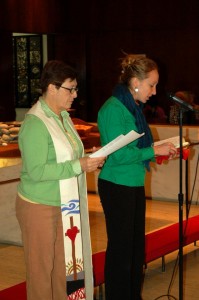
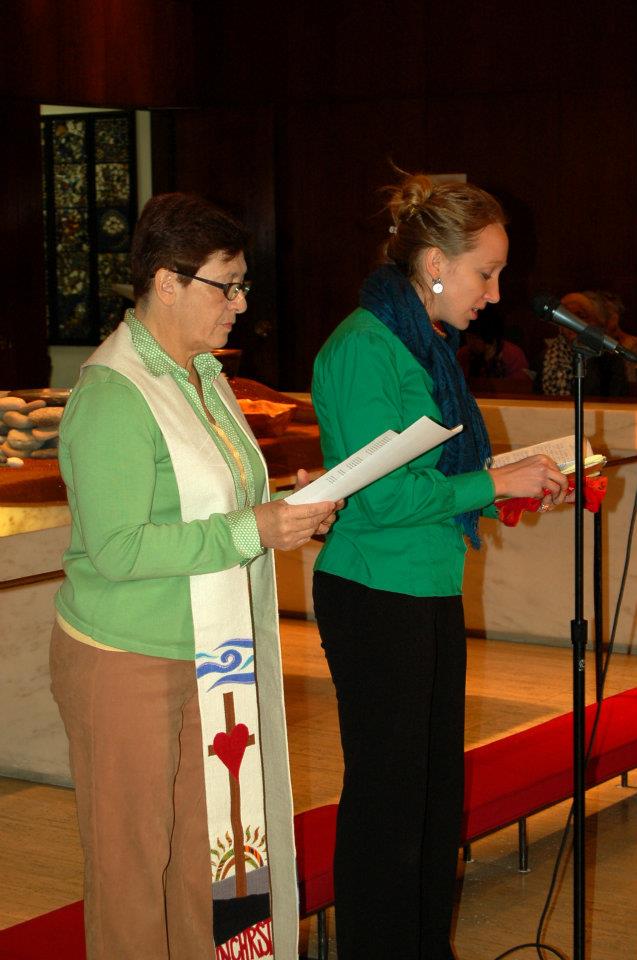
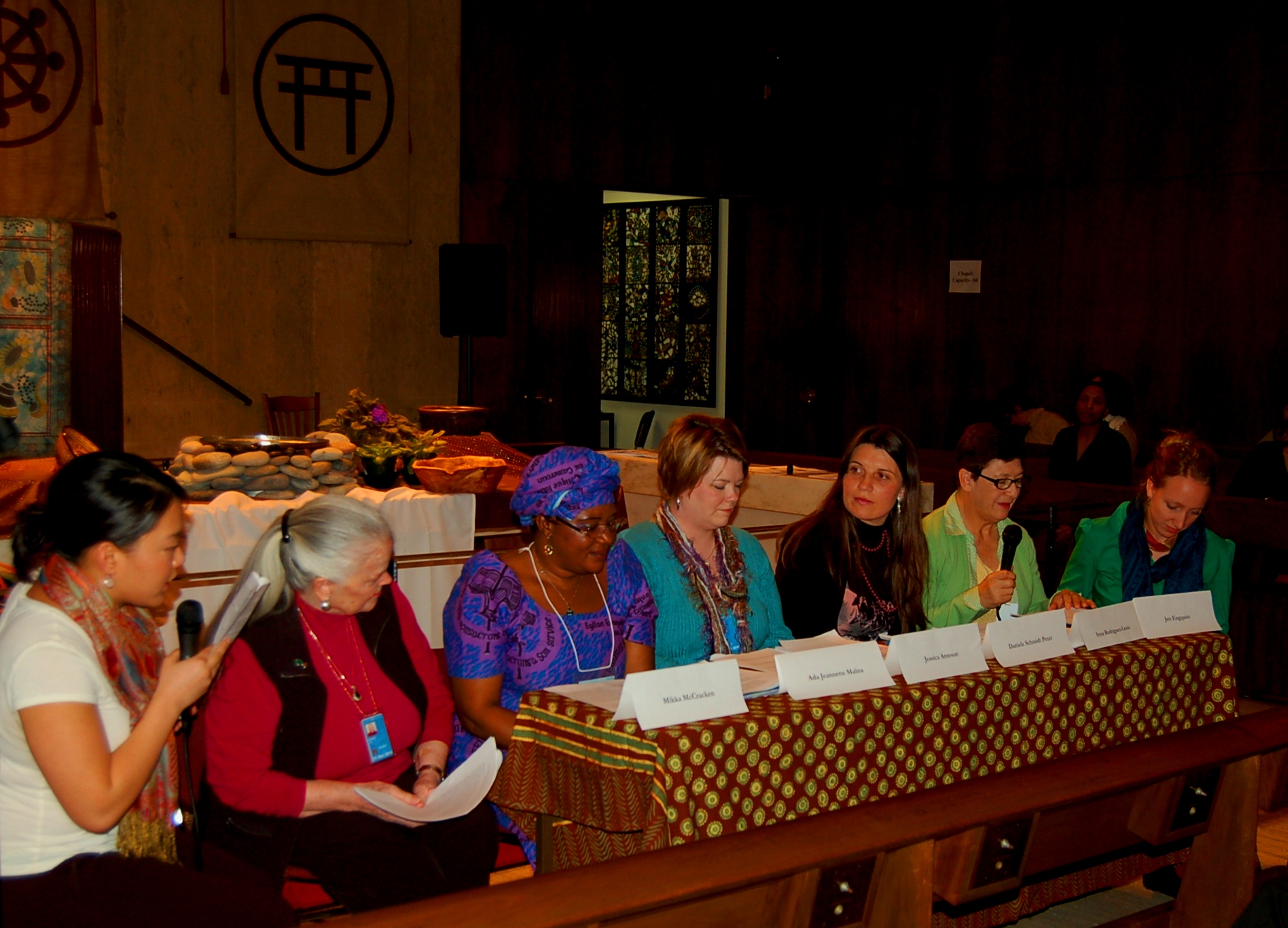
LWF and ELCA women sharing their seeds to sustainability stories at UN CSW side event.

On Monday, 27 February 2012, the Lutheran World Federation Women in Church in Society Office (WICAS) sponsored a side event of exactly these leaders in the Lutheran Communion. During the side event, “From Potential Impoverishment to Seeds of Sustainability,” Daniele, Irma, Jeannette, and Jessica each shared her relationship with rural women, her story of seeds to sustainability and her hopes for the future in this work.

Each woman’s story is her own and some of them will be highlighted here at other points, but as I sit here this afternoon, I want to highlight three key themes that shone through all their reflections and experiences:

  1. In the Gospel of Luke, Jesus is coming down from the Mount of Olives to Jerusalem and a multitude of disciples are singing his praise. The Pharisees told Jesus to quiet the crowd. Jesus said, “I tell you, if these were silent, the stones would shout out.” Through their witness, these Lutheran women shouted out and raised their voices for wholeness and reconciliation in all our homes, communities and throughout the world.
  1. At the Ecumenical Women orientation, Ana from Brazil who works with indigenous women shared a quote, “She learned not only to read or write…she learned to read the world.” These Lutheran women wrestled with, defined and redefined women’s leadership.
  1. At the non-governmental organization orientation, Madame Michelle Bachelet, executive director, UN Women said, “Women are at the heart of ending poverty and hunger. […] We cannot do this alone. We depend on you.” These Lutheran women shared about the relationships in their communities and churches that bind us together and grow seeds into sustainability.

So ELCA World Hunger colleagues, what are your reflections on those three themes? Share your story and join the conversation!

Also, a special word of thanks to Jen who has been assisting us with interpretation and translation all weekend, including on the panel. We can look forward to more of her story here soon.

Meet the Women!

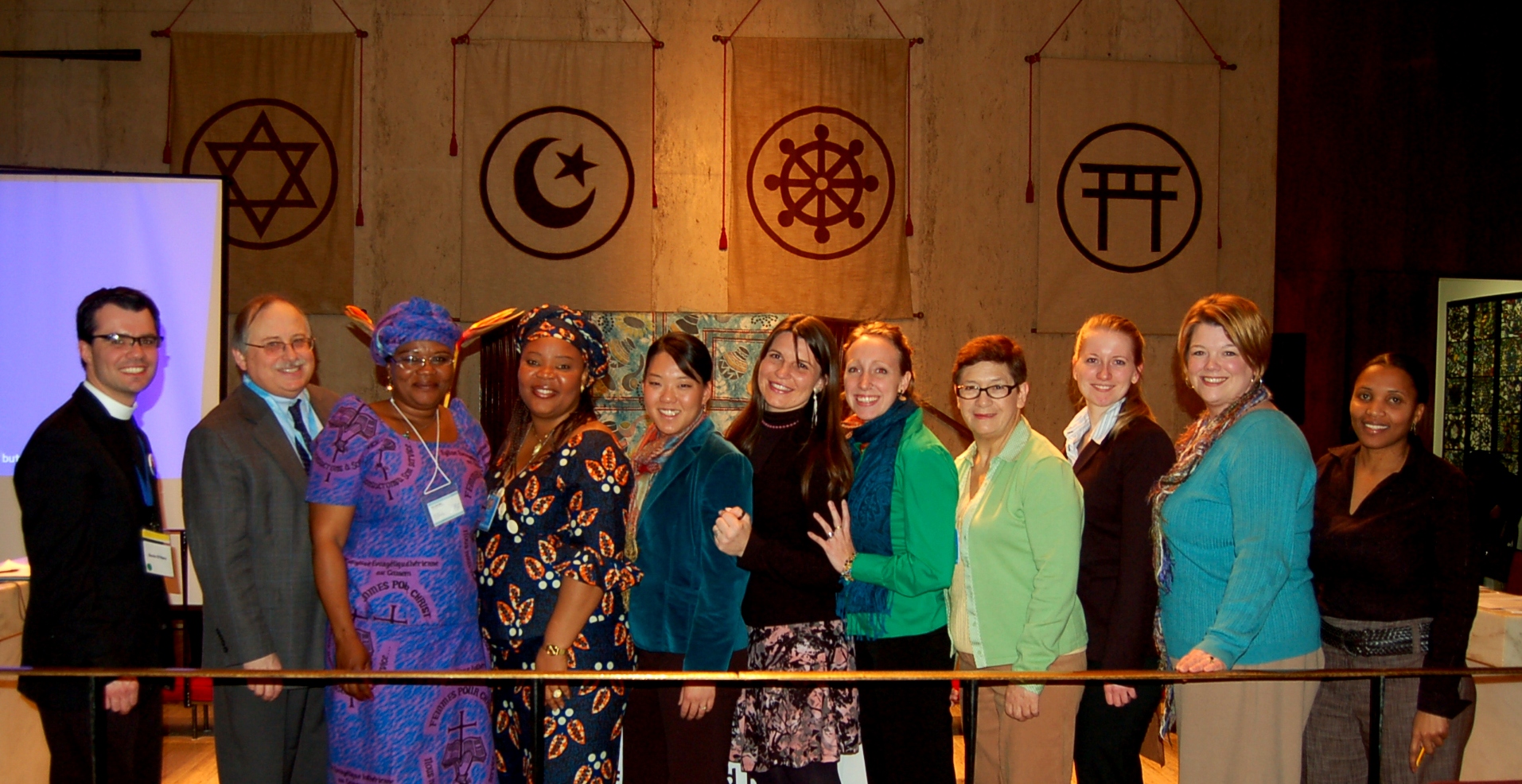
Lutherans with Nobel Peace Prize Laureate, Leymah Gbowee. Pr. Kevin, Dennis, Jeannette, Leymah, Mikka, Daniele, Jen, Irma, Kristin, Jessica, Christine

Hello Hunger Rumblers,

I have been posting like mad on the blog and Twitter trying to keep you up to date on the proceedings here at the 56th United Nations Commission on the Status of Women. Although there are many people with us here, Lutheran and not, let me take a moment to pause and introduce you more formally to a few of the women gathered here.

Jeannette, Evangelical Lutheran Church in Cameroon. Jeannette is a PhD student in theology and will be one of the first women ordained in her church this coming May. She serves with the Christian Women’s Association in her church and as the LWF Women in Church and Society (WICAS,) West African Regional Coordinator. Jeannette is married and has four children– two boys and two girls.

Daniele, Evangelical Church of Lutheran Confession in Brazil (IECLB). Daniele is 25 years old and graduated in Pedagogy and Mathematics. Her life has been directly connected to agriculture as she was born in a family of small farmers. Now, Daniele works with CAPA (Support Center for Small Farmers), an NGO of the IECLB, which aims to assist small farmers in their fight for social justice and development. Daniele has two sisters and three brothers.

Irma, Evangelical Lutheran Church in America (ELCA), originally from the Evangelical Lutheran Church of Colombia. Irma was born in Colombia to hard working parents and life in the country. She is a human rights lawyer and professor of international humanitarian law. Irma is now the coordinator of the project/ministry Pueblo De Dios at Augustana Lutheran Church in South Dakota. She also serves as the vice president of the Lutheran Association of Hispanic (Latino) Ministries, ELCA.

Jen, ELCA. Jen comes from small town, North Dakota. Over the past seven years she has been blessed to work in Africa, North and South America, including last year where she served in Argentina with the ELCA Young Adults in Global Mission program. While there, Jen focused on inner-city community building and rural development with emphasis on the voices of women, native populations, and organic growers. Currently Jen works as community center director at Churches United for the Homeless, a shelter in Minnesota and is a youth leader at Martin’s Lutheran Church just outside of Fargo.

Jessica, LSW, serves the greater Fargo-Moorhead community as Community Partnership Coordinator for RSVP+ North Dakota’s Amachi Mentoring Coalition and Metro Youth Partnership programs. She advocates for social policies promoting the advancement of human rights regarding issues such as immigration, gender disparity in politics, trade and economic justice, and access to food and water. She is a Hunger Justice Leader for Bread for the World, co-chairs the Eastern North Dakota ELCA Synod Hunger and Justice Committee, is a 2008 alumni of the National Empowerment of Women’s Leadership (NEW) Institute, and serves on several volunteer boards and committees that promote community engagement and development. Ms. Arneson lives in Casselton, ND with her husband and daughter.

In posts below and in posts above, you will hear the voices of these women. We are happy to meet you!

Siyahamba!

We are marching, we are marching, Alleluia! We are marching in the light of God!

This has been my prayer song today, in this place that I am with thousands of women…from every corner of every land.

We are mothers, we are daughters, we are  sisters, aunts, grandmothers, and friends. We lead…by example, through our actions, through our words, our work, and our service. We are led…by our faith, by our passion, by each other.

Jessica

To shine God’s light…in places of darkness, in places of struggle, indifference, and idleness. To countries throughout Africa, where women and girls are gaining access to education, healthcare, and business… To Brazil, where women by the thousands stand up for land rights and food sovereignty… To the Australian outback and reservation lands throughout the United States, where indigenous women call out to end oppression and discrimination…

We stand with one another.

We are marching…we are praying…we are singing in the light of God, and my heart cries for joy for the greatness in the world! Alleluia!!

A tale of two videos

httpv://www.youtube.com/watch?v=FhribaNXr7A&feature=youtu.be

httpv://www.youtube.com/watch?v=r3UBwBH89iY&feature=youtu.be

What feelings does the first video evoke?  The second?  Which gives us a better understanding of poverty and marginalization?

David Creech

Are we listening?

Tomorrow morning, the Lutheran women gathered here at the United Nations 56th Commission on the Status of Women will lead the ecumenical community in worship. One of the texts is the story of the widow of Zarephath (1 Kings 17: 7-16). Pastor Ada Maina Jeannette from the Evangelical Lutheran Church in Cameroon offers us this reflection on the story:

Oh Lord! One more test? Don’t you see, I am a widow with a child in charge? Don’t you see that I am a poor woman, left alone without support? Don’t you see that all I have to eat for food is just this small bit of flour and oil, which is not sufficient for me and my child. I am thinking, “if we finish and eat this, what will we do after?” But you, my God, have seen the situation of your servant. You send me your servant, Elijah, that I might be fed.

Yes, you have made woman the mother of life. This is a great responsibility. Even if she doesn’t have the possibility to nourish herself, she must do a miracle to feed those who come to or depend on her. It is always a test to give, but giving when you have nothing is greater still. A number of women want to give, but they didn’t have the means to do it.

For those who are widowed or poor like me, give us the strength to be the protectors of life—to be the one who brings joy to the hearts without joy; to bring laughter on the lips that cannot smile; the peace where there is injustice and other sorrows. You are a just God who loves all your children—you will do it.

Indeed, women all over the world are providing for their families out of the little or nothing they have. What is our call? How will we answer? More to come on some of the solutions after the Monday side event we are hosting, “From potential impoverishment to Seeds of Sustainability.” Even the rocks are crying out—but are we listening?

ELCA World Hunger and LWF at the UN CSW

ELCA World Hunger at CSW: Jessica, Mikka, Irma and Jen

Does that title look like alphabet soup to you? It did to me, too the first time I experienced the United Nations Commission on the Status of Women. I first attended with the National Council of Churches Young Women’s Leadership experience, once as an intern with the ELCA Justice for Women program and now, bringing a group (in the photo) with ELCA World Hunger as mentioned in the last post. Hard to believe, but feeling very blessed.

You are invited to follow us on Facebook or Twitter.

Twitter: @MikkaMusic. #CSW56 and #UN_Women are good to track, too.

Gender Justice: What’s hunger got to do with it?


The work we are engaged in through ELCA World Hunger has many points of interest. Perhaps the network can be thought of as a house with many rooms where people can find affinity around topics that interface with hunger and poverty in a real way. So, what do hunger and gender have to do with one another?

Beginning tomorrow, three ELCA World Hunger Leaders, Jessica, Jen and Irma, will begin participation in the United Nations 56th Commission on the Status of Women (CSW). In addition the three women above, we will be joined by two women from the LWF, Pastor Ada from Cameroon and Daniele from Brazil.

CSW happens every year, and this year’s review theme is “the empowerment of rural women and their role in poverty and hunger eradication, development and current challenges.”  This theme is particularly suited to the work and ministry of ELCA World Hunger and the larger global communion of which the ELCA is a member, the Lutheran World Federation (LWF).

In collaboration with other ELCA colleagues and the Lutheran Office for World Community (LOWC), we will be participating in the Commission with the non-governmental organization (NGO), Ecumenical Women. We will also as be part of a side event about the Lutheran World Federation and ELCA World Hunger, “From potential impoverishment to seeds of sustainability.”

Today through next Wednesday, you are invited to learn more and follow us right here. See you back here soon!

In the meantime, check out the new Gender and Hunger Connections ELCA World Hunger toolkit. Use this, plus our coming blog posts, to start the conversation in your congregation or community.

Re-membering at the Table

I recently read Cynthia Moe-Lobeda’s Healing a Broken World: Globalization and God in which she discusses a new way to think about the Eucharist. Each week before we share the sacrament, the minister reminds us of the story of the Last Supper and Jesus’ command to “do this for the remembrance of me.” All too often we hear the words but don’t really think about what they mean; the ritual becomes a routine and we listen to the story and take the bread and wine out of habit but not necessarily with thoughtful purpose.

Moe-Lobeda offers a different way to understand the Eucharist. She challenges us to reconsider the word “remember.” Instead of taking the word to mean recall or recollect, she breaks the word into two parts “re” and “member” and presents a new way to participate in and think about Communion. In recollecting the story of the Last Supper, we re-member, that is put together again, the body of Christ. We essentially are making fractured relationships and the broken body of Christ whole again through the re-membering in the Eucharist.

In re-imagining what this holy meal means for us, what would happen if we did not try to build relationships and support for church members who are living without food or water? I think it is difficult to truly remember the Last Supper and re-member Christ’s body without thinking about our local neighbors as well as our global neighbors who are hungry. If we indeed want to work for God’s justice and love in the world, then we are called to strengthen and rebuild the brokenness we find in the world.

Emmi Gordon is in the second year of her M.Div. program at the University of Chicago.  Prior to her studies she lived for several years in South Africa and noticed the effectiveness of Christian aid programs and wondered why Christian programs in particular were so successful.   Your own thoughts and reflections, as always, are welcome.

A Time to Listen: The ELCA and HIV & AIDS

By Allison Beebe

ELCA World Hunger recently held an event outside of Atlanta, Georgia on the topic of HIV & AIDS. Those in attendance were a blend of professionals in the field, people with personal testimonials related to HIV & AIDS, and interested members of the faith community. We looked at HIV & AIDS from our vantage point in the U.S., and also from an international perspective. It was an event which encouraged open dialogue and informed action.


I have had a heightened interest in HIV & AIDS after spending some time in East Africa. While in college, I studied and volunteered in Kenya through a program called “Minnesota Studies in International Development.” This particular study abroad program focused on public health as it relates to international development.


This experience brought me to an organization called “Solidarity with Women in Distress” or SOLWODI. This organization provides vocational training, access to basic health care and counseling to women who find themselves in difficult situations. Specifically, SOLWODI serves women who have been coerced into commercial sex work. Prevalence rates of HIV & AIDS are high within this demographic. With families to support and no jobs to be found in their community, women have sold their bodies in a desperate attempt to earn some income. Many of the women who frequented SOLWODI were people living with HIV or AIDS. They came for health screenings or vocational training, but stayed for the encouraging community where they wouldn’t be judged for their actions. While I admittedly arrived at SOLWODI with my own set of stigmas and assumptions, I left knowing that these were women with hearts of gold in desperate situations. They inspired me to find ways that I could be involved with the HIV & AIDS community in my home context.


The time spent in Atlanta reminded me of my cherished Kenyan friends. This was a chance to stand in solidarity with them, and rally around the same cause though we are in different places. When one member of the body of Christ suffers, we all suffer.  With that logic, when one member of the body of Christ stands up against injustice, we can all stand together.


One of the things I took away from the event was that hunger and HIV & AIDS are very closely connected. Some reasons are obvious – people who are not eating a nutritious diet are not as healthy, and therefore have a more difficult time fighting off disease. Some reasons related to my SOLWODI sisters – people who are hungry will do anything to earn money for a good meal. This can lead to prostitution, where HIV & AIDS is more likely to be transmitted. Some reasons are consequential – once a person contracts HIV, they must purchase medicine, which may prevent them from purchasing adequate food. As the list goes on, it becomes clear that hunger is a thread which is woven into the HIV & AIDS story.


It is my hope that people left Atlanta knowing that ELCA World Hunger is a place where they can be engaged to support work related to HIV & AIDS. When we fight against hunger, we fight against many more issues of injustice, not the least of which is HIV & AIDS.

Allison Beebe, Assistant for Constituent Relations ELCA World Hunger

Solving the last-mile challenge

After 10 car-free years, I am a car owner once again.

Shedding my car meant mastering new ways of moving around the world. The alternatives come naturally now, which is why so many of my posts try to encourage—hector, even—readers to take up their carbon-dependent, gas-guzzling beds and walk, ride a bike, or take the bus.

But for a year now I have suffered from what transportation planners call the “last mile” problem. My wonderful local transit hub can get me around and between towns from Canada to Portland, Oregon. But only a handful of buses can get me the three miles to the Skagit Station—all before 6 pm, and never on Sundays. Bicycling is a great option for good weather and daylight savings time, but from November to April my biking day ends by 5 pm—and snow, ice, showers, or 40-mile-per-hour gusts can keep it from starting at all.

My new challenge is to own a car without lapsing back into blind dependence on it. To stay committed to biking, walking, and taking buses FIRST instead of lazily letting the convenience of my car gradually eclipse the other options. To continue to SEE the options and to start figuring out how to overcome that last-mile—or last-three-mile—problem.

Fortunately, trends are going my way. Google Transit is taking the mystery out of planning a public transit trip. Cities like New York and Mexico City declare some areas car-free on weekends. More than half a million members share almost 8000 cars in car-sharing programs across the U.S. (Find the closest to you here) General Motors itself is a partner in the new RelayRides program in San Francisco, a system through which private car owners profit by sharing (for a fee) their cars with neighbors who have been vetted and screened.

I see my car ownership as temporary, a sort of bridge to the world I have been trying to create by not owning one. Perhaps I’ll persuade more people to take my country bus line so we can extend its hours. Perhaps I’ll organize a small car-sharing group among my country neighbors. I have lots of allies, especially among the young.  A recent New York Times article noted that 46 percent of people 18 to 24 would choose access to the Internet over access to their own car. Only 15 percent of their baby-boom parents felt that way. “The iphone is the Ford Mustang of today,” quipped an automotive analyst.

Even more exciting, car ownership is declining among the young. In 1978, 50 percent of 16-year-old Americans obtained their first driver’s license. In 2008, only 30 percent did. My son was over 18 when he got his first license, and at 24, he still has no car. Those with licenses drive less, said the Times:  21- to 30-year-olds now drive eight percent fewer miles than they did in 1995.

Life without a car takes ingenuity, creativity, and commitment. It also costs a lot less. (Buying, registering, insuring, fixing, and fueling a 14-year-old-car in the last six weeks of the year boosted my 2011 expenses by 11 percent.) And it’s getting easier.

My 2012 resolution is to own a car that stays off the road as much as possible. Here’s where I get back to hectoring. Won’t you join me? Get to know your local bus system. Walk to the store. Set up a carpool. Urge your mayor to declare a popular part of town car-free for an afternoon. Dust off your bike. Keep your car, but drive it less. Broaden your transportation strategy to include some more active choices. Together we can figure out the last-mile problem.

Anne Basye, Sustaining Simplicity