Skip to content
ELCA Blogs

ELCA World Hunger

The Music of the Future

In Wichita and many other communities across Kansas, more than a month of high temperatures and no rain has harmed crops and triggered water conservation efforts. The swimming pool in my Holiday Inn is closed. There’s no drain plug in the bath – a hint to take short showers only, perhaps?

Whether global climate change is behind this is controversial. Yes, says a scientist from the National Center for Atmospheric Research: “When climate change and natural variability happen in the same direction, that’s when records get broken.” Others disagree. On blogs about the weather and human behavior, a lot of name-calling is going around.

In the clamor, I’ve been encountering darker, more pessimistic views about what lies ahead of us. “I am not about despair, but I am leaving hope up to someone else,” one young man told me. A friend who consults with businesses on sustainability no longer believes that her work will have any impact on the near future. She says she is working for people in the far distant future—the small group of humans who will survive whatever comes next.  And responding to a climate question in a lecture on gardening, writer Jamaica Kincaid shrugged her shoulders and said: we are ephemeral. The world lasts. People don’t.

For an optimist who lives by the saying, “hope is the ability to hear the music of the future. Faith is dancing to its tune,” this was hard to take.  But my friends who hear a dirge have a point. Maybe our actions have little immediate impact. Maybe no one cares. Maybe temperatures will rise, rainfall decrease, ocean currents change direction, disasters overwhelm us, and our era on earth draw to a close. We don’t know. Instead of being optimistic or pessimistic, we can let go of the outcome, and strive to make choices now and live in ways today that care for the earth and its future residents.

Weeds are growing in the Little Arkansas River bed. Wells are dry.  The Kansans at this weekend’s Glocal Mission Gathering can only pray for rain. Act on their new-found solidarity with people contending with drought and famine in the Horn of Africa. Remember that God is good, and turn off the tap water.

Thank you for your hopeful music, Kansas. May it rain soon.

Anne Basye, Sustaining Simplicity

Garbage, garbage everywhere

Is garbage really disappearing? You’d think so, from my last two cheerful posts (here and here). But I have a darker view today, because I had to do garbo.

“Garbo” is an inescapable duty for Holden Village volunteers, who must all put in at least one morning processing the previous day’s waste. At 8:15 am, we report to the quaint-sounding Garbo Dock for a couple hours of hard work. First, that morning’s five-person team breaks down and bundles cardboard boxes for recycling, setting aside waxy fruit boxes to send back to the growers. Next, we load the kitchen and dining room compost cans onto the pickup truck. We tuck them next to a dozen or more large plastic bags the Village Garbologist has collected from cans around the village—cans labeled Landfill, Burnable, or Recycling. When the truck is full, we walk to the Garbo Dock and spend 20 to 45 minutes opening and sorting the contents of those bags, one at a time, into the correct container.

We pluck candy wrappers and half-filled yogurt containers out of the recycling, moldy sandwiches from paper bags, toothpaste tubes out of paper towels. We separate plastic by number; glass into green, brown, and clear; stash items to be landfilled into bread flour sacks. All kinds of odd things turn up as we sift: toothbrushes, pennies, batteries, love letters, peach pits, postcards. When everything is in its proper place, we walk up a long hill to the compost pile. Depending on the village census, we dump and chop four to eight 32-gallon cans of compost into little pieces with flat shovels. Each day’s compost is slightly different; on my morning, we chopped coffee grounds and filters, kale stems, orange peels, oatmeal, and tomatoes. When the mixture is fine enough, we add it to one of the nine compost bins, throw in sawdust and already cooked compost, string up the electric bear-and-deer barrier, rinse out the garbage cans, and call it a day at about 10:00 am.

But not before we load the bundled landfill and recycled items into old school buses whose windows have been replaced with metal to keep bears out. Every few months, Mattias the garbologist unloads the buses onto a truck that he drives down the mountain, onto a barge, and, at the other end of the lake, to the Chelan County Waste Transfer Station. There he re-sorts the recycling and tips the landfill materials into a dumpster that goes to the landfill in Kittitas County, where more people and machines handle what Holden Villagers have discarded.

His daily duties have not made Mattias optimistic. He doesn’t think garbage is diminishing or that people are changing their ways.  “Once people throw something out, they don’t think about it anymore,” he says. “I know that 95 percent of this stuff is going to sit around forever. It’s really depressing.”

I was depressed, too.  Four hundred people trying to live lightly in the wilderness still generate A LOT of trash. Sorting it, you confront wastefulness (who threw this away??), laziness (why did this person skip sorting?), a pretty high ick factor, and a stern reality check to fanciful notions about the disappearance of garbage.

Nature, unlike humans, operates a closed system that converts one living being’s waste into another living being’s life source. Not us. We invented “away,” as in “let’s throw this away,” and then set up wonderful systems to take our trash there. A morning committed to garbo reinforces the truth that there is no away. Away is still on our planet (although Mattias has some intriguing ideas about sending trash to space) and in our—or someone else’s—neighborhood.  Throwing away something is a process that involves lots of steps and people, from the stewardesses who pick up your inflight drink to the hotel maids who clean your room and countless janitors and waste haulers who bend, sort, lift, and carry what used to be yours to its resting place in a transfer station or landfill.

Mattias does feel that the hundreds of people who participate in garbo leave with more insight into their role as wastemakers and clients of the mythical “away.” And watching garbage come and go, he  has determined one step he plans to take to create less waste. He is giving up disposable razors—one of the items he sees most frequently—and investing in an old-fashioned razor. The kind you don’t throw away.

Anne Basye, Sustaining Simplicity

Functional Optimism

The state of the world is discouraging. But I’m a functional optimist. I try to live as if my actions and decisions made a difference. And when change shows up, I like to think I played a role in its birth.

My last post on the disappearance of garbage is a case in point. I’d like to believe that every can and bottle I’ve recycled since my junior high recycling project in 1970 has been like a dripping faucet, slowly and steadily advancing the idea that garbage is silly. That slow, steady drips from millions of like-minded people pushed this notion at all levels of government and civil society. That those drippers worked together on legislation, testified before waste management boards, set up municipal recycling programs or got degrees in product design or lifecycle engineering, the better to create products that use less energy and produce less waste.

I’m pretty excited about the drippers who work for manufacturers. In industry magazines, they are discussing compostable, returnable and reusable containers, and the radical notion of providing no packaging at all. In the retail industry, drippers are discussing In.gredients, a zero-packaging store opening in Austin, Texas, this fall. In.gredients was inspired by Unpackaged, which opened in London in 2006 by a dripper who has been praised for her “system-changing idea.”

That’s what these drippers and their drops are doing: changing a system. Which is what it takes to make lasting change. Individual efforts will always be important, but they must be multiplied to have an impact. Go ahead and light your candle in the darkness—but your light will be greater if you link up with some other candle holders. (I’m mixing metaphors, but water and light are elements that transform!)

Says the press release from In.gredients: “Americans add 570 million pounds of food packaging to their landfills each day, while pre-packaged foods force consumers to buy more than they need, stuffing their bellies and their trash bins: 27 percent of food brought into U.S. kitchens ends up getting tossed out.” Now that’s a system.

If I see that system as powerful and oh-so-distant from little me, I’ll feel overwhelmed. But if I can see zero-waste stores and returnable packages as another response to the steady drips of my 41-year-long recycling career, I can get up and live another system-changing day.

Jesus knew the power of the tiny mustard seed. (Oops! Metaphor # 3.)  In fact, he was counting on our mustard-seed faith, habits and practices, joined with others, to coax system-changing ideas like the kingdom of heaven into existence. For people of faith, life is a system-changing enterprise. Let’s live into it and see what emerges!

Anne Basye, Sustaining Simplicity


The Disappearance of Garbage

Never mind “City of the big shoulders.” Chicago is the City of the Big Garbage Cans. Behind my old four-occupant, two-unit apartment building stood four 96-gallon supercart containers: two black ones for garbage, and two blue ones for recycling. Together, these monstrosities could have held 384 gallons of garbage and recycling, and the City of Chicago was prepared to empty all of them every single week!

In spite of our big garbage cans, I’m starting to see a shift in the way the world thinks about garbage. Outside of Chicago, garbage can sizes are shrinking as cities offer larger containers for recycling and yard waste/compost material. Collection calendars are shrinking, too. Skagit County tackles the waste-generating, big-container-frequent-pickup mindset by offering weekly, twice-monthly, or monthly collection. Every two weeks I set out a few ounces of plastic packaging and bottle caps in a 32-gallon can. Monthly pickup—or no pickup at all—is in my future.

Garbage is disappearing. It’s becoming a resource. “There is no garbage, only fuel we haven’t converted yet,” says one energy expert. In Denmark, garbage burned in very clean incinerators is an alternative energy source. In Washington and other states, methane from landfills is captured and converted into electricity.

“Urban mining” is gaining traction. Mining companies in Japan and China (and soon, the U.S.) are extracting rare-earth elements and minerals from cellphones, computers, and other electronics in landfills. Peninsula Plastics & Recycling in Turlock, California is remolding millions of pounds of plastic bottles into packaging for fruit, cookies, and cupcakes. Oft-cited on the internet is this nugget: Americans throw away enough aluminum every three months to rebuild our entire commercial air fleet.  If that’s true (I can’t find the source of that statement), mining landfilled aluminum can’t be far behind.

Then there’s my favorite: the Zero Waste trend. It’s partly an industry push to redesign products to eliminate wasteful packaging like plastic clamshells, and partly an individual quest to keep garbage at bay by buying in bulk, reusing containers, and otherwise avoiding packaging. The Zero Waste mantra? “Refuse, refuse, refuse” and “Don’t buy it!”  These folks are upgrading the old three Rs into five—Refuse, Reduce, Reuse, Rot (compost) and then Recycle—and launching a great new word: minsumerism.

Here are two Zero Waste slide shows to watch: this one about a California family that produces almost no garbage, and this one about the village of Kamikatsu, Japan, on track to become first place in the world to produce Zero Waste.

This is one race to the bottom—the bottom of my garbage can—that I’m really going to enjoy!

Anne Basye, Sustaining Simplicity


Home again, home again, to our national food culture

“Make half your plate fruits and vegetables,” says the USDA, which recently introduced “My Plate,” a new nutritional icon.

Not a problem for garden-tenders with productive backyards and back fields, or people who live near farmer’s markets and produce stands.  Not a problem for the Obama family, whose 2011 Kitchen Garden is teeming with seasonal produce. Challenging for people in “food deserts” and everyone whose diet is heavy on frozen and processed foods.

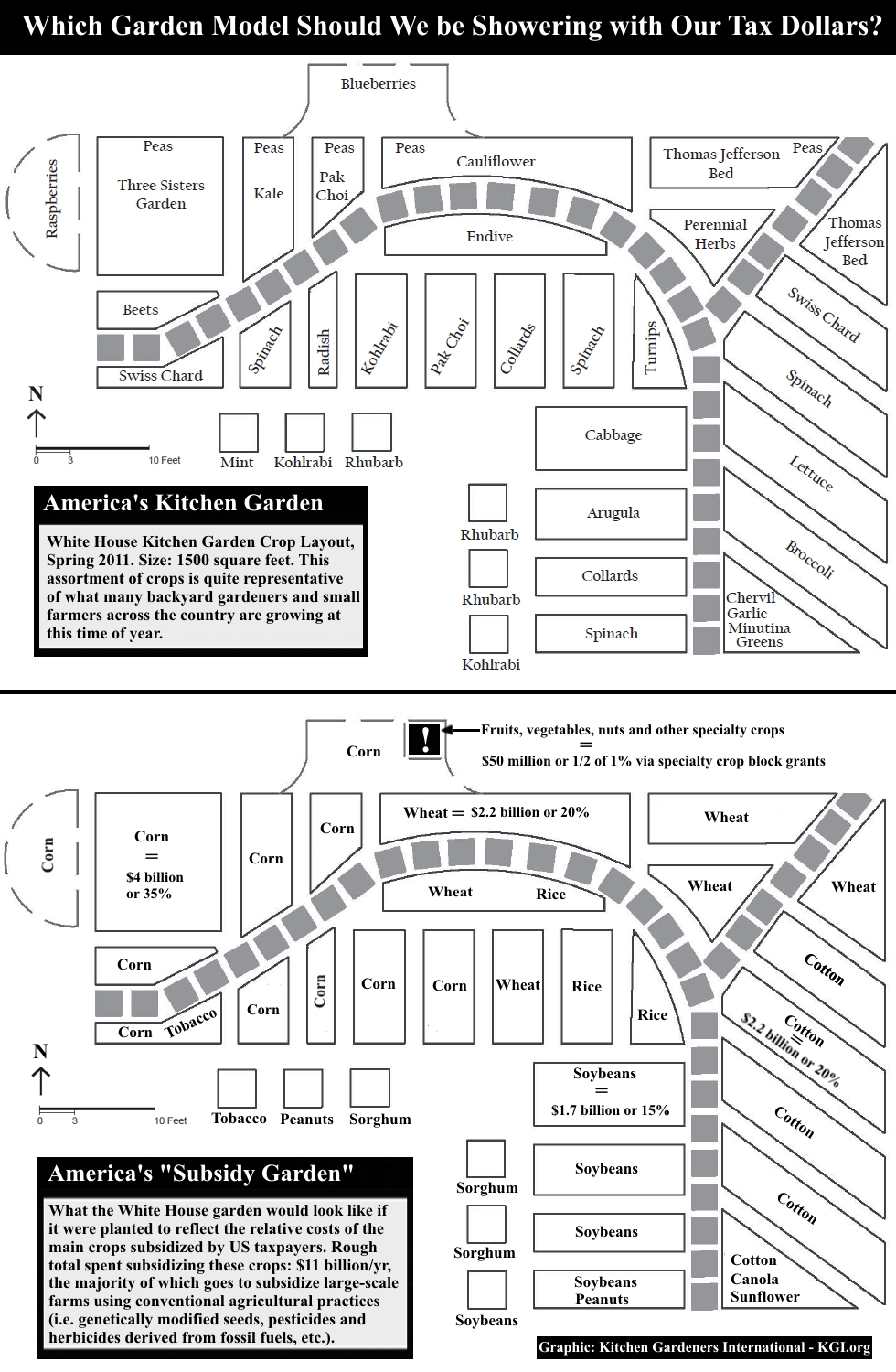
This fascinating kitchen garden map hints at the reasons why our national food supply favors frozen pizza over fresh vegetables. It compares two versions of the 2011 White House kitchen garden: the actual garden, and how it would look if it were planted according to how much U.S. taxpayers spend to subsidize crops! (To enlarge the map, hold your control key and hit the plus sign.)

The subsidized garden is devoted to commodities: corn, wheat, cotton, soybeans, and rice. A lot of them, like 70 percent of our wheat crop, end up as processed food. While 80 percent of the rice crop is eaten as just plain rice, about 20 percent goes into processed food or beer. Corn, the only vegetable on this list, ends up as animal feed (40 percent), ethanol (33 percent), or things like corn chips and high fructose corn syrup that nutritionists recommend we avoid. Soybeans become oil, livestock feed, or even cement. Way up in the corner you can see “fruits, vegetables, nuts, and other specialty crops” which receive one-half of one percent of subsidy dollars.

This is not a polemic about crop subsidies but my next step in pondering the subject of local food cultures. After eating so well and so darn locally during my pilgrimage across northern Spain, I’m curious about the foundational ideas and policies of our own food culture. Lots of helpful stuff has been posted on this blog, like this review of the movie “King Corn”. Nancy Michaelis brought up the subject of our lack of crop diversity long ago.  On her visit to a food desert in Detroit, Julie Reishus ran into lots of products made with commodity crops and very few fresh fruits and vegetables.

But we don’t seem to talk about the farm bill, food subsidies, or the values that are built into this system…and how our participation in this system impacts not just our own diet and health, but the world’s food supply.  Hmmm. I guess it’s time to finish my half-read copies of Kingsolver’s Animal, Vegetable, Miracle and Pollan’s The Omnivore’s Dilemma—and time to put a little more energy into understanding agricultural policy. Unsubsidized fruit and vegetable growers are my new neighbors, and now that our rainy spring has ended, their tractors are out in force, prepping for a new season and new crops. If I’m going to live in farm country, if I’m going to eat locally, I have a lot of learning to do.

Anne Basye, Sustaining Simplicity

Slow Food, Sore Feet

A bowl of chewy bread is placed in front of us, with a green bottle whose label, the size of a bandage, modestly identifies the town where this white wine was produced. Next comes a wooden plate of chopped octopus drenched in oil and dusted with paprika. A few thick toothpicks are our utensils, and for an hour and a half we nibble, chew, sip, and sigh with pleasure in the company of an Irish Franciscan nun.

In our backpacks we carry breakfast and lunch: bread baked in the last town, cheese, yogurt, oranges, chocolate, pears, dried ham and sausage, all made in this province or this country, Spain.

When it’s time to eat, everyone sits down! Nobody is walking around eating like Americans do. We sit too, as often as possible, because my friend and I are completing the last third of the Camino de Santiago, the 450-mile long ancient pilgrim path across northern Spain. Subtracting a couple of quick bus trips, by the time we reach Santiago we will have walked 228 kilometers or 141 miles over 11 days, up mountains, through valleys, along rivers in chestnut forests, and down the streets of cities big and small.

Slow food has been the reward for having sore feet. How delicious, at the end of a 20-kilometer day, to tuck into real food produced by the farmers whose tractors, cows, and pigs we evade on dirt tracks. So much more enjoyable than gripping the steering wheel with one hand while clutching a styrofoam coffee cup or a plastic wrapped something –something shipped a few thousand miles—with the other!

Astonished by the abundance around us, I read up on Spanish agriculture in an internet cafe. After absorbing lots of facts about exports and imports, farm land fragmentation and concentration, humid regions and arid regions and so on and so forth, it finally hit me: on our pilgrimage we are experiencing an informal local food culture that exists alongside and within officially tracked Spanish agribusiness. These farmers don’t just produce for export. They also feed their neighbors.

Where I have lived, that’s not so true. All those soybeans and corn in Illinois go somewhere else. California rice and tomatoes are exported. Lots of farmers in the Skagit Valley, where I live now, raise seeds for others to grow the next year. Sure, we have farmer’s markets and CSA farms, but they are still the exception. The fruit, bread and yogurt in our stores have generally traveled a long way. And they taste like it!

Eating my way across Spain is reminding me that local food culture matters. Food that is shipped can be food without flavor. Food that is shipped is also food that can’t reach us when fuel isn’t available or a natural disaster like the floods along the Mississippi, as Nancy pointed out in her last post, interrupts delivery. For maximum food security, some portion of our food supply needs to be produced near by. And why shouldn’t we be able to savor the abundance of our own region, and say to visitors, these peaches came from that field, those cows made this milk?

As a pilgrim, I’m getting to participate this strong local food culture. When I get home, I’m going to be intentional about getting to know whatever food culture surrounds me. As for those sore feet, they are just part of the journey, says Lutheran theologian and writer Martha Stortz, who walked the Camino de Santiago last year. Fortunately, a little glass of the local vintage takes away a lot of the pain!

Anne Basye, Sustaining Simplicity


Tool of the day, the month, the year!

Last fall my niece and I used a combination of bicycles, buses, and ferries to visit some friends about 20 miles away. Our multi-modal trip was so much fun that when we finished, Lily said, “I wonder if we could take public transportation all the way down to Sacramento to see grandpa and grandma?”

It was an appealing idea with one big obstacle: exactly how do you figure out all those local transfers? It’s easy in Chicago, where the main transit website links the city and suburban buses, el and commuter trains and can calculate any itinerary within about 40 miles. It’s not as easy where I live now: getting to or from Seattle means three buses, three counties, three transit systems, and three websites. Grrr!

Enter Google Transit, launched by Google “to make public transit information as easy to find as any other geographic information.” Type in your start and end locations and it tells you how to get there without a car!

Yes, yes, yes, and yes!! What an exciting and powerful alternative to our car-based society—a positive way to create more public transit riders, which can’t help but create even more alternatives to driving. Alternatives are the best way out of our current system of overconsumption and a grandiose entitlement. They anchor a competing set of ideals in real practices that we can start to adopt. As a proponent of active transportation, I think Google Transit is a reason to celebrate.

But can it get my niece and me to grandma’s house on public transit? Just for fun I checked. Sensibly, GT told me to take the bus to Skagit Station, enjoy the 815-mile ride on Amtrak, and then switch to the local bus when we step off the train in Sacramento. So I think we will!

Anne Basye, Sustaining Simplicity

Only connect

Throwing my two cents into the David-Erin-Bob/Uncle Billy discussion, I’d like to post these musings:

When we buy a car, we carefully research everything except our basic assumption: that we need one. Is there another way to move around the world that might be less damaging, like keeping the car we have and biking more and taking public transit, or sharing a car with a neighbor, or carpooling, or walking?

Of course, as “consumers” we are rewarded for making our personal buying decisions our most pressing concerns. How about we just stop calling ourselves consumers? Let’s not even be Christian consumers. Let’s be Christian citizens. Christian community members. Anything that helps lift the spell that traps us in “take-make-waste” so we can start discerning needs from wants, asking where our stuff comes from and who or what was harmed in its production, and understanding how our greed is connected to—or may even cause—other people’s need.

This is where charity becomes justice. That old saying about giving a man a fish? Sure, teach a man to fish—but don’t forget to ask who owns the pond. The world is full of competent people who know how to fish and farm but can’t access land or water—or whose land and water has been fouled by a multinational factory farm, mining operation, or Coca-Cola plant whose products are shipped to … Christian consumers.

The due diligence we need to be doing about hunger is about our own system. I say, start asking why. Why do I need this? Why was this product produced so cheaply? What hidden environmental or social costs are being paid by the people who made it? How’s their garden?  Unlike buying a car, the goal of questions like these isn’t to make us feel good about our own purchases. These questions lead us from consumerism to collective advocacy, because when a small why is amplified by other individuals, groups, or law-making bodies, it can change a system.

The bottom line why for Christians is: Why does so much of our “good life” come at the cost of other people’s welfare? Our system blinds us to these consequences. It’s time to ask our way out of this trance, to let the power of why open our eyes and start drawing the lines to world hunger that begin in our own backyards.

Anne Basye, Sustaining Simplicity

Getting into recovery

Now that I’m living down the road from the family farm, asked my mom in a phone call today, could I please do something about the fruit trees? Prune them, care for them, harvest them? Clear the weeds away from the overgrown lingonberries and blueberries? And line up some kind of charity for the unused fruit, since that’s not the tenants’ job?

I hadn’t realized that these trees and bushes had been neglected. Which got me thinking about food waste.

“Americans waste more than 40 percent of the food we produce for consumption,” says journalist Jonathan Bloom. “That comes at an annual cost of more than $100 billion. At the same time, food prices and the number of Americans without enough to eat continues to rise.”

Bloom’s website and blog, www.wastedfood.com, and his new book, American Wasteland: How America Throws Away Nearly Half its Food (and What We Can Do About It) detail the problem and lift up emerging solutions.  Like the dining hall trays temporarily or permanently banished by colleges like Luther and Wartburg. Like links to fact sheets that help stores and restaurants give away food safely. And lists of food recovery groups that are trying to connect wasted abundance with real need. (How are you doing on that Lenten meal of scavenged or recovered food that I suggested in my last post?)

My family’s fruit trees should be feeding more than the birds. Tending them, making  pies and jam, and sharing their harvest are small steps away from our culture’s “take-make-waste” paradigm (as Annie Leonard of Story of Stuff calls it).  But I’m always looking for new ways to do that. So sure, mom. I’m on it! Recovery, here I come.

Anne Basye, Sustaining Simplicity: A Journal

Omnivore, locavore, invasivore: Lenten supper alternatives

Omnivore, locavore–yes, invasivore! Already on the list of new words for 2011, an invasivore is someone who eats species that are crowding out natural species. Click here to google the term (otherwise Google will try to convince you you’ve misspelled invasive) and you’ll find clever articles and www.invasivore.org ‘s tasty recipes for Himalayan blackberry (a pest in Washington state and 24 others), garlic mustard, kudzu, and annoying animal species like the Chinese mysterysnail, now invading many freshwater lakes.

While you’re smiling, note the bottom line: We humans are great at eating species out of existence, but when we’ve depleted their stock, we “farm” them or introduce a new, similar species from somewhere else. Thus, we farm tilapia for our dinner plates—but the little fish make the invasive list when they escape their “farm” and start dominating their immediate environment. And the Himalayan blackberry introduced to our country by Luther Burbank in the 19th century is making a mess of everything.

Tasty, but pushy, and crowding native species out of their space.

Friends of mine are working hard to get the Himalayan blackberry out of their woods. I’m thinking hard about the wisdom of humans moving plant and animal species to new parts of the world—and planning to make a lot of blackberry jam and pies this summer.

Conflict food is another emerging trend. (Too bad conflictarian isn’t as catchy as invasivore.)  Started by artists in Pittsburg, the Conflict Kitchen only serves food from nations with which the U.S. has conflicts. Every four months, the look and menu changes. The Kubideh kitchen, serving Iranian food, was first. Now open is the Bolani Pazi Afghan takeout restaurant, created with local Afghan refugees and featuring events and discussions about culture and conflict. Coming soon: North Korea and Venezuela.

Food not Bombs, which I heard about last summer from a young woman at Holden Village, collects and cooks surplus and wasted food and serves vegetarian meals for free in many cities. You’ll get the basic story but not the specifics on the web, because it’s controversial; some of the food comes from dumpsters, and FNB often has skirmishes with local municipalities over food licensing. But I appreciate their strong challenge to our wasteful system, which wastes or discards about 40% of our food.

Lenten supper season will soon be upon us. How about replacing the same old thing with meals of invasive, conflict, or scavenged foods? As a cook, I’d love to investigate and prepare local invasive plants and animals. Or learn about a different culture, a conflict, and its implications as I cook a dish from a conflict country. Or even find out firsthand how much food is wasted in my town, by trying to scavenge something for a meal!  Besides challenging the cooks, all three would open bold new conversations around hunger.  Shall we give them a try?

Anne Basye, Sustaining Simplicity