Skip to content
ELCA Blogs

ELCA World Hunger

Four Ways COVID-19 May Impact Hunger


Since 2015, undernourishment around the world has been on the rise, after years of decline. In the latest estimates from the United Nations, more than 820 million people are undernourished. Even as we face the clear and present threat of coronavirus, we need to remain aware of the ongoing, persistent threat of hunger around the world. The current pandemic is revealing and exacerbating long-standing disparities – in income, access to health care, and social mobility. As the disease continues to spread, and as governments take steps to avert it, what might be the consequences for hunger?

Here are some of the things to keep an eye on when it comes to hunger in a pandemic.

Food Prices

What do we know?

One of the reasons we have seen rises in hunger in the last 10-15 years is volatility in food prices. In 2007-2008, for example, prices for wheat, corn and rice reached new highs. Milk and meat also spiked. This increased vulnerability to hunger in many countries. Some countries were harder hit than others. India, for example, saw an increase in wasting (low weight for height) among children. Fourteen African countries also experienced civil unrest over high prices, as did Bangladesh and Haiti. The research suggests that the biggest impacts of the price crisis were felt particularly among low-income groups. Some analysts also argue that the food price crisis may have contributed to the Arab Spring protests that erupted in the early 2010s.

What should we be watching?

One of the main concerns about COVID-19 early on was that both the disease and the government responses to it may cause a spike in food prices. This could be the result of infections preventing people from working in agriculture or in processing, restrictions on trade, and stockpiling[1] of food, all of which can reduce supply. As supply decreases and demand increases, of course, prices rise. If this were to happen in the midst of a pandemic, when many folks are also vulnerable to infections that can keep them from working, we might see a spike in global hunger, especially for those whose income leaves them vulnerable already. At particular risk are farmworkers, particularly field workers, many of whom are at increased risk of infection because of a lack of sufficient protocols for safety. As the agricultural industry is impacted, many of these workers may face reduced pay or reduced opportunities for work, both of which can leave them vulnerable to poverty, hunger and increased infection, especially as they pursue work in unsafe settings or under-regulated industries.

What are we seeing so far?
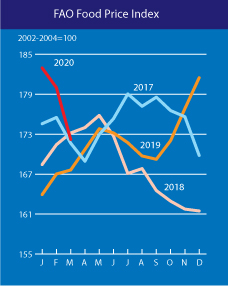
There’s good news and bad news. We aren’t yet seeing spikes in food prices. The Food and Agriculture Organization of the United Nations (FAO) tracks food prices by month, and the latest data for March 2020 didn’t show significant increases. That’s good news. Also, this year is looking to be strong for harvests of wheat and some other cereals. That’s also good news. The price spikes earlier this century were often accompanied by droughts that caused down years for crops. So far, that isn’t the case in 2020. The biggest concern for now is that restrictions on trade and mobility might create a situation friendly to higher prices.

The bad news is actually in the other direction, with prices falling. In the US, many farmers rely on restaurants and stores to purchase their produce. With the closures of these businesses and direct-to-consumer markets, farmers face a challenging environment for selling their crops. The CARES Act included an allocation of $9.5 billion to help support them through the USDA.

Farmers in other countries face similar challenges. With markets closed or closing and developed economies slowed or retreating, prices for exports and commodities are moving down. This could create long-term problems for people in agriculture. In developing countries, where the share of the labor force dependent on agriculture can reach well above 50%, this is a significant problem. See below for more on exports this year.

Health Care Costs

What do we know?

Medical out-of-pocket costs are a significant driver of poverty in the United States. According to the US Census Bureau’s Supplemental Poverty Measure, medical out-of-pocket costs were responsible for adding about 8 million people to the number of people living in poverty in 2018. Globally, the World Health Organization (WHO) and the World Bank estimated that in 2010, 800 million people spent 10% of their household budget on health care, and about 100 million people were pushed into extreme poverty because of health care costs. For many, the choice to seek medical treatment is a choice between paying for care and paying for other needs, such as food.

The relationship between health and hunger is kind of a double-edged sword. On the one hand, malnutrition can lead to significant health problems, such as hypertension, anemia, coronary heart disease, and diabetes. Based on what we know so far about COVID-19, this leaves people who are hungry at greater risk of severe symptoms from infection. As people get sick, they are more likely to miss out on income and thus less able to afford food and other necessities. When they aren’t getting enough food, they are more likely to get sick. It’s a vicious cycle.

What should we be watching?

Without access to a sufficient, stable healthy diet, people who are already vulnerable to poor health will be at heightened risk from COVID-19. Moreover, in many areas, communities with high rates of poverty and hunger also have limited access to health services, particularly the kinds of specialized services that are needed to treat severe symptoms of COVID-19.

One of the ways to measure access to health care services – and along with that, the ability of a country to mitigate a pandemic – is the number of health care professionals within an area. In developed countries, the number of medical doctors per 10,000 people can be as high as 20-40. The number of medical doctors in developing countries can be lower than one per 10,000 people. Disparities exist within other needed professions, as well, such as pharmaceutical personnel and nursing and midwifery personnel. The combination of undernourishment, low numbers of medical workers and a severe pandemic is a serious problem.

The other concern is that even if they have access, people living on the edge of extreme poverty may not be able to afford health services. It’s difficult to measure the number of people who have health coverage for essential services, but based on their research, WHO and the World Bank estimate that more than half of the world’s 7.3 billion people lack this coverage. That’s a lot of out-of-pocket expenses for many of the people who can least afford it.

For these and other reasons, ELCA Advocacy is working to ensure that the next COVID-19 funding bill in the United States includes additional funding resources in international assistance to ensure effective global responses that will protect all of us here in the United States and around the world.

What are we seeing so far?
Treatment for the kind of severe symptoms COVID-19 causes doesn’t come cheap. A 2005 study of 253 US hospitals (a bit dated, certainly) found that the average cost of mechanical ventilation for patients in intensive care was as high as $1500 per day. Without insurance, affording treatment will be out of reach for many people. According to the US Census Bureau, in 2018, more than 28 million people in the US lacked health insurance. This coverage is not evenly distributed, either. Of the wealthiest households (with incomes above $100,000 per year), less than 5% are uninsured. Of households with the lowest income (less than $25,000), more than 13% are uninsured.

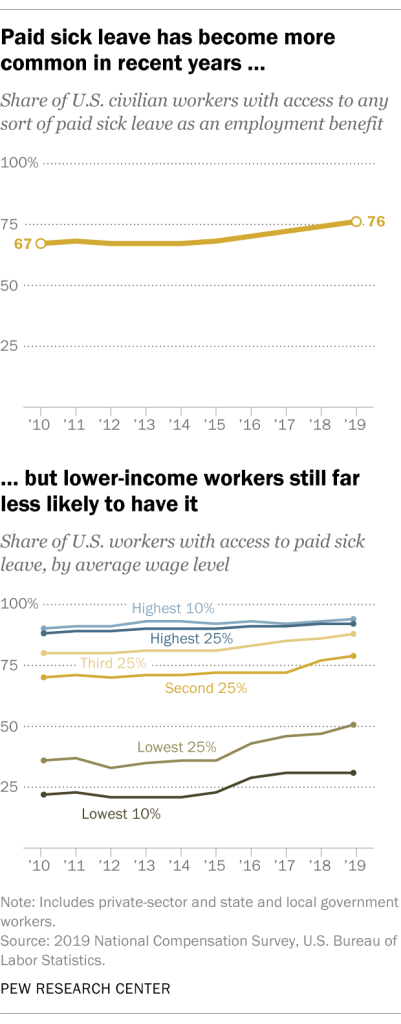
Moreover, according to the Bureau of Labor Statistics, more than 33 million people in the US do not have paid sick leave from work. As the Pew Research Center notes, while this has improved overall, with many workers gaining this benefit in recent years, lower-income workers are still less likely to have it. These workers are also less likely to have the financial resources to weather a major health crisis.

The long and short of it is, at this point, we don’t have a ton of verifiable data to draw conclusions about the health care impact of COVID-19 on hunger. But we do have enough information to reiterate the importance of the health projects supported by ELCA World Hunger. These projects, including hospitals and clinics, maternal and child health care, psychosocial support for mental health, vaccinations, and more, are effective ways of accompanying communities toward well-being – and building resilience to health crises. As “unprecedented” as the COVID-19 pandemic is, it is worth remembering that safety from contagious, deadly infectious diseases is not evenly shared by all. Outbreaks of Ebola, SARS, and MERS, and the ongoing pandemic of HIV/AIDS have impacted many of us and our neighbors just in the last ten years. Typically, it is the poorest households that are disproportionately impacted.

Loss of Livelihoods

What do we know?

Poverty is responsible, according to the FAO, for about half of the undernourishment around the world. Reducing poverty and achieving sufficient, sustainable livelihoods for people is critical for ending hunger. Tremendous progress has been made on this front in recent years, with poverty declining in much of the world over the last 30 years. In East Asia and the Pacific, for example, poverty has declined from about 60% in 1990 to less than 3% in 2015. Much of this decline is because of economic growth. Sadly, of course, this doesn’t mean that inequality has eased. A rising tide doesn’t necessarily lift all boats, so there is still quite a bit of poverty within countries, even as the rates overall have come down. The growth also hasn’t been even between countries. Sub-Saharan Africa has seen an increase in poverty during the overall global decrease.

What should we be watching?

The effect of sickness on income was already mentioned. But as many folks have said, the attempts to slow the virus will have their own consequences. One of the big ones will be loss of livelihoods, at least temporarily. What we are keeping an eye on here in the US is, of course, the jobs reports and the unemployment rate. Globally, we will be looking at similar things, particularly in industries like tourism, agriculture and manufacturing. In agriculture, especially, much of the work is timebound. It’s difficult to catch up on a season once it passes.

What are we seeing so far?

The numbers in the US aren’t good. The federal government has expanded unemployment coverage, and the number of applicants so far is astounding. According to the most recent (April 9) release of weekly unemployment claims by the US Department of Labor, more than 6.6 million people filed claims in the first week of April continuing the trend from the previous week and bringing the total number of people filing claims to more than 16 million. On a graph, the increase of late looks like a sharp right turn:
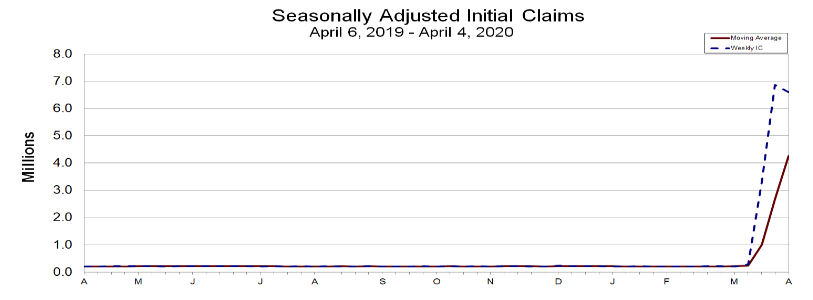
In the US, the March 2020 jobs report showed a loss of over 700,000 jobs. The biggest losses were in leisure and hospitality.

Internationally, the United Nations Conference on Trade and Development (UNCTAD) has reported some significant price decreases for commodities so far this year. As developed countries emerge from closures related to COVID-19, it will take some time for their economies to come back. At the same time, some developing countries are only at the beginning of the process of managing the pandemic. This could mean a long road back for exports and commodities. To put it simply, with weakened prices for exports and commodities, it may be a while before industries such as agriculture, processing and mining recover.

Social Safety Nets

What do we know?

Social safety net programs are government-funded programs that provide assistance to people during times of need. These can include benefits that allow people to buy food, cash assistance, subsidized medical care, and more. In the US, major safety net programs include the Supplemental Nutrition Assistance Program (SNAP), Temporary Assistance for Needy Families (TANF), Supplemental Nutrition Program for Women, Infants, and Children (WIC), the Low-Income Home Energy Assistance Program (LIHEAP) and others. These programs are critical supports in times of crisis.

SNAP is one of the more commonly used social safety nets. It provides people in need with money to purchase food during the month. The average benefit nationwide is about $130 per person per month. SNAP is one of the most effective social safety nets. The US Census Bureau estimates that, in 2018, SNAP helped keep about 3.2 million people out of poverty. During the Great Recession, increases to the program helped stabilize the Supplemental Poverty Measure calculated by the US Census Bureau. This helped keep people out of poverty.

What should we be watching?

Federal legislation in response to the pandemic has authorized increases in funding for some of the social safety net programs, like LIHEAP and WIC. For others, some of the requirements have been waived. For example, the CARES Act has waived the requirement for a woman to by physically present to apply for WIC. This will allow more people to apply while keeping themselves and their families healthy. The expansion of LIHEAP will help families maintain their utilities and use needed money for other necessities.

The big question right now is, will the social safety net do what it is intended do, namely prevent a short-term crisis from becoming a long-term situation of need for individuals and families?

The ELCA is working through ELCA Advocacy to encourage the US Congress to increase the maximum SNAP benefit by 15 percent during the duration of this emergency to ensure households have enough resources to avoid the hard choice of choosing between paying for their bills or for food.

What are we seeing so far?

SNAP was a big piece missing from the legislation. The Department of Agriculture, which administers SNAP, received a boost in funding, but this was not for an increase in benefits. Rather, it was to help cover the costs of what is expected to be a rise in eligible participants. So, the allocation will allow more people to participate, but it won’t necessarily provide the increased funding per person that we saw during the Great Recession. Advocating for this in future legislation is important. Again, it was SNAP increases, more than other government transfer programs, that contributed to increased jobs and reduced poverty during the recession, according to the Economic Research Service of the USDA.

Globally, the World Bank found in a 2018 study that less than 20% of people in low-income countries have access to social safety nets of any kind. Without access to public programs during crises, it is likely that COVID-19 will take a significant toll on many communities’ resilience to poverty and hunger. This will likely deepen the divide between higher-income and lower-income people within countries, as some will have the means to weather the pandemic while others may not.


The COVID-19 pandemic points to the importance of addressing hunger at the root causes. It also highlights the many ways that the burdens of crises are often not evenly shared, globally or within an individual country. The pandemic also brings into sharp relief the need for cooperation and coordination between business, nonprofits and government. Food banks and pantries have stepped up to meet immediate needs. Farmers have supported this by donating produce – at a cost to themselves. And the federal government’s legislation related to the pandemic will provide critical support.

This will be a long road, and it will require a lot of effort, particularly in advocacy with the communities most affected. To stay up-to-date on legislation and ways you can help, sign up for ELCA Advocacy action alerts at ELCA.org/advocacy/signup. In worship and in your devotions at home, remember those who are affected now and those who may be affected in the future. And stay healthy. There are many lessons for us in this situation, but one of them is clearly just how much we need one another.


[1] Stockpiling is different from “hoarding.” Stockpiling here means countries or other large entities purchasing large amounts of commodities as a security against scarcity. This isn’t the same as a shopper buying a lot of toilet paper or canned soup.
Celebrating Maundy Thursday at Home


Ending hunger goes beyond providing calories. The ministry of ELCA World Hunger and the work we support together is about recognizing the significance of food and the ways it can bring us together with one another, with God, and with all of creation. In the sacrament Christ initiated on Maundy Thursday, we glimpse what the banquet table God has promised for our future might look like. Today, with churches closed and many fasting from the sacrament until we can be together again, the story of the first Maundy Thursday is particularly poignant. It reminds us of God’s presence at the many tables we dine at, and it reminds us of the powerful way God’s gift of food can bring us together in anticipation of that day when all will be fed.

In this spirit, Pastor Tim Brown offers a plan for an intentional meal at home for Maundy Thursday. Pr. Tim is a Gifts Officer and Mission Ambassador for the Lutheran School of Theology at Chicago and a pastor and writer out of Raleigh, NC. You are invited to use the message below for personal devotion as well as prompts for sermon writing. 

Maundy Thursday Family Feast

Below is a full reflection with additional ideas. Here is a quick guide you can print and follow with your family: Family Maundy Thursday Quick Guide

Maundy Thursday is an observance of intention.  The word “maundy” is taken from “maundatum” or “mandate,” where Jesus commands his followers to love one another.

The whole observance is a story in three parts: confession and forgiveness, acts of service, and a meal of love.  For an adapted family service around the table, a simple prayer will suffice for confession and forgiveness on this night and will open the observance with sacred empty space.  The washing and meal that follow can be done with as much joy or as much solemnity as your family dynamics dictate.  Remember that the point of this observance is not to feel anything in particular, but rather to participate in a larger story that these holy days narrate.

It’s also important to note that, while your family meal is certainly sacred, this is not the Sacrament of Holy Communion and not a “Christian Seder.”  This is recalling what every Eucharist reminds us: every shared meal is ordinary and extraordinary, and Christ is present in our gathering whenever we dine in fellowship.

Decide What You Want to Eat for Dinner

So, what should you eat for dinner? Frankly, you’re welcome to eat whatever you’d most enjoy on this night.  If you want a more traditional Middle Eastern meal, not unlike the food Jesus may have eaten, grapes, dates, figs, olives, and some crusty bread are good additions to the table if everyone enjoys them. Perhaps some crackers and hummus, too. But if these aren’t in your usual diet or don’t agree with your palate, the point is not to re-enact a meal, but to have a meal, together. Eat what you’d like.

If, as part of your Holy Week observance you’ve made some bread, enjoy that on this night. Bread-baking as a family is a time-honored tradition that spans cultures and ages. Remember to enjoy the gathering, don’t sweat the details too much and just do everything with intention.

Gather Around the Table

To begin, gather the family together around the table, standing or seated. Invite everyone to take a deep breath and quiet themselves.  Light some candles to use as a centerpiece for the table if you have them. If using candles is unwise, or they aren’t available, just take some time to be quiet in God’s presence.

Talk Together

After a while, invite everyone to share their favorite memory that involves a meal. It could be a favorite dish from childhood, a time they shared food with someone at school or on a trip, a special event that they attended, or even a perennial meal they enjoy. What do they enjoy about it? Why?

Pray Together

Then, invite someone to offer a prayer with these, or similar, words. Note that the prayer should both give thanks for the gift of shared meals and food and also acknowledge that we too often ignore the hungry around us.  In this way the prayer is both an act of praise and confession.

“Gracious God, you give us good things to eat and invite us to share with one another.  Thank you for the many ways you feed our minds, feed our hearts, and the very real ways you feed our bellies each day. We also know that we do not share our food, our minds, and our hearts in the ways that you would have us.  For the ways we don’t give of ourselves and our resources, we ask you forgiveness.  And for the many ways you sustain us, we give you thanks.  On this holy night when Jesus shared his last meal with his friends, we remember the great gift it is to eat and spend time with one another. Thank you for this meal, for this holy night, and for all your gifts. Amen.”

Wash Each Other’s Feet or Hands

Invite everyone to be seated with their chairs facing outward, away from the table. Have a bowl of substantial size nearby, like a mixing bowl, a pitcher or larger cup of warm water and a towel for drying.

Invite someone to read John 13:1-17, the story of Jesus washing the feet of the disciples. After you’ve read the story, say the following (or something like it):

“On this night we have heard our Lord’s commandment to love one another as he has loved us. We who receive God’s love in Jesus Christ are called to love one another, to be servants to each other as Jesus became our servant. Our commitment to this loving service is signified in the washing of feet, following the example our Lord gave us on this night.”

Then invite each family member, in turn, to wash one foot of another member of the family, carefully drying it.  Only one foot is necessary, and each person should take a turn. If foot washing is not preferable, you can do hand washing instead, though there is something particularly special and intimate about foot washing.

If you’re performing this ritual with children, it’s natural for them to laugh and giggle during this. This is OK! This night should be about enjoyment as much as it is about sacred acts. Often, they are one and the same. During the foot-washing, it’s appropriate to sing if your family is a singing family. “Come by Here” is a great option, or even just a verse of a familiar song like “Amazing Grace” or “Jesus Loves Me” works well.

After foot-washing, you can invite people to wash their hands and turn their chairs to face back toward the table for the meal.

Eat Together

After everyone is seated and ready, enjoy the meal! Invite people to share reflections about their day, or perhaps ask them what they liked or didn’t like about the foot washing. You can ask those gathered what love means, how they like to best express love, and what the most beautiful act of love they’ve ever seen was.

Tell the Story Together

Toward the end of the meal, but before you’re completely done, invite everyone to quiet back down as you tell the story of the meal portion of the last supper. During this part, I encourage you not to lift up any bread or wine, but if there is bread on the table or a drink, you can reference it as a reminder of the meal. Read 1 Corinthians 11:23-26, recalling Jesus’ last supper.

Then say these words, or something similar:

“Tonight we have participated in a supper like Jesus’ last as his disciples gathered together around him.  The Gospels tell us that after supper Jesus and his disciples sang a hymn together and went out to the Mount of Olives.  You’ll be given a few minutes to eat just a bit more and have another few sips, and then we’ll begin cleaning up quietly, without any loud talking, taking any dishes to the kitchen sink, wiping down tables, and sweeping up. Everyone gets to help.  After we clean up, we’re going to stay pretty quiet the rest of the night to honor this holy night.”

Clean Up

Invite everyone to clean up quietly. On this night where it’s tradition to strip the altar and take everything out of the sanctuary, you may want to take your clean up a little farther by sweeping the whole room, washing down the tables and chairs and countertops, and even keeping the table free from adornments like table cloths or candles. Make everything bare.

After the clean-up is done, invite everyone back around the table for a final prayer saying these words, or something similar:

“I’m glad we got to share this time together tonight!  As we remember Jesus’ last meal, let’s keep honoring it by spending some time together. But before we do that, let’s pray, ‘Thank you, God, for this most holy night, and for Jesus’ example of love.  Help us to love each other, and ourselves, as you love us, and may we always remember the deep love shown through Jesus, a love that will do anything for us. Give us a holy rest tonight, a sweet sleep, so that we may rise to praise you in the morning. Amen.”

Enjoy a Quiet Night Together

Then decide on a family how you will spend the rest of the night! You can read quietly together, or maybe read aloud all from one book. You can play a family game together, listen to music, or if it’s getting late for young children, a bath and story-time is very appropriate. In these days of shelter-in-place when screen-time has probably been at a premium, this is a perfect night to keep all screens off and keep visual distractions to a minimum, including phone distractions.

A Maundy Thursday service in the home should both feel distinct from a normal night routine, and also very familiar. After all, Jesus’ last supper was, at its heart, a simple meal with his friends. Though this Maundy Thursday doesn’t look like many in our lifetime, it can still honor the holiness of the night when done with a little preparation, intention, and a lot of sacred joy.

Can You Flee a Pandemic? Four Lessons from Luther


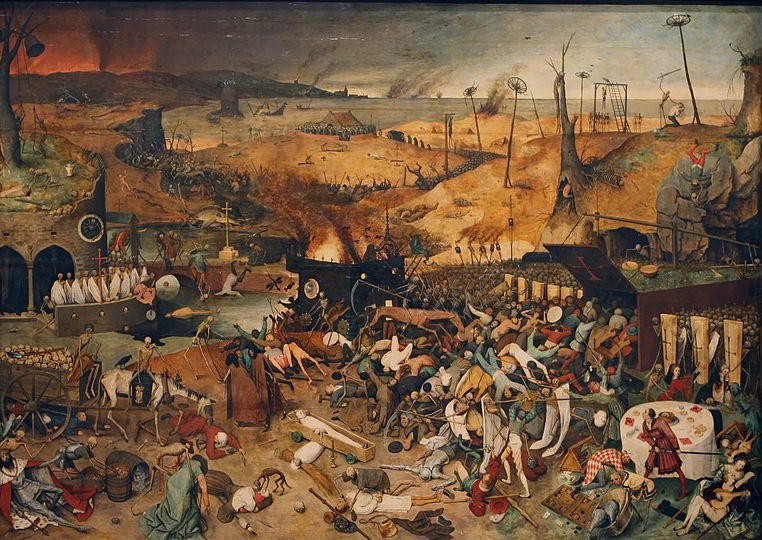
As new as the COVID-19 pandemic is to us living today, it is far from the first pandemic the church has had to address. One of the deadliest was the bubonic plague, which ravaged Europe in the mid-1300s, killing millions (estimates range from 25 to 50 million people.)  In 1527, the plague re-emerged. When it hit Wittenberg in late summer, the University of Wittenberg closed. The students were sent home, and many residents self-quarantined to avoid the deadly sickness.

Peter Bruegel the Elder, Triumph of Death (1562)

Martin Luther, recovering from his own illness, responded to an earnest plea from Johann Hess, the pastor at Breslau. Hess’ central question was thus: as everyone else sequestered themselves in isolation, “is it proper for a Christian to run away from a deadly plague”? Luther responded with his letter “Whether One May Flee from a Deadly Plague.” Below are four lessons we can learn from Luther’s response, both for our situation today and for our long-term approach to health and wellness.

Good health matters to God.

The Lutheran World Federation’s “Waking the Giant” initiative invites member churches to reflect on the many ways churches are already contributing to the United Nations’ Sustainable Development Goal of good health and well-being for all – and to consider new ways churches can be part of this work. Accompanying communities as they seek good health for all people is a cornerstone of ELCA World Hunger. As a member of the LWF, and with the United States being a target country of “Waking the Giant,” the ELCA continues to accompany companions and partners in this initiative and to work toward the goal of good health here in the US and the Caribbean.

This focus on health is nothing new for the church. Some of the earliest hospitals were founded by Christian leaders, and history is full of examples of churches accompanying people living with illness, from the Plague of Justinian in the 600s to today.

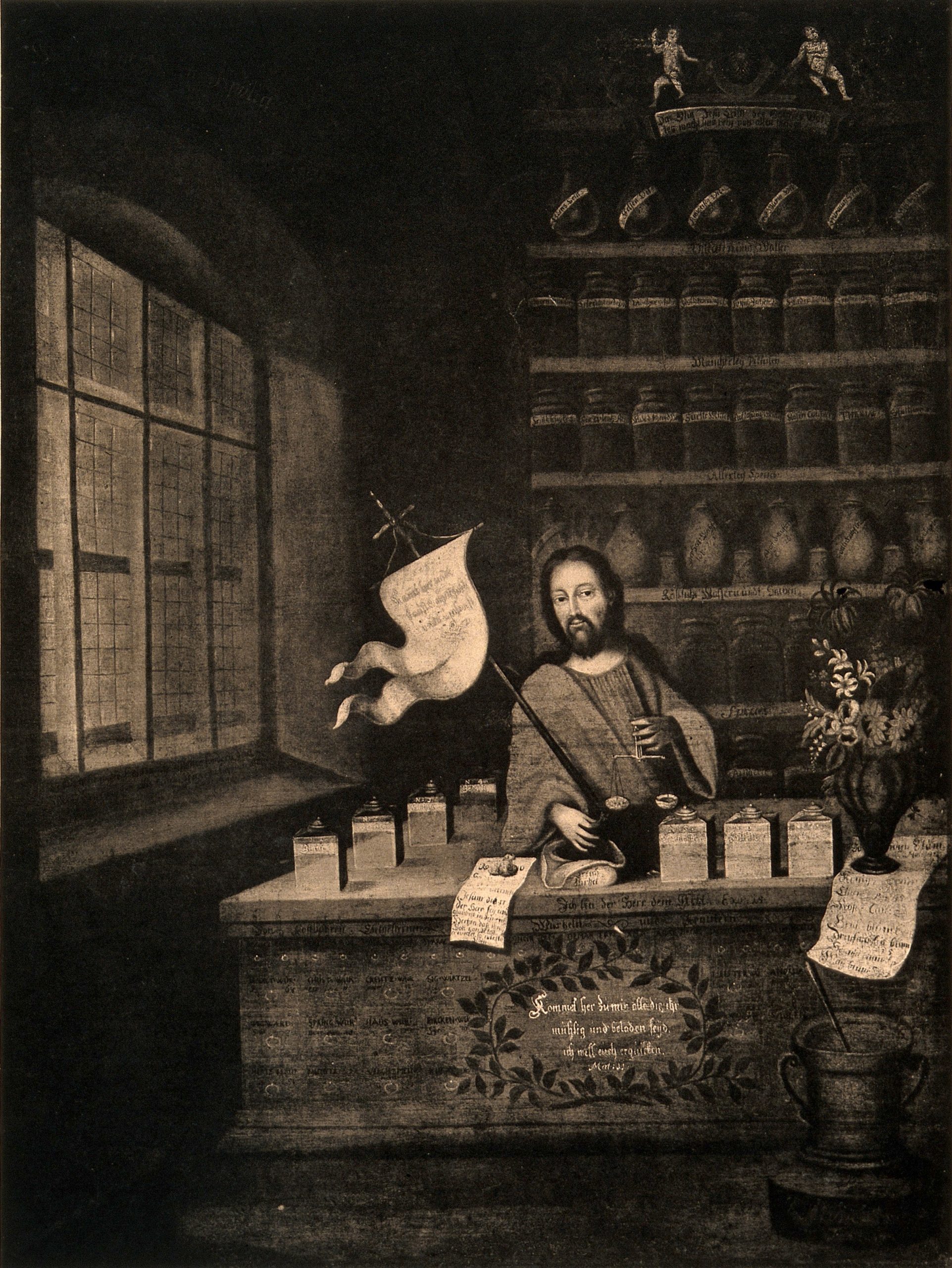
For Luther, this work was grounded in two claims of faith. First, the church is called to service of the neighbor, particularly in times of distress. Citing Matthew 25:41-46, Luther argued in his response to Hess that “we are bound to each other in such a way that no one may forsake the other in his distress but is obliged to assist and help him as he himself would like to be helped.” To help one’s neighbor in times of illness is to serve Christ. Second, Luther believed that medicines, treatments and intelligence are God’s gifts so that “we can live in good health.” Recalling St. Augustine’s image of Christ as the “physician,” Luther counsels Hess that God cares both for the spiritual needs of the soul as well as the physical needs of body. Simply put, good health matters to God.

Christ as apothecary; suggesting the idea of Christ as the universal healer. Reproduction of a photograph of an oil painting after J. Marie Appeli, 1731. Credit: Wellcome Collection. Attribution 4.0 International (CC BY 4.0)

And good health matters to God’s people.

So, can one flee a plague if one’s life might be threatened? Luther’s answer is not simple, in part because the question itself is a bit of a problem. When we ask, “what ought we to do in a crisis?” it’s often asked from the perspective of obedience. “Can one flee a deadly plague?” is really a way of asking, “Can I flee a deadly plague and still be doing what God wants me to do?”

Of course, for Luther, the life of faith isn’t about obediently completing certain tasks. It’s about responding in love to the neighbor. So, whether one can flee a crisis to save oneself depends: what is in the best interest of the neighbor? Luther offers a well-reasoned defense of self-preservation in the face of pandemic. BUT, he is quick to temper this by saying that self-preservation is only permissible if we are certain our neighbors are taken care of. It’s one thing to leave a neighbor with a network of other supporters. It’s a very different thing to leave a neighbor alone, without aid.

What ought we to do in a crisis? For Lutherans, the answer isn’t obedience to a universal rule but rather a question of discernment – what is in the best interest of our neighbor? Accompanying the neighbor is the end against which our methods should be measured. This includes helping care for the bodily needs, as well as the spiritual, as we’ll see below.

That said, Luther also wanted his readers to consider whether their presence was more harmful than helpful. What, besides self-preservation, ought to shape our response to a pandemic? And, what might love of neighbor look like?

Pray…then work.

Therefore I shall ask God mercifully to protect us. Then I shall fumigate, help purify the air, administer medicine, and take it. I shall avoid places and persons where my presence is not needed in order not to become contaminated and thus perchance infect and pollute others.

Leaving aside his questionable belief that epidemics are spread by “pestinential breath,” Luther’s description sounds timely, still today. What he is describing, essentially, is social distancing. Pray, yes, but take practical steps to avoid infecting yourself and others, he claims.

Of course, Luther is not discouraging prayer. But in his day, as in ours, there are those who believe that prayer, faith or other spiritual powers can protect them, and so they do not need to take other precautions. Luther called this sinning “on the right hand.” Those who rely solely on faith as a sort of spiritual, magical power without taking advantage of the other gifts of God, such as intelligence and medicine, “are much too rash and reckless, tempting God and disregarding everything which might counteract death and the plague.” Contrary to this, Luther argued that Christians are called to take necessary, practical steps to protect physical health.

He went further, too, arguing that governments should “maintain municipal homes and hospitals staffed with people to take care of the sick so that patients from private homes can be sent there.” This, he wrote, would be “a fine, commendable, and Christian arrangement to which everyone should offer generous help and contributions, particularly the government.” This echoes what Luther says elsewhere, namely that government, too, is a gift of God for our well-being. As such, those in power are obligated by their station to help. Churches, for their part, are called to assist in this work – and to hold government accountable when it fails.

Listen to the experts.

In his letter, Luther admonishes readers of the importance of taking medicine, of self-quarantining, of hygiene and other practical measures. He also offers his proposals for care for the soul, responding as we would expect a pastor to do. But throughout, what is very interesting is Luther’s deference to medical experts. Sure, he is more than qualified to offer spiritual care advice, and he does so. But when it comes to specifics about avoiding illness, he is more hesitant.

This is clearest near the end of the letter, where he writes about burials. Because of the spread of the bubonic plague, there was debate about how to handle the dead bodies of victims. Luther writes,

I leave it to the doctors of medicine and others with greater experience than mine in such matters to decide whether it is dangerous to maintain cemeteries within the city limits. I do not know and do not claim to understand whether vapors and mists arise out of graves to pollute the air.

What to do with dead bodies is no small matter in any religion. Christians, like other faiths, have specific rituals and practices, informed by our beliefs about death and life. It’s not too much to assume that deferring to medical authorities here is a pretty significant step for Luther. It means giving up the church’s right over its dead. Luther does a bit of fancy prooftexting of scripture to support not burying corpses within the city limits in his letter. But in the end, his thought process is clear: when it comes to health, defer to those who have been gifted by God with expertise. And recognize their work as one of the ways God is active in our world, promoting good health for all.

Luther’s understanding of health and illness may be scientifically outdated, but his nuanced approach to the church’s vocation during times of crisis can give us food for thought. Health and wellness for all are not ideals for the future reign of God but practical realities the church is called to pursue today. Accompanying neighbors facing illness and working to keep communities healthy is an important way to reduce hunger and to discover God at work in our midst, through community leaders, medical experts, first responders and one another. And we see this in the hospitals, maternal and child care programs, health education initiatives and other ministries ELCA World Hunger supports.

Health was part of God’s intention for the world long before it was a Sustainable Development Goal. Working together toward this – even if that means, right now, working and living apart for many of us – is where the church is called to be, and where it has been during the “plagues” of the past.

All quotes cited above are from Martin Luther, “Whether One May Flee from a Deadly Plague (1527),” in Timothy F. Lull and William R. Russell, eds. Martin Luther’s Basic Theological Writings, 3rd edition (Minneapolis: Fortress, 2012), 475-487.