

Skip to content
ELCA Blogs

ELCA World Hunger

Burying the Alleluia for Lent


After a lifetime of Sundays, worship can seem so rote, so mechanical. Sermon lessons blend together, and we can float through liturgy on autopilot. But as I was reminded this weekend, once in a while something as simple as a children’s sermon can catch us off-guard, grab us, and force us to pay closer attention.

This Transfiguration Sunday, in preparation for Lent, the congregation I was with watched as the pastor gathered the children in front of the altar. Posted on the railings were hand-written signs proclaiming “Alleluia.” The pastor clutched her guitar while talking with the children about the meaning of the word and asked them about when they had heard it before in worship. Then she explained what would happen this week, when “Alleluia” is excised from our sacred speech as we journey through Lent.

She presented them with a box and invited them to remove the signs and place them therein. Then, she rose and began strumming an “Alleluia” verse as the children placed the colorful signs in the monochrome chest, burying the “Alleluia” until Easter.

This wasn’t new or novel. Lutheran churches around the world will do the same this week. The children’s sermon and that final ritual was seasonally appropriate, liturgically relevant. Catechetically sound. And it was also one of the saddest sights I have seen on a Sunday morning. Each child carefully laid a handmade sign in the box, and on that Transfiguration Day, the signs became lifeless, the box like a tomb. In that moment, the death toward which we will accompany Jesus this season became real, and with it the many deaths that have come after Jesus’ own.

The simple act of youth during that children’s sermon was a powerful ritual, made all the more poignant by the lilting tune the pastor strummed and sang. It was as if the juxtaposition of the happy tune and the grave act encapsulated all the tension and paradox within Lutheran faith. It was profoundly solemn and somber, even as the pastor held out hope for the opening of the box on Easter. It was a sermon for the disciples in the shadow of the cross, who lose their innocence as their Messiah is tried and convicted. It was a sermon about the deep sorrow of Lent, and the deeper sorrow of God for a fallen world. It was a children’s sermon for people who can no longer be children.

It recalled to me the millions of children who must keep their own “Alleluias” buried all year round:

  • In 2016 (the last year for which we have data), children in nearly 300,000 households across the United States didn’t know where their next meal would come from.
  • On a single night in January 2017, the Department of Housing and Urban Development’s point-in-time count found nearly 110,000 children living with families that were homeless. Another 4,800 children under age 18 were unaccompanied by any adult and homeless.
  • The World Health Organization estimates that malnutrition was a factor in 45 percent of the 5.6 million deaths of children under the age of five in 2016.
  • UNICEF estimates that 50 million children around the world are “on the move” – fleeing violence, disaster, and poverty as refugees or migrants.

As we bury the “Alleluia” in our congregations this week, as we journey through Lent with its sacrifice, repentance, and critical self-examination, our world longs for the “Alleluia” that will not remain buried. Seeing this ritual play out so vividly at the foot of the altar this Sunday, I was reminded why we do this – why we accompany our neighbors in need, why we strive for a world where all are fed, and why we refuse to believe that this is an impossible goal. We do this because we know we must know we cling in faith to that promise that the “Alleluia” must not, cannot, and shall not stay buried forever. That in life, there is death, and in death there is life. We do this because we know that, outside the rhythm of our liturgical season, the “Alleluia” has been released forever by the resurrection of Christ, so that no shout of joy ought to be stifled by hunger, silenced by injustice, or hidden by pain. We know that God’s intention is for our “Alleluia” to resound – forcefully, loudly, boldly – now, in this world, in this time.

As we reflect on the buried “Alleluia” this Lent, we also remember that grace continues to abound in our world through God’s continued work through our church and our neighbors:

  • Through the Lutheran Church in Rwanda’s “Integrated Child Support and Welfare” project, more than 130 vulnerable children received the financial support they needed to continue their education in 2017;
  • Last year, 25 beehives provided by the Lutheran Conference and Mission Home produced over 660 pounds of honey, which Roma families in Hungary used to earn stable income and provide for their children;
  • In 2016, Boise Rescue Mission Ministries in Idaho served nearly 350,000 meals to people in need and helped 600 individuals transition from homelessness to independent living. This life-changing work will continue in 2018.

All of these ministries – and nearly 600 more – were supported last year by gifts to ELCA World Hunger. And all of them bear prophetic witness against the injustice and exclusion that can bury cries of joy beneath mounting need.

Even as we reflect on sin, death and our dependence on God in Lent – even as we ritually bury the “Alleluia” in our sanctuaries, we know that God’s work in the world continues. The work of ending hunger goes on with faith in a promised future where all will be fed. We share in God’s work with hope, joy and faith. And we do this work because we know by faith that when it comes to the seemingly insurmountable problems of hunger, poverty, and human need, God will have the final word. And that word will be “Alleluia!”

Ryan P. Cumming, Ph.D., is the program director of hunger education with ELCA World Hunger. He can be reached at Ryan.Cumming@ELCA.org.


How I Learned to Stop Worrying and Like Matthew 25


37Then the righteous will answer him, “Lord, when was it that we saw you hungry and gave you food, or thirsty and gave you something to drink? 38And when was it that we saw you a stranger and welcomed you, or naked and gave you clothing? 39And when was it that we saw you sick or in prison and visited you?” 40And the king will answer them, “Truly I tell you, just as you did it to one of the least of these who are members of my family, you did it to me.” (Matthew 25:37-40)

This is probably going to sound odd coming from someone who works for an anti-hunger ministry, but I cringe nearly every time someone cites Matthew 25. It’s impossible to avoid, much as I try. It isn’t that I have anything against the author of the Gospel (though, really, isn’t Mark more exciting?) But the chapter is cited uncritically so often that it becomes tedious, like the cloying relative who corners you at every holiday, leaving you searching for distractions anywhere and everywhere. Yet, in the last month, I have heard not one but two presenters draw on this troublesome chapter and, through their words, force me to re-think my distaste for it.

Some of the problems with the passage are intrinsic to the words themselves. “The least of these”? Really? We should feed people who hunger, clothe people who are naked, give drink to those who thirst and fellowship to those ill or imprisoned because they are “the least”? The “least” what? The least deserving? The least important? The least powerful? No one in their right mind wants to be considered “the least of these.”

Then, there’s the whole problem of whom Jesus is talking about. Most often, modern uses of Matthew 25 seem to imply that “the least of these” includes anyone in need (or, anyone who might be considered “least” by any measurable standard, however idiosyncratic it might be.) But there are some reasons to believe that Jesus didn’t mean “anyone in need” here. Many biblical scholars point out similarities between Matthew 25 and Matthew 10, noting that Jesus may be referring here to how people are to treat his disciples. So, this passage might have more to do with how we are to treat followers of Jesus than it is about how we are to treat neighbors who are hungry, thirsty, naked or imprisoned. (Or, it might not. That’s how biblical interpretation rolls.)

Still, even these are not the things that trouble me the most when I hear Matthew 25, especially among Lutherans. The biggest problem I have is how quickly we turn from the gospel message of grace back to the law. Matthew 25 is too often set up as a legalistic charter for determining who gets saved and who doesn’t.

The passage itself seems to set this up – you’re either a sheep or a goat. And as the old children’s song goes, “I don’t wanna be a goat – nope…I just wanna be a sheep – baa.”

Matthew 25, a visual interpretation


The goats are destined for afterlife apart from God, while the sheep will enjoy eternal fellowship with the Savior and Creator. Which side we’re on will be determined, it seems, by how or whether we do the stuff Matthew’s Jesus tells us to. How quickly we slide from saying that the Christ event reveals God’s grace to us, who have been convicted by the Law and freed by gift, to saying that there still exists a litmus test of obedience that determines our salvation.

We don’t get to have it both ways. We don’t get to say we are saved by grace and then say that if we don’t act in a certain way, we won’t be saved. It doesn’t work like that.

But does that mean that none of the works listed in Matthew 25 matter? Of course not. Jesus is clear that as we encounter the neighbor in need, we are encountering the Christ. There is something here about how we see the face of God, how we serve God, how we participate in God’s being in the world. And that’s worth paying attention to, though maybe not in the ways we have paid attention to it in the past.

Being saved by grace, as Martin Luther made clear, doesn’t free us from works but from false ideas about works, namely the false idea that works can save us. Too often, we lose sight of this when it comes to Matthew 25, and we start tossing it around as a new law. But it isn’t a new law or to-do list for the anti-goat crowd. Matthew 25 is not a Carnegie seminar for getting into Heaven. It’s a treasure map for finding God. If we are to stay true to the message of the gospel, indeed, the message of all of Scripture, the key is that God is to be found in places of need and among people in need. Maybe “least” here means “least expected.”


“Well, I’ll be! God’s right there in that neighbor.”

Grace impels us to seek God in our midst. St. Augustine characterized love as the pursuit of the object of our love. We pursue what we love. The beloved draws the lover to it. Love of God means being drawn to God – and to all that God loves. We moderns then ask the question, “How can we love what we cannot see?” Matthew’s answer is rather straightforward: you can see God! You see God every time you see your neighbor, especially when you see your neighbor in need. In a strange parallel to the preteen Jesus, I imagine the resurrected Christ saying in exasperation, “Didn’t you know I would be out on my Father’s streets?”  Where else would we find the crucified God than among the “crucified people”?

Seen this way, the passage makes much more sense to me. It stops being about whether we’re sheep or goats, or whether we’re “least” or “more.” Those kinds of hierarchies make it difficult to envision ministry as mutual. It also makes it difficult to encourage authentic service of our neighbors that goes beyond begrudging obedience. But if we start with grace and then do our interpretation, there is so much more to be gained. (Ain’t that always the truth?) Grace changes our service from begrudging acceptance of a task to joyful embrace of a mission. It transforms the neighbor, too – from a tool for our own salvation to a complex reflection of Emmanuel (literally, “God with us.”)

If we read Matthew’s chapter through a lens of grace and allow it to shape ministry in such a way that we see our neighbors as visible manifestations of the living God, maybe there’s hope for this passage yet. And maybe there’s hope for us, as we learn ever-deeper ways to live out our faith in an increasingly needy world.


Ryan P. Cumming, Ph.D., is the (often ornery) program director of hunger education for ELCA World Hunger. He can be reached at Ryan.Cumming@ELCA.org.
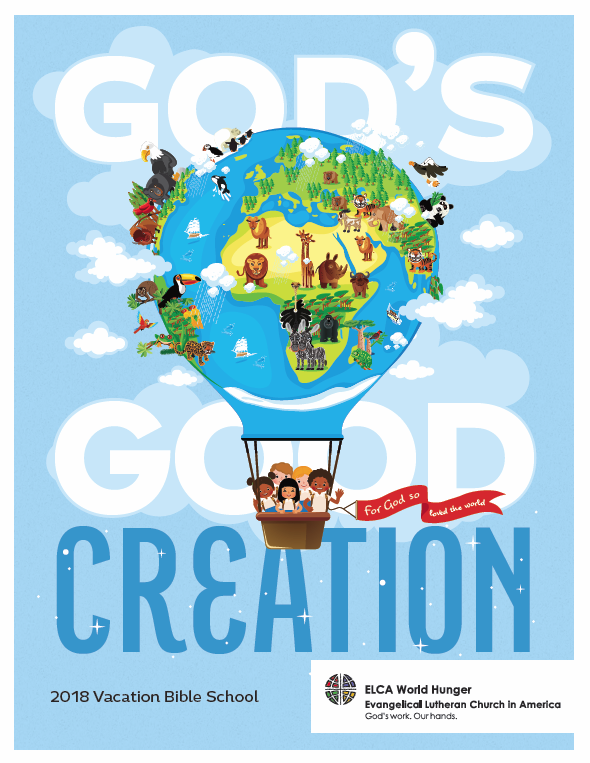
A New VBS for 2018!


It’s hard to believe, but summer is just around the corner, and ELCA World Hunger is happy to announce that “God’s Good Creation,” our new Vacation Bible School program for 2018, is now available!

“God’s Good Creation” is a free resource available in both print and as a download. The curriculum invites children of all ages to explore the many gifts God has given our world – and the ways these gifts can help end hunger. Each day focuses on a different animal that is part of the more than 200 projects supported by ELCA World Hunger around the world, including chicks, goats and bees. Rooted in Lutheran theology, children will learn how God has called them to use their gifts to help their neighbors. In addition to daily plans for up to three hours, the program also includes sample schedules, tips for including children of all abilities and song suggestions.

Themes for Each Day:

  • Day One – God created the world, and it is good (Genesis 1:31).
  • Day Two – God can use you whatever size you are (Matthew 13:31-32).
  • Day Three – God Made everyone different and important (1 Corinthians 12:4-6).
  • Day Four – Jesus uses us to bring miracles to life (Matthew 14:20).
  • Day Five – Working together, we can change the world (Ephesians 4:11-12).

Each day begins with a large group opening, including a skit to introduce the daily theme and the animal of the day. This is followed by “family time” – small group sessions to dig deeper into the theme and bible verse for each day. Then, participants travel through five rotations: crafts, games, snacks, storytelling and a “simulation station” – a fun activity to learn more about hunger and how our faith calls us to respond. (Special shout-out to Lisa Cornwell of Christ the Servant Lutheran Church in Bellingham, Wash., for this idea!) At the storytelling station, children will hear about some of the ways animals are helping our neighbors fight hunger in their communities through projects supported by gifts to ELCA World Hunger. Each day ends with a large group session to recap the theme and lessons.

The program is designed to be flexible and can be used in full or in part for three- or four-day VBS programs. The stories and activities are also perfect for Sunday School, family faith formation and children’s sermons throughout the year!

Free posters and downloadable certificates for participants will be available soon!

If you have any questions about “God’s Good Creation” or ELCA World Hunger’s educational resources, please contact Ryan Cumming, program director of hunger education, at Ryan.Cumming@ELCA.org.