Skip to content
ELCA Blogs

ELCA World Hunger

Advent Study Series: The World Is About to Turn


Week 4: The world is about to turn

 From the halls of power to the fortress tower,
not a stone will be left on stone.
Let the king beware for your justice tears
every tyrant from his throne.
The hungry poor shall weep no more,
for the food they can never earn;
These are tables spread, ev’ry mouth be fed,
for the world is about to turn.
      -Canticle of the Turning ELW 723


Mary’s Magnificat in the Gospel of Luke, paraphrased in Rory Cooney’s 1990 “Canticle of the Turning,” is a powerful testimony of the fulfillment of God’s promise to those for whom the current state of the world just isn’t working. It is a striking testimony to the depth and breadth of God’s love and the significance of God’s promise, a promise that includes not only eternal salvation but also justice here and now.

The Food and Agriculture Organization of the United Nations estimates that there are nearly 815 million people who are undernourished worldwide. This is a tremendously positive change from the early 1990s, when more than a billion people lacked access to sufficient food.

Change is possible. But so much more work needs to be done.

For the first time in a decade, famine was declared this year, with more than 100,000 people in South Sudan caught in the midst of a humanitarian crisis. One million more people in South Sudan were at severe risk of famine. That’s not even to mention the other countries where the risk of famine is imminent: Yemen, Somalia and Kenya. Access to this most basic of needs – food – is rapidly eroding for many of our neighbors. At the same time, many others have been driven from their homes by violence, drought and fear, their arrival in refugee camps and on coastlines and borders challenging the depth of our commitment to hospitality for the stranger.

In Advent, we focus a lot on waiting, expectation and hope for the future. But for our neighbors who hunger, thirst and flee now, the church’s witness cannot just be about the future. And as Lutherans, we know it is not. The world is about to turn, certainly, but Advent is also a celebration that the world has turned, that the fulfillment of God’s promise has already begun.

Mary’s Magnificat is more than a song of anticipation. It is a song of invitation, inviting us to “magnify” the One who has “done great things…shown strength with God’s arm…scattered the proud…put down the mighty…exalted those of low degree…filled the hungry with good things [and] helped God’s servant Israel” (Luke 1:49-54). Mary’ song recalls Isaiah’s prophecy and points forward to Jesus’ declaration:

“Today, this scripture has been fulfilled in your hearing” (Luke 4:21).

The Christmas season that the end of Advent ushers in is just the beginning of the work of God through the church in the world.

In the first session in this study, we began at the end, and now, we end at the beginning. Mary’s song invites us to carry the promise of God forward, to take with utter seriousness the task ahead, with faith that the world has turned, is turning and will continue to turn as God’s promises unfold. It is an invitation to see Advent as preparation for both the bright dawn of Christmas and the work that lies ahead.

Theologian and poet Howard Thurman in his reflection on Christmas captures this sense of initiation in his poem, “The Work of Christmas.”

When the song of the angels is stilled,
When the star in the sky is gone,
When the kings and princes are home,
When the shepherds are back with their flocks,
The work of Christmas begins:
To find the lost,
To heal the broken,
To feed the hungry,
To release the prisoner,
To rebuild the nations,
To bring peace among the people,
To make music in the heart.

We end at the beginning. Advent commemorates Mary’s preparation for a new life growing inside her, a life that represents the coming of a new era. This new life is a turning that brings hope to those who have lived in desperation – and brings anxiety to the powerful who have fostered injustice. Advent is also a story of God’s preparation of us, preparing our church to reveal the transformation of the world that again will offer hope to those who continue to live in desperation – and will again bring potent anxiety to those who continue to foster injustice.

Reflection questions

  1. What does Mary’s Magnificat mean for us today?
  2. Looking back on the past year, how has our congregation borne witness to God’s promise of hope for our world? For our local community?
  3. How can or has our Advent journey prepared us for “the work of Christmas” year-round?
  4. Reflect on each of the lines of the verse from “Canticle of the Turning” and Thurman’s poem quoted above. Which “works of Christmas” in Thurman’s poem highlight the church’s role in revealing the changes God is enacting in the song?

Prayer

Merciful God, you have filled the hungry with good things, remembered your people Israel in your mercy, and lifted up all those of low estate. Grant that we may be filled, remembered and lifted up this Advent. May the work of your promise within us inspire our work of Christmas within our world. Bless our efforts toward justice, peace and wholeness for all creation. In your holy name. Amen.

Hymn suggestions

Canticle of the Turning ELW 723

O Day of Peace ELW 711

Hark, the Glad Sound! ELW 239


To download this entire study, or to see some of our other congregational resources, please visit www.elca.org/Resources/ELCA-World-Hunger.
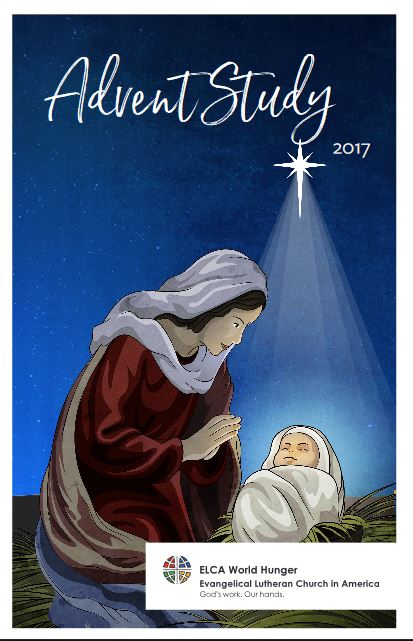

Advent Study 2017

The Augustana College Campus Kitchen – One Year In

Witticisms about college students surviving on cheap noodles and coffee abound, but hunger on campus and off campus is no laughing matter. Just ask the student leaders at Augustana College in Rock Island, Illinois.

With support from an ELCA World Hunger Education and Networking grant, students at Augustana, an ELCA-affiliated institution, launched a new effort to address hunger on campus and in the surrounding community in 2016. The Augustana College Campus Kitchen is affiliated with The Campus Kitchens Project, a national nonprofit and partner of ELCA World Hunger. CKP facilitates student-led initiatives on campuses across the country to target food waste and hunger. Students provide a way for excess food from dining services and other on-campus sources to be distributed to people in need.

At Augustana, the Campus Kitchen student leadership team saw early on that hunger is not just a problem off-campus. Many students themselves face food insecurity and often find it difficult to access the nutritious food they need to get through school and work. In fact, a 2016 study by the National Student Campaign Against Hunger and Homelessness found 48 percent of respondents reported being food insecure in the 30 days prior to being surveyed.

The Augustana College Campus Kitchen began their work by hosting community meals for fellow students. But they didn’t stop there. Below is an update from Lauren Clapp, a member of the leadership team, detailing some of the great work they have been doing the past year. Lauren is a junior majoring in Art History and Communication Studies and is the Education Coordinator for the Augustana College Campus Kitchen. Next year, she will be President of the chapter. Lauren designed and launched the Sticker Program with the help of the leadership team and advisory board and the support of faculty and staff on campus.

Hello from the Augustana College Campus Kitchen!

Community Meals

The meals we offer have been a great success so far and have made a big impact on campus. We have heard from some students that these meals are one of the few times they have access to healthy, sufficient food. We have had two already this year and are amping up for a third very soon. During our second meal we served a record number of 233 meals to students on campus, bringing our total number of meals served to 888 meals since our launch November 2016. Of those 888 meals served, 830 pounds of the food was recovered from our campus dining center! This next meal we are looking forward to hopefully breaking our previous record of 233 meals!

Campus Cupboard

This past term the student leadership team at Augustana launched our Campus Cupboard in collaboration with another organization on campus. So far the Cupboard has received 3,611 of pounds in food donations and given out 2,290 pounds. The cupboard is open 4 hours a week and averages about 36 students per week. As the cupboard’s presence on campus continues to grow we are excited to see what the future will look like!

#starvethestigma

We also know that the stigma about hunger on campus is significant, so we launched a Sticker Program to help raise awareness and reduce stigma. The sticker program is a 45-minute training program for faculty and staff of Augustana College. The program addresses what food insecurity is, what it looks like in the community and on campus, how to address the issue among students, and how to be a resource for those seeking help. Upon completion of the program the faculty or staff member receives a sticker to put on the outside of their office space to let students know they have been through the training and are dedicated to addressing the issue of food insecurity on campus.

The Augustana Sticker Program helps train faculty and staff in hunger awareness.

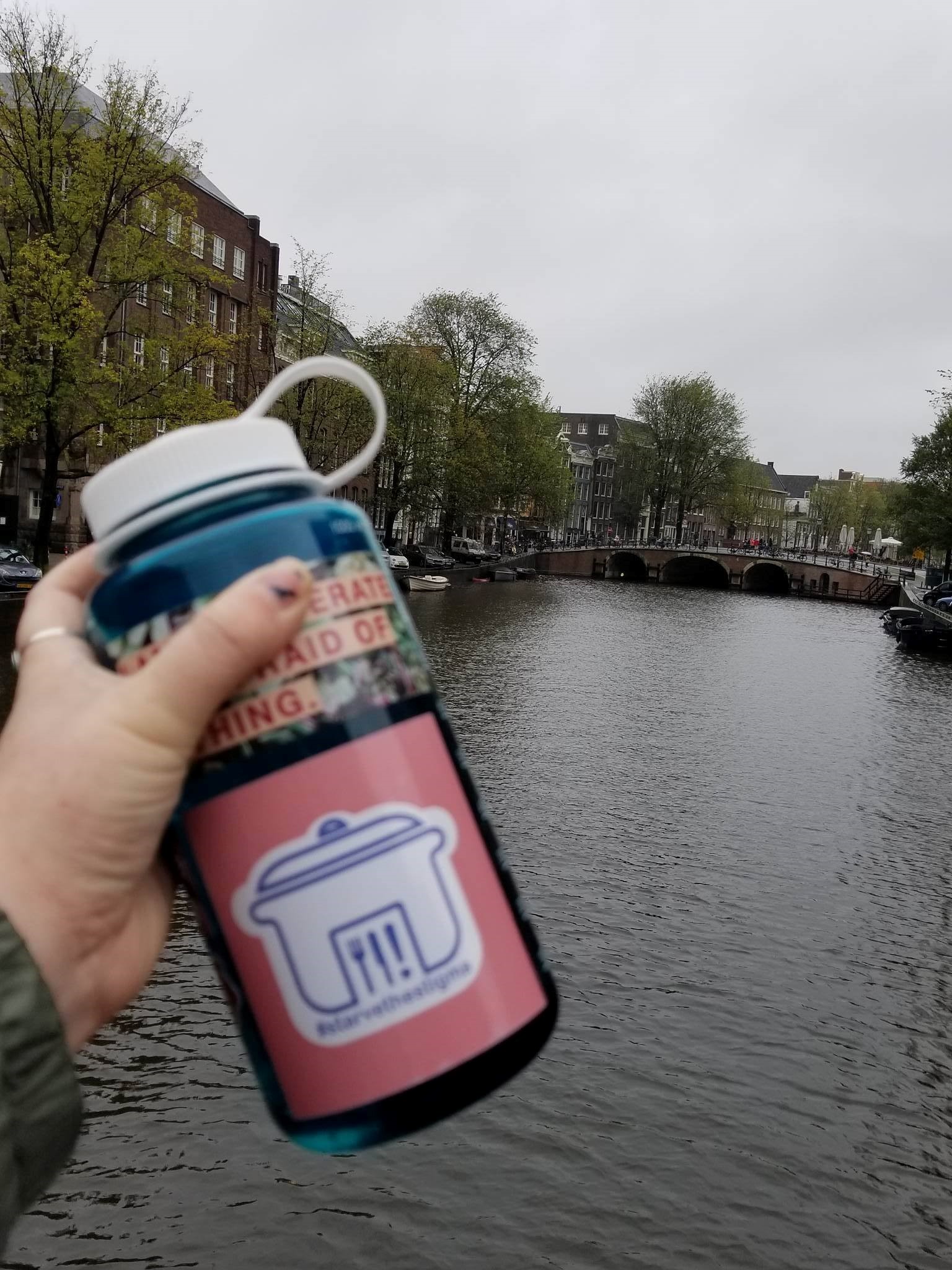
This year, while studying abroad in England, I was able to take my Campus Kitchens Sticker Program sticker along and get some wonderful pictures in different locations that our team was able to use on social media and in advertising for the program.

Outside Buckingham Palace


The sticker program makes it to Amsterdam.

In terms of the future, the Augustana College Campus Kitchens will be presenting the Sticker Program two more times this year to educate our faculty and staff on what food insecurity is, what it looks like on our campus and how they can be resources for the students. We are also looking into attending CKP’s Food Waste and Hunger Summit again this year in March and are hoping to send more than one of our leadership team members. After attending last year with ELCA World Hunger, I returned with enough enthusiasm and information that our entire leadership team is hoping to go and experience the fun!

Thanks to Lauren for sharing this update with us, and to the team at Augustana for their hard work in ending hunger! Check back for more updates to follow their work. 

Follow the Augustana College Campus Kitchen on Facebook! https://www.facebook.com/CampusKitchenatAugustana/


Advent Study Series: Movers and Shakers (Week 3)


Week 3: Movers and Shakers


Have you ever thought of the “movers and shakers” in your community? This is one collective term we often use to describe the people we think of as powerful, important or effective in their leadership. Perhaps they have enough money to buy whatever they want or need. Perhaps they have a seat at important tables where decisions are made. Perhaps they have friends in high places or are in positions of influence.

These are the people who “keep the world turning.” At least, that’s what most of us think.

The Gospel reading this week describes John the Baptist encountering people sent by the Pharisees as a sort of screening committee, checking his references and reviewing his qualifications for ministry. “Are you Elijah?” they ask. “Are you the prophet?” (John 1:21). John the Baptist replies in the negative. He is simply a camel-hair wearing, locust-eating “voice of one crying out in the wilderness” (John 1:23). Yet, this “voice” is one of the most important the people can hear at that moment. The questioners go away dissatisfied; clearly, this crazed man does not have the pedigree it takes to be baptizing and preaching.

Pharisees often get a bad rap in Christian Scripture and history, though they were devout Jews, who believed sincerely in God’s law and God’s promises. Until the middle of the first century, they were known for their ministry among the people in what might have been called the working class of Palestine. Like John the Baptist and other Jews, they knew what Isaiah has prophesied about “good news to the oppressed” (61:1) and “the year of the Lord’s favor” (61:2).

The problem wasn’t that they didn’t believe, or worse, that they didn’t want release for those held captive. The problem was that they didn’t believe God would choose to announce this through a person who wasn’t a “mover or shaker” in the Jewish world.

Yet, the people God chooses to work through in Scripture are often not the people we see as successful, powerful and important. They are tax collectors, shepherds, fishermen, women, craftspeople and even former criminals who would barely merit a second glance in the temple – unless of course, the temple authorities wanted to throw them out.

Yet God lifts them up as disciples, prophets, rulers and priests.

So often, our attention is focused in the wrong places, and we miss what God is working on in our midst. Our eyes are on people with wealth, power and influence – at least, the kind of wealth, power and influence our culture deems worthwhile – and we can fail to see the transformation God is enacting in the overlooked spots in our communities. While the Pharisees were looking for salvation in other places, a poor young woman from an unimportant town was carrying a child that would announce the Advent of Isaiah’s promise.

As many of us look to the traditional centers of power for signs that the world is turning, the world is already turning in our communities. In Minneapolis, youth participating in St. Paul’s Lutheran Church’s Young Leaders Program are taking part in the transformation of their community through art, gardening and entrepreneurship. The word “youth” often implies negative stereotypes – too young, too unruly, too childish. But at St. Paul’s, the community knows that “youth” often means creative, intelligent and motivated leadership – the kind of leadership that can change a community for the better.

Their world is turning because God is working through youth and adults who know that real power is not always found in the places we expect. Their work is supported in part by ELCA World Hunger.

While Advent is a season of waiting for the fulfillment of God’s promises, the Gospel of John, the prophecy of Isaiah and the song of Mary (Luke 1:46b-55) invite us to recognize that God is already at work, “moving and shaking,” in communities our stereotypes about power might make us overlook.

Reflection questions

  1. What does it mean to have power? Who has power in your community?
  2. How have we acted as “screening committees,” denying the worth of the people God might work through in our community or church? How can we remain open to God at work among and through everyone we meet?
  3. What are some ways that our congregation can be part (or is part!) of the transformation God is enacting in our community?

Prayer

God of all our hopes, we wait with expectation for the coming of your son into the world. Forgive us for the ways in which we have been blinded to your presence by worldly wealth and success. As we long for Christmas Day, keep our eyes open to your presence in our midst – in one another, in our neighbors, in the people at our doors. Open our hearts to receive the promise you reveal to us through each other and all creation. In your holy name, we pray. Amen.

Hymn suggestions

Unexpected and Mysterious ELW 258

All Earth is Hopeful ELW 266

My Soul Does Magnify the Lord ELW 882


To download this entire study, or to see some of our other congregational resources, please visit www.elca.org/Resources/ELCA-World-Hunger.

Advent Study 2017

Advent Study Series: Our Baptismal Calling (Week 2)


Week 2 | Our baptismal calling

“In the wilderness prepare the way of the Lord, make straight in the desert a highway for our God. Every valley shall be lifted up, and every mountain and hill be made low; the uneven ground shall become level, and the rough places a plain.”

(Isaiah 40:3-4)


A voice cries out in the wilderness, “Prepare the way of the Lord!”

What does baptism look like in your congregation? How is it celebrated? What rites are practiced? Without consulting an official survey, it’s probably a safe bet that most baptisms don’t involve camelhair vestments, locusts during the after-service meal, or much crying out (except, perhaps, for an infant who just got doused).

Perhaps this wasn’t even what most folks reading Isaiah envisioned when they first encountered John the Baptist, the strange messenger assembling a following from “the whole Judean countryside” (Mark 1:5). But the Gospel makes clear the link between John and the one prophesied in Isaiah, the one who would announce the coming of God’s salvation in the form of the Messiah.

The voice crying out, the one Mark identifies as John the Baptist, “calls for a radical transformation of earthly topography in prelude to a mind-blowing revelation of the glory of the Lord to all people.”

The very natural landscape of the earth will be changed by the arrival of the One who is to come. The author of 2 Peter keeps up this theme, proclaiming that “the heavens will pass away with a loud noise, and the elements will be dissolved with fire, and the earth and everything that is done on it will be disclosed” on the day of the Lord (2 Peter 3:10).

The world is about to turn, mightily, and that transformation is coming.

Mark’s brief but powerful introduction to John the Baptist is a prelude to Jesus’ baptism and the beginning of his ministry. Voices crying out, the transformation of the earth proclaimed, and release to captive Jerusalem is announced (Isaiah 40:1). It is quite the scene!

So, again, the question – what does baptism look like in your congregation?

In baptism, we are made children of God, “sealed by the cross of Christ forever.” In the covenant of baptism, Lutherans believe we are claimed by the power of grace, gathered into community with one another, and send by God’s grace into the world. When we affirm our baptism, we affirm our identity as part of the body of Christ with a solemn vocation to:

  • live among God’s faithful people;
  • hear the word of God and share in the Lord’s Supper;
  • proclaim the good news of God in Christ through word and deed;
  • serve all people, following the example of Jesus; and
  • strive for justice and peace in all the earth.

In baptism, we are baptized into Jesus’ death and resurrection, but we are also baptized into the transformation of the world that God is enacting, a transformation that heralds “new heavens and a new earth” (2 Peter 3:13) in which “God’s glory may dwell in our land” (Psalm 85:9).

John’s pronouncement, drawing on Isaiah’s prophecy, is “comfort” to the people who wait with eager longing for redemption and a word of warning to their oppressors: the world is about to turn, make straight the paths.

Change is coming, and that right soon.

We, the people of God, are called to be part of that chance. In baptism, we are commissioned to increasingly live, hear, proclaim, serve and strive for the transformation of the world. As it was in Jesus’ time, the baptismal announcement today should be joyous news to those anxiously awaiting transformation and terrible news for those who would perpetuate an oppressive and unjust status quo.

What would it look like for the pronouncement of Isaiah and John the Baptist to shape our own practices of baptism, to see the sacrament as the sacred calling, gathering and sending of one who will be part of the very transformation of the world? “I introduce you to the newest member of the body of Christ!” would be words that would shake the foundations of community, for they would announce the re-birth of a person into the work of God “who is turning the world around!”

Reflection questions

  1. How can our celebration of baptism better reflect the commissioning of new Christians to be part of God’s transformation of the world? How does our celebration of baptism already do this?
  2. What voices do we hear “crying out” today, declaring the need for the transformation of the world? What “voices crying out” today do we hear proclaiming the transformation of the world?
  3. Re-read the baptismal covenant quoted above. What do each of these commitments mean to you? How do you live them out in your life?

Prayer

Gracious God, in baptism, you welcome us to fellowship with you and claim us as your own. Give us strength and courage to live our baptismal vocation as a sign of hope to all who await the fullness of your reign. Open our eyes and hearts to see your hands at work in our world, reconciling all creation to you. In the name of your son, Jesus Christ, into whose death and resurrection we are baptized. Amen.

Hymn suggestions

There’s a Voice in the Wilderness ELW 255

Prepare the Royal Highway ELW 264

I’m Going on a Journey ELW446


To download this entire study, or to see some of our other congregational resources, please visit www.elca.org/Resources/ELCA-World-Hunger.


Advent Study Series: Beginning at the End


Advent is a season of hope and expectation. It is a season in which we “prepare the way of the Lord” (Mark 1:3). Advent candles, wreaths and calendars are joined with as-yet unfinished nativity scenes to mark our preparations for the birth of Jesus Christ. This year, ELCA World Hunger’s Advent Study celebrates this season with reflections focused on the preparation of the people of God for the work of the new year – the work of feeding, clothing, accompanying and advocating with our neighbors for a just world in which all are fed.

The four sessions of this Advent Study and the accompanying Advent calendar are based on the Scripture readings for each week of Advent. Each week includes a meditation on the theme, reflection questions, a prayer and hymn suggestions.

May you, your family and your community be blessed this season to see the important role the people of God are called to play in God’s transformation of the world – as individuals, as families and as the church together.


We begin at the end, and we will end at the beginning. What an odd way to go through Advent! We enter this season of expectation of Jesus’ birth and the advent of his ministry, only to start by hearing the words of Jesus describing the end of days. In a few weeks, we will celebrate the beginning of Jesus’ incarnate life among us.

We begin at the end, and we will end at the beginning.

The heavy thumb of Roman rule, high taxes and widespread vulnerability to poverty were all part of everyday life in first century Palestine. The people among whom Jesus would be born were eager for the Messiah who would deliver them. And there was no shortage of “false messiahs” (Mark 13:22) claiming to offer salvation. Some promised military victory over the Romans. Others claimed gifts of magical power and prophesied re-taking the temple.

And yet, here, in the Gospel of Mark, the true Messiah comes offering a very different story. The people of God will not ride triumphantly into Jerusalem – they will “flee to the mountains” (13:14). They will not re-take Jerusalem and its temple – “all will be thrown down” (13:2b).

But “after that suffering” (13:24)…

In the end…

Of all the Gospels, Mark is perhaps the most honest about suffering. Facing persecution at the hands of Rome, early Christians needed a message that was honest about suffering. More than that, they needed to know that God was honest about their suffering. In Mark, Jesus does not hold back in naming that suffering. The Messiah is born into suffering. The people will face suffering. He himself will suffer.

This wasn’t a newsflash to first century Jews any more than it is to the millions of people today for whom suffering is a mournful part of life – those who know the pangs of food insecurity, those who long for clean water, those who grieve the loss of their homes or their jobs. The idea that suffering is a part of life is sadly nothing new to so many of us. But Jesus makes clear two things that transform how we understand suffering. First, God knows our suffering. And, second – God rejects it.

The “great buildings” (13:2) in Jerusalem, which occasioned the beginning of Jesus’ long speech in Mark 13, were not merely beautiful examples of architecture. They were symbols of the powers and principalities that maintained systems of oppression and marginalization and would eventually carry Jesus to the cross. They seem imperishable, unshakable, overwhelming.

But the world is about to turn. And those walls are coming down.

Advent is a season of hope and expectation, but with Jesus’ exhortation in Mark 13:33 (“Beware, keep alert”), we move from “Advent as anticipation” to “Advent as active alert.” As we await the birth of the Messiah, let Advent be a season not of patience but impatience, not of passivity but activity, seeking out those places where God is already at work undoing systems of suffering and living in the daring confidence founded on faith in the promised end of suffering, sin and death.

Reflection questions

  1. How has God been present with you in your suffering?
  2. Where do you see suffering in the world today? How are people of faith actively working to end it?
  3. As people of faith who believe God rejects suffering, how are we called to respond to suffering in the world?
  4. What is the difference between patient anticipation and being on “active alert” during Advent?

Prayer

Loving God, in your incarnation, you took on to yourself our humanity and our suffering. Be present with us today as we face the pain of hunger, thirst, war, disease and neglect. Keep fresh in our hearts your promise of an end to suffering and an eternity of well-being with you. Send us out among our neighbors, that we may share with them your promise and share with you in the transformation of our world. In the name of your son, Jesus Christ. Amen.

Hymn suggestions

Canticle of the Turning ELW 723

The People Walk (Un pueblo que camina) ELW 706

Each Winter as the Year Grows Older ELW 252

To download this entire study, or to see some of our other congregational resources, please visit www.elca.org/Resources/ELCA-World-Hunger.