Skip to content
ELCA Blogs

ELCA World Hunger

Hurricanes Threaten Lives and Livelihoods in Caribbean: Update and Call for Prayers


NOTE: This post was originally published on the Lutheran Disaster Response blog.

This has been a devastating season of hurricanes for our neighbors throughout the Caribbean and the U.S. South. Hurricanes Harvey and Irma have already left a path of destruction, and at the time of this writing, Hurricane Maria has made landfall in Puerto Rico. As response efforts begin and continue, Rev. Albert Starr, Jr., director of Ethnic Specific and Multicultural Ministries and program director for African Descent Ministries for the ELCA, offers this update and call for our prayers for all our neighbors affected by the storms, including those on smaller islands often given too little attention in U.S. national news.

Beloved,

Please continue to hold our sisters and brothers throughout the Caribbean in prayer.

As efforts are being made to respond to the devastating impact of hurricane Irma in the Caribbean, plans are being made in anticipation of yet another hurricane, Maria, which made landfall in Puerto Rico September 20, 2017. Residents of the Virgin Islands and Puerto Rico were urged to take shelter in the available emergency centers as many private homes have already been damaged and structurally compromised by previous storms and hurricane Irma. The island of Dominica and the U.S. Virgin Islands have already been devastated by Maria, a powerful storm right on the heels of Hurricane Irma.

Communications with the islands of St. Thomas, St. John in particular, have been sporadic at best over the past week. St. Croix and Puerto Rico experienced the least impact of hurricane Irma. We have limited reporting out from the ELCA churchwide offices so as not to inadvertently add to the level of anxiety with unverified or false information.

Our Lutheran Disaster Response team here at our churchwide office in Chicago has been in direct communication with Lutheran Social Services of the Virgin Islands, with offices on the island of St. Croix and with Lutheran Social Services of Puerto Rico. For more information on the efforts of Lutheran Disaster Response, please visit the Lutheran Disaster Response blog or follow Lutheran Disaster Response on Facebook.

The U.S. Federal Emergency Management Agency (FEMA) has been on the ground but may withdraw staff and return after Hurricane Maria has passed.

Ms. Junia Stryker, director for Lutheran Social Services of the Virgin Islands has brought on an additional staff person whose work will be dedicated completely to hurricane response in the Virgin Islands. Their staff has not yet been able to make an on-the-ground assessment. Travel between the islands by both sea plane and ferry has been curtailed by continued unfavorable weather. The airport on St. Thomas was restricted to emergency and military air traffic only.  St. John does not have a commercial airport.

As of this past week here are some of the effects from Hurricane Irma:

St. Thomas and St. John

  • Frederick Church sustained damages and is worshiping in the parish hall building.
  • Nazareth Church on St. John island received some damage but is standing. The parsonage was destroyed. St. John is without power and running water. We have heard from Pastor Carlyle Sampson indirectly that he is well but without means of connecting and communicating with all the members across the island. This is true of the ministries and pastors on St. Thomas as well.
  • The hospital on St. Thomas has been destroyed. Patients have been evacuated to St. Croix, Puerto Rico and mainland U.S.
  • The main power plant on St. Thomas was destroyed. Power outages continue. Cell phone access is sporadic. When possible, texting seems to be the best opportunity for connecting.
  • FEMA has set up food and water distribution centers across the island.
  • An island-wide 6 p.m. to 6 a.m. curfew is being enforced.

Please continue to hold our neighbors in prayer this season. If you would like to support the efforts of Lutheran Disaster Response, please visit their “Hurricane Relief” giving page to make a gift. 100% of gifts to Lutheran Disaster Response will be mobilized to support response and recovery efforts related to the hurricanes.

Additional Ways to Give

Checks or money orders can be sent to:
Lutheran Disaster Response
P.O. Box 1809
Merrifield, VA 22116-8009

Write “Hurricane Response” on your check memo line.
———————–
Give by phone at 800-638-3522
New Data on Poverty and Food Security Show Positive Trends, More Work to Do


Each year, the United States Census Bureau updates the statistics on poverty, health care coverage, and the median income for Americans. This research gives us not only a glimpse into how the country is faring in terms of economic opportunity for a given year but also a broad view of historical trends year-over-year.

Around the same time, the United States Department of Agriculture releases new data on food security in the United States. These data help us see how the country is faring in terms of access to healthy, safe food for Americans.

The data for 2016 were released last week and contained few surprises. Before getting into the numbers, though, here’s a few helpful notes on the Census reports. (Many thanks to the Coalition on Human Needs, an alliance of nonprofit organizations that hosts an annual webinar on the census data.)

  • The data are collected annually through two tools: the Current Population Survey (CPS) and the American Community Survey (ACS). Both provide information on similar issues, but the ACS involves a much larger sample, making it possible to get statistics for smaller datasets. For example, you can use the ACS to find the rate of poverty in your state, county or congressional district.
  • The rate of poverty is calculated for the previous year based on the official poverty thresholds for households based on household size. Households with annual income below the thresholds are considered to be poor. This matters a great deal, since some means-based public support – SNAP, TANF, etc. – are based on the poverty thresholds. For 2016, the year measured by the CPS and ACS in the newest data, the thresholds are:
    • 1 person, average – $12,234
    • 1 person, below 65 years old – $12,486
    • 1 person, above 65 years old – $11,511
    • 2 people – $15,585
    • 3 people – $19,109
    • 4 people – $24,563
  • In addition to the official poverty rate, the Census Bureau provides data based on the “Supplemental Poverty Measure.” The Supplemental Poverty Measure has a few key differences that make it interesting. First, it includes forms of “income” that the official measure does not, for example, Social Security income, SNAP benefits, housing assistance and tax credits. It also makes adjustments in the poverty thresholds based on housing costs in a local geographic area. This makes the SPM fascinating, since it can be used to track the effect things like SNAP benefits, Social Security and medical out-of-pocket costs have on the rate of poverty in the US. For example, we can use the SPM to see what the rate of poverty might be without a program like SNAP. Or, we could use it to estimate what the rate of poverty would be if households had no medical out-of-pocket costs.
  • To be statistically significant, the poverty rate has to change by at least .2 or .3 percent. For example, a change in the poverty rate from 15.5% to 15.4% is not statistically significant. For median income, the change has to be about 1 percent to be significant. (Thanks Jared Bernstein, Senior Fellow at the Center for Budget and Policy Priorities for his analysis here.)

Alright, enough notes. Here’s the numbers:

Food Security – 2016

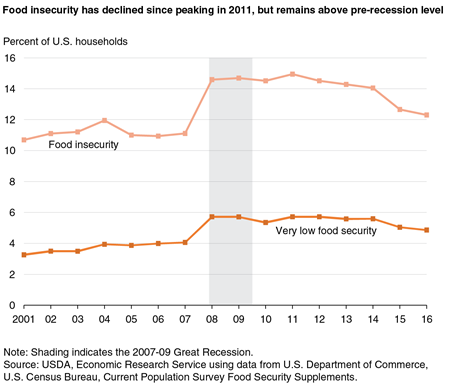
  • 3 percent of Americans – about 15.6 million households – were food insecure at some point during the year. This is down, but not significantly, from 12.7 percent in 2015. It is a significant decline from 2014, though, when 14 percent of Americans reported experiencing food insecurity in 2014.
  • 9 percent of people in the US – about 6.1 million households – had very low food security in 2016, which means that their food intake was reduced and their normal eating patterns were disrupted at some point during the year. This is essentially the same rate as 2015, when 5 percent of households reported low food security.
  • 5 percent of households with children experienced food insecurity in 2016. One interesting note here is that in 8.5 percent of households with children, only the adults were food-insecure. This may be due to the tendency of adults to reduce their own food intake and change their eating habits to ensure that children have enough to eat. Still, in 298,000 households, children, too, experienced disruptions in their food intake due to food insecurity.
  • As you can see in the graph below, the Great Recession caused spikes in food insecurity, which have since abated. But food insecurity still hasn’t declined to what it was before the recession.

Poverty

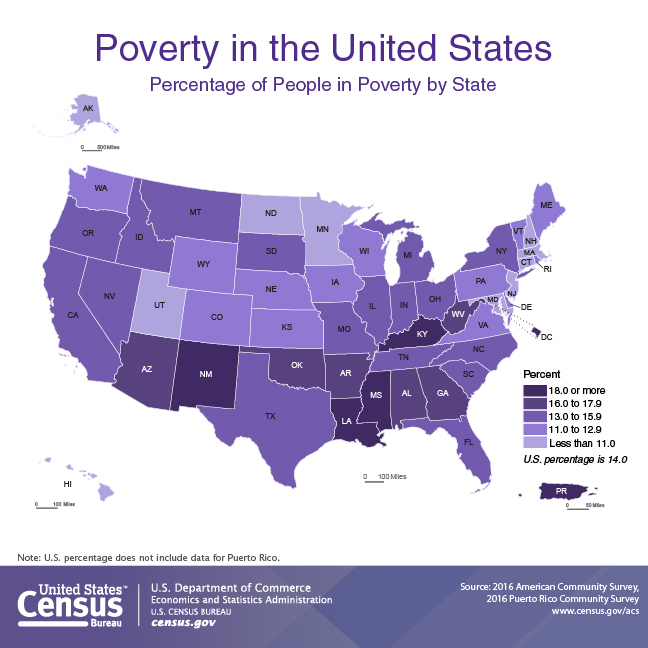
  • In 2016, 12.7 percent of Americans – about 40.6 million people – were living in poverty. This is a decline from 13.5 percent in 2015.
  • While still high, the new rate reflects the biggest two-year decline in poverty in nearly 50 years. 2.5 million Americans who experienced poverty in 2015 had incomes in 2016 that were above the poverty threshold (see above.) This is a tremendous positive change.
  • The number of children living in poverty continues to be high, though we did see a reduction in the number of children living in impoverished households from 2015 to 2016. In 2015, 14.5 million children were living in poverty. In 2016, the number dropped to 13.2 million.
  • The Supplemental Poverty Measure demonstrates the huge impact that government programs have had on the rate of poverty in the United States. For example, Social Security helped 26 million people from experiencing poverty. The Supplemental Nutrition Assistance Program (SNAP) reduced the number of people in poverty by almost 3.6 million.
  • Higher income may be part of the reason for the decline in poverty. For the second year, the median income for American households increased, to $59,039 in 2016. This is still lower than it was before the Great Recession ($59,992 in 2007), but it shows a positive trend, at least from 2014 to 2016.
  • Interestingly, this growth is not necessarily attributable to a growth in wages. Rather, the most likely reasons seem to be higher employment and the effects this has on household income. Wage growth, unfortunately, remains slow.

Altogether, the news from the US Census Bureau shows the positive effects of economic growth, as well as the importance of public programs like Social Security, SNAP, housing assistance and others. For a full report on the new data, see  https://www.census.gov/topics/income-poverty/poverty.html.


Disaster and Hunger – Harvey’s Long-Lasting Effect


“Disasters are a leading cause of hunger, affecting all aspects of food security: economic and physical access to food, availability and stability of supplies, and nutrition,” according to the World Food Programme. The Food and Agriculture Organization of the United Nations estimates that as much as 25 percent of the damage and economic losses caused by disasters in developing countries falls on the agriculture sector – a huge problem when we consider the sheer number of people dependent on agriculture worldwide.

The immediate losses of homes and lives caused by Hurricane Harvey have been devastating in Texas:

But these numbers don’t fully capture the long-term and long-range effects the disaster may have on food security and the economy, particularly for farmers in Texas and beyond. Whether left in the fields or stored in bulk, crops such as grain, corn, wheat cotton are all likely to be affected.

“I can’t think of a crop that is designed to handle four feet of rain in a short period of time,” Mike Steenhoek said in a recent interview. Steenhoek is the executive director of the Soy Transportation Coalition. While many crops in Texas have already been harvested, anything still waiting for harvest will be at a risk of a total loss. Crops that have been harvested – rice, corn and the like – are at risk of contamination from floodwaters.

Even crops shipped from other states are at risk because of structural damage to infrastructure. Damage to roads and railroad lines may cause grain elevator operators to lower commodity prices that are paid to farmers from as far away as Kansas and Illinois. Steenhoek estimates that nearly a quarter of the country’s wheat is shipped through the Texas Gulf region, creating uncertainty for farmers across the country.

The road to recovery from Hurricane Harvey will be long. The pictures and videos coming across the news wires today are important calls to action to respond in the here-and-now, but as a recent editorial in the Chicago Tribune points out, “it’s important to remember Houston and neighboring areas once the sun is shining” and the storm (and media attention) has passed. Lutheran Disaster Response, the ELCA’s primary ministry accompanying communities faced by disaster, has been hard at work through its affiliate in the area to respond to the devastation of Hurricane Harvey. But we know from experience that this will be a years-long effort. Local congregations and affiliates of Lutheran Disaster Response are still at work in communities now years past their own disasters.

We also know that hurricane season is far from over, and even now, authorities are keeping a close eye on Hurricane Irma as it winds its way across the Atlantic.

It may be easy to see vulnerability to storms like Harvey as a regional issue, but with the widespread effects on food supply and livelihoods for farmers, the effects of disaster aren’t limited by regional or state borders. Thankfully, neither is the concern of our church and of other people of goodwill. Please keep in your prayers the people affected – directly or indirectly – by the storm, the first-responders working tirelessly to assist victims and the many folks who will be invested in long-term recovery.

For more information on the recovery effort, visit the Lutheran Disaster Response blog to sign up for updates. You can also read an article featuring interviews with staff from Lutheran Disaster response here. To support Lutheran Disaster Response’s accompaniment of communities affected by Hurricane Harvey and other hurricanes in the United States, please visit https://community.elca.org/ushurricanerelief?_ga=2.153566650.3498744.1504023048-1341912399.1476461047.