
Skip to content
ELCA Blogs

ELCA World Hunger

Hunger and Higher Education: The Campus Kitchens Project

Elyssa J. Salinas

August 27, 2015

Last night I went to the grocery store near closing, and I noticed how much food was still out in the produce section. There was an abundance of avocados, a plethora of pears and a bounty of bananas. There was no way that this would sell out by closing, so I wondered, what will happen to this food?

When we throw out our garbage, how much is food waste? We throw away leftovers, excess food that goes bad and remnants from our cooking. In larger settings like restaurants and schools, much of the food prepared for large groups may go unused. Food waste is astronomical in the United States, but how does that compare to the multitudes of people who go hungry every day? The Campus Kitchens Project, based in Washington, D.C., is working to raise awareness about food waste and hunger and to help college and university students do something about both.

ckp.jpg

The project makes use of the leftover, quality food from schools and grocery stores that would otherwise be wasted and uses it for meals in the community. Students run Campus Kitchens at their university or college and are able to have hands-on experience in running a non-profit initiative while working with partners in their local communities. There are currently 45 schools that are part of this initiative, which spans the country from coast to coast. The project’s mission is to strengthen bodies, empower minds and build communities through empowering and educating students about what they can do to combat food insecurity in this country.

Every Campus Kitchen has the same general model to combat food insecurity in its community. Waste is curbed with food recovery that takes uneaten, quality food from places like campus dining services or local grocery stores. There is meal preparation, which trains volunteers to use the donations to create balanced and healthy meals. Meals are delivered to organizations or families in the area where the students make connections with the recipients. These connections enable the students to get a better understanding of the issue of hunger through relationships and conversations. These Campus Kitchens also provide education and empowerment to families in the community, including culinary training with unemployed adults and children’s programs on nutrition.

Through an Education and Networking Grant, ELCA World Hunger has helped support The Campus Kitchens Project’s work to promote opportunity and raise awareness about food insecurity.  ELCA World Hunger and the project agree that hunger cannot be solved by food alone. Education, advocacy and, especially, building relationships within communities are key parts in stopping hunger for good. At Campus Kitchens, as at many ELCA World Hunger-supported ministry sites, food is an entry point for a deeper, long-lasting relationship with neighbors.

To learn more about The Campus Kitchens Project please visit http://www.campuskitchens.org/start-a-kitchen/ or email Matt Schnarr, the Expansion and Partnerships Manager at mschnarr@campuskitchens.org.

To learn more about ELCA World Hunger Education and Networking grants, visit http://elca.org/News-and-Events/blogs/ELCAWorldHunger/646.

Elyssa Salinas is program assistant for hunger education with ELCA World Hunger.  Please direct comments or questions to Hunger@ELCA.org.
Cleaner Cooking in Bangladesh

Ryan P. Cumming

August 20, 2015

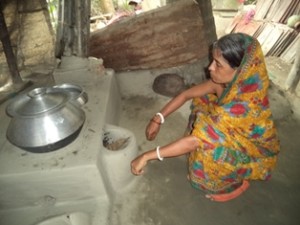
Ramoni Rani and her husband, Nor Uttam Hawlader, live in the village of Rajakhali in Bangladesh with their two sons. Like many Bangladeshi farmers, Ramoni and Nor use wood-burning stoves to cook food in their homes. The cost for fuel for the stoves can be very high for families with limited incomes, around 4,000-4,500 takas (about $50-57 per month). Wood-burning cookstoves also produce a lot of smoke, a key culprit in many health problems. In fact, a 2009 profile of Bangladesh from the World Health Organization found that indoor air pollution contributes to nearly 50,000 deaths every year. Ramoni, Nor and their children suffered from respiratory illnesses and eye problems because of the smoke in their homes.

Case Story on Improved Stove

Because of problems related to health, the cost of fuel and the risk of indoor fires, the Bangladesh Science and Industry Research Council developed an improved cookstove called “bondhu chula.” Yet, a Yale University study published in 2009 found that many Bangladeshis are reluctant to use improved cookstoves for a variety of reasons. Some of the Bangladeshis they surveyed didn’t know how to use the new stoves. Many had never even seen an improved cookstove. Nearly all worried about the cost.

Addressing some of these difficulties, Lutheran Health Care Bangladesh, supported in part by ELCA World Hunger, introduced bondhu chula stoves to 256 women, with significant, far-reaching goals:

  • reduce cost of fuel for cooking;
  • reduce the rate of respiratory infections and eye problems;
  • reduce the time women spent cooking;
  • reduce the number of trees cut down for cooking fuel; and
  • reduce carbon emissions from stoves.

By giving women in the Dumki Upazilla region of Bangladesh the improved cookstoves and offering training in using them, Lutheran Health Care Bangladesh helped many women provide a safer, cleaner and more affordable way to cook for their families. Ramoni and Nor, who participated in the program, found that the new stoves cut their costs and the time they spent cooking in half. Now the health problems they and their sons had are all but gone, and Ramoni and Nor can spend the extra money on taking care of their children.

The use of more efficient cookstoves is also a step toward better care of creation in Bangladesh.  According to a 2009 report from the Food and Agriculture Organization of the United Nations, nearly 2,000 hectares of forest are lost in the country every year. This results in a “serious imbalance in the environment of Bangladesh,” according to representatives of Lutheran Health Care Bangladesh. This makes the increased use of improved cookstoves – and the country’s growing emphasis on planting trees – even more important.

By providing clean, efficient cookstoves to Ramoni, Nor and more than 250 other people, Lutheran Health Care Bangladesh is meeting the significant goals of its program. Slowing the deforestation of rural Bangladesh, improving the air quality in homes, and freeing time and money for other activities are made possible in part because of gifts to ELCA World Hunger. This sustainable solution to deforestation, indoor air pollution, and high costs for fuel is an innovative way Lutheran Health Care Bangladesh is making an impact, while demonstrating how care of creation can make good economic sense for families.

Ryan P. Cumming, Ph.D., is program director for hunger education with ELCA World Hunger.  He can be reached at Ryan.Cumming@ELCA.org.

Hunger and Higher Education

Elyssa Salinas

I never thought that I would use a food pantry, but my first year in seminary changed that. I came to campus with barely enough money for a few school supplies and a meager pantry. It was embarrassing and I honestly thought I was the only one who needed help. My family was unable to help and I was anxious how I would survive the school year. On the day of orientation there was a bunch of announcements, but one in particular gave me a sense of belonging. There was an announcement about a food pantry on campus, where everyone was welcome. At first I was embarrassed as I walked toward the empty gym, but then I saw my classmates smiling and asking if I had enough for the week. There was no shame or stigma, just the honesty of our situation as students.

In recent years, college and graduate students are becoming the new face of food insecurity in the United States. The stigma usually associated with food and higher education is the weight gain associated with the glibly titled “freshman fifteen” (a fact in my experience), but now students have a different worry: how am I going to pay for food this week?

A study done at Western Oregon University found that 59% of students were categorized as food insecure. Food insecurity is defined by the United States Department of Agriculture as, “limited or uncertain availability of nutritionally adequate and safe foods or limited or uncertain ability to acquire acceptable foods in socially acceptable ways.” There could be many reasons for students to be vulnerable to food insecurity for instance, rising tuition costs, not qualifying for food stamps, cost of living, or the shifting demographic of students that come from low income groups or are first generation children of immigrants.  The 2008 recession was also a significant factor for many students.

The consequences for students facing food insecurity are steep. They include links to depression and lower academic performance, because how can you focus on a test when you are unsure of where your next meal is coming from?

Many campuses have started to respond to this reality through relief programs. According to a report in the Los Angeles Times, there were nearly 200 food pantries or banks for students across the country by August 2015.  Yet there is also a great deal of stigma surrounding hunger, so students are hesitant to talk about it. Although I had a great deal of support from my school and I confided in close family, this is the first time I am publically acknowledging my food insecurity.  Aware of this, some campuses have developed new models of pantries to alleviate stigma.  There are also programs that allow students to donate unused “swipes” of their meal cards to fellow students or other members of the community.

In a parable from Matthew 25, Jesus reminds us that when we feed one another, we are also feeding him. “Truly I tell you, just as you did it to one of the least of these who are members of my family, you did it to me” (Matt. 25:40b). When I was given that first handful of food from one of my peers, I was overjoyed that I would be fed and I was comforted that my community was helping to feed me.

To learn more about starting a campus food pantry, see this handy guide from the Oregon Food Bank.

To learn more about swipe programs, see Swipe Out Hunger.

Look for a post on our blog next week about the Campus Kitchens Project, a partner of ELCA World Hunger!

Elyssa Salinas is the program assistant for hunger education with ELCA World Hunger.  She can be reached at Hunger@ELCA.org.

Hungry. And surrounded by food

Jenny Sharrick

August 3, 2015

I have a very complex relationship with food. I absolutely love it. My favorite food changes almost daily because there are so many incredible ones from which to choose. So many flavors to experience within a short life. But often food does not love me. Or perhaps, a better way to explain it is that my body does not love food. You see, I have an intestinal disorder called Crohn’s disease. It means that portions of my 22 feet of small intestines can become ulcerated (like a bunch of open sores, but on the inside) and inflamed. Crohn’s disease, along with ulcerative colitis, is part of a group of diseases known as Inflammatory Bowel Disorders (IBD), which affect 1.6 million Americans.1

Personally, I don’t like to draw attention to my illness and generally I give a non-committal non-answer when people ask how it affects me: “I have good days and bad days; but I’m always hopeful for more good than bad.” It’s hard to talk about an illness that is invisible to everyone else. It’s even harder to talk about an illness when it presents with the symptoms of Crohn’s. And sometimes, I would just rather pretend that my body is healthy and that nothing is wrong. But the reality is that it always affects my body and sometimes it means I’m in excruciating pain when I eat.

But the worst part of all is not the lack of food. It’s the lack of fellowship. We encounter Christ at The Table. And we encounter Christ around our tables at home with friends, family, and new acquaintances. When we want to “catch up” with others, the first instinct is to grab lunch, ice cream or go for coffee. Without the ability to eat, it becomes nearly impossible for fellowship, communion, and emotional support.

Crohn’s can be so isolating. I can find ways to sneak in enough calories to survive until tomorrow with easily digested foods such as pureed baby food or nutritional shakes, but it’s harder to find ways to sneak in authentic time and experiences with friends that don’t end up exhausting me further. It’s hard to find those moments to say “I really need to be in fellowship with you, but I can’t continue to pretend like going out for Indian food isn’t the worst idea I’ve had all week. Can we just sit here on my couch and chat without any refreshments?”

I spend a lot of my life thinking about various aspects food. My favorite de-stressing activity is to bake any and all desserts (I’d be lying if I didn’t say I also love eating desserts, too!). I’m always in search of a good recipe on Pinterest. I am on my synod’s “(anti-) hunger team” within the ELCA. My congregation is involved in anti-hunger ministries including a food pantry and a food co-op. My research focus for my Masters in Public Health (MPH) is rural food insecurity. I even come from a long line of food-growers. Some day I will inherit one and a half farms in Nebraska (although truthfully I know very little about the actual process of growing food other than what I’ve gleaned from my unsuccessful ventures in gardening and what I’ve heard about the process of farming around the dinner table growing up). The thing I’m most looking forward to when I return home to Nebraska is my weekly bag of vegetables, fruits, cheeses, eggs, honey and freshly baked bread from local farmers and producers.

Even after all that thinking and reflecting on different aspects of food, I still struggle daily with what it means to come to the T(t)able and not be able to eat, regardless of the reason.

Food is everywhere. It’s engrained in my life and also in yours. It’s in the news (the newest fad diets, research about what we should or should not eat, advertising campaigns about food), and it’s in our homes and most places we visit. It makes sense. Food is literally life-sustaining. But now, more than ever, I can recognize how much fear and anxiety food can cause for people.

I have never been without access to enough food. I’ve been lucky enough to be food secure my whole life. I’ve always known that I can find food. But I can resonate with the 49 million people in the United States who are food insecure.2 Even more so with those who are food insecure and have IBD, an eating disorder or a food allergy.

I am often also hungry for the communion with others that comes from breaking bread, salad and casserole around the table.

Sometimes “feeding the hungry” also includes those of us who would give anything to be seated with you, but can’t. Can’t because of allergies. Can’t because our psychological relationship with food is disordered, for example, by anorexia, bulimia, or other eating disorders. Or can’t because of tiny pockets of inflammation that we don’t like talking about.

We are often surrounded by a sea of food but still drowning in our inability to eat any of it.

Jenny Sharrick is the 2015 summer intern with Constituent Engagement with ELCA World Hunger.


1 http://online.ccfa.org/site/PageServer?pagename=TS_homepage

2http://www.feedingamerica.org/hunger-in-america/our-research/map-the-meal-gap/child-food-insecurity-executive-summary.html?referrer=https://www.google.com/