Skip to content
ELCA Blogs

ELCA World Hunger

An Earth Day Reflection

Gina Tonn

April 22, 2015

10301134_10153135917120428_5147120092565945873_n

How do you honor God’s creation? Part of my spiritual practice is being a morning person, to honor the light by greeting it early, allowing the new dawn to fill me with the spirit. Each new day is an opportunity to continue the work we are called to do, refreshed and renewed through sleep and new light. I sense hopefulness of morning; I am filled with hope for the world, in our ability to create positive change, for there to be more people fed and nourished each day. I have confidence in the abundance of God’s creation; I see the divine in everything the sun touches.

Even as I honor God’s creation in my rising, I often take the earth and God’s gifts for granted in my living. I confess to being a lesser steward of the earth than I am called to be. I confess to my crimes against the environment – both things done and left undone out of laziness, convenience and self-centeredness. I confess to ignorance about where my food comes from and how it’s grown. I confess to ignoring future degradation for the sake of present quality of life.

My actions contribute to climate change. Climate change disproportionately affects people who live in vulnerable conditions, who experience poverty and hunger. As we observe Earth Day this week, let’s not only recommit to changing our attitudes and actions toward the earth and resources, but also to changing our attitudes and actions about food security, production and access around the world.

This year, the Earth Day Sunday Resource[1] produced by Creation Justice Ministries, formerly the National Council of Churches Eco-Justice Program, asks “How does food production and consumption impact the climate? How does climate change affect growing and accessing food? How are we sharing communion with God, one another, and all creation?”

In the ELCA Social Statement Caring for Creation: Vision, Hope and Justice, our church corporately confesses that we arenot in communion with all creation because of our alienation from God and creation, through captivity to sin. We proclaim God as creator of the earth. We live and work within a scientific world. Divinity and science need not be at odds. As Caring for Creation suggests, “In our time, science and technology can help us to discover how to live according to God’s creative wisdom.” In the United States today, use of science and technology to protect and honor creation is often controlled and dictated by our government. One way we can encourage and participate in ways our government takes action on climate change is through ELCA Advocacy. Other ways to get your congregation involved in caring for creation can be found through Lutherans Restoring Creation, an organization supported in part by grants from ELCA World Hunger.

But caring for creation cannot only be scientific and political; care for the earth is a profoundly spiritual matter.[2] So I will continue to honor God’s creation by rising with the sun and by looking for the divine in the beauty of the earth. I will also work to love God’s creation by mitigating my environmental footprint, better stewarding resources, and accompanying my neighbors near and far who are most susceptible to climate change because of food insecurity. Earth Day is not only an opportunity to celebrate and renew our commitment to environmental sustainability, but also to renew our love for neighbor, as we too were made of earth.


Gina Tonn serves as Program Assistant for Education and Constituent Engagement with ELCA World Hunger through a placement in the Lutheran Volunteer Corps. 


[1] Have you anything here to eat? includes resources and ideas for worship and congregational life such as liturgy, prayers, discussion questions, and action steps.

[2] Paraphrase from Caring for Creation, “Even as we join the political, economic and scientific discussion, we know care for the earth to be a profoundly spiritual matter.” ​

Mahdi’s Story – Kakuma Refugee Camp, Kenya

Gina Tonn

​The Kakuma Refugee Camp in northwest Kenya is host to 180,000 individuals,[1] more than 100,000 of whom are children. Since its establishment in 1992, the camp has become home to refugees from South Sudan, Sudan, Burundi, Ethiopia, Somalia and the Democratic Republic of Congo. Grants from ELCA World Hunger, in partnership with the Lutheran World Federation Department for World Service (LWF-DWS) Kenya-Djibouti Program, help to support programming for children in the camp.

A March 2015 update from the  Kenya-Djibouti Program states that the core of its work in Kakuma for the coming year will focus on education, child protection and community services.  ELCA World Hunger is directly supporting the Anti-Child Labor Campaign project for 2015.  The Anti-Child Labor Campaign will focus on increasing advocacy capacity through trainings for community-based organizing within the Kenyan host community and working to improve school environments with in the Kakuma Refugee Camp. The campaign seeks to offer children protection and support by increasing access to education for children who have been subject to child-labor violations throughout Turkana West District and within Kakuma Refugee Camp. According to the LWF DWS Kenya-Djibouti Program website, the organization is committed to protecting the rights to life, survival and development of children who call the Kakuma Refugee camp home.

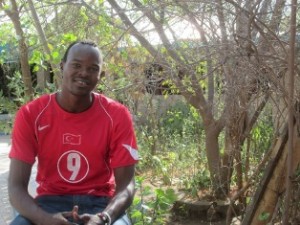
Mahdi Riek Khor is a South Sudanese refugee, Kakuma resident, elected community leader, Child Protection Community Development Worker, aspiring politician, and only 23 years old. Thanks to the LWF Kenya-Djibouti Program, we are able to share his story with you:

Mahdi - Kakuma

Mahdi says, “Me, one day, if God is willing, I want to be a politician. As a politician I will maintain peace. I will be transparent, I will consider different cultures and I will accept being corrected. As a politician, I will consider any human being as a somebody.”

In December 2013, Mahdi became the first secondary school graduate in his family and was returning home to Bentiu to see his mother after 13 years apart, when violent hostilities disrupted his journey. ‘Fighting reached Unity State on the 19th of December. I remember it. There was a lot of destruction – guns, killings, arbitrary arrests, rape of women and girls. I had to come to Kakuma for safety.’

Mahdi is one of more than 45,000 people to reach Kakuma Refugee Camp, in north western Kenya, since December 2013 – among almost 2 million South Sudanese people to have become displaced inside or outside the country in the same period: ‘Life is a struggle in Kakuma. I can’t meet my basic needs. I am providing for 9 nieces and nephews. I don’t have good shelter, I’m not comfortable in the environment, there are no televisions to watch the news and learn about the world. Now the only world I know is inside Kakuma.’

Despite this, Mahdi is among 90 refugees who work with LWF as Child Protection Community Development Workers, working to prevent and respond to child protection issues across the camp’s population of 101,000 children. In Kakuma IV, the camp’s newest area, the team is supporting children with various protection concerns: children separated from their parents and family, children who have experienced or witnessed notable violence, children vulnerable to sexual exploitation and abuse – most of whom have lost everything and need much more than agencies can provide. ‘Child Protection work is very, very hard,’ Mahdi says. ‘It’s the working environment, going door to door, walking very far when the condition is too hot. We have a problem with promises. We want to help but we can’t always fulfil [needs], so some people see us as an enemy. They think we are lying.’

Refugees working to protect children in their own camp communities show courage and commitment. The work is challenging, resources are limited and cultural practices often conflict with the rights that workers are trying to promote. Mahdi considered the question of why he continues with the work. ‘I want to encourage children… Life has many challenges… it is my responsibility to help protect people. These cases, when you can resolve a situation, reunite a child with their family. I reunited two children with their parents and the children were most happy. They were so, so happy. That’s why we do the work.’

It is easy to imagine Mahdi as a very successful leader in the future. ‘Here in Kakuma, we hope that opportunity will come. Kakuma teaches us to live in a hard situation but I see now that I have met people here I would not have met outside. You can learn from different nationalities – their culture, their attitudes, we can learn from them.’ And in the meantime, Mahdi is working hard to support children in Kakuma – considering every child as a somebody.

ELCA World Hunger is proud to be a part of LWF Department of World Service’s ongoing commitment to education and development for children, and protection of rights and wellbeing for all children at Kakuma and around the world.

​Madhi’s profile written and provided courtesy of the LWF Kenya-Djibouti Program

Gina Tonn is a Program Assistant for Education and Constituent Engagement with ELCA World Hunger through a placement in the Lutheran Volunteer Corps. 

[1] UNHCR, February 2015

Welcome Elyssa Salinas – Program Assistant for Hunger Education!

Elyssa Salinas

Please welcome our newest colleague in ELCA World Hunger – Elyssa Salinas!

es

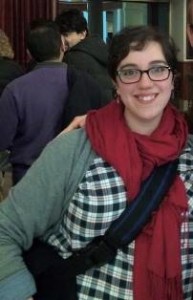
Hello! I’m Elyssa Salinas and I’m thrilled to join ELCA World Hunger as the program assistant for Hunger Education! Currently I’m finishing my Masters of Divinity at the Lutheran School of Theology at Chicago, and I will be graduating in May! I’m originally from the Chicago area, growing up in Oak Park and Des Plaines. I attended Valparaiso University and pursued a degree in theatre, enjoying roles such as Lady Bracknell in The Importance of Being Earnest and Sir Toby Belch inTwelfth Night. Also in college I began to develop an interest in gender studies and performance poetry.

After graduating in 2012 I decided to take the advice of one of my professors and give the East Coast a try, so I decided to attend the Lutheran Theological Seminary at Philadelphia as a Fund for Leaders scholar. While there I got a job with a nonprofit organization that worked with families dealing with home instability in connection with a diverse pool of faith groups in the area. This experience provided me with an opportunity of engaging my faith with social issues I felt (and still feel) strongly about.

Throughout my time in college and seminary I spent four summers working near Santa Cruz, California, at Mt. Cross Ministries, a Lutheran camp set in the Santa Cruz Mountains. Mt. Cross gave me a chance to experience the West coast and engage with youth, where every day was about seeing God through their eyes.

Throughout my discernment process in Philadelphia I found that my call was not what I expected, and so after two years I decided to transfer back home to Chicago and pursue a call in teaching. I’m happy to be home and close to my family while I continue to follow my path in education. This Fall I will start my Ph.D at LSTC in systematic theology and sexual ethics, where I plan to focus on body/sex shaming and how to embrace our bodies as God embraces each of us, as children of God’s abundant love. I am an advocate for positive body image, and I challenge myself and others to see each of us as God sees us, beloved and beautiful.

Poetry has been a vehicle to explore my own challenges with body image and my identity as a Latina. I have been performing poetry for the past few years at various open mic performances in Philadelphia and Chicago along with using poetry as part of my academic career. Currently I’m working on a book of poetry from the point of view of biblical women, especially Old Testament women such as Hagar, Dinah and Jael.

Fun Facts about Elyssa!

  • I was a competitive public speaker for 7 years!
  • My favorite movie of all time is Beauty and the Beast, and I love Disney! My mother is the only person to beat me at Disney trivia.
  • I got my first poem published this year in Thinking Theologically!
  • My CTA commute always entails a book and I’m always looking for more to read!

Exploring: Relief

Ryan P. Cumming

Exploring: Relief

In this series of posts, we will take a closer look at some of the areas of work ELCA World Hunger supports domestically and internationally.  This week, our focus is on “relief.”

What Is Relief?

Relief is any response to immediate needs.  When someone comes to the door hungry, they are fed.  When someone is hurt, they are treated.  Relief might not look toward long-term solutions, but it is the most immediate response we can offer when we encounter someone in need.  Occasionally, relief can also be the best response to the needs of people who might never be able to reliably meet their own needs.  For example, someone who is unable to work due to a very serious injury might never be able to earn enough income to feed themselves.  Relief ministries can step in and fill this gap.

It is very important, though, to remember that RELIEF IS NOT THE SAME AS RESCUE.  Whether someone volunteers at a food pantry, receives a hot meal at a church, or packs backpacks of food for children on the weekend, relief should always be thought of first and foremost as work we do together – whether we are receiving food or providing it.  Relief done well creates a table at which ALL can be fed.

As Lutherans, we recognize that hunger takes many forms – physical hunger for food, emotional hunger for support or intimacy, spiritual hunger for fulfillment and so on.  Relief ministries aren’t simply a way for struggling families to be fed with food; they are opportunities for those serving to be fed spiritually, socially and emotionally, by being invited to share in the meaningful relationships that can be created when God draws together people who might otherwise not encounter one another at work, school, or home.  Seeing our mutual need as both recipients and providers can be an important first step in helping our ministry be guided by the dignity of the people involved on every side.

Roots of Relief

One of the clearest places we see relief in our scripture and tradition is in the miracle stories of the Bible.  In the Old Testament, we hear of God providing manna to the wandering Hebrews.  After they left Egypt, the people roamed through the wilderness, seeking the land God had promised them.  This story gives us some helpful tips for what relief ought to look like.

First, God isn’t just an outside “hero” who rescues Israel.  Rather, God is walking with them, accompanying them as they make their way to Canaan.  Because God is traveling with them, God knows their need, and God provides.

Second, God’s relief is given during a time when the Hebrews simply could not support themselves.  Without land, these agriculturalists would have been hard-pressed to provide for their families.  God’s relief is given in response to the expressed needs of the people and with an eye toward their future well-being and livelihood.  The goal isn’t to provide just enough of one kind of relief (manna) so that the Hebrews remain dependent.  Nor is it given to assert God’s worth over and above the worth of each human being.  It is given in love and hope, to support the Hebrews on the journey to a new life that they will build in cooperation with God.

Third, the Hebrews aren’t just passive recipients; they are part of a relationship with God and important actors in the progress of God’s plan for Israel.  There is no covenant without God, and there is no covenant without people.

Finally, and this seems almost to go without saying, Moses isn’t God.  No human leader, no human participant in the community is so elevated that they become replacements or substitutes for God.  God’s way of relating gives all of us an ideal picture of what relationships can look like, but there is a big difference between helping our community meet its needs and being the Creator and Sustainer of all existence.  In the wilderness, God uses the people’s gifts – Moses’ gift of leadership, Miriam’s gift of music, Jethro’s gift of counsel.  Each gift counts, each person matters.  There is a measure of equality among the members of the community; once they are confronted by the majestic powers of God, any minor distinctions between individual humans pale in comparison.

In the New Testament, Jesus provides excellent examples of relief in the stories of healing.  On the surface, this relief seems pretty straightforward.  Someone has a disease or disability; he or she asks Jesus for help; Jesus provides immediate help.  End of story, right?  Not quite.

As biblical scholars have pointed out, to have a disease like leprosy or a disability like blindness in Jesus’ time meant something very different than it does today.  To have leprosy was to be an outcast, someone who could never be “clean” enough to dine with others or to go to synagogue.  To have a permanent disability like blindness was thought to be a sign that a person was cursed by God for some failing.  Jesus, by healing people around him – indeed, even by touching them – was turning both of these notions on their heads.  People with disabilities weren’t cursed by God; they were loved by God – so much so, in fact, that Jesus is willing to break the law by healing on the Sabbath (Mark 3:16; Luke 13:10-17.)

Jesus wasn’t just healing people; he was subverting social mores that tossed justice and compassion out the window.  Relief ministries of today, when done faithfully, are important witnesses against a society that believes people’s suffering is ordained by God or that people who have real needs will somehow “taint” the community.  (If you don’t believe this happens today, I would invite you to read this fine article on recent laws passed to keep homeless people out of public spaces.)

Everyone Jesus meets is in need of healing, not just those who different physical abilities or illnesses.  Providing immediate relief to people who hunger for food, for companionship, for fulfillment – when done in love, in solidarity, and with an eye toward future well-being – can be a powerful testimony to the worth and dignity of every human being, including those who have been invited to serve.  And often, such a ministry can create a cycle, with clients of a ministry often using their talents and skills as volunteers or employees.

Examples of Relief

Relief ministries are some of the most vital ministries ELCA World Hunger supports.  Here are some examples:

Peace Lutheran Fellowship in Port Ludlow, Washington, provides an average of 20 backpacks of food to children who are food insecure in their community.  By working closely with the local school, they can identify children who might not have enough to eat during the weekends, when they are not receiving food at school.

Churches United of the Quad Cities Area is an ecumenical group of Iowa churches that maintains a network of 24 food pantries and 3 hot-meal sites.  Together, they are committed to serving all who are hungry, without discrimination.  Almost half of the people who receive free suppers at their hot meal sites are under 18, and all are food-insecure.  By working together and with support in part from ELCA World Hunger, they are able to serve meals to over 29,000 people each year.

Lutheran World Federation’s Kakuma Refugee Camp Assistance Program helps provide humanitarian assistance and protection for people fleeing violence and persecution in other parts of Africa, especially Sudan most recently.  When refugees arrive at the camp in Kenya, they are given food rations and referred to other agencies for psychosocial needs.  This year, LWF expects to assist 13,000 new refugees, including many asylum seekers, at the camp.  LWF supports these new asylum seekers and helps them get connected with other agencies like the United Nations High Commission for Refugees (UNHCR). Each of the refugees will be given immediate assistance until long-term solutions can be found for their protection and well-being.  In addition, the project helps improve educational opportunities for children, including providing accommodations for children with disabilities and has a program specifically for unaccompanied minors.