Skip to content
ELCA Blogs

ELCA World Hunger

Fight Hunger, Work for Peace

Ryan P. Cumminig

A new United Nations-supported report offers tragic insight into the effects of the conflict in Syria.  Since the conflict broke out four years ago, rates of poverty and hunger have skyrocketed, life expectancy has fallen by nearly 20 years, and nearly 10 million people (more than half of the population) have fled their homes in search of safety.  At the end of last year, 82.5% of people in Syria were living in poverty, an increase from 64.7% in 2013.  Perhaps more startling, at the end of 2014, 30% of families and individuals were living in what the report calls “abject poverty,” meaning that they could not afford even their most basic food needs.

There are a lot of reasons for such deep and broad poverty in Syria:

  • Violence and the threat of violence have forced workers to flee their homes and jobs;
  • Destruction of land and irrigation systems has made farming very difficult;
  • Rising food prices have made it challenging for many people to afford their basic needs;
  • Crop production was hit hard by both the conflict and the long drought in Syria.  Wheat and barley production, for example, was down 25% just from 2013 to 2014;
  • Even in places not affected as much by the drought, armed conflict has made it dangerous for farmers to return to their land or to take their products to markets.

We’ve known for a long time that war is a major cause of hunger and poverty.  Threats to safety, the closing of markets, destruction of land and buildings – these sorts of things can have a long-lasting impact on the ability of people to feed themselves and their families.  While we are not currently supporting projects in Syria, ELCA World Hunger is involved in other projects that help to reduce conflict and foster peacemaking.

One ongoing project is focused on equipping youth to be leaders for peace.  With support from ELCA World Hunger, theWorld Student Christian Federation (WSCF) took twelve participants to Palestine in 2014, where they met with members of the Palestine Youth Ecumenical Movement to learn more about the realities of life in the midst of conflict there.  At a larger meeting in Jordan with other members of WSCF, the group heard from youth from other countries in the Middle East and reflected on ways to promote justice and peace throughout the region.  As one participant put it, the youth in attendance were “deeply transformed through the combination of friendship, solidarity, faith, and thinking together and are motivated to spread their voice and to take action.”  In 2015, the group is gearing up for a General Assembly and is ready to “make a bigger impact for justice and peace in the world, motivated by God’s love.”

Sometimes, ending hunger means providing a community meal or helping people facing hunger get access to training and education.  At other times, though, our work takes us to a different level, to a new root cause of hunger.  Here, among the tangles of causes, the church’s call to end hunger intersects with other vocations of people of faith – to be peacemakers, to be reconciled and reconciling, and to be passionate seekers of justice.  With faith and with each other, we, too, can “make a bigger impact” for justice, peace, and a world in which all are fed.


Ryan P. Cumming, Ph.D., is Program Director of Hunger Education for ELCA World Hunger.  He can be reached atRyan.Cumming@elca.org.
Faith, Hunger & Justice: The ELCA Young Adult Cohort at the United Nations Commission on the Status of Women

Gina Tonn

10300627_935739463980_2317950265069384494_n

March 24, 2015

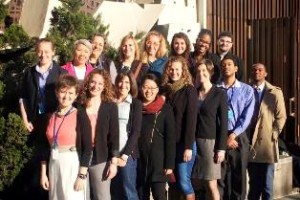
Looking at a picture of the ELCA Young Adult Cohort, one might think we look like quite the random conglomeration of people – 3 men, 12 women; 13 young adults, 2 not-quite-as-young adults; 5 ELCA networks. What brings this group together, particularly around the United Nations Commission on the Status of Women (UN CSW) and gender justice?

The ELCA networks from which individuals come to the ELCA Young Adult Cohort include the Justice for Women Program, Young Adult Ministry, Strategy on HIV and AIDS, Young Adults in Global Mission alumni and ELCA World Hunger. All of these groups bring their respective priorities and goals to the cohort, but more importantly, each of us comes to the table with a commitment to and interest in the intersection of faith and justice. Gender justice, or rather gender injustice, is prevalent in the work of each of these networks. As the ELCA World Hunger network, we are aware that hunger and poverty disproportionately affect women and their children. Anthony Mell shared this example from a session hosted by The Hunger Project in Bangladesh and the UN Zero Hunger Challenge in his post on the ELCA Young Adult Cohort blog:

In Bangladesh family life it is typical for the husband and other men to be given a larger portion of food relative to the rest of the family. This simple patriarchal cultural norm has profound consequences. Because of the state of poverty in which most Bangladeshi families live, the extra food taken by the husbands leads both their wives and their children to malnutrition. The injustice does not end there. The children also often suffer these nutritional deficiencies during key periods of cognitive development, the negative results of which can greatly affect them for the rest of their lives.

10422094_10153098995180428_1772328731233751310_n

Women’s equality and empowerment are prerequisites for development and eradication of hunger and poverty. Through the ELCA Young Adult Cohort and our presence at the UN CSW, ELCA World Hunger connects with other faith-based groups and non-governmental organizations (NGOs) committed to relief, advocacy, sustainable development, and grassroots organizing around the issues of hunger and poverty.

From my perspective, playing double-duty as cohort member from the ELCA World Hunger network and an ELCA World Hunger staff person, one of the most impactful aspects of the trip was witnessing and experiencing the ways in which the spirit of ELCA World Hunger’s message and mission touches people. The ELCA Young Adult Cohort did not only attend sessions; we also hosted several events. Over 100 members of the New York and New Jersey attended a “Meet & Greet” to learn about the cohort and its networks. We brought young people of faith together for conversation about justice and culture. We created space for dialogue about the church’s role in perpetuating and ending sexism and gender-based violence. Through all three of these events, and in all our interactions, I witnessed the spirit of our work to remain even as the specific content or presentation style varies to fit the setting. I believe this spirit endures because our work is firmly and clearly rooted in our identity as the church.

The ELCA Young Adult Cohort engages at the intersection of faith and justice. We also engage with the building up of young leaders in our church. These words shared during the March ELCA World Hunger Network Webinar by cohort member, seminary student and Hunger Leader Jessica Obrecht capture the connections between faith, work with ELCA World Hunger and membership in the ELCA Young Adult Cohort, and development as a leader in the church:

As I am new to the World Hunger network, it was really stark to me how connected World Hunger and the experience at the Commission on the Status of Women was…If we truly want to eradicate poverty and hunger we really need to empower women and look at how women are oppressed in different ways and the reality that 1 in 3 women has experienced gender based violence. We need to look at how that affects not only our economy, but how we function as a world interpersonally.

The fact that so many young adults participated in the experience raises the question: How do we empower young adults and pass the torch? As we listened to men and women speak about how we need to work together in the world, it was powerful to feel that we are at the table and that we are welcome to become leaders as well.

While the presentations and information sessions I attended during the UN CSW were fascinating and energizing, the time I spent with my fellow members of the ELCA Young Adult Cohort was inspiring and gives me so much joy and hope to be part of our church and have the privilege to be part of a group of convicted and passionate leaders for justice.

I will end my comments about the experience and takeaways of the United Nations Commission on the Status of Women here, and allow the words of my peers shared on the ELCA Young Adult Cohort blog during and after the UN CSW witness to the change ahead – within the church and around the world.

As a church, how do we measure gender justice? At the very least, we need sex-disaggregated data about our leadership, members, communities, institutions, and the lives the church touches. We also need qualitative data to understand how women, girls, and LGBTQ persons are viewed and valued in all areas of ministry and church life. It is assumed that having females in leadership roles or educating girls will lead to empowered women….In Bible studies and other spiritual formation, may we learn to directly address detrimental inequalities in our hearts, families, churches, communities, and world. We need to partner with others to build gender justice. Gender experts emphasize that gender is found in all sectors of life and that complicated gender issues – such as gender-based violence – must take a multi-sectoral approach. This means you can look for or assess gender in EVERY context!  – Crystal Corman – Young Adults in Global Mission Alumni

Men are needed to break this silence, and the first thing to do is to become aware, a problem can’t be solved if you don’t even know it exists.  – Richard Adkins – Young Adult Ministry & Strategy on HIV and AIDS

I am a youth, children, and family minister within the Evangelical Lutheran Church in America. I have returned home inspired with a renewed commitment to not only exemplify what it means to be a Christian feminist, but to be an active participant in creating a church culture that speaks about and practices taking up the cross. Within my sphere of influence, I wish to live out a theology of the cross by naming the reality and pervasiveness of sin as it is exemplified in the oppression of patriarchy and acts of gender-based violence. I will continue to recognize Christ in our midst, who bears the wounds of death, but is no longer fettered by death. I will remember the grace of the cross; that it is not our will or perfect abilities that will change the oppression of this age, but the transformative power of Christ within each of us. It is the power of Christ that strengthens us to step forward together, speak out against the reality of sin, practice forgiveness, and live remembering that the kingdom of God is among us.Casey Cross – Young Adult Ministry

I am reminded that patriarchy is a pervasive, systemic, and viciously subtle force. It moves us and in us in ways that we struggle to conceptualize and combat. However this is not meant to be defeatist. Rather it has served to me remind of the diligence and creativity required to overcome these obstacles. Simply put combating patriarchy cannot be a part time job. – Anthony Mell – Justice for Women Program

I get overwhelmed as I learn more about the realities of women and girls in the world.  And then Jesus puts it in perspective: “‘You shall love the Lord your God with all your heart, and with all your soul, and with all your mind.’ This is the greatest and first commandment. And a second is like it: ‘You shall love your neighbor as yourself.'”(Matthew 22:37-39) Fern Lee Hagedorn – Justice for Women Program

I understand that my sisters all around the world are being raped, beaten, oppressed, silenced and ignored every single day.  I understand that this problem is not just somewhere else, it is in my own country, my own state, city, community, and church.  And I have a seat at this great table, amongst great minds, warm hearts, and beautiful souls. What an honor, what a privilege, what a joy, and what a responsibility that holds. Jessica Obrecht – ELCA World Hunger & Young Adults in Global Mission Alumni


Gina Tonn is a Program Assistant for ELCA World Hunger Education & Constituent Engagement through the Lutheran Volunteer Corps. She graduated from St. Olaf College in Northfield, MN with a BA in Economics and Religion in 2014. She lives in Chicago, IL with four other Lutheran Volunteer Corps members.

World Water Day – March 22, 2015

Gina Tonn

How many times a day do I turn on the faucet in the kitchen or bathroom to fill a glass, wash my hands, brush my teeth, or fill a pot with water to cook pasta? How many times a day do I flush a toilet? How many times a day do I stop and think about the privilege of my easy access to clean, potable water? The answer to the former questions is “many,” the answer to the latter is “too few.”

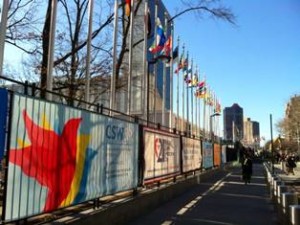
This Sunday, March 22nd is World Water Day. This year’s World Water Day also marks the conclusion of the UN-Water’s Decade for Action “Water for Life.” Last week, while in New York City with the ELCA Young Adult Cohort attending theUnited Nations 59th Commission on the Status of Women (UN CSW) I took some time to explore an exhibit in the entrance hall of United Nations Headquarters commemorating the progress of the Decade for Action and looking ahead to the unmet needs for water access and sanitation around the world that call for action in the future.

Knowing I would have the opportunity to share both my experience at the UN CSW and call attention to World Water Day through the ELCA World Hunger blog, I made sure to pick up the exhibit brochure and snap some photos of the exhibit on my phone. Now, a week removed from the throes of the UN CSW and my perusal of the “Water for Life: Voices” exhibit, I realize that my experience in New York, the opportunity to research and promote World Water Day, and my position with ELCA World Hunger aren’t just happy, coincidental life experiences, but that working for gender justice, water rights, and solutions to hunger and poverty are inextricably linked. Women bear much of the burden for collecting water for their families in Sub-Saharan Africa and other areas of the world. The many hours women and girls spend collecting water are hours not spent in school or participating in economic activity, earning money or growing food to feed their families, or contributing to their community.

Over the summer, thousands of youth will converge on Detroit, Michigan for the 2015 ELCA Youth Gathering. ELCA World Hunger’s Walk for Water at the gathering has a goal to raise $500,000 through fundraising efforts, to be matched dollar by dollar through the gift of very generous donors. If we meet our goal, $1 million of water-related projects will be funded around the world. You can read about ELCA World Hunger’s Walk for Water, including the types of projects the initiative will fund, fundraising ideas, and statistics about the water crisis, at www.ELCA.org/walk4water.

A point that was raised frequently at the UN Commission on the Status of Women is that, too often, when we throw phrases like “internationally” or “around the world” out into conversation, we forget that the United States is included. At UN CSW this was usually in regards to oppression and discrimination against women; no nation in the world, the United States included, has succeeded in establishing gender equality in legislation, in sentiment or in practice.

The same is true of the water crisis. Because of the effects of climate change, failing economies, or corporate negligence, there are people in the United States who would answer the questions I posed at the outset of this post rather differently. In fact, right in the ELCA Youth Gathering’s backyard are people experiencing the effects of a water crisis – the Detroit water shut-offs. Ryan Cumming, Director for Hunger Education, drew attention to this problem back in August in his post “Myths and Realities about Water Shutoffs in Detroit.” Water shutoffs continue to loom in Detroit, even as the city and suburbs justapproved an increase in water utility rates.

As Lutherans, we proclaim that all people, all around the world, are created in the image of God, are privy to equal rights and protection and inherent dignity. Gender justice affirms that no one should suffer discrimination, oppression, or exploitation on account of their sex or gender. Working to end hunger and poverty affirms that we live in a world of abundance that has been perverted by broken relationships and greed. The Water for Live: Voices Exhibition brochure voices invites visitors to the exhibit to add their voice to those featured because “humankind is notable for its rich diversity; yet we are all the same in our need for water and sanitation.”

This World Water Day, I invite you to add your voice with mine in prayers for strength for my sisters around the world who walk for water each day and the mothers who struggle to feed their families, prayers of rejoicing for the progress made during the Decade for Action and potential impact through ELCA World Hunger’s Walk for Water, and mindful prayers of thanksgiving for the life-giving gift of water…

We pray for people who don’t have access to clean water to drink. We pray for people who must walk long distances to collect water. We pray for people, especially children, who face disease and death because of unclean water. Lord, in your mercy, Hear our prayer.

We pray for areas of our world impacted by drought and chronic water insecurity. Lord, in your mercy, Hear our prayer.

We pray for areas of our world that are impacted by frequent floods, severe storms and other natural disasters.  Lord, in your mercy, Hear our prayer.

We give you thanks that through water and the Holy Spirit you give us new birth, cleanse us from sin, and raise us to eternal life.  Lord, in your mercy, Hear our prayer.

Amen.


Prayer & Litany for World Water Day written by Pastor Annie Edison-Albright of Redeemer Lutheran Church in Stevens Point, Wisconsin.  

Gina Tonn

Program Assistant, ELCA World Hunger

Lutheran Volunteer Corps

Changing Schools, Changing Lives: God at Work in Bolivia

Ryan P. Cumming

A lot of folks know how stressful it can be to switch schools.  Imagine not just going to a different school in a new neighborhood but in a whole new region!  For children displaced from rural areas to the cities in the Latin American country of Bolivia, this is a real challenge.

We know the strain instability can have on children in school.  Research indicates that when families move, children often have difficulty adjusting to their new communities and new schools.  When they are already vulnerable to economic instability, the challenges can be especially tough.  When education is so central to reducing vulnerability to poverty and hunger, this is a serious issue.

In Bolivia, displaced families have found the support they need to meet some of these challenges.  The Evangelical Lutheran Church in Bolivia (Iglesia Evangélica Luterana Boliviana – IELB), with support from ELCA World Hunger, has welcomed displaced families to take part in the Escuela Biblica Apoyo Escolar after-school program.  This program provides a space of support to at-risk children and youth.  At the program, children learn about tolerance and equality and get help they need to build their math, spelling, and reading skills. During breaks from school, the center still runs, offering in 2014 not only tutoring in regular classes, but also workshops on peace and nonviolence relating those to Christian values.

Together, IELB and ELCA World Hunger are actively accompanying children and families in Bolivia as the church lives out its calling to serve the whole person.  This is work we are called to do as Church, and it is also work the IELB is empowered to do as Church.  As one representative wrote, families involved in the program are starting to see “the congregation as a new social service place, both for the youth and…for the families.  Much of this confidence originates in the trust [the congregation has] from having this church program.”

As Lutherans, we recognize the role of both Law and Grace.  Under the Law, we are commanded to be servants of God and neighbor in the world.  By Grace, we are invited and empowered to do this work.  For the IELB’s after-school program,the grace which inspires the church to be a place of welcome and trust is the very grace that empowers them to be part of the community, to walk alongside children and families as they gain the skills they need to feed themselves and their neighbors for years to come.

The ELCA has been invited to be part of IELB’s ministry by supporting this program for at least three years, during which many more families will be able to take part in this impactful ministry.  Because of gifts to ELCA World Hunger, our church has been able to say “YES!”