
Skip to content
ELCA Blogs

ELCA World Hunger

Bethel New Life: A Close-up View

Teri Mueller

On Wednesday, July 16th, the summer interns at the ELCA churchwide office had the opportunity to visit Bethel New Life on the West Side of Chicago. Bethel New Life is an example of an organization that has done some amazing work with its social ministry and community development programs. I was very excited about the opportunity to see the work of a community partner of the ELCA and to get a glimpse of how grassroots work relates to work we do at the national churchwide office.  The experience was educational, inspirational and thought-provoking.

Joe Young, ELCA Program Director of Community Development, briefed us on some of the background of the community before we actually went into Bethel. He described the difficulties the community has faced, saying, “The Neighborhood was very, very different prior to the Nelsons’ coming…25 plus years ago, the neighborhood was a mess.” (Mary Nelson was the former CEO of Bethel New Life.) He further went on to explain that the neighborhood has had unemployment ranging from 10-45% over the years. People have had to make tough choices about things like feeding their family or fixing their roof.  Large parts of the north Austin neighborhoods are also food deserts, meaning that there are no actual full- service grocery stores so people have to travel a significant distance to get food or purchase it from often overpriced corner stores. Some stores even have customers ask for food behind plexi-glass that separates customer from vendor. They do not even get the dignity of picking out their own food, and sometimes the items they purchase are expired.

Prior to visiting Bethel, I knew very little about the organization. Bethel New Life was born in a time of severe hurt after the riots of the late 1960s and early 1970s that followed the Civil Rights Movement and the assassination of Martin Luther King, Jr. The organization was founded over 30 years ago in 1979 by Bethel Lutheran Church. The church had a dream of making an impact on the poverty and desBethel Artworkpair that the local community was facing. Though money was scarce, members decided to mortgage the church and put the limited funds they had into purchasing a building. They relied on their faith and passion as they diligently worked to make a difference.
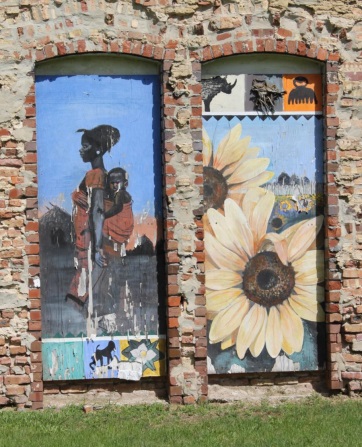
Photo: Outdoor artwork at Bethel New Life 

Ms. Mildred Wiley, Senior Director Community Affairs, provided us with a lot of the history of Bethel along with giving us a tour and telling us about new initiatives. Ms. Wiley made it very clear that Bethel has a legacy of looking at community assets and working to help enable people. Her colleague, Ms. Tina Levy, Director of Communications and Fundraising, talked about how the community has been entrenched in poverty for decades and explained Bethel’s philosophy to “value people investing in themselves so they can help themselves.” Ms. Levy also shared with us about the West Side Forward campaign that is currently underway. The campaign seeks to significantly reduce concentrated poverty on Chicago’s West Side. I was amazed looking at the figures within the West Side Forward report.  It claims that the total cost of transforming the neighborhood over the next ten years would be about $3.4 billion dollars, while the cost of keeping it the same would be around $29.1 billion. The solution seems like it should be clear, but I know change takes a lot of time, convincing and initiative.  Bethel tour in hallway
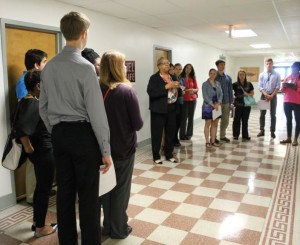
Photo: Ms. Wiley gives the interns a tour of Bethel

West Side Forward is directly part of Bethel New Life as it serves as the strategy of the organization. Staff are heavily invested in the initiative. Bethel’s core areas of focus over the next ten years align with West Side Forward and include Community Economic Development and Education.  Senior housing is also a key part of Bethel New Life. We had a chance to see senior housing, economic development, and education in action during our visit. Ms. Wiley took us on a very informative tour of Bethel’s facilities. Bethel has both senior housing and assisted living housing. We got to hear about many of the services offered at the assisted living facility including a barber and beauty shop, nurse’s station, activity room, fitness facility, full meals and more.

Ms. Elayne Nickaloau, Director of Education at Bethel New Life, talked to us about the educational components of Bethel. She explained that Bethel places a strong emphasis on identifying partners and forming connections. She specifically mentioned the collaboration between Bethel and the By the Hand program in the community. The hardest challenge Bethel faces on the education front is getting people to dream and find hope in what they can do. Great programs are in place, but attracting participants is a challenge as is the case with many new opportunities.

We also got to see and hear about the Small Business Development Center at Bethel. In my eyes, the center is a combination of the educational and economic foci of Bethel. There is a 14 week entrepreneurship program that goes through forming a business plan, marketing strategies, etc. and helps people start their own businesses which can help contribute to the local economy. We briefly met Mr. Marshawn Feltus, a graduate of the Entrepreneurship program and owner of ACT Yoga. He talked passionately about his business and the benefits of yoga.

Bethel is also doing some awesome work that helps with economic development. Bethel has a three- pronged approach towards community economic development that focuses on business development, workforce development, and asset-building. One example of a helpful economic service that is supported by Bethel is the Community Savings Center.  When the neighborhood started to decline decades ago, all of the banks left the community and people could not easily obtain loans for socio-economic and racial reasons. Because of this, the Community Savings Center at Bethel New Life has significantly helped community members.
Street picture
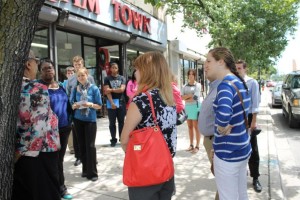
Photo: Ms. Wiley talks about the economic climate of the neighborhood

Looking back, the trip to Bethel was challenging because it was hard to see a neighborhood lacking in things that I have always regarded as fairly basic services like banks and grocery stores. However, it was also extremely inspiring to see the positive work that Bethel New Life has done and witness some of it in a first-hand manner. I do not know what the future holds for me or the other interns, but I know that I want to do my part to combat social injustices in one way or another. Together, we have the power to make an impact. As Joe Young asked us at the end of our trip, “If not you, then who? If not now, then when?” Supporting ELCA World Hunger and organizations like Bethel New Life is one way to have an impact. There are communities like those on the West side of Chicago combatting the effects of poverty all over our city, country, and world, but a positive difference can be made.

Teri Mueller is an intern with ELCA World Hunger.

Hunger, Poverty and the Minimum Wage

Teri Mueller

​Imagine a world where you cannot afford to put food on the table. Imagine a world where hungry children look up at you with pleading eyes as you stare at an empty pantry that you cannot afford to stock. Imagine not being able to provide for the basic nutritional needs of yourself and those you love. Imagine having to make the choice between paying for heat in the dead of winter or purchasing nutritious food.

Many people in America do not need to imagine the above scenarios. For them, the frustration of poverty is a daily reality. Many wage workers all across the country struggle to get by. These workers’ wages are at or slightly above minimum hourly wage of $7.25. Chapter 2 of the 2014 Bread for the World Hunger Report focuses on the problems of poverty and hunger that many hourly workers face. Statistics reveal the harsh reality that 28% of American workers earned poverty-level wages in 2012. While many people believe that teenagers make up the majority of low wage workers, in actuality, 80% of minimum wage earners are at least 20 years old. Poverty does not just affect the jobless, as 10 million families with at least one person employed still fall below the poverty line. Furthermore, a report issued in 2013 by the Center on Budget and Policy Priorities noted that  “Among SNAP households with at least one working-age, non-disabled adult, more than half work while receiving SNAP — and more than 80 percent work in the year prior to or the year after receiving SNAP.  The rates are even higher for families with children — more than 60 percent work while receiving SNAP, and almost 90 percent work in the prior or subsequent year.”

Raising the minimum wage is a very controversial topic but one that has increasingly come up in recent months. A 2014 report from Oxfam International supports a minimum wage increase from the present $7.25/hour to $10.10/hour over the next few years. The report states that 25 million workers would be affected, one-third of whom have dependent children. Additionally, over 20% of women would benefit from a minimum wage increase as women tend to work in minimum-wage jobs more often than men. Oxfam emphasizes the growing income inequality in the United States as the rich get richer and the poor get poorer. Specifically, the report notes that “in 2013 the CEO-to-average-worker pay ratio was 331 to 1; 30 years ago, it was just 40 to 1. Today, the CEO-to-minimum-wage-worker pay ratio is 774 to 1.”

Despite the millions of people that would be positively affected by an increase of the minimum wage, controversy abounds because of possible adverse effects on the overall American economy. The cost-benefit ratio of an increase is rather unclear. Oxfam claims that economic growth and development would occur because better-paid workers would spend more money and contribute more in taxes.  However, some business owners and federations are strongly against a minimum-wage increase because they say it will kill jobs and force employers to cut back employees and raise prices. ACNNMoney article from early May explains the strong opposition of some companies to the proposed $10.10/hour minimum wage.

The contentious nature of minimum wage issues can easily overshadow the people behind the debate. Regardless of political views, we must remember the thousands of people in the US who are struggling to get by and provide adequate nutrition for themselves and their families. There are plenty of resources in our world, and we are called to seek a sufficient, sustainable livelihood for all. We have the responsibility to consider our neighbors and family and to not solely maximize our own interests. Support for a livable wage is necessary as we strive to walk along side wage workers. Because of these convictions, the ELCA supports an increase in the federal minimum wage. Visit the advocacy statement on raising the minimum wage to learn more about the pressing nature of the issue and the views of the church.

Teri Mueller is an intern with ELCA World Hunger.

The young and hungry: The reality of food insecurity for many American children

Teri Mueller

No one likes to be hungry, but for many American families, food insecurity is a regular part of life. Currently, one quarter of American children are at risk of hunger (See Table 12 in Bread for the World’s 2014 Hunger Report). In 2012, the prevalence of food insecurity among U.S. households was 14.5%. Children were hit even harder as 21.6% faced life with food insecurity.The last six years have been tough on American children. Food insecurity jumped up after 2007, which corresponded with the economic recession of 2008. To be specific, there was 16.9% prevalence of food insecurity among children in 2007 and 22.5% prevalence of food insecurity among children in 2008. (See Table 12 in Bread for the World’s 2014 Hunger Report). That is an increase of 5.6% in solely one year.

Young people especially suffer as a lack of food can jeopardize more than immediate health. For instance, frequent food insecurity can affect the development and educational attainment of children. Hungry children are more likely to be late to school or miss altogether.1 If they do arrive, they struggle to focus on learning.

Children who do go to school often rely heavily on the food provided through programs like the National School Lunch Program (NSLP). Sometimes the lunches provide students with the only actual meals they receive all week. The NSLP provides families that are under or at 130% of the poverty level with free school lunches for their children. Families who fall between 130 and 185% of the poverty level qualify for reduced-price lunches.

As summer continues, many children who relied heavily on school lunches must find other ways to get food. Because of this, programs like the Summer Food Service Program (SFSP) have been established. The week of June 2nd-6th served as the kickoff of SFSP for Summer 2014.  However, significantly fewer children are reached by the SFSP in comparison to the NSLP. Specifically, a USDA report mentioned in a Milwaukee Wisconsin Journal Sentential article says that only 2.3 million of the 30 million children that receive reduced price meals during the school year continue to receive meals over the summer.

The problem of food insecurity among children has not gone away in the United States, but federal programs like NSLP, SFSP, and others help young Americans receive food and nutrition. However, danger has arisen as many of these programs are up for reauthorization in the near future. The Healthy, Hunger-Free Kids Act of 2010 permanently implemented the NSLP and the School Breakfast Program, but other programs are set to expire in 2015. They must be renewed in order to continue. The SFSP and the Special Nutrition Program for Women, Infants, and Children (WIC) are two examples of programs that need to be reauthorized soon. The continuation and strengthening of these programs along with the work of many community organizations is important for the future of American youth. With time and effort, we will hopefully begin to see a decrease in food insecurity among children in the future, which will result in improved conditions for the growth and development of America’s young people.

Teri Mueller is an intern with ELCA World Hunger.

  1. Mariana Chilton & Donald Rose, “A Rights-Based Approach to Food Insecurity in the United States. American Journal of Public Health 99:7, 2009: 1203-1211

Region 6: Ethics of Eating Announcement – UPDATED

Henry Martinez

Ethics of Eating

Region 6

Thursday – Sunday, Aug. 14-17, 2014

​It seems obvious that food is essential to our lives and communities. But what we see on our plates is part of a complex process that involves a confluence of lives, communities and systems. The Ethics of Eating event presents an opportunity to explore issues of food production and our response to this process as it relates to hunger, the environment and daily life. As people of faith, we approach the topic from a theological lens, while listening to those who are involved in this system for their livelihood. Join us as we consider this topic through some hands-on experience at a farm, a variety of speakers and engaging discussion.

ELCA World Hunger is inviting approximately 25 participants from various contexts in the region to attend the Ethics of Eating event in the Mansfield, Ohio, area Thursday, Aug. 14 – Sunday, Aug. 17, 2014. ELCA World Hunger will underwrite the cost of participation. To ensure the best stewardship of ELCA World Hunger’s investment in this event, participants must commit to attendance of the entire Ethics of Eating event.

Application Due: Monday, July 14, 2014

For this event, participants will be invited from Region 6, which includes the following synods:

6A  ̶  Southeast Michigan

6B – North/West Lower Michigan

6C – Indiana-Kentucky

6D – Northwestern Ohio Synod

6E – Northeastern Ohio Synod

6F – Southern Ohio Synod


Please email ELCA World Hunger (hunger@elca.org) to request the Ethics of Eating application. Your completed application AND letter of support are due by July 14, 2014, if you wish to be considered for participation. Applicants will be notified of invitation decisions shortly thereafter. After June 30, applications will be approved on a rolling basis until all openings are filled.

After this event, each participant will:

  1. Enrich their understanding of a just and sustainable food system and gain perspective on a theological response to hunger.
  2. Implement a follow-up project, action or activity.
  3. Participate in the ELCA World Hunger Leader Network and online community.
     
    If you have any questions, please contact ELCA World Hunger (hunger@elca.org) or 800-638-3522, ext. 2616. We look forward to receiving your Ethics of Eating application.