

Skip to content
ELCA Blogs

ELCA World Hunger

Carrying the Cross in Public

Ryan P. Cumming

protest2

Used with permission from Boston at en.wikipedia


In the summer of 2012, Junior Garcia carried a 12-foot wooden cross from his home in Texas to Washington, DC, in an attempt to share the gospel in the public square.

In February of this year, a secular group filed a lawsuit to remove a 40-foot tall cross from public land in a suburb of Washington, DC.  A quick Google search will reveal lots of similar stories.

What does it mean to bear the cross in public?  This is a question that has been on my mind a lot as I prepare to join other Christians in Washington, DC, for Ecumenical Advocacy Days this weekend.  I sincerely doubt that many of us will show up with literal crosses on our backs.  And erecting a marble/wooden/plastic cross on the National Mall doesn’t appear on my copy of the agenda.  Yet, many of us will travel to Washington believing that people marked by the cross have something worthwhile to say in the public square.  We will carry the cross in public, to the halls of our government.

Too often, Christians have carried the cross in public with a steady supply of nails, ready to pin down and condemn their neighbors.  The public face of Christianity in America, it seems to me, is too often a posse of crucifiers, rather than a communion gathered around the crucified.  To bear the cross in public does not mean fighting over monuments or carrying literal crosses, and it certainly does not mean entering political life with a readiness to put others on the cross.    As Lutherans, we believe that we are marked by the cross in baptism and shaped by it for our whole lives.  We are a cruciform (“cross-shaped”) people, who bear our mark in private – at home or church – and in public – as workers and citizens.  And this must mean something more profound than either of the alternatives above.

To bear the cross, to enter politics and public life as one shaped by the cross, is to be marked by three qualities: humility, honesty and love.

Humility

The cross is a problem that confounded early Christians and continues to confound us.   Christian history is filled with attempts to explain the cross, but the cross is nothing short of a scandal.  To bear the troubling cross is to carry with us the humble awareness that we don’t have all the answers.  The cross restrains those who would enter the public square with a triumphalist Christianity as much as it chastens those who believe that any human government or policy or law can ultimately solve all the world’s problems.

The first person who reveals Jesus’ true identity in the Gospel of Mark is the most unlikely of characters: “Now when the centurion, who stood facing him, saw that in this way he breathed his last, he said, ‘Truly this man was the Son of God!'” (Mark 15:39).  In the Gospel of Luke, it is from a common criminal, executed with Jesus, that we hear a clear pronouncement of Jesus’ innocence and a sustaining faith in the coming Kingdom of God (Luke 23:39-43).

To be marked by the cross is also to recognize that wisdom and clear sight are gifts God grants in unlikely places, to unexpected people.  Cross-shaped advocates recognize this and remain open to this wisdom wherever it arises.  This means being open to dialogue and discernment with a variety of people.  Being shaped by the openness that comes from humility, we know that public life is lived in common, among people with diverse gifts.

Honesty

To bear the cross is to be marked by honesty.  We know as well as Isaiah did that “truth stumbles in the public square” (Is. 59:14).  Yet, as cross-shaped advocates, we are called to speak the truth from a long tradition of truth-tellers, ancestors like Moses, who “spoke truth to tyrannical power” (Paul Hanson, Political Engagement as Biblical Mandate, p. 32) and Amos, who refused to be silent in the face of injustice.

Most of us know the famous story of David and Bathsheba.  David saw Bathsheba bathing, desired her and so arranged for the death of her husband.  After David had claimed her for his own, the prophet Nathan told him the story of a rich man who cheated a poor man out of the one small lamb that the poor man had raised (see 2 Samuel 12:1-15). “Who is this man? He deserves to die!” David exclaimed, to which Nathan, in an ironic turn, shouts, “You are the man!”  Nathan holds a mirror up to David to reveal to the king his own injustice.  Sent by God, Nathan dares to speak the truth when power becomes corrupt.

The cross, too, is a mirror.  We see in its torturous use the oppressive power of the Roman empire.  It reveals to us the depth of human sin which would lead us to kill our own savior.  There is nothing joyous or triumphant here; there is simply a body broken by the political and religious power that sin corrupts.  To bear the cross is to hold up a mirror to a sinful world.  This means channeling Nathan and speaking the truth in the face of injustice.  It means telling the stories many don’t wish to hear.  Truth demands that we speak up, with and, sometimes, for those who really are “left behind”: the poor, the marginalized and the excluded.

Love

Yet, to carry the cross is also to be a loving presence within the public square.  The cross reveals the depth of human sin, but it also reveals the more profound depths of God’s love.  And the empty cross reveals that, in the end, it is God’s love – and not human sin – which wins out.  The cross reveals a broken humanity, persons whose lives are one long via dolorosa, who cannot overcome injustice on their own.  To carry the cross in public is to accompany in love those who are treated unjustly.

To be a Christian advocate for justice demands – and offers – much more than dogged pursuit of a policy or a position.  Perhaps by taking up our cross as Lutherans, we can showcase a faithful citizenship that is loving, just and worth listening to.

Ryan P. Cumming, Ph.D., is the Program Director of Hunger Education for ELCA World Hunger. Ryan.Cumming@ELCA.org 
Paul’s Humbly Firm Request

Henry Martinez

​The word advocacy does not appear in the letter to Philemon. Interestingly, the word commonly translated as advocate (paraclete) appears a few times in John’s gospel, once in 1 John and nowhere else in the New Testament. But Paul’s letter to Philemon is a helpful example of how theology and practicality come together in a personal advocacy-like appeal. It seems lazy to consider only a few verses of Philemon since the book is so short, but the following passage provides a glimpse at Paul’s tone and strategy.

For this reason, though I am bold enough in Christ to command you to do your duty, yet I would rather appeal to you on the basis of love—and I, Paul, do this as an old man, and now also as a prisoner of Christ Jesus. I am appealing to you for my child, Onesimus, whose father I have become during my imprisonment. Formerly he was useless to you, but now he is indeed useful both to you and to me. I am sending him, that is, my own heart, back to you. I wanted to keep him with me, so that he might be of service to me in your place during my imprisonment for the gospel; but I preferred to do nothing without your consent, in order that your good deed might be voluntary and not something forced. (Philemon 1:8-14)

Onesimus was a slave in Philemon’s house who, for some reason, may have wronged Philemon and somehow found Paul. We can only guess if Onesimus knew of Paul’s influence or had hoped for a result other than the one Paul was willing to provide. But from this letter it is evident that Paul has chosen to come alongside Onesimus and speak out on his behalf to someone who has sway over Onesimus’ future. One of the key moves in this letter is Paul’s emphasis on the change in Onesimus’ status. The change from “useless” to “useful” may be more rhetorical than descriptive, but the change from slave to beloved brother (v.16) demands more attention.

Paul is able to call Philemon brother because of the new identity they share in Christ. His appeal is for Philemon to see his relationship with Onesimus in the same way, that is, through Christ. This of course hadn’t settled the issue of slavery or how Christians should respond to it as an institution. But his appeal works in a different way. Paul appeals to Philemon’s faith in Christ knowing that it is something that has shaped him as well as the community to which he belongs. Since this faith has influenced Philemon’s attitude, Paul is hopeful that it will influence his relationships as well. In this case, Philemon has a claim on Onesimus that Paul wants to contextualize in terms of faith in Christ. Since Christ’s self-giving love demonstrates what laying down power looks like, Paul is presenting Philemon with the opportunity to do the same with Onesimus. He is not appealing to some general ethic of looking out for the interest of someone in need (which is not a uniquely Christian idea), but Paul is asking Philemon to set aside worldly power for the sake of Christian love. At some unidentified point, the two become incompatible.

When interpreting Philemon it is difficult to ignore the passages that seem slightly passive aggressive, if not opaque. First is the fact that the letter is addressed not just to Philemon, but to the church in his home. What was Paul hoping the others would do with this? He also notes that he is bold enough to command Philemon but chooses not to. What function does this serve if not to appeal to Paul’s stature in the community? There is another subtle move. Paul has been building his case through verse 13, then backs off just for a moment to recognize Philemon’s agency in the matter by stating that he wants this to be something voluntary rather than forced. Paul is not afraid to tell Philemon what he should do but he concedes that the choice is Philemon’s. Finally, Paul tells Philemon to get the guest room ready because he is planning to visit. The request may of course be innocent, but it may also be Paul’s way of saying he is coming to see for himself how things shook out.

What does this mean for how we understand advocacy? There may be some useful tactics for us to employ. However, it probably isn’t as simple as trying to identify parallels between this letter and our contemporary context; a significant discrepancy being that we aren’t usually on equal footing with Paul regarding the leveraging ability of our advocacy efforts. It requires a special relationship to even be received like Paul. I would offer that it has something substantial to say to us about how we understand power. Whether we have the influence of Paul or not, aligning our voice (individual and collective) with another’s need, especially the most vulnerable, is part of how we express our faith in Christ. In this way it is both with humility and boldness that we write to legislators, seek to change policy, and try to build relationships with our neighbors.

To find out more about advocacy efforts and resources in the ELCA visit http://www.elca.org/Our-Work/Publicly-Engaged-Church/Advocacy.

Daily Work — Making a Difference in the Lives of Immigrants

Julie Hoff

Imagine.

You are smart and charming. You’re motivated to succeed. You’ve moved across the world, left behind your friends and family, and embraced a very different culture to start a new life, hopefully a better life, in America.

But your first year here was really tough. You lived in a homeless shelter because you couldn’t find a job or an affordable place to live. Because you are a new immigrant, you are ineligible for most forms of public assistance. Even though you’re a college graduate, it doesn’t matter in America because you weren’t educated here. Plus, it’s almost impossible to get a call back for a job interview, because no one knows how to pronounce your name, and rather than call you, employers simply move on to the next candidate.

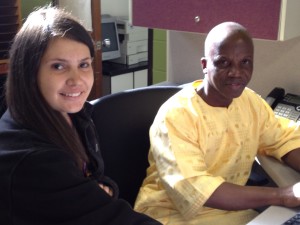
Imagine you are Baryogar (pronounced buy-yo-gar), who came to the United States as a refugee from Liberia. In Liberia, Baryogar had jobs in human resources and bookkeeping. But when he arrived in America, Baryogar couldn’t find any job.

Baryogar and Sarah

“When I came here, I didn’t have any idea of American culture. In Africa, it is a sign of disrespect to look in someone’s face. I had to learn in America, it is the opposite. Without Daily Work’s help, I would not have learned those things and I would not have gotten a job,” Baryogar said.

Founded as a Lutheran ministry in 2000 by a collaboration of ELCA pastors in St. Paul, Minnesota, Daily Work’s mission is to assist job seekers by helping them prepare for, find and maintain work that enables them to support themselves and their families. We operate from two ELCA churches in the Twin Cities: Christ on Capitol Hill in St. Paul and Christ the King in New Brighton.

Baryogar is one of more than 750 people affected by joblessness and poverty who have come through Daily Work’s doors to get the personalized help they need to transform their lives and become contributing members of the workforce. Today, more than 60 percent of the people Daily Wo​rk serves are immigrants, most of who are from the African countries of Ethiopia, Eritrea, and Liberia.

Baryogar continues to work as a nursing assistant in the same job Daily Work helped him find in 2007. His transition to America, while challenging, also came with some advantages. For example, English is the official language in Liberia, which meant that Baryogar had significantly better English skills than many other new immigrants. Baryogar was also a refugee, which enabled him to receive some refugee support and public assistance for up to eight months following his arrival in America. (However, most immigrants to Minnesota are not eligible for these types of supports. To learn more, read hereabout how medical assistance has been cut in Minnesota.)

Typically, the immigrants Daily Work serves come to the U.S. by “winning” a diversity visa. The Diversity Immigrant Visa program is a congressionally mandated lottery program that annually makes available 55,000 permanent resident visas to natives of countries deemed to have low rates of immigration to the United States.

According to Abera, another Daily Work job seeker and visa lottery winner, it was shocking to find out how hard it is to get a job in America and provide for his family here…and in Africa. Many immigrant families expect the family member now in America to send money home to Africa to help support them.

“I came here because I heard America is the land of opportunity. Everybody wishes to come to America. Life is very hard in Africa, the income from jobs in Africa is not enough to make a life and the politics are very unstable. In order to afford to come here, my family sold their family home to pay for all the expenses for me and my wife to move here.  It was a big sacrifice for them because now my mother must live in a public house,” Abera said.

Abera

Abera first came to Daily Work in mid-2012, about 18 months after moving to America. In that time, he had worked four different, temporary jobs that kept ending in lay-off. In the fall of 2012, Abera again came to Daily Work after being laid-off from another temp job. In addition to helping him put together a better resume and cover letter, his Daily Work counselor suggested that he take a 10-week job training course through another local nonprofit organization.

“Abera needed something new on his resume that demonstrated his work ethic and drive to succeed,” said Julie Hoff, Daily Work Executive Director. “We felt that taking this course would give him a bigger network, fresh information on his resume, and of course, some new skills to showcase to employers,” Hoff said.

The strategy worked! Today, Abera has a year of steady work history. He currently works two full-time jobs, one as a security officer and the other as a customer service provider at an airport. While he knows he still has a long way to go to achieve his goal to be a small business owner, Abera feels good about the progress he has made in the past year.

“This is all possible for me because of help from Daily work.  Now this day is brighter for me because I can help myself and my family. Having a good work means to me that I have more options to develop my career and take care of my family, both here and in Africa,” he said, smiling.

These are just two examples of the immense challenges new, legal immigrants face when moving to the U.S. While most of the focus on immigration today is about border issues and undocumented immigrants, there are many barriers and issues that new, legal residents of the United States face, including lack of financial support following arrival, difficult immigration laws that keep families apart, and unfair employment practices that both discriminate against and take advantage of immigrants who will do anything to survive.

On top of that, new immigrants face tremendous challenges just to learn English and drive a car, obtain new education and job skills that American employers value, and simply understand and adapt to American culture. As native-born Americans, we have had 20 years or more to gain the key assets needed to obtain living wage work: English language skills, cultural competence, formal education, and driving skills. Imagine if you had to learn all these things in a matter of weeks or months and support your family at the same time.

Daily Work was founded by ELCA pastors who believe that we are called to serve others and to share our personal gifts in meaningful ways. The ELCA, its congregations, and people like you play an important role in helping new immigrants by starting and supporting programs in your communities like Daily Work; but you can also make a difference by speaking out as voices for reform. Please consider what you can do to make life better for someone new to America. To learn more about immigration reform and the challenges facing immigrants, check out the resources below.

Challenges Facing New Immigrants and Refugees

Reform Immigration for America

Fair Immigration Reform Movement

Campaign for Community Change

Julie Hoff is the Executive Director of Daily Work in St. Paul, Minnesota. Daily Work is a nonprofit organization supported, in part, by a Hunger Education grant from ELCA World Hunger.