

Skip to content
ELCA Blogs

ELCA World Hunger

“But they’re here ILLEGALLY!”

Ryan Cumming

tombstone1
 

Well THAT epitaph is sure to get a lot of rubbings.  Perhaps in the right cemetery, it might be a perfect fit.  After all, there is something to be said about following the law.  Indeed, in great measure, the safety and security of a community depends less on the ability to efficiently deter lawbreakers – or to swiftly punish them – than on the hope that the majority of citizens won’t break the law in the first place.

Lutherans historically have appreciated the important role of civil laws.  At a minimum, the law – and the powers that exist to enforce it – help us go about our daily lives in relative security.  Martin Luther was famously supportive of obedience to civil laws and to the ruling authorities in his day.  When the peasants rebelled against the landed gentry in Germany, Luther referred to them as animals, writing that they should be killed like “mad dogs” (which brings up a whole other question of animal cruelty – see the colorfully titled “Against the Robbing and Murdering Hordes of Peasants,” 1525).  Of course, the Lutheran deference to civil laws and authority has led to other problems.  One of the more dangerous memories of Lutheran history is the use of this obedience to undergird support for Hitler and the Nazi Party in Germany.  (Truth be told, Luther’s prevalent anti-Semitism didn’t help much, either.)

Still, the Lutheran notion that civil law is a gift from God meant to help us live lives in security and safety is an important one.  It keeps Lutherans in a unique middle ground, between those who believe that being faithful means abandoning their identity as citizens of a country and those who believe that faithful citizenship means making sure all the laws of the land reflect their own religious beliefs.  This is at the heart of that pesky “two kingdoms” stuff we Lutherans keep touting.  God enables us to be citizens so we can exercise responsibility, live out our faith and serve our neighbors free of the chaos and fear of anarchy.

Lutheran citizens are neither expatriates nor demagogues.  We don’t have to choose between abandoning our country and dominating our country in order to live in it faithfully.  The law, for Lutherans, serves an important function, one which we support and one in which we are engaged.

So, why is my epitaph above still lacking a bit of luster?  Why is it that I want to leave a mark on this world that goes a bit deeper than just being “a law-abiding citizen”?

Lutherans appreciate the law; we value it; ideally, we follow it (and, obviously, here we’re talking about civil laws, not the Law of God.  That’s a topic for a different day.)  But, we also recognize that the law isn’t good in itself.  It’s good because of the purpose that God intends for it.

Laws, and the authorities that enforce them, are good because they keep us safe, they help organize our lives, and they help us live meaningfully and responsibly as members of a human community.  They have a deeper purpose than merely commanding our obedience.  We see this in how we talk about laws, in general.  We don’t merely want enforceable laws; we want just laws.  We don’t want laws that merely keep us safe; we want fair laws.  We don’t want laws that merely constrain our lives; we want laws that enrich our lives.  And we lift up these same qualities in ourselves and our leaders.  In the 2009 Social Policy Resolution on immigration reform, the ELCA outlined this pretty clearly: “Governing authorities are to seek justice, foster peace, protect people, and support their well-being.”  There is something more profound that we want for ourselves and for our community than merely obedience.

 tombstone2

Aha!  Now THERE’S an epitaph I can live with! (Umm…)

So often we get focused on obedience to the law without plunging deeper into the values that we, as law-making and law-abiding citizens, are supposed to pursue through this obedience.  The rhetoric surrounding the immigration debate in the US is, tragically, a good example of this.

“We do not owe people who broke our laws to come into the country.” (Rep. Michelle Bachmann, R-MN)

“These illegal aliens are criminals and we need to treat them as such.” (Rep. Paul Broun, R-GA)

Outside the hallowed halls of government, how many of us haven’t heard some version of this sentiment: “But they’re here illegally!  They’re criminals!  They broke the law!”  In the debate, we’ve lost touch with the notion that there is more to citizenship than obedience, and more to laws than merely restrictions.  Good laws – like good citizens – reflect our deepest feelings about justice, fairness, and the common good.  Good laws, like good citizens, enable and enrich life.

To what extent do current immigration laws do this?  To what extent to they reflect – and form – a society that is just, where life is enhanced by opportunity and community?  To what extent do they measure up to the vision Americans have of our nation, and how do they reflect the vision God intended for human laws and human societies?

As Rev. Stephen Bouman, the executive director of the Congregational and Synodical Mission Unit of the ELCA pointed out recently, over 24,000 unaccompanied minors crossed the border between Mexico and the United States in 2013.  They risked starvation and violence to make the passage here, only to be incarcerated by the US when caught.  It is no secret what led them to take this modern-day journey through the wilderness to a land of promise: violence, abject poverty, desperation.

Those who are not caught, incarcerated, or deported often find that the “promised land” is not without its own challenges.  Of the estimated 11 million living in the US illegally, nearly 4 million are living in poverty.  Even those immigrants who are living here legally still find themselves relegated to jobs, especially in food production and food service, that do not pay a living wage (See Bread for the World’s 2014 Hunger Report).  It seems that even being “obedient” is not enough to feed one’s family.​

Our tradition gives us a way of talking about immigration and the obstacles immigrants face.  Citizenship, for Lutherans, is about more than following laws and paying taxes.  It is about contributing to a community that reflects God’s good plans for human life.  While never perfect, life within a political community now is supposed to give us a glimpse “through a glass darkly” of the perfect reign that we will experience in the Kingdom of God.  This doesn’t mean campaigning for Christianization of the country.  But it also doesn’t mean leaving laws behind, as if we are unconcerned.  It does mean lifting up leaders and policies that serve the common good by enhancing our lives and by creating a community in which all who desire it can go beyond mere obedience and live meaningful lives as faithful citizens.

Why the book of Ruth is not a love story: A study of Ruth 2:1-16

Henry Martinez

I used to think the book of Ruth was a love story. First there is the love Ruth shows Naomi:

“Do not press me to leave you or to turn back from following you! Where you go, I will go; where you lodge, I will lodge; your people shall be my people, and your God my God. Where you die, I will die—there will I be buried. May the Lord do thus and so to me, and more as well, if even death parts me from you!” Ruth 1:16-17

This display of devotion rivals the sentiments of most romantic poems (the good ones at least). And then there is the love between Boaz and Ruth, wrapping it up nicely and providing a colorful backstory for some essential branches in King David’s family tree. But calling the book of Ruth a love story or dramatized genealogy runs the risk of evading a crucial issue of our time. At its heart the book of Ruth is a story of immigration.

We don’t know the reasons for Ruth’s decision to throw her lot in with Naomi. No one is surprised by Naomi’s choice to go back to her homeland, or by Orpah’s choice to go back to her family after her husband dies. But Ruth’s decision to leave the security of her family and homeland to pursue an unpromising future with a fellow widow could only be called foolishness or faith. She is commonly referred to as Ruth the Moabite, which leads us to think her nationality would have been an issue. She takes to gleaning in the fields as a way of ensuring she can feed herself and her mother-in-law. She’s earning no wage for her labor; at most she hopes to glean enough grains for a meal. She catches the attention of Boaz, who learns of her story (at least part of it) from the labor overseer. Thankfully for her, she chose the right field to glean from.

​Boaz assures her that she will find protection in his field, safe from the rebuke she presumably would have received from the other field workers or overseers. He also gives her permission to drink from the water they have drawn. She asks what she, a foreigner, has done to earn such favor. Boaz responds:

‘All that you have done for your mother-in-law since the death of your husband has been fully told me, and how you left your father and mother and your native land and came to a people that you did not know before. May the Lord reward you for your deeds, and may you have a full reward from the Lord, the God of Israel, under whose wings you have come for refuge!’ Then she said, ‘May I continue to find favor in your sight, my lord, for you have comforted me and spoken kindly to your servant, even though I am not one of your servants.’ (2:9, 15-16)

Rather than see her as a foreigner and respond in a way which protects his economic interests and preserves the rights of the locals, Boaz extols Ruth’s character. He hears her story and sees her sacrifice and devotion ahead of whatever hindrance her nationality or ethnicity may have presented. Even though the Torah teaches that the poor and foreigners should be allowed to glean in the fields (Leviticus 19:9-10), this does not mean there is universal acceptance of this (especially when Moabites are involved). There are other stories in scripture where anti-Moabite prejudice is allowed (Genesis 19, Numbers 25, Ezra 9). Boaz doesn’t seem to have anything to gain by extending this hospitality to Ruth, but his care for her in spite of the conflicting social custom signifies a deep regard for the vulnerable that offers us a witness worth considering as we reflect on immigration today.

The attitude toward immigrants in the US often ranges from indifference to hostility. A welcome acceptance appears to be rare. Regardless of their story or character, it is more likely that we would welcome them in our fields than our communities. The story of Ruth reminds us that social customs may conflict with our understanding and practice of hospitality. No, God doesn’t explicitly tell Boaz to consider Ruth, but God uses the unfolding events and kindness of Boaz to show us how redemption and care of neighbors can work. Knowing someone’s story makes a difference. Rather than see her as merely a Moabite, Boaz sees Ruth as a person of faith and character, with dignity.  Her story can help us explore our own hospitality, and the extent to which we acknowledge its boundaries and our acceptance of social norms.

For more on the importance of examining perceptions of immigrants and welcoming the stranger, see two great articles by Carmelo Santos and Bishop Wayne N. Miller (Metro Chicago synod) in the December issue of the Journal of Lutheran Ethics. ​

Book Review: Fresh Fruit, Broken Bodies

Henry Martinez

​​

fresh fruit broken bodiesIn Fresh Fruit, Broken Bodies, Holmes attempts to better understand the “social and symbolic context of suffering among migrant laborers” (29). The book begins with a personal account of a dangerous border crossing, then records his work alongside a particular group of Triqui people (an indigenous group in what is now the Mexican state of Oaxaca) through harvest fields in Washington, California and back to Oaxaca. His explorations progress with the hope that his observations will help change public opinion, practices and policies (29). ​
The book chronicles Holmes’ journey to understand how the poor suffer, often reading like a sociologist’s annotated field notes. The first-hand interviews and narrative presentation serve two purposes. First, and most obviously, these give the reader a glimpse into the lives of his Triqui companions. Secondly, the author relies heavily on the interviews and narrative to transition to topics that are contextually essential to the issue, but require further analysis beyond the scope of the book (e.g. neoliberal capitalism, North American Free Trade Agreement). As a result the narrative, combined with critical reflection and knowledge of social science research, advances Holmes’ case and signals the need for some additional context.

In the third chapter the author gives a vivid depiction of farm work. His insights not only give the reader a glimpse at some of the issues affecting these laborers, but also explain the segregation of labor, one of the social structures he wants us to challenge. The fourth chapter studies the issue of embodied violence and examines how racism is naturalized (a term the author uses frequently) in the industry. The fifth chapter looks at the health care available to the farm workers, both their access and opportunities in Mexico and the United States. The sixth chapter is devoted to the “public gaze” regarding the farm workers, where the author surveys the systematic effects.

In his analysis Holmes avoids simplistic arguments. Instead, he strives to draw attention to the systematic ways in which populations are marginalized or written off completely. One critical step he acknowledges is combating normalization- seeing the plight of migrant workers (a term which the author interrogates thoroughly) as an unfortunate but inevitable part of the social order. He finds this sort of indifference destructive, and an impediment when working toward respect, and common humanity as far as seeking a solution regarding migration and the U.S.-Mexican border (156). These sorts of conclusions sometimes leave the reader wondering how to work for systematic change, and the author offers a couple anecdotes of how he sees this done.

Since Holmes works, lives, and travels with the Triqui people he is reporting about, his methods of research could be criticized for a lack of objectivity. One would expect a certain degree of empathy, if not bias, would develop when spending a substantial amount of time building relationships with a particular group. On the other hand, the position he assumes makes his claims and analysis tough to dismiss (as he seeks perspective from grower and picker, medical care practitioner and patient). In the end he is able to achieve a unique ethnographic account that fully supports his analysis. Whether or not that analysis is sufficient for his critics is another matter.

Throughout the book I kept wondering whether or not his analysis would be convincing for someone who disagrees with his conclusions. We get the sense that he interviews people who disagree with him, but Holmes doesn’t go into detail about how the conversations took shape or conclude. Of course a lot depends on where the disagreement lies, but overall his case could benefit from a more thorough policy review (i.e. NAFTA and migration). The reader would do well to look into supplement articles and papers from the Economic Policy Institute or other related publications: NAFTA in the New Millennium, (eds. Chambers and Smith) and “NAFTA and Migration.” I have had only a cursory review of these sources and merely recommend them as examples without endorsement of their findings.

​This book would be well suited for those interested in issues of race relations and/or work among migrant populations, specifically farm laborers (a population which often exists under the radar in many communities). A common refrain throughout the book is the need to challenge structures that devalue humanity. By identifying the unabashed racism that exists in this system, Holmes is calling us to recognize complicity and work to change it wherever we can.

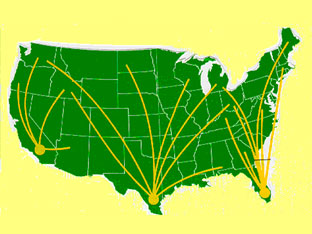
farm laborer migrationMap showing major migration streams in the United States.