Skip to content
ELCA Blogs

ELCA World Hunger

My Friend’s House and Pebbles Phillips

Ryan P. Cumming

“If you hold your hand out clenched, you can’t give or receive.  But if your hand is open, you can give and receive.”  Pebbles Phillips, a vocalist and musician who has performed with top acts, lives by this motto.  As a single mother, she not only takes care of her daughter but also helps her daughter’s father, her neighbors and people she meets in food lines.  Pebbles teaches her daughter to be grateful for what they have, even though both of them depend on food pantries and government assistance to keep food on the table.

Pebbles and Azure3Pebbles’ daughter receives SNAP benefits each month, but Pebbles herself does not because she receives a small amount of Social Security which “barely pays rent.”  Getting benefits for her daughter is a burdensome process that requires “a lot of patience.”  Still, she says, “I have to do it.”  Without help from other family members, her daughter depends on SNAP to eat, though even with the meager benefit she receives, both Pebbles and her daughter were going hungry by the last week of each month.  SNAP helped a lot, but it didn’t keep them from going hungry.

To make it through the month Pebbles “never misses the food line,” sometimes waiting three to four hours in line to receive fresh food for herself and her daughter.  Finding My Friend’s House, a ministry supported by ELCA World Hunger, was a “blessing.”  In line there, she joined folks who would sleep on the porch or arrive in the wee hours of the morning to get food.  When her daughter’s benefits were reduced November 1, 2013, she relied even more on My Friend’s House and other food programs.

Still, Pebbles makes the best of her situation.  “Even if all we have is beans and potatoes, we make it into a feast.”  Together she and her daughter served other folks at My Friend’s House dinner on Thanksgiving Day.  Her positive attitude helps Pebbles face the grim reality of food insecurity: the laborious process of applying for and maintaining benefits, the long lines at food pantries, the anger and frustration of some of her friends and neighbors in similar situations, the uncertainty of having heat or power each month, and the pressing fear that SNAP, Section 8, Social Security or other programs might be threatened by cuts.  Her family depends on the assistance they receive from both the church and the state.  Without both, Pebbles and her daughter will join the millions of Americans who go hungry in a land of plenty.   With them, Pebbles and her daughter not only feed themselves but are also able to contribute to their community in many ways.

Contracts, Covenants and Charity

Ryan Cumming

Much ink has been spilled critiquing the difference between the simplistic act of donating to the poor and the more complex ministry of accompanying those in poverty.  On the one hand, it seems a good thing to put coins in a panhandler’s cup, or donate toys to a gift drive, or pack meals to be shipped overseas.  In fact, all of this has a long history within the religious tradition of almsgiving.   On the other hand, a whole cadre of activists and advocates have called these acts paternalistic and tried to pull (or push) well-intentioned Christians into a ministry that is marked by interpersonal relationships rather than one-sided giving of time or treasure.

Bishop Wayne Miller (Metro Chicago Synod) attempted this in 2011, when he described a continuum of ways that the church encounters the poor.  At one end is pity, which essentially views people in poverty as objects of sympathy or derision.  At the other end is identification, in which we identify so closely with people in poverty that we experience their suffering as our own and seek to end it.  Somewhere in the middle, we move from mere pity or charity to the beginnings of actual relationships with people in poverty, a move Bishop Miller urges the church to make.

But, really, who has time or energy for that?  When our good intentions have brought us to the crossroads of service, we seem left with two choices: charity or relationships.  Too often, Bishop Miller and Robert Lupton (whose Toxic Charity wasreviewed here earlier this month) remind us, we choose the former, since we don’t have the time or desire to form a relationship.

I will press Bishop Miller a bit here, though I agree with him otherwise.  A relationship isn’t formed somewhere near the middle of the continuum; every interaction with the neighbor forms a relationship.  The question isn’t, “Should I put money in the panhandler’s cup, or should I form a relationship with her?”  The question is, “What kind of relationship am I forming in this action?  How will this act shape how I view my neighbor and how my neighbor views me?”  The point to consider here is not whether to form a relationship but what quality of relationship the church is forming in its service.

That the church is in the business of forming authentic relationships with people in poverty and working to end their suffering is central to who we are as people of God.  There are those who disagree, claiming that active service and advocacy make the church too worldly, that the church should teach the word and sacraments and focus only on spiritual matters.

To put it bluntly, they are wrong.  The Law, the prophets and the Gospel reveal that there is no greater evidence of alienation from God than unrepentant alienation from the neighbor.  The two cannot be separated.

Many Lutherans are familiar with Martin Luther’s famous paradox in Freedom of the Christian: Christians are perfectly free, subject to none; Christians are perfect servants, subject to all.  Understanding this contradiction requires understanding what salvation means for Lutherans.  We believe that sin, in its most basic form, means being “curved inward,” so focused on our own needs and our own goodness that we can’t be there for other people.  By grace, God has justified us; we don’t need to be so insular.  We are “curved outward” by God’s saving action, freed to be there for the neighbor.

After all the theology, soteriology, Christology, harmatiology, and so on – after all those lofty doctrines and tenets, one thing is left: the neighbor.  We are saved for the sake of the neighbor.  Or, more appropriately, we are reconciled to God that we may be reconciled to the neighbor.  To be in relationship with God is to be in relationship with the neighbor.  To serve God is to serve the neighbor.  We take joy in God by taking joy in the neighbor.  We express hope in God by sharing in hope with the neighbor.  We commune with God by communing with the neighbor.  We neglect one relationship only at the cost of the other.

We learn what it means to be in relationships by looking closely at God’s relationship with us.  The most basic shape this takes is the form of the covenant.  Christian ethicist Stewart Herman contrasts covenants with contracts, another powerful image of human relationship.  He notes that in a contract, we demand certain kinds of behavior from other people and leave room for penalties if the contract is violated.  Once the contract term is ended, both parties walk away, hopefully satisfied.  A contract is marked by calculated trust, protection against risk and impermanence.

A covenant, on the other hand, goes far beyond demanding specific behaviors.  In a covenant, the hope is that each party learns to value the other.  Rather than being forced or compelled to fulfill a contract, in a covenant, each party takes the risk of trusting the other and becomes vulnerable to the other.  Rather than ending with a term, both covenant partners move toward a future of togetherness in which the relationship doesn’t end but is deepened and fulfilled.

God doesn’t force Israel to be faithful; God moves among the Israelites, accompanying them despite their unfaithfulness, and invites them to be part of this relationship.  The people are called not merely to follow the Law but to “love God.”  God doesn’t merely do things for them; God loves them and claims them (Jeremiah 30:22), in a move that Bishop Miller’s “identification” recalls.  More than this, according to Herman, God and Israel are vulnerable to each other.  God needs Israel to fulfill God’s plan; Israel needs God to bring the plan to full flower.  They depend on one another.

So much charity seems like a contract.  Those with resources share them with the expectation that those who receive charity will be deserving and grateful.  One party receives resources, the other receives the rewarding feeling of having done some good.  Not only is this often based on distrust (“How do we know they are really poor and not scammers?” so many ask), but in some ways it depends on there being a steady supply of people in poverty to serve as contract partners.  Otherwise, how would people with resources feel the satisfaction of charity?

Seeing ministry as a covenant, though, means moving toward a future together.  It means taking a risk, not only that we might be “scammed” – that’s the small risk – but that we might be called to change how we see the world and how we live within it.  It means recognizing our vulnerability to each other.  It means people with resources seeing themselves as equally needy and recognizing that God meets those needs through the neighbor.  It means moving together toward a new future, one in which the suffering of poverty is ended and not merely “addressed.”

Above all else, it means recognizing that God has called us and claimed us for the sake of our relationship with one another.  In a shared world of interdependence, we will be in relationship with each other.  What has been given to us is to determine whether that relationship is a mutual, life-affirming covenant or a one-sided, termed contract.  To which are we called as people of faith?

At the Gate: A look at accompaniment in Acts 3:1-10

Henry Martinez

Peter looked intently at him, as did John, and said, “Look at us.” And he fixed his attention on them, expecting to receive something from them. But Peter said, “I have no silver or gold, but what I have I give you; in the name of Jesus Christ of Nazareth, stand up and walk.” And he took him by the right hand and raised him up; and immediately his feet and ankles were made strong. (Acts 3:4-6)

In the follow up to his gospel, Luke goes to great lengths to show how the Holy Spirit is given to the apostles and what this gift means for their ministry and the life of the early believers. Implicit in the purpose of Acts, so it seems, is the apostles’ faithful witness to the person of Jesus and God’s gift of the Holy Spirit that enables their activity and mission. The ministry of Jesus is left in their hands. In other words, you can smell this healing story coming from a mile away. At the risk of simplifying the matter, the arc of a healing story can be understood as follows: problem—solution—proof.

The problem is realized as the scene opens on a man who is carried to church (I’m contextualizing here) by some faithful friends every day. As worshipers file past, the man at the gate collects whatever alms they can spare. The people go in to become the worshiping body, the man stays at the gate. Enter Peter and John.

After a stare from each of them (I wonder how awkward that was), the Spirit moves Peter and John to do something more than give money. If they did have silver or gold, Luke probably would have told us they gave that as well. The healing/solution works well for Luke’s purposes, but it leaves us with a question: “If we’ve been given the Holy Spirit, why can’t it be this easy for us?” Why aren’t lives healed or made new with a simple command? Why isn’t poverty solved with a job? Why isn’t more food, money, or help enough? The man walks – leaps for joy even – and praises God, but in a way he is getting ready for healing of another kind.

The final step of the healing is the proof, which we read in verse 10: “and they recognized him as the one who used to sit and ask for alms at the Beautiful Gate of the temple…” This confirms the healing act of the apostles, but I almost wish Luke, the author of the gospel story where the dinner host orders the servant to invite the poor, crippled, blind and lame (Luke 14:21) would have emphasized the other drama that unfolds here. Something like: “and he recognized them as the ones who passed him by at the gate of the temple as they went on to pray.”

The healing story is the introduction to another chapter not written in the book of Acts. It is a chapter that begins as the crowd disperses from Solomon’s Portico and the man walks away for the first time. Just as he has to learn what it is like to walk, he also has to confront his feelings that come from knowing what it is like to be passed by your whole life. Meanwhile, the rest of the community has to come to terms with the likelihood that their response to the man’s previous condition affects any relationship with him from here on out. The man and the community have to learn how to walk together in a new relationship, one that requires a different kind of healing, though nonetheless guided by the spirit.

In one way it looks like Peter and John just went in and fixed the man (and this isn’t Luke’s fault). But in another way we begin to see that God’s healing spirit is also needed as we stumble through the relationships we have with one another. Only by the work of the spirit are we able to recognize the barriers in our midst that before looked as innocent as gates.


Henry Martinez is an education associate with ELCA World Hunger.

Review of Robert Lupton’s Toxic Charity: How Churches and Charities Hurt Those They Help

Ryan P. Cumming January 9, 2014


Robert D. Lupton, Toxic Charity: How Churches and Charities Hurt Those They Help.  New York: HarperOne, 2012.

Recently, a friend who does ministry in an urban area expressed his frustration with “mission trips”.  “These groups call us all the time and they want to come down and do projects that don’t help us. We try to tell them about what we’re doing and how they can help, but they don’t listen.  They just want to paint walls or pick up trash.  Even worse, they tell us that we’re doing it wrong.”

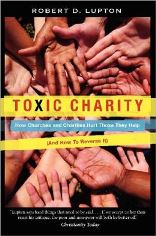
Toxic Charitytoxic charity captures this divide in writing that is perceptive and prophetic, even if not always persuasive.  Lupton tells of the church in Mexico that was painted six times by six groups one summer, the gift-giving program that left the fathers of children feeling emasculated and inadequate, and the tile floor in a Cuban seminary that was inexpertly laid by novice volunteers as skilled local laborers were left without work.

Lupton’s criticisms of the billion-dollar charity industry are important, and we should listen to them.  His suggestions for transforming ministries are also thought-provoking, as is the “oath for compassionate service” he describes in later chapters.  Its principles, in fact, coincide with the ELCA’s method of accompaniment and are vitally important for authentic and effective service.

Because of these high points, it is easy to mutter “amen” while reading.  Lupton does a great job pointing out the problems of some forms of direct service of the poor.  But for a church that also does public advocacy, his book has some remarkable shortcomings.

One criticism is that Lupton moves uncritically between uplifting the capacity and creativity of the poor and degrading them as lazy and dishonest.  “Most [panhandlers] are scammers,” he states (45).  Most poor people in the United States “assume that their subsistence is guaranteed” and so lack any kind of work ethic, he claims (121).  I won’t dignify his words with the verb “argues” because Lupton doesn’t argue his points; he simply states them.  I would be concerned that statements like this, when coupled with his criticisms of charity, would motivate more people to avoid service work in the first place than to engage in the community development he suggests.

His approach to the role of government is particularly troubling, again, given the lack of evidence he marshalls to defend his claims. “As a country,” he writes, “we understand that welfare creates unhealthy dependency [and] erodes the work ethic” (22).  This indictment continues in his evaluation of international aid (given to the same people who, according to his own account, have the stronger work ethic that should make such aid effective).

The difficulty here is not his rejection or support of foreign aid or welfare.  There are arguments to be made on both sides of the debate.  The problem is that the only apparent research Lupton draws on is Dambisa Moyo’s controversial 2009 book Dead Aid.  Outside of this, Lupton appears to draw on his own experience, which I admit is extensive, but this does not make for a well-defended argument.   And this is vitally necessary when making statements about both the poor and government’s relationship to them that are far from self-evident.

For example, Lupton claims that “all our efforts to eliminate poverty have succeeded only in creating a permanent underclass, dismantling their family structures, and eroding their ethic of work” (3).  Such a premise neglects the arguments that such programs have been woefully underfunded since the 1970s and so may be said to have been set up to fail.  There may be structural and systemic reasons why poverty remains a problem.  What is more, to blame poverty-elimination efforts for the “breakdown” of the family is a leap that requires defense and explanation.  Such statements are common in political rhetoric, but if they are to influence churches (as Lupton desires) there at least should be some evidence demonstrating their truth.

That said, I still cautiously recommend the book.  Clearly, Lupton touches a nerve when it comes to how the “haves” respond to the “have-nots.” And the similarities between his recommendations and the ELCA’s model of accompaniment create points of entry for talking and thinking about how we live faithfully in the midst of a complex world, where even our highest ideals fall short.  Perhaps it may also be an occasion for drawing out some of these complexities in ways that Lupton ignores.

If your congregation or group is looking to do service on the frontlines or planning a mission trip, I strongly recommend Lupton’s book.  But if your group is dealing with public policy issues or advocacy, I would suggest also looking at Sasha Abramsky’s The American Way of Poverty:  How the Other Half Still Lives (reviewed here last month) or David Beckmann and Arthur Simon’s Grace at the Table: Ending Hunger in God’s World to balance Lupton’s claims.

Martin Luther’s Top Ten Quotes about Ministry among People in Poverty


10

“According to this passage [Matthew 25:41-46] we are bound to each other in such a way that no one may forsake the other in his distress but is obliged to assist and help him as he himself would like to be helped.”

-Whether One May Flee from a Deadly Plague (1527)


9

“Christians are to be taught that the one who sees a needy person and passes by, yet gives money for indulgences, does not buy papal indulgences but God’s wrath.”

-Ninety-five Theses (1517), #45


8

“Let us also be generous [as Abraham was], and let us open the door to poor brethren and receive them with a joyful countenance. If we are deceived now and then, well and good.  In spite of this our good will is demonstrated to God, and the kind act…is not lost on Christ, in whose name we are generous.  Hence just as we should not intentionally and knowingly support the idleness of slothful people, so, when we have been deceived, we should not give up this eagerness to do good to others.”

-Lecture on Genesis, Chapter 18


7

“Therefore, we should be guided in all our works by this one thought alone – that we may serve and benefit others in everything that is done, having nothing before our eyes except the need and advantage of the neighbor.”

-Freedom of a Christian (1520)


6

“But in times past, [Holy Communion] was so properly used, and the people were taught to understand this fellowship so well, that they even gathered food and material goods in the church, and there – as St. Paul writes in I Corinthians 11 – distributed among those in need.”

-The Blessed Sacrament of the Holy and True Body of Christ, and the Brotherhoods (1519)


5

“For this reason, true theology and recognition of God are in the crucified Christ…God can be found only in suffering and the cross.”

-Heidelberg Disputation (1518)


4

“Now there is no greater service of God than Christian love which helps and serves the needy, as Christ himself will judge and testify at the last day, Matthew 25.”

-Ordinance of a Common Chest, Preface (1523)


3

“The rule ought to be, not ‘I may sell my wares as dear as I can or will,’ but, ‘I may sell my wares as dear as I ought, or as is right and fair.’  Because your selling is an act performed toward your neighbor, it should rather be so governed by law and conscience that you do it without harm and injury to him, your concern being directed more toward doing him no injury than toward gaining profit for yourself.”

-Trade and Usury (1524)


2

“We do not serve others with an eye toward making them obligated to us.  Nor do we distinguish between friends and enemies or anticipate their thankfulness or ingratitude.”

-Freedom of a Christian (1520)


1

“If your enemy needs you and you do not help him when you can it is the same as if you had stolen what belonged to him, for you owe him your help.  St. Ambrose says, ‘Feed the hungry: if you do not feed him, then as far as you are concerned, you have killed him.’ ”

-Treatise on Good Works (1520), reflecting on the seventh commandment