Skip to content
ELCA Blogs

Faith Lens

April 12, 2026 – Peace Be With You

Prepare:

Jesus’ disciples are familiar with fear. Throughout the gospel of John, we hear that Jesus’ followers are filled with fear, especially of the Jewish authorities. To proclaim Jesus as messiah is to face expulsion from the synagogue and separation from family and friends. Following Jesus comes with fear and risk. This fear is compounded at Jesus’ death. He tries to prepare his disciples for his death and resurrection, but they are unable to comprehend these predictions.

After Jesus’ death, the disciples’ fears are intensified by grief. They had hoped for Jesus to rebuild Israel into a great nation and end Roman occupation. They also had hoped to be at his side when he did it. But now their leader and friend, as well as their status and hopes for the future, are all lost. They are unsure of their standing in the Jewish community and unable to trust in the news of Jesus’ resurrection. Consequently, the disciples have no idea what to do next.

Into this situation of fear and uncertainty, Jesus shows up. Jesus shows up, gifting the disciples with his peace and the Holy Spirit. These gifts empower the disciples to begin planning for a new future of proclaiming Christ’s love to others.

Opening Exercise:

Listen to the hymn Let There Be Peace on Earth or read the lyrics.

Discuss together what you felt and heard as you listened to the hymn.

  • What lyrics stood out to you?
  • What does it mean for peace on earth to begin with you?
  • The hymn emphasizes seeing others as our family. How does seeing others as family help promote peace on earth?

Text Read Aloud:

John 20:19-31

Peace Be With You

If you are like me and my congregation, you have been praying for peace. A lot. Praying for peace in our world is a regular worship practice. It has certainly felt needed in the last month as we have watched the war between Iran and Israel and the United States. Amid the violence and loss of life, we pray for God’s mercy and presence. Among the fear and chaos of war, we pray for Jesus’ peace, hoping this ceasefire holds.

The time after Jesus’ death was filled with fear and chaos. The disciples were hiding in a locked room. They didn’t trust
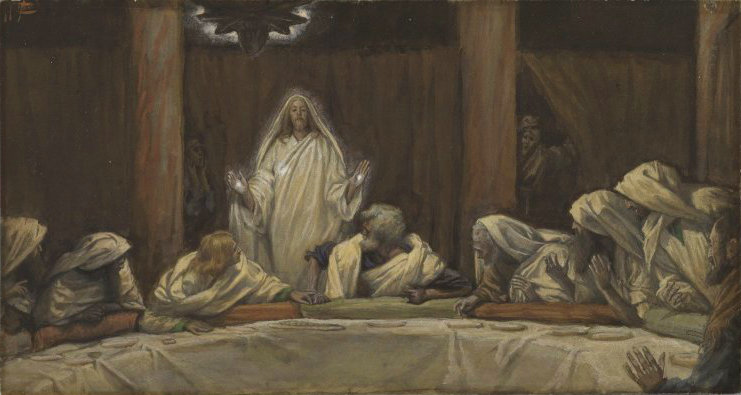
James Tissot, The Appearance of Christ at the Cenacle, 1886–1894. Public domain, via Wikimedia Commons.

the message from Mary Magdalene that Jesus was risen. They were afraid of the religious leaders. They had no idea what to do next. So, alone and afraid, they hid.

Into their fear and chaos, Jesus shows up and proclaims not once but three times, “Peace be with you.” In some ways, we could say Jesus’ proclamation of peace changes nothing. The disciples are still alone in a locked room, afraid of what will come next. Yet, in other ways Jesus’ proclamation of peace changes everything. Jesus’ greeting of peace offers reassurance to the scared disciples. It does not change the disciples’ present circumstances, but it changes the disciples. Blessed with Jesus’ peace, the peace that passes all understanding, the peace that provides calm even in a chaotic world, the disciples are empowered to go out and begin their ministry.

Peace Be With You

Jesus’ peace does not yet equate a world in harmony. We know that on this side of heaven, we will not know a world without war and violence, pain and strife. Unfortunately, this is what we do as humans. This does not mean, however, we are left in fear and despair. Instead, Jesus blesses us with the peace that passes all understanding. Jesus’ peace gives us the ability to trust in God’s presence and provision even when surrounded by fear and chaos. Jesus’ peace gives us hope, even when the world gives us so many reasons for worry and despair. Such a peace moves us to action.

As we await Jesus’ second coming and the redemption of the world, we do not simply accept the violence of the world. We are called to share Jesus’ peace with those around us. As the hymn states, let there be peace on earth and let it begin with me. We, like the early apostles, have received the gifts of Jesus’ peace and are empowered to go out and share that peace with others.

Reflective Questions:

  • How do you think Jesus’ disciples felt before Jesus arrived? How did their emotions change after Jesus arrived?
  • Jesus tells the disciples, “as the Father has sent me, I am sending you.” What are the disciples sent out to do? How are we, as Jesus’ disciples, also sent out?
  • What was a time where you felt at peace? Share what makes this memory special to you. What provided you with peace?
  • What are some ways you find peace when you are feeling anxious?

Closing Activity:

Brainstorm three ways your group can work for peace: one within your congregation, one in your community, and one in our country.

Some ideas to get you started:

  • Write cards to a group or family in need of encouragement
  • Reach out to a different faith community to learn about their ministry and build relationships of understanding
  • Volunteer with an organization working for the good of your community

Let there be peace on earth and let it begin with you!

Final Prayer:

Holy God,

We ask that you draw near to us when we are feeling anxious or afraid. Fill us with your peace and empower us to share your peace with others. Amen.

Bio

Amy Martinell serves as the Associate Pastor of Congregational Care at Gloria Dei Lutheran Church in Sioux Falls, SD. Amy shares her life with her husband, three kids, a disinterested cat, and a disobedient beagle. She loves reading, baking, and swimming.

November 11-18, 2009 – The end is near… run!

Contributed by Rod G. Boriack
Chicago, IL

Warm-up Question: Do you ever think about the world coming to an end? How do you envision it happening?

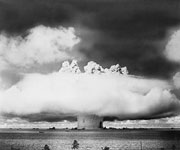
bomb-blast180The end is near — again — run! The movie “2012” is getting ready to open in theaters everywhere in November.

“2012” is based on the pop-theory that the end of the world is going to be on December 21, 2012. The story follows an academic researcher leading a group of people in a fight to counteract the apocalyptic events that were predicted by the ancient Mayan calendar and other historical documents, astronomy, biblical and scientific data.

There’s plenty of action, mysterious and ancient messages, destruction, earthquakes, tsunamis, narrow escapes, explosions, and more! The characters even out-run, out-drive, and out-fly the massive collapse of the entire West Coast. Yipes!

“2012” joins a long line of end of times movies:

  • “Independence Day” (1996)
  • “The Day After Tomorrow” (2002)
  • “The Fifth Element” (1997)
  • “Terminator 2” (1991)
  • “Men in Black II” (2002)
  • “Deep Impact” (1998)
  • “The Day the Earth Stood Still” (1951 & 2008)
  • “War of the Worlds” (1953 & 2005)
  • “Left Behind: The Movie” (2001)
  • “End of Days” (1991)
  • and on, and on, and on.

If it’s got you worried or wondering, remember, it’s just Hollywood smothering us in computer generated imagery (CGI) special effects and appealing to the worst of our inner fears and imagination.

Discussion Questions

  1. Do you like these end of times kind of movies, or the ones that show the survivors of a world disaster or collapse? What draws you to them? Or, what do you find uninteresting about them?
  2. What do you think of the predictions and theories of when and how the world will end? What do you think of the people who make them? (Like Nostradamus’ predictions, the Left Behind novels, people who interpret numbers and symbols, astrologers, self-proclaimed prophets, religious or cult leaders, etc.)

Scripture Texts (NRSV) for Sunday, November 15, 2009.

(Text links are to oremus Bible Browser. Oremus Bible Browser is not affiliated with or supported by the Evangelical Lutheran Church in America. You can find the calendar of readings for Year B at Lectionary Readings.)

For lectionary humor and insight, check the weekly comic Agnus Day.

Gospel Reflection

Talking about the end of the world is nothing new. We fear it, hope it doesn’t happen, can’t wait for it to happen, pray that we’ll survive it somehow, want to the know the signs of it approaching, and are sometimes shocked or depressed by the thought of it. We want the details.

(Oh yeah, and we probably want to be able to out-run any explosions, tidal waves, or earthquakes that may happen. Like in the movies.)

The end of the world, and what follows, was a hot topic in Jesus’ time, too. A lot of people thought it was going to happen any day (that was 2,000 years ago). They wanted to know if what they were experiencing in life — war, persecution, famines, earthquakes, sickness, political problems… sound familiar? — were signs that the end of the world was near.

There were plenty of people who claimed to know how and when it was going to happen. And, as throughout history, plenty of people believed and followed them: “…they will lead many astray.” Here in the book of Mark, Jesus reminds his disciples not to be drawn in by such con artists or people stirring up fear and panic in the name of God.

So, what are we to do? Act like nothing is going to happen? Forget about the present and become obsessed with the end? Run?

Jesus has another idea: actively wait. Don’t ignore the life we have right now — it’s a gift entrusted to us. Don’t run away and ignore everything. Instead, challenge each other to actions and relationships of love, compassion, and justice. Get together and encourage each other. Never let go of hope. We have been given life and set free by God’s love and forgiveness to live it fully…

“Let us hold fast to the confession of our hope without wavering, for he who has promised is faithful. And let us consider how to provoke one another to love and good deeds, not neglecting to meet together, as is the habit of some, but encouraging one another, and all the more as you see the Day approaching.” (Hebrews 10:23-25)

Discussion Questions

  1. Imagine Jesus is sitting here with us in the room. We’re talking about all the great stuff going on in life right now and all the cool stuff we’re going to do, and Jesus interrupts: “You know, it’s all going to come to an end someday. It’s all going to be gone. I don’t know when, but it’s all going to end.” What’s your first gut reaction to his comments? Then what questions pop into your head that you want to ask Jesus?
  2. What’s your interpretation of what’s meant by “actively waiting”? When you read the Bible and reflect on God’s word, what things does God seem to want us to be busy with in life? What things does God want us to be concerned about (other than the end)?
  3. Where do you find hope when things seem dark, pointless, or overwhelming? What hope do you find in God’s word and promises?

Activity Suggestion

No better time than right now.

Pass out paper and something to write with. Ask each person to write down as many things as they can that they want, hope, or need to do, accomplish, or say before they die. Give the group 3 minutes or so to make their lists.

Gather back together or in small groups. Share your list of “must do” things. Give each person encouragement to actually do something that they have mentioned; encouragement to work on it right now.

If participants permit, post all of the lists on the wall and leave them up for a few weeks. Refer back to them now and then, and see if anything is happening. Give gentle encouragement and offer prayer.

Closing Prayer

God, make me brave for life: oh, braver than this.
Let me straighten after pain, as a tree straightens after the rain,
Shining and lovely again.
God, make me brave for life; much braver than this.
As the blown grass lifts, let me rise
From sorrow with quiet eyes,
Knowing your way is wise.
God, make me brave, life brings
Such blinding things.
Help me to keep my sight;
Help me to see clearly
That in darkness, you are light.
Amen.

(author unknown)