Contributed by Jay Gamelin
Pastor of Jacob’s Porch, ELCA campus mission to The Ohio State University
Warm-up Question: What is a tradition in your family you would love to see continue? Perhaps think of holidays or vacations or eating dinner together. What is a tradition you wish would go away? Perhaps how mom always asks you to recite the Gettysburg address every July 4th, even though you’re not 8-years-old anymore.
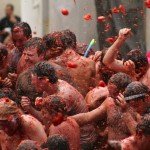
The traditional -- and very messy -- tomato food fight of La Tomatina Fiesta of Buñol (Valencia), Spain.
The world is the canvas and festivals are the paint. Every year, people gather in campgrounds, state fairs, amphitheaters, back yards, city streets, and parks to celebrate culture, music, and tradition. One thing you can count on — each festival maintains its own identity by highlighting the fun, local, and sometimes downright weird. Here are a few unusual festivals occurring around the United States and abroad.
The Wooly Worm Festival of Banner Elk, NC, celebrates tiny wooly caterpillars that come out in droves each fall. The highlight of the festival is the wooly worm race in which contestants race their own segmented caterpillar up a piece of string against other worms. The winner leaves with the pride of their worm being the fastest of the festival.
And what is a festival without a certain amount of saliva hurled at great speed? The Rossville, KS, Tall Corn Festival highlight is a corn kernel spitting contest. The Blenheim Cherry Fest (Ontario, Canada) includes a cherry pit spitting contest. However the most serious about the art of spitting seeds must be the people in Luling, TX, in the Luling Watermelon Thump festival. This is the home to the world championship of watermelon seed spitting, the record being 68 feet, 9 and 1/8 inches by a local man in 1989. In addition to the watermelon spitting contest, the Luling Watermelon Thump includes a watermelon carving contest which would not be so unusual if it were not a requirement that the carving be worn like a hat.
In Tibet, on their annual new year festival, Buddhist monks pay tribute by creating enormous colorful sculptures from yak butter. Sculptures of the Buddha, flowers, birds, ancient people, and homes attract 150,000 people annually. Sculptures can take anywhere from a few days to a month to create.
Some other unusual festivals include the Gloucestershire Cheese Rolling Contest in Gloucester, England, the Frozen Dead Guy Days of Nederland, CO, which celebrates all things macabre, the Australian Darwin’s Beer Can Regatta where competitors build boats of beer cans, and the famous La Tomatina Fiesta of Buñol (Valencia), Spain, which hosts the world’s largest food fight. More than 90,000 pounds of tomatoes are hurled about the town square resulting in one fun, gooey, sticky time. Remarkably, within hours of the event, the town square is back to normal. The smell however takes a few days and a perhaps a few rainstorms to get rid of.
Discussion Questions
- What traditions does your town, school, or state have that one might find unusual? Try to see them from an outsider’s point of view and describe the tradition.
- What sort of traditions does your church have that you think are important to your identity as a parish? Make a list of some of the studies, programs, and events your church does regularly. Would you call these unique to your church?
- How would you describe your worship? Traditional? Contemporary? Mixed? Something else? Describe the traditions within your service that would make it recognizable as such.
Scripture Texts (NRSV) for Sunday, August 30, 2009.
(Text links are to oremus Bible Browser. Oremus Bible Browser is not affiliated with or supported by the Evangelical Lutheran Church in America. You can find the calendar of readings for Year B at Lectionary Readings.)
For lectionary humor and insight, check the weekly comic Agnus Day.
Gospel Reflection
Tradition is a beautiful thing. It helps ground us in our history. In a way, it is how the ancient continue to teach us today, by handing down ideas and thoughts and habits through our traditions. Tradition’s roots are to be honored and adored and truly respected. But what happens when we begin to lose sight of these roots and begin to focus on tradition itself? What happens when we begin to honor the tradition rather than what tradition points to?
In our lesson today, the Pharisees confront Jesus for not holding to ceremonial washing traditions. These traditions probably come from important reasons; ways to keep hands, food, and dishes clean so that diseases do not get passed on. Or perhaps the traditions help ingratiate the washer with thankfulness toward God who has provided the meal, the dishes, the time, and everything to put a meal together. The tradition comes from holy roots, roots designed to teach us about ourselves, God, and how to care for one another’s health. However, the Pharisees have focused so much upon the tradition that they have forgotten the reason. Tradition existed for its own sake, to be done because it was “supposed” to be done, not because it pointed beyond itself.
Jesus points out that cleanliness does not come from activity alone but from a place much deeper. What does it mean that someone follows all the rules of hand-washing but does not care for the other? (see the list from Mark 7:21-22) Cleanliness is not what we do, but is a way of life. Tradition is not the point. It is what the tradition points to, that is the point.
When we think of tradition in the church, we often think of worship. For many, traditional worship is a holy experience, a beautiful and transforming act that re-centers us in God and our community. In more contextual worship, or what you might call contemporary, they too come with their own traditions and ways of doing things, if done a little different from so called traditional worship. But isn’t it easy to go through the motions in either and not think about what we are doing? It isn’t like us to get so tied in what we are supposed to do that we forget why we do it? Isn’t the goal about “who” we worship and not “how” we worship?
Many of our own worshipping traditions have grown out of our theology, and also from our culture. Just like the festivals, worship is born of where they were grown. A wooly worm festival would not work in a place where there are no wooly worms. Butter carvings would melt in Arizona sunshine and some people just might find a Frozen Dead Guy festival too dark and depressing to attend. For their culture, it makes sense, but for others they may feel strange. So too, our worship reflects the culture from where they were born. For some, our culture is a white, western European, culture. This culture gave birth to what we may call “traditional” Lutheran worship. For others, they worship from an African American culture, Caribbean culture, Native American culture, or just about any culture you can imagine; these, too, are “traditional” in that they may be born of their culture’s traditions in worship.
This doesn’t mean that one group worships the right way and the others do not, it only means we can worship in many ways with many traditions and in many languages. God is present in all these places of worship, no matter how comfortable or uncomfortable you are. The goal is not the act of worship but the God in and with whom we worship. This is the root of all worship, traditional and contemporary and cultural.
When we invite someone to worship with us, we invite them not to the “usual” but to the “unusual” of our particular congregation. We invite them into our own traditions and ways of worshipping. It is our hope to invite them into our traditions not as an act but as a way of pointing to God. Our hope is that we may not find ourselves so tied to the outside cleanliness of the act that we forget where our tradition points us, to an unfettered relationship with the Creator.
Quotables:
- “Traditions are group efforts to keep the unexpected from happening.”
Barbara Tober, president of Acronym, Inc
- “Tradition is a guide and not a jailer.”
W. Somerset Maugham, English Playwright and Novelist
- “Traditions are the guideposts driven deep in our subconscious minds. The most powerful ones are those we can’t even describe, aren’t even aware of.”
Ellen Goodman, Pulitzer Prize winning columnist
- “Tradition means giving votes to the most obscure of all classes, our ancestors. It is the democracy of the dead. Tradition refuses to submit to the small and arrogant oligarchy of those who merely happen to be walking about.”
G. K. Chesterton (1874 – 1936), theologian
- “Traditionalists often study what is taught, not what there is to create.”
Ed Parker, Grandmaster, American Kenpo
Discussion Questions
- Have you ever been to a worship service that made you feel uncomfortable or like an outsider? What was it that made you feel this way?
- Do you think there is a wrong way to worship? Share your thoughts on why or why not.
- Think about your church and the worship service(s). Imagine you are a guest to the church, you have never been to church before in your life and you have never heard of Jesus. What are things you do in your church, things you may call a tradition that a guest might find strange or unusual? Kneeling? Raising hands? What points to and describes our relationship with God?
Activity Suggestion
Resident Alien
Have the group walk through their usual worship service. Think of everything they do as a part of normal worship: standing, sitting, kneeling, how the pastor dresses, the songs that are sung, musical instruments used, confession, passing the peace, raising hands, laying on of hands, folding hands, bowing heads, languages spoken, how Communion is distributed, who helps lead worship, art and symbols, how you enter and leave worship, etc. Make a list of these things on a black board, newsprint, or just a sheet of paper. Now take a look at these things from an outsider’s point of view.
Discuss:
- Describe how it may feel as a guest to encounter these things.
- Discuss what you think the point or purpose of these acts may be. Why do we kneel? Why do we or perhaps just the pastor hold hands a certain way when praying? Why do we use some instruments and not others to lead the service?
- What do you think your worship says about your church? What things would you say are important to your congregation, and are shown by what you do or do not do in worship? What does your worship say about you? What does it say about God? About Jesus? The Spirit?
- Lastly, what would happen if someone tried or did something unusual in your service? How would people react? Are there good reasons for this reaction? What are they? How about negative reasons? What are they?
Closing Prayer
Jesus, you teach us not to focus on the outside things but rather the inside deeper cleanliness you have given us through your death and resurrection. It can be so easy for us to be distracted by how we worship that we forget it is you to whom we give thanks and praise. Forgive us for claiming we know best, and open our hearts so that we may worship you with our hearts as well as in our holy traditions. Help us to remember the reasons for our actions. We pray this in the name of the Father, and of the Son, and of the Holy Spirit. Amen.

 2.
2.  3.
3. 4.
4.